Listen through the publisher, then discuss the episode here or arrange an in-person Roundtable. Your city determines where to meet.
Roundtables are designed for groups of four, with a shared subject and room for everyone to speak. Come for discussion, with no dating expectation.
The Greek tragedian Euripides gave the world perhaps the most villainous woman ever created: Medea, the scorned wife who murders her own children. But can we trace this mythological figure back to a real-life historical woman who migrated to Greece in the late Bronze Age? In this episode, Jacke talks to one of Britain's foremost classicists, Edith Hall, about her book Medea: A Life (https://yalebooks.yale.edu/book/9780300270723/medea/), which draws upon meticulous research to construct a biography of a woman navigating the violent patriarchies of the ancient Mediterranean - and questions whether the figure long regarded as an abhorrent psychopath should instead be viewed as a brilliant, embattled outsider pushed to extremes. SPECIAL OFFER! The music in this episode is by Gabriel Ruiz-Bernal.
Episode information is provided by the publisher. Listening takes place on the publisher’s service.
Algorithms are fundamental to the story of mathematics – they’ve been around for over four thousand years. A theorem may prove that a solution to a problem exists, but an algorithm gives you the directions to actually find it. This lecture explores four key algorithms that have not just shaped pure mathematics, but have found unexpected applications in areas as diverse as nuclear physics, film-making, medicine, and music. This lecture was recorded by Sarah Hart on October 15th 2026 at Binks Hall, St John's College, Durham University, Durham. Sarah Hart was the first woman Professor of Geometry at Gresham College, and Acting Provost between March and October 2025. She is also Professor Emerita of Mathematics at Birkbeck, University of London. Professor Hart studied at Oxford and Manchester, gaining her PhD in 2000. Postdoctoral research and teaching followed, including a prestigious Engineering and Physical Sciences Research Council Fellowship, before she was appointed to a lectureship
From ancient sundials to modern atomic timekeepers, the history of clocks reveals how human societies have measured time with growing precision. Early mechanical clocks in the Northern Hemisphere adopted a clockwise motion to mirror the sweep of sundial shadows across the sky, while exceptions such as Prague's 16th-century Jewish Town Hall clock and La Paz's modified legislative clock demonstrate cultural and regional variations. Practical timekeeping milestones include Levi Hutchins's 1787 4:00 a.m. alarm clock, Antoine Redier's 1847 adjustable alarm patent, and the November 18, 1883 establishment of four North American standard time zones to replace chaotic local solar times across towns and railroads. Precision timekeeping spans from monumental pendulums to quantum-scale oscillators. London's Great Clock in Elizabeth Tower relies on a two-second pendulum regulated with pre-decimal pennies to adjust its daily rate by two-fifths of a second, whereas cesium-133 atomic clocks define the
In this week's IN CASE YOU MISSED IT episode, Kathy goes over all the episodes from the week and reveals all the juicy details you might have missed. Tune in to hear all about the crazy confessions involving watermelon sex, a scorned housewife, prison sex and a bisexual threesome, why Tammy's hardcore hotwife episode was such a hit, what makes Kyle's wild lifestyle stories and hilarious gone-wrong hookups so entertaining, the jealousy and drama threatening Amanda and Robyn's poly throuple, how Kathleen's wild threesome stories made her episode worth repeating, how Nicki went from swinging to crossdressing and hooking up with men, how Rob and his wife have managed to maintain a great sex life well into their late 60s, plus a whole lot more. GET A COPY OF THE STRICTLY ANONYMOUS BOOK! A bunch of short, super sexy, TRUE stories. GET YOUR AUDIO COPY HERE: https://amzn.to/4i7hBCd Want to be on the show? Call the CONFESSIONS hotline at 347-420-3579. All voices are changed. https://auraframes.
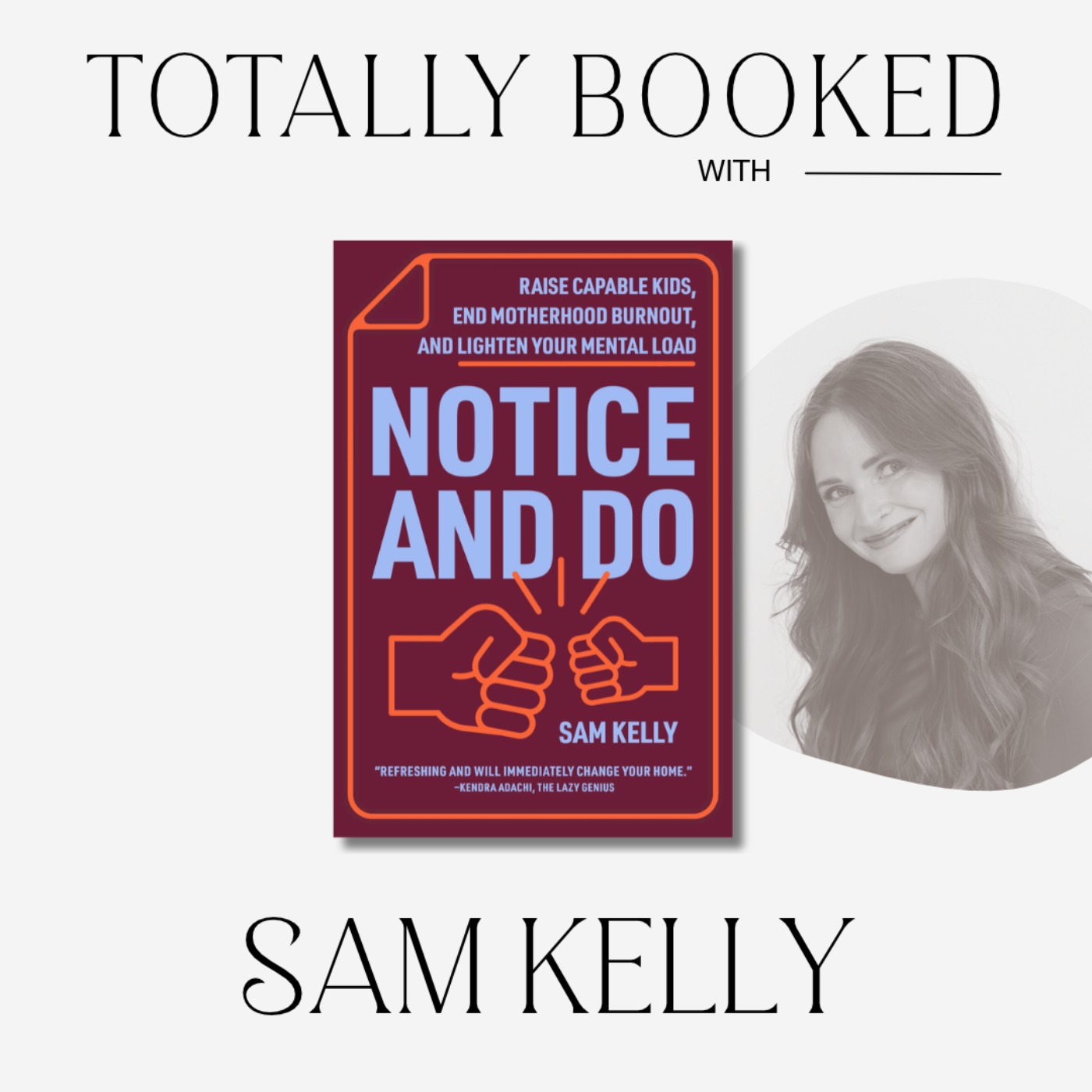
Parenting expert Sam Kelly talks with Zibby Owens about her groundbreaking viral method and book, Notice and Do: Raise Capable Kids, End Motherhood Burnout, and Lighten Your Mental Load. Sam shares the fascinating backstory of developing her method while parenting three neurodivergent children, offering game-changing, practical advice on navigating resistance, side-stepping the reminder trap, and building "learning ladders" to break down complex household chores into bite-sized steps. She also reflects about the raw, necessary conversations that ultimately saved her marriage, the power of implementing "pre-existing motivators" instead of bribes, and why changing the narrative around chores is a direct pipeline to raising confident, independent, and resilient kids. Learn more about Sam here (https://hellosamkelly.com/), and follow her on Instagram @samkelly_world (https://www.instagram.com/samkelly_world/). You can purchase Notice and Do: Raise Capable Kids, End Motherhood Burnout, and
Have a question you've always wanted to ask? Send it to me: https://shop.sexwithemily.com/pages/ask?utm_source=youtube&utm_medium=video&utm_campaign=yt-RImh4_rw8Y8&utm_content=description (https://shop.sexwithemily.com/pages/ask) What if you're not an asshole for wanting more, you're just the only one willing to say it out loud? My producer Eric and I are back answering your AITA questions about sex and relationships. We cover a peck on the lips that's killing the vibe after moving in together, a new relationship where someone just disclosed they have herpes, a partner who keeps promising oral sex and never delivers, and a man in England with a very specific fetish whose partner shuts down every time sex comes up. Spoiler: in almost every case, the answer is the same, you're not an asshole, but you will be if you don't have the conversation. In this episode: - Wanting more intimacy and sexual tension after moving in together: how to bring the heat back - Herpes disclosure in a new rela
Thanks to Strawberry.me for sponsoring this video. Get matched with a professional career coach and get 50%off your first coaching session: https://www.strawberry.me/eddie What if the only thing standing between you and the life you want is the option to turn back? Real growth begins when you stop negotiating with your comfort zone. In this powerful motivational speech, Eddie Pinero explores why eliminating Plan B, embracing uncertainty, and committing fully to your future can unlock strength you never knew you had. Burn the boats. Close the door. There's only one way forward. Follow Along:Support the Podcast on Spotify - https://spoti.fi/2BLf6pB Instagram - https://www.instagram.com/your_world_within/ TikTok - https://www.tiktok.com/@your_world_within Comment below with what's been holding you back as of late. Would love to help you #liveinspired #yourworldwithin #motivation
As a member of the notoriously eccentric Mitford family, Jessica Mitford was raised to marry well, not fight for others' rights. And yet, even as her sisters became infamous for their glamorous dalliances with Nazis (and others), Jessica rejected her upbringing, running away to America and plunging into anti-fascist and anti-racist causes. How did this blue-blooded Englishwoman wind up as a resident of Oakland, California, the best friend of Maya Angelou, and a best-selling author whom Time magazine called "the Queen of the Muckrackers"? In this episode, Jacke talks to biographer Carla Kaplan about her book Troublemaker: The Fierce, Unruly Life of Jessica Mitford (https://hurstpublishers.com/book/troublemaker/). PLUS Morgan Lloyd Malcolm (who adapted Henry James's Turn of the Screw (https://www.bloomsbury.com/us/turn-of-the-screw-9781350685499/) for the London stage) stops by to discuss her choice for the last book she will ever read. SPECIAL OFFER! The music in this episode is by Gabr
Brazilian novelist Machado de Assis (1839-1908) began his life in poverty and sorrow, then experienced 35 years of literary success and what he called a "perfect married life." When his wife Carolina died in 1904, the aging Machado was filled with despair. It is during this period that he wroteMemorial de Ayres (https://link.amazon/B0i9lzPOd), in which a world-weary retired diplomat wonders about his place in a shifting society, even as a new love interest threatens to disrupt his complacency. In this episode, Jacke talks to Margaret Jull Costa and Robin Patterson about their work translating Machado's final novel. SPECIAL OFFER! The music in this episode is by Gabriel Ruiz-Bernal.
How do we think about planet Earth? What's our relationship with it? Humans since the Enlightenment have been tempted to believe we've transformed and even - perhaps - tamed it. And yet, Earth is independent of us, and indifferent. In this episode, Jacke talks to Kir Kuiken, whose book Adrift on the Earth: Caribbean Romanticism and Geopoetics (https://www.sup.org/books/literary-studies-and-literature/adrift-earth) uses pairings of Caribbean and Romantic-era authors to deepen our understanding of how we've related to the Earth from the Romantic era through our own. PLUS Jonathan Gross (The European Byron: Mobility, Cosmopolitanism, and Chameleon Poetry (https://anthempress.com/books/the-european-byron-hb)) stops by to discuss his choice for the last book he will ever read. SPECIAL OFFER! The music in this episode is by Gabriel Ruiz-Bernal.
Commercially funded research should disclose sponsors' influence over its design and publication.
Share your view, then see how readers voted. No sign-in required. This poll is shared across stories.
Do you agree or disagree?
Common Quandary
A Common Quandary to discuss
Another conversation to explore, separate from this news story.
Your family connection could get your child into their dream school. Do you use it?
A university argues that considering family ties builds loyalty and encourages donations that fund scholarships. Critics say the preference preserves inherited advantage and takes places from stronger applicants.
Can benefits to the whole institution justify an unequal admissions advantage?