Runaway government spending, rising costs, and a new wave of legal battles over constitutional rights. With Democrats preparing to take control of Congress and several state governments, Republicans are confronting a very different political landscape. John Solomon and Amanda Head welcome Montana Senator-elect Kurt Alme, who says Washington must get serious about reining in spending, lowering inflation, and making everyday life affordable again. Already preparing for his arrival in the Senate, Alme discusses his priorities for protecting Montana's way of life, keeping taxes low, creating good-paying jobs, and working across party lines when possible. He also addresses the challenges Republicans face in the minority, the remaining lame-duck session, and concerns about efforts to expand the Supreme Court and eliminate the filibuster. Then, Southeastern Legal Foundation President Kimberly Hermann joins the show with a warning about potential policy reversals in states where Democrats have
November 20, 2026; MS NOW's Ari Melber breaks down Trump and MAGA allies reacting to a Democratic blue wave, then interviews Mississippi Senator-elect Scott Colom with his twin brother Andrew about their historic campaign. The episode also features Rod Wave on music, emotion, and his new album "Don’t Look Down". Hosted by Simplecast, an AdsWizz company.
The Democrats swept the midterms. Donald Trump is still president. What will the next two years look like? And what can history teach us about what comes next? Martin Wolf speaks to historian Heather Cox Richardson about the cycles in the past 250 years of US politics — how renewal (and division) can both follow periods of oligarchy, and how the Democrats should react to a “constitutional crisis”. To enjoy future episodes, be sure to subscribe to ‘Martin Wolf on the World’ wherever you get your podcasts. You can also watch Martin’s podcast series on the FT’s YouTube channel here:https://www.youtube.com/@FinancialTimeshttps://www.youtube.com/@FinancialTimes Host: Martin Wolf Producer: Mischa Frankl-Duval Senior producer: Laurence Knight Video editor: Richard Topping Senior audio engineer: Breen Turner Broadcast engineer: Andrew Georgiades Podcast development: Laura Clarke FT Global Head of Audio: Flo Phillips Learn more at www.ft.com/martin-wolf-on-the-world (http://www.ft.com/martin-wo
Economists use “core” inflation to describe price changes minus food and energy (which can be up one week and down the next). But for the past six months, energy prices have been stubbornly high, as the White House drags out its war in Iran. That sustained inflation is having a trickle-down impact. In this episode, why core inflation can’t escape fuel costs. Plus: Retailers cater to picky consumers, and the stock market tumbles after a historic IPO. Every story has an economic angle. Want some in your inbox? Marketplace is more than a radio show. Read the stories in today’s episode: Who wants more oil? (https://www.marketplace.org/story/2026/11/20/trump-xi-and-putin-meet-in-china-plus-anthropics-ipo) Core inflation measures can't escape high energy prices (https://www.marketplace.org/story/2026/11/20/core-inflation-measures-cant-escape-high-energy-prices) Salmon may soon be off the menu as fisheries struggle to meet demand (https://www.marketplace.org/story/2026/11/20/salmon-supply-flo
One week after the U.S. midterm elections, join Valérie Beaudoin, one of Canada's most respected commentators on U.S. politics, for a discussion on how Canadian policymakers and officials are digesting the results in Washington. From the new balance of power in Congress to the potential implications for Canada-U.S. relations, trade economic growth, and cross-border policy priorities, we'll explore what the election outcome could mean for Canada in the months ahead. Recorded on November 10, 2026. -- Optique canadienne sur les élections américaines de mi-mandat – Valérie Beaudoin Pour une version avec des sous-titres français, veuillez consulter Une semaine après les élections de mi-mandat aux États-Unis, Valérie Beaudoin, l’une des commentatrices de la politique américaine les plus respectées du Canada, discute des façons dont les décideurs canadiens et Ottawa ont réagi aux résultats à Washington. Du nouvel équilibre des pouvoirs au Congrès aux répercussions possibles sur les relations
November 21, 2026; 12pm: In almost every presidency, there comes a time when the president turns their attention overseas – usually after some sort of political defeat. President Trump’s attention is definitely overseas, but for personal reasons. Ruth Ben-Ghiat points out the red flags of Trump cozying up to notorious Strongmen; Democrats have never held this much power before and it’s not just in Congress, it’s at the state level too. State Rep.-elect Allie Phillips (D-TN) and State Senator-elect Robyn Vining (D-WI) explain how they will set their most important agenda items into action; MS NOW’s Rachel Maddow continues her discussion with Jacob Soboroff about her brand new book “The Department of Fate,” Stephen Miller’s rise, and much more. Hosted by Simplecast, an AdsWizz company.
How much is Anthropic actually worth? And were investors assured by Nvidia’s strong earnings report? Plus, will "Grand Theft Auto VI" lift Take-Two Interactive’s stock? Host Vicky Ge Huang discusses the biggest stock moves of the week and the news that drove them. Sign up for the WSJ's free Markets A.M. newsletter (https://www.wsj.com/newsletters/markets-am?mod=WSJ_WNPOD). Hosted by Simplecast, an AdsWizz company.
P.M. Edition for Nov. 20. Despite Nvidia’s strong earnings and Anthropic’s record-breaking IPO this week, tech stocks had one of their worst weeks (https://www.wsj.com/finance/stocks/anthropics-ipo-bust-punctuates-4-trillion-ai-wipeout-on-wall-street-f1f1ec90?mod=WSJ_WNPOD) in years. Journal markets reporter Hannah Erin Lang (https://www.wsj.com/news/author/hannah-erin-lang?mod=WSJ_WNPOD) discusses why investors have gone cold on the AI trade. Plus, in a press conference today, President Trump, flanked by Vice President JD Vance and Secretary of State Marco Rubio, said there will be new penalties on companies (https://www.wsj.com/politics/policy/trump-to-hold-white-house-press-conference-following-trip-to-asia-25c8ecc0?mod=WSJ_WNPOD) that build data centers outside the U.S. We hear from White House reporter Philip Wegmann (https://www.wsj.com/news/author/philip-wegmann?mod=WSJ_WNPOD) about ramifications for the 2028 presidential election. And, to help solve New York City’s bathroom cri
Bonus Episode for Nov. 20. Few companies have a pulse on the American shopper like Walmart and Target, and both got a boost in the latest quarter from healthy consumer spending—a good sign for the current quarter that contains much of the crucial holiday shopping season. Target’s turnaround is strengthening (https://www.wsj.com/business/retail/target-posts-strongest-sales-growth-in-years-as-focus-on-new-products-value-pays-off-4f82006d?mod=WSJ_WNPOD), while Walmart’s growing e-commerce business is helping offset shrinking sales (https://www.wsj.com/business/earnings/walmart-wmt-3q-earnings-report-2026-6e658c54?mod=WSJ_WNPOD) at its U.S. stores. Both Walmart and Target raised their guidance for the year. Sarah Nassauer (https://www.wsj.com/news/author/sarah-nassauer?mod=WSJ_WNPOD) covers big retailers for The Wall Street Journal, and took a close look at these earnings. Pierre Bienaimé (https://www.wsj.com/news/author/pierre-bienaime) hosts this special bonus episode of What's News in E
Communities losing a major industry deserve transition support before jobs disappear.
Share your view, then see how readers voted. No sign-in required. This poll is shared across stories.
Do you agree or disagree?
Common Quandary
A Common Quandary to discuss
Another conversation to explore, separate from this news story.
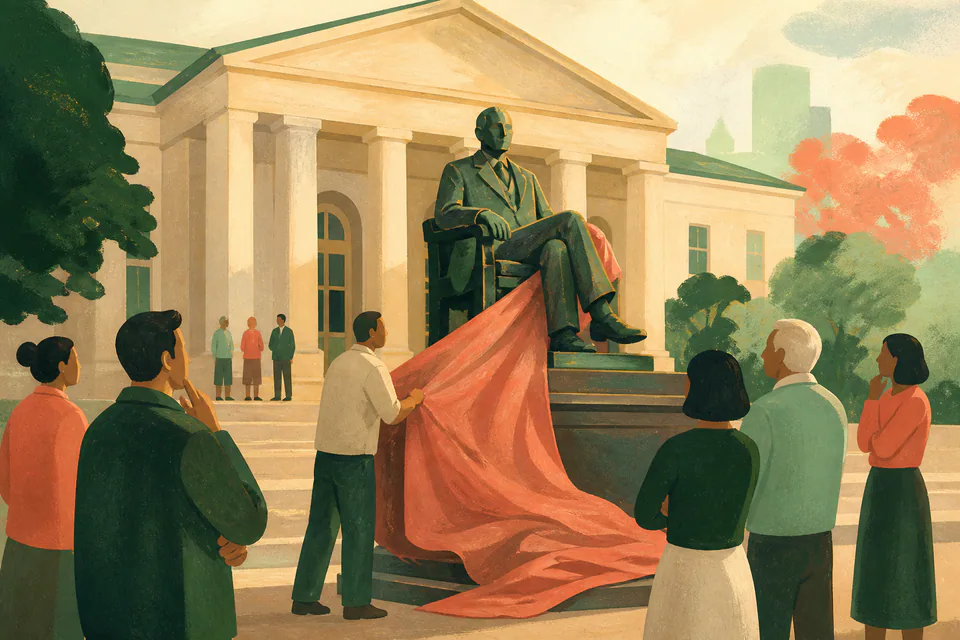
A disgraced billionaire's name is on the beloved campus library. Does it come down?
A major donor funded a beloved public building decades ago. New evidence shows they also caused serious harm that was legal and accepted by many peers at the time. Removing the name may jeopardize future donations.
What does an institution owe the truth when its history funded the present?