Can you buy peace of mind about your health? Dr Margaret McCartney
58 min
Listen through the publisher, then discuss the episode here or arrange an in-person Roundtable. Your city determines where to meet.
Roundtables are designed for groups of four, with a shared subject and room for everyone to speak. Come for discussion, with no dating expectation.
Finding something earlier must always be better, surely? Dr Margaret McCartney has spent thirty years saying that just because something sounds like a good idea, it doesn't mean it has been shown to be one. In this episode, I'm joined by Margaret, a GP and the author of The Patient Paradox. I read her book years ago, when I was a fairly new GP partner, and it changed how I looked at testing and awareness campaigns. We start with why screening people who feel well needs such a high standard of proof, using the PSA test as the example. It was developed to follow men who already knew they had prostate cancer, and the man who brought it into public use later called screening with it a public health disaster. We talk about what Australian data shows when men are given high-quality information, and why explaining any of this is so hard in a ten or fifteen minute appointment. Then we turn to the market in home test kits, subscriptions and full body scans. Margaret explains why a false positive bought privately lands back in an NHS appointment, why a scan can't sell you reassurance, and the complaint she made about a testing company's claims when she could find no published evidence for them. We also look at Zoe and the leap from continuous glucose monitors for people with diabetes to everyone else, and ask why declaring a conflict of interest may not be enough. And there is the story of Archie Cochrane switching the bed rest results and showing them to cardiologists. Towards the end, we talk about why tests deserve the same scrutiny as medicines. Margaret also has a rule for anyone hovering over a purchase. Get your advice from people who don't earn more if you say yes. In this episode: Thirty years of asking for evidence Is finding something earlier always better? Why screening healthy people needs such a high standard of proof The PSA test and a public health disaster What men choose when they are given high-quality information Statins by text message and the cost of rushed conversations Home kits and genetic risk without the counselling Who pays for a false positive bought privately Buying a full body scan for reassurance Zoe, glucose monitors and the evidence behind the claims Why declaring a conflict of interest may not be enough Archie Cochrane and the switched results Treating tests like medicines Margaret's complaint about a money-back blood test Where to find independent advice As Margaret puts it: things that can't benefit you can only harm you. If you enjoyed this, listen back to my conversation with Deb Cohen, former BMJ investigative journalist and co-author of "Bad Influence: How the Internet Hijacked Our Health": https://pod.link/1762298788/episode/Y2MxYjg1OWItYmQ3Yy00MDYzLTliZjYtMWRkNTNhMWQ0ZjE0
Episode information is provided by the publisher. Listening takes place on the publisher’s service.
Is your body weight stable, but you're still not eating enough to properly fuel your training, recovery, and overall health? Introducing Why Stable Weight Doesn't Always Mean You're Eating Enough from Jeff Hoehn of the Mind Muscle Connection Podcast (https://www.buzzsprout.com/1508401). Just because your weight isn't changing doesn't necessarily mean you're adequately fueled. In this episode, Jeff breaks down why maintaining a stable body weight doesn't always mean you're meeting your body's energy needs, especially if you're training hard, staying lean, or spending long periods dieting. You'll learn: Why stable body weight doesn't automatically mean adequate energy availability Who is most at risk of underfueling, even when their weight isn't changing How high training output, staying too lean, and chronic dieting can contribute to low energy availability The potential signs of underfueling, including changes in performance, recovery, hormones, and menstrual health Why spending too lo
For the days you got through and nobody saw what it took. A quiet place this evening where it counts. About 12 minutes with Steven Webb's calm voice and music underneath. Perfect for the evening. We let the body soften, from the jaw and the eyes down to the belly, because it's been on alert all day. Then we look at what today really cost. Getting up when your body said no. Being kind to someone while you were falling apart inside. Saying "yeah, fine" because where would you even start? There's an old Zen idea I keep coming back to: a thing doesn't need to be seen to be real. The rain falls on an empty field, nobody watches, and it still soaks in. We put the day down for a minute, not away, just down, and finish with three gentle wishes. May the hard days I got through be counted. I've been paralysed a long time, and I know what it can take just to get through the day. You're not doing this on your own. Treat me to a coffee, keep the podcast free, and get my Weekly Calm every Sunday. It
Does your relationship feel like home, or does it feel like standing on the edge of something you might lose? In Part 3 of our Relationship Anxiety series, clinical hypnotherapist and former paramedic Martin Hewlett guides you through the process of teaching your nervous system that love doesn't have to hurt to be real. We explore the physical manifestations of anxiety—the tight chest, the 2:00 AM racing mind, and the "stomach drop" when a text takes too long—and provide the tools to "turn down the alarm" of your internal survival response. If you are ready to stop "cherry-picking" evidence of disaster and start building a foundation of trust, this session is for you. In This Episode, We Cover: The Science of Safety: Understanding how your nervous system confuses love with danger. Guided Visualization: A journey into your own "safe room" where you are already enough. Rewiring the Brain: Moving from worst-case disaster reels to the reality of small, daily kindnesses. Breaking the Cycle:
Let go of negative thoughts, release limiting beliefs, and drift into peaceful sleep with this gentle guided sleep hypnosis for positive thinking, self confidence, and inner peace. If you've been struggling with self doubt, harsh self criticism, or the feeling that you're never good enough, this soothing bedtime journey invites you to replace those familiar thoughts with kinder, more supportive beliefs. As you settle into deep relaxation, a slow and peaceful induction helps your body soften and your mind become quiet. You'll imagine stepping into an old wood-panelled lift that gently carries you down ten floors, allowing you to relax more deeply with every level. At the bottom, you'll discover a beautiful inner library filled with the stories you've told yourself throughout your life. Here, old beliefs such as "I am not enough" and "I always fail" can be gently put away, making room for new, encouraging thoughts: • I am learning and growing every day. • I can handle things one step at
If you appreciate nuanced science and learning about human metabolism, check out StayCurious Metabolism, now a Top Overall Best-Seller in Science globally: https://staycuriousmetabolism.com (https://staycuriousmetabolism.com/) Start by checking out the Heart Health Archives. Papers: Seven Years of 700 Cholesterol Without Coronary Atherosclerosis: https://www.mdpi.com/2079-9721/14/5/168 Lipid Energy Model: https://pubmed.ncbi.nlm.nih.gov/35629964/ Oreo vs Statin Paper: https://pubmed.ncbi.nlm.nih.gov/38276308/ Cholesterol Code Movie: https://cholesterolcodemovie.com (https://cholesterolcodemovie.com/) Description For seven years, I’ve been living with cholesterol levels that most doctors would say should have killed me by now — not just high, but astronomical — and I did it intentionally because I believe there’s something fundamentally misunderstood about cholesterol, heart disease, and people like me that modern medicine doesn’t understand. If I’m right, the implications could challen
This week on Keto while Pregnant Kiley takes an at home 3 hour Glucose Tolerance Test. She takes the Glucose Tolerance Test using both a Blood Glucose Reader and a Continuous Glucose Monitor. I think you'll find a really interesting teachable moment in this Glucose Tolerance Test and find that Glucose Tolerance Testing could be helpful whether you're Pregnant or just want to better understand your bio chemistry. Thanks for tuning into my channel. Find more stories and information at my website: www.BozMD.com BOOK-LINK - ANYWAY YOU CAN. AUDIBLE: https://adbl.co/2SLLfS1 PAPERBACK= (Affilate link) https://amzn.to/2Of06m0 The most common questions I get ... 1) "Doc, what BLOOD METER do you recommend?" ANSWER: FORACARE: http://bit.ly/2QKGmKG For years my diabetics told me this system was great. I tried several others before I bought this one. I can't count the number of times I have tested my blood only to get an ERROR message from the strip. Grrr. I hate that. FORACARE gets my vote because
"I spent twenty-five years trying to be skinnier and then accidentally got jacked, and I'm happier." That's roughly what Niki Sims, a strength coach at Barbell Logic, posted, and I loved it. In this episode, I'm joined by Niki to ask whether you can change your body without trying to make it smaller. There are still plenty of old gremlins knocking around for women about shrinking our bodies, and she has years of coaching experience to draw on. Niki tells me what made her sit down and write that post: being exhausted by stressing over the scale, and seeing old photos of herself and realising she was skinnier than she thought she was at the time. We talk about why you can't work on your muscle and spot-treat fat, why you need to fuel your training if you want to perform, and what Niki says to a new client who wants to be strong but "could still do with losing ten, fifteen, twenty pounds". Her answer starts with why, and then an honest look at what losing those pounds would take. We also
In this episode, I'm joined by Matt Hussey, a therapist and former journalist behind Griftonomics, who makes videos taking apart the claims of wellness influencers. Matt trained as a therapist after years as a journalist, and now has a private practice. He started making videos to find a better way of talking about mental health and the internet, and the one that really took off was a two minute piece on Mel Robbins. Around the same time he noticed influencers creeping into his clients' sessions, which led him into the world of wellness grifting. We talk about what makes someone a grifter, from exploiting anxiety, uncertainty and mistrust for financial gain, to why borrowed authority works so well and why the biggest podcasts so rarely challenge their guests. We look at Mel Robbins, Steven Bartlett and Mindy Pelz, the questions raised about Jay Shetty's monk story, and whether any of them know they are doing it. Matt's view is that many have bought into their own story so completely th
Institutions should demonstrate equal treatment through people's actual experiences, not just written policies.
Share your view, then see how readers voted. No sign-in required. This poll is shared across stories.
Do you agree or disagree?
Common Quandary
A Common Quandary to discuss
Another conversation to explore, separate from this news story.
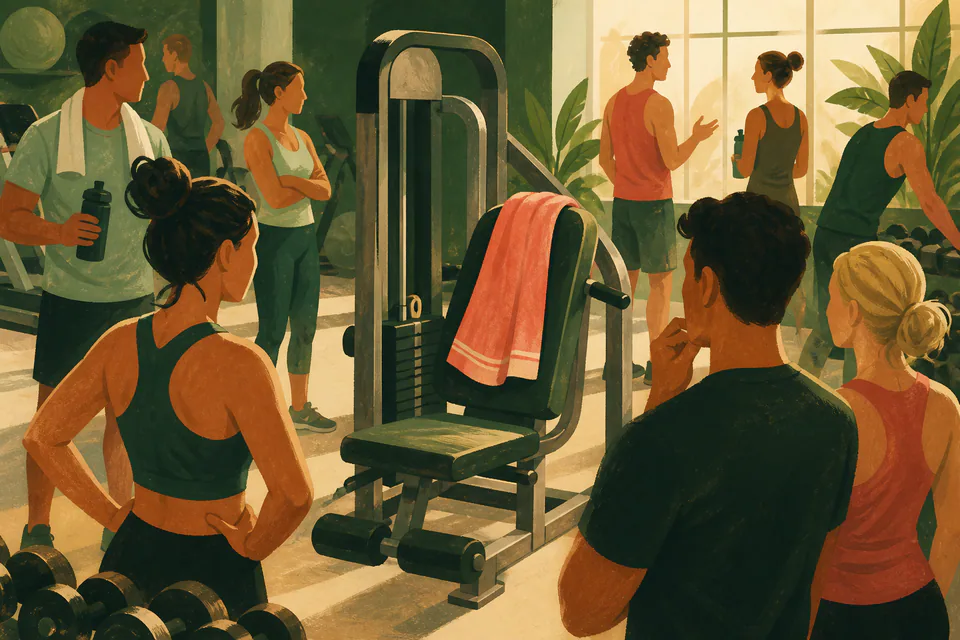
Someone reserves the best gym machine with a towel. When may you move it?
At a crowded gym, a towel has occupied the most popular machine for fifteen minutes while its owner chats across the room. Gym rules prohibit reserving equipment, but everyone occasionally steps away between sets.
How long may convenience masquerade as continued use?