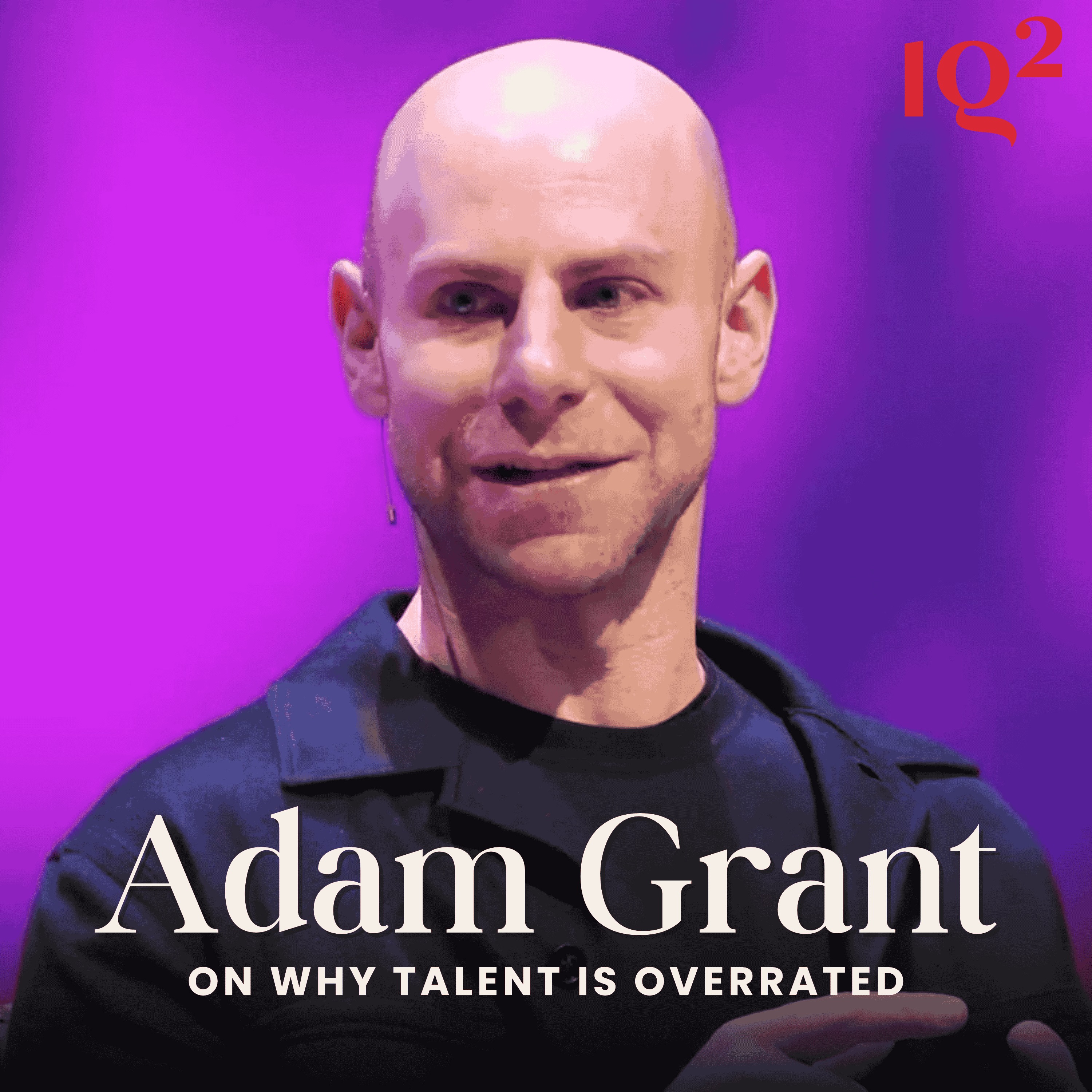
Adam Grant is one of the most sought after organisational psychologists in the world. He has provided expert advice to many of the world’s greatest business leaders, including Bill Gates and Sheryl Sandberg, equipping them with the mental tools to find motivation and meaning, rethink assumptions, and achieve greatness in their business and personal lives. In January 2024 Grant came to the Intelligence Squared stage for a rare, exclusive London event where he shared his revolutionary framework for how we can all exceed the expectations and aspirations we have set for ourselves. Drawing on his new book Hidden Potential he explained that despite living in a world that tends to admire people who start out with innate talent, there is clear scientific evidence that we can all bridge the biology gap and improve ourselves dramatically. In conversation with economist and FT columnist Tim Harford, Grant wove together groundbreaking evidence, surprising insights, and vivid story telling to take
The ransom note was discovered inside the Ramsey home, written on paper investigators traced to a household notepad. Nearly thirty years later, John Ramsey is pressing police to test more evidence. How can investigators reconcile what happened inside that house with what new forensic technology might finally reveal? Tony Brueski brings Producer Todd and Lisa into the conversation about JonBenét Ramsey’s still-unsolved 1996 murder. The ransom note demanded $118,000, a figure close to John’s prior bonus. Investigators found what appeared to be the beginning of another note in the same pad. Patsy Ramsey called police that morning; John later discovered his daughter’s body in a basement room. These details remain consequential, but they do not identify a killer. John says several items initially returned from labs were not tested and wants additional DNA analysis of the note and other objects. Boulder Police dispute the idea they are ignoring viable evidence. At a November 2026 briefing, o
Vals AI founder Rayan Krishnan joins Theo to discuss his new report revealing that frontier AI models have few guardrails against autonomous weapons, including targeting civilians and a school in simulated and real warzone footage. They also break down GPT-6.2 Astra’s post-training limitations compared to Anthropic’s Fable models, why Anthropic is nerfing public RSI capabilities, and why Vals AI’s timeline still points to full recursive self-improvement by July 2027. MTS chronicles the singularity, live. Monitoring the situation of tech and AI. Follow MTS: Spotify |https://open.spotify.com/show/4HUNNmV1pjV7CW6Lphm1rM Apple |https://podcasts.apple.com/us/podcast/mts/id1891088763 – Brought to you by: Mongo DB - Anyone can prototype an agent. Lovable - Turn ideas into software people love with Lovable. Start today at https://lovable.dev/ Factory - A 24/7 system turning signals into production software. Visithttps://factory.com/ Neon (by Databricks) - Scale your startup on Neon. The Postgr
What actually works when it comes to detecting lies, and why are so many popular ideas about reading people and nonverbal behavior at odds with the scientific research? I talk with Aldert Vrij, one of the world's leading deception-detection researchers, who has spent almost four decades studying these topics. We discuss why what people say is far more revealing than their body language; why the perceived “sexiness” of reading nonverbal behavior has contributed to widespread myths and misconceptions; whether vocal behaviors like pitch, volume, and hesitation contain meaningful clues; and whether there's value in analyzing minor word choices and turns of phrase, as is done in so-called “statement analysis.” We discuss Paul Ekman's legacy as a source of faulty ideas about deception, micro-expression-based deception detection training, and the strategies that popular “body language experts” use to appear scientifically credible while simultaneously promoting ideas that conflict with the sc
Quinn Thompson says a dramatic Fed pivot is coming, and when the Fed is forced to expand its balance sheet again, Bitcoin is the asset that does really well. The Lekker Capital founder joins Andy to explain why he would fade the latest hot CPI print and why even one more hike would be a mistake. He walks through why commodities are already rolling over, why the first half of next year calls for patience, and why late-stage apathy in Bitcoin is exactly where opportunity shows up. He also covers why the SpaceX IPO marked the top for semis, what the Anthropic IPO and NVIDIA earnings mean for risk, and why a return to liquidity sets up the next big move. Quinn Thompson is the Founder and CIO of Lekker Capital. Live from the financial capital of the world. Timestamps: 00:00 Intro 02:16 A Big Fade On 50 Basis Points 06:27 A Dramatic Fed Pivot Mid Next Year 08:34 Fade The Hawkish Yield Spike 12:10 73K Is Bitcoin's Second Chance 14:34 Late-Stage Apathy Creates The Opportunity 16:51 SpaceX IPO
Having been jailed for 10 years and six months, disgraced entertainer Russell Brand remains very much in the headlines. Since his conviction, six more women have come forward with allegations of misconduct. Meanwhile, Brand's voice and image continue to be broadcast around the world, and not just in the form of news stories and documentaries. Brand's X account remains open, and his popular YouTube channel recently uploaded a pre-recorded episode of his Sunday Service programme that also featured a post-sentencing letter penned by Brand and read aloud by his wife, Laura Gallacher. In addition, the UK government is under pressure to change laws related to the age of sexual consent in the wake of Brand’s imprisonment. Fionnán Sheahan is joined by Daily Mail feature writer Fred Kelly and Irish Independent features journalist Kirsty Blake Knox to look at the impact that the jailing of Russell Brand has had on the disgraced comedian’s brand. Hosted on Acast.
https://clearmeasure.com/developers/forums/ Today's guest is James Shore, author of The Art of Agile Development and a consultant who transforms software development organizations when repeated fixes have failed. James is a recipient of the Gordon Pask Award for Contributions to Agile Practice, an early adopter of Extreme Programming, and previously served three years as VP of Engineering at OpenSesame. James last joined me in 2021 to talk about the second edition of The Art of Agile Development, and I'm glad to have him back to learn about his most recent project. Website - https://www.jamesshore.com/ Biography - https://www.jamesshore.com/v2/services/biography Blog - https://www.jamesshore.com/v2/blog The Art of Agile Development - https://www.jamesshore.com/v2/books/aoad2 Are You Getting Your Money's Worth - https://www.jamesshore.com/v2/blog/2026/are-you-getting-your-moneys-worth-from-ai Assessing AI Impact Notes For Your CFO https://www.jamesshore.com/v2/blog/2026/assessing-ai-imp
https://clearmeasure.com/developers/forums/ Derek Comartin is a senior software developer and Microsoft MVP with 20 years of experience building software across industries including consumer goods, distribution, transportation, manufacturing, and accounting. He is the creator of CodeOpinion, a YouTube channel and blog where he explores software architecture and design topics such as domain-driven design, event sourcing, and decoupling systems; his most recent post, "Decoupling in Software Architecture Moves Complexity," published August 6, 2026, examines how backend processes are affected as systems become more distributed. Derek shares his insights daily on X as @codeopinion and maintains an active GitHub profile with over 100 repositories, including his popular DDD-CQRS-ES-Example project. This will be his third appearance on the podcast, previously joining to discuss migrating to .NET Core and the mindset of a software architect. You can find more about Derek and his work at codeopi
A majority vote should not override the basic rights of a smaller group.
Share your view, then see how readers voted. No sign-in required. This poll is shared across stories.
Do you agree or disagree?
Common Quandary
A Common Quandary to discuss
Another conversation to explore, separate from this news story.
Your family connection could get your child into their dream school. Do you use it?
A university argues that considering family ties builds loyalty and encourages donations that fund scholarships. Critics say the preference preserves inherited advantage and takes places from stronger applicants.
Can benefits to the whole institution justify an unequal admissions advantage?