CREDO - Edward Hadas - Magnifica Humanitas Part 13
62 min
Listen through the publisher, then discuss the episode here or arrange an in-person Roundtable. Your city determines where to meet.
Roundtables are designed for groups of four, with a shared subject and room for everyone to speak. Come for discussion, with no dating expectation.
Edward concludes the section of the Pope's encyclical on the principles of Catholic Social Teaching, looking at the idea of integral development. Edward Hadas is the author of Counsels of Imperfection: Thinking through Catholic Social Teaching, published by the Catholic University of America Press. He teaches Political Economy at the Department of Continuing Education at Oxford University and also teaches philosophy to visiting American undergraduates. He previously worked in finance and financial journalism. He is currently completing a book on narratives of modernity. CREDO is a programme that nourishes listeners in their Catholic faith. It airs live on Radio Maria every weekday at 4pm and is rebroadcast at 4am the following morning, as well as 4.15pm on Saturday and 5pm on Sunday. It is only through the generosity of our listeners that we are able to be a Christian voice by your side. https://radiomaria.uk/donations/
Episode information is provided by the publisher. Listening takes place on the publisher’s service.
Dr. Kevin Kambo analyzes the classical concept of "homophrosune," or oneness of mind, as a model for integrating the masculine and feminine temperaments of courage and orderliness, providing his listeners with a picture of the sexes harmoniusly unified in the household and city. This lecture was given on September 22nd, 2026, at New York University. About the Speaker: Kevin M. Kambo is an assistant professor of philosophy at the University of Dallas in Irving, TX. Before completing his doctoral studies at the Catholic University of America, he earned a bachelor of science in Chemistry at Stanford University and worked as an intellectual property paralegal in Manhattan, NY. Dr. Kambo specialises in classical Greek philosophy, particularly on Platonic moral psychology and on the dramatic elements of Platonic dialogues. He also works on the reception of Platonic thought through history, from late antique (e.g., in Clement of Alexandria and Augustine of Hippo) through contemporary (e.g., W
An 18-year-old at Columbia wrote a rebuttal defending Jane Austen, and her teaching assistant was livid. Thomas Mann went unmentioned in her four years there, not even once. And she says literary circles don't like Dostoevsky, because he points readers toward faith. Liza Libes on what happened to the study of great literature.Liza talks about growing up on Russian classics in a Soviet-immigrant home, Edward Said and Cloud Nine at Columbia, why she found 2026 Nobel laureate Anne Carson's poetry empty, Cormac McCarthy being mocked in MFA classrooms, and why authors like Dostoevsky, T.S. Eliot, Thomas Mann and Vladimir Nabokov still point readers toward beauty and redemption.Liza Libes is an author, poet and the founder of Pens and Poison (pensandpoison.org), her Substack, YouTube channel, Instagram and podcast dedicated to restoring literature as an art form. She holds a BA and MA in English and Comparative Literature from Columbia University and is the founder and CEO of Invictus Prep.
The debate over Christian nationalism raises some uncomfortable questions about faith, politics, and the role of government. Al, Zach, John Luke, and Christian examine how Christianity transformed the Roman Empire and why the early church flourished despite intense persecution. The guys also revisit the Garden of Eden, questioning whether Adam's failure to protect Eve was the first sin and what his actions reveal about responsibility and obedience. They consider what history teaches us about the dangers of unchecked power and why Christians must put their allegiance to God's kingdom above any earthly government. In this episode: Genesis 2, verses 15–17; Genesis 3, verses 1–7; Daniel 2; John 1, verses 4–5; Matthew 5, verses 27–30; Matthew 28, verses 18–20; John 11, verses 49–52; Luke 23, verses 6–12; Galatians 3, verse 28; 1 Timothy 2, verses 11–14; Romans 13, verses 1–7 Today’s conversation is about Lesson 6 of Western Heritage: From the Book of Genesis to John Locke taught by various
She escaped slavery only to return and help others do the same. Some called her a prophet. Harriet Tubman heard the voice of God in a hayfield, and became a leader of the Underground Railroad, the secret network of safe houses and routes used by African American slaves to escape to free northern states and Canada. The US Army has posthumously commissioned her as a brigadier general. She was after all a Union Army spy and scout in the Civil War, and her raid on a Confederate supply line freed more than 750 slaves! But who owns her legacy? The Army? The Church? The Treasury? Her face was to be on the US $20 bill! Or the countless African Americans who see her see her as a collective mother, given their knowledge of their own family trees were so violently interrupted by slavery? GUESTS: Professor Riche Richardson (https://english.cornell.edu/riche-richardson), chair of Africana Studies at Cornell University. Professor Catherine Clinton, historian at the University of Texas San Antonio, a
Steve sits down with Eric Metaxas, best-selling author of "Revolution: The Birth of the Greatest Nation in the History of the World," to ask what the founders would make of America at 250. Metaxas argues the Revolution was a deeply Christian project, pointing to Samuel Adams declaring that the colonies had restored the Sovereign, and to Franklin and Jefferson proposing scenes from the Exodus for the national seal. He contrasts a decadent British elite with colonists willing to suffer at Valley Forge and explains why he believes America is now in the third existential crisis of its history. Metaxas also shares how a faithful fifth-grade teacher planted the seeds for his book 50 years earlier. TODAY'S SPONSORS: MIRACLE MADE SHEETS: https://try.miraclebrand.co/sheets/ksp-v15?utm_source=Podcast_deace&utm_medium=Podcasting&utm_campaign=deace&color=stone TECOVAS: https://www.tecovas.com/?utm_source=podcast&utm_medium=audio&utm_campaign=steve& and save 10% when you sign up for email and texts
In today’s episode, Sr Catherine and Sr Carino answer questions sent in and phoned in by listeners. Raj starts with a puzzler from Luke’s Gospel. It says Satan fell from heaven, so why was Satan in heaven at all? And are there other Satans there? Raj also asks why Christians drink alcohol when Ephesians says not to get drunk on wine. Anthony calls in with a question for the more “mature” churchgoer. How can he deepen his understanding of the Catechism of the Catholic Church? The sisters share their advice. Sonia asks about receiving the Eucharist after time away from the Church. The sisters offer a warm and practical answer. Have a question of your own? Send it in or call the show, and you could hear it answered in a future episode. Email: [email protected] or send a WhatsApp message to +44 (0) 333 444 1211.
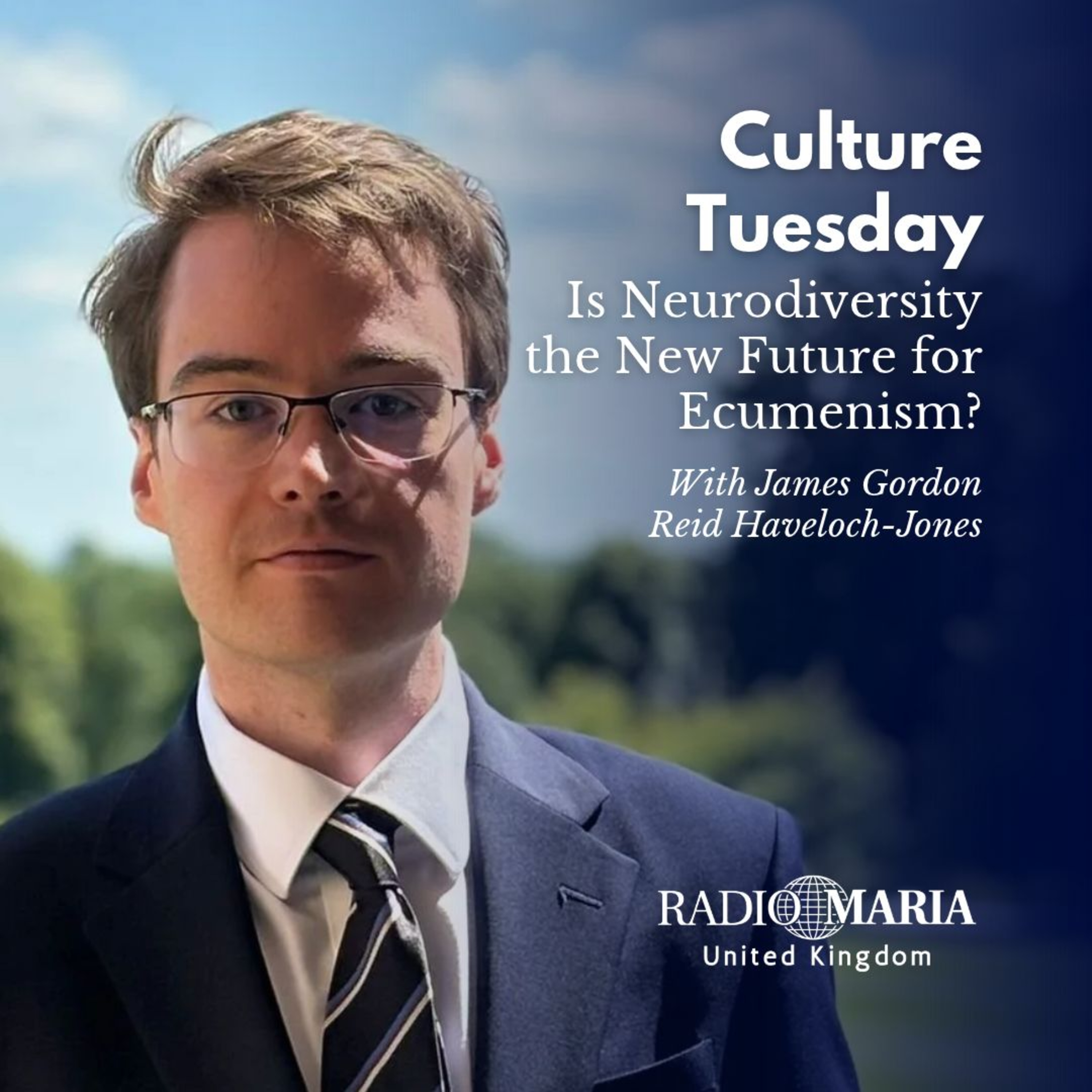
Autism rates, special needs schools and workplace inclusion have been in the news for years. A major study published in March 2026 has now prompted Church leaders across the denominations to act. Join Helena Judd as she asks whether neurodiversity could be a new meeting point for Christians of every tradition. Her guest, James Gordon Reid, will explain what neurodiversity means in everyday life and look at examples in Scripture, including Jeremiah and Paul. He will also share how parishes and the Anglican Church are responding. Tune in for an honest, hopeful conversation about the Church’s welcome for everyone, who is “fearfully and wonderfully made”. James Gordon Reid Haveloch-Jones is an educational consultant, public theologian, and author of the Amazon Top 50 study skills bestseller 'The Gold Standard: Coaching for Excellence'. He is a contracted contributing writer for the Catholic Bishops' Conference of England and Wales and a guest writer for The Tablet and the National Catholic
How is the liturgical year lived out in our Catholic schools? In this episode, Jonnie and Helen Bridges of Magister Resources explore three simple ways teachers can let the rhythm of the Church’s year guide their work: visibility, music and collective worship. They also discuss the challenges teachers face in fitting this into an already full school day, and share ideas for making it achievable. Quiz question for listeners: In the second branch of the RED, the following verse is featured: “In many and various ways, God spoke to our ancestors by the prophets.” Which book of the Bible does this come from? Send your answers to the Studio line, phone or WhatsApp on 0 333 444 1211. Bible and Blackboard is live on Radio Maria on Thursdays at 9am, in the 1st, 2nd and 3rd weeks of the month. Listen to Radio Maria on DAB digital radio, online at: https://radiomaria.uk/ and on the Radio Maria Play app.
Clubs should reject lucrative sponsors whose activities conflict with their stated values.
Share your view, then see how readers voted. No sign-in required. This poll is shared across stories.
Do you agree or disagree?
Common Quandary
A Common Quandary to discuss
Another conversation to explore, separate from this news story.
Everyone exaggerates on dating apps. Are two imaginary inches harmless?
A friend adds two inches to their listed height because they believe filters exclude them before personality has a chance. They plan to be charming enough that a date will not care once they meet in person.
Can deception be a fair response to superficial gatekeeping?