DNA, Hot Pockets, and The Longest Word Ever: Crash Course Biology #11
20 min
Listen through the publisher, then discuss the episode here or arrange an in-person Roundtable. Your city determines where to meet.
Roundtables are designed for groups of four, with a shared subject and room for everyone to speak. Come for discussion, with no dating expectation.
Hank imagines himself breaking into the Hot Pockets factory to steal their secret recipes and instruction manuals in order to help us understand how the processes known as DNA transcription and translation allow our cells to build proteins. Table of Contents: 1) Transcription 2:12 A) Transcription Unit 3:00 B) Promoter 3:10 C) TATA Box 3:32 D) RNA Polymerase 4:12 E) mRNA 4:15 F) Termination signal 5:21 G) 5' Cap & Poly-A Tail 5:34 2) RNA Splicing 6:08 A) SNuRPs & Spliceosome 6:26 B) Exons & Introns 6:56 3) Translation 7:28 A) mRNA & tRNA 8:01 B) Triplet Codons & Anticodons 8:39 4) Folding & Protein Structure 10:51 A) Primary Structure 11:11 B) Secondary Structure 11:23 C) Tertiary Structure 11:58 D) Quaternary Structure 12:44 Links to episodes referenced in the video: DNA structure episode: http://www.youtube.com/watch?v=8kK2zwjRV0M Animal cells episode: http://www.youtube.com/watch?v=cj8dDTHGJBY Fold-it SciShow episode: http://www.youtube.com/watch?v=JdBcpdH_ptA This video contains the following sounds from Freesound.org: "IMPresora.wav" by melack "swishes.wav" by pogotron Crash Course is on Patreon! Want to find Crash Course elsewhere on the internet? Facebook - http://www.facebook.com/YouTubeCrashCourse Twitter - http://www.twitter.com/TheCrashCourse Instagram - https://www.instagram.com/thecrashcourse/ CC Kids: http://www.youtube.com/crashcoursekids
Episode information is provided by the publisher. Listening takes place on the publisher’s service.
This week, Kate is joined by her friend and fellow solo podcaster Madi Murphy of The Bad Broadcast. They get into how 45 minutes on the internet unraveled her Mormon upbringing, thought-stoppers like "doubt your doubts," Molly Mormons vs. Jack Mormons, and what it's like to watch the church relax the rules on the shoulders you spent your whole girlhood covering. Plus: Secret Lives of Mormon Wives OC, from the slicked-back buns to the self-proclaimed "emasculated" husbands, the lost art of complaining, and a Love/Hate featuring one toddler life hack you'll want to steal immediately. Enjoy! PRE-ORDER (https://www.google.com/url?q=https%3A%2F%2Fstatic.macmillan.com%2Fstatic%2Fsmp%2Fshe-let-herself-go-9781250434968%2F&sa=D&source=calendar&usg=AOvVaw0jHgJi17ziwPR4kj1rl89v&ust=1795461647781770) Kate's upcoming book, She's Let Herself Go (https://www.google.com/url?q=https%3A%2F%2Fstatic.macmillan.com%2Fstatic%2Fsmp%2Fshe-let-herself-go-9781250434968%2F&sa=D&source=calendar&usg=AOvVaw0jHgJi17
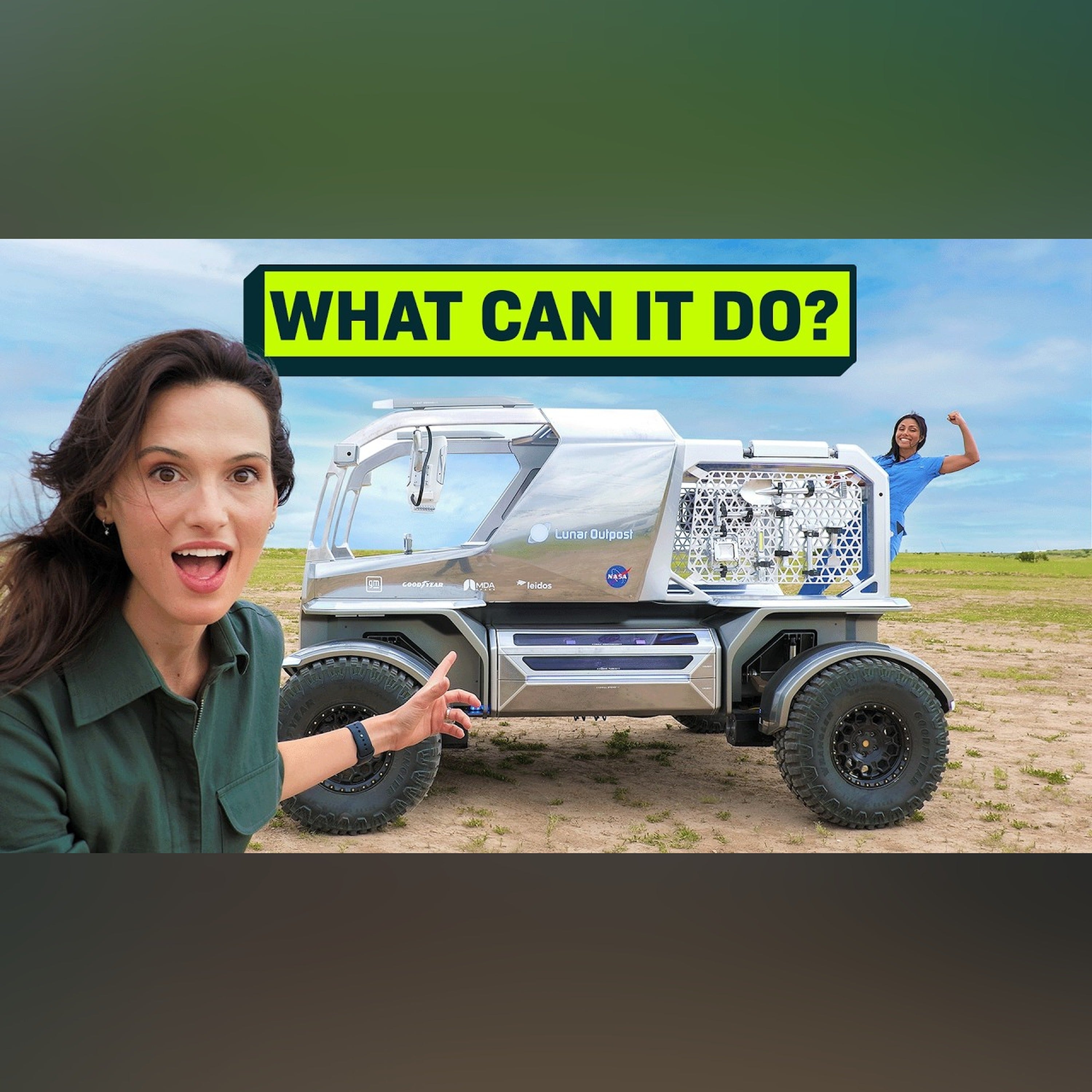
This truck is going to the moon. So we put it to the test… Get an exclusive 15% discount on Saily data plans. Use code CLEO at checkout. Download Saily app or go to https://saily.com/cleo This is the world’s first “space truck.” It’s going to the moon to help us go farther, faster, and discover places we’ve never been… Because humans are about to go back to the moon for the first time in 50 years! And no one but its builders have ever driven it… until today. In this video I'm going to put this brand new space truck to the test in a series of 5 challenges. And I've invited someone who knows a thing or two about challenges: YouTube daredevil and host of Challenge Accepted… Michelle Khare! Let’s go. Chapters: 0:00 This is the world’s first space truck 0:38 Introducing Michelle Khare! 01:04 What is a space truck? 01:52 How do astronauts drive? 02:21 First impressions! 02:47 Moon truck v normal truck 04:47 How fast can you drive on the moon? 05:18 Will we crash? 08:36 Can we break the lunar
For the references, deeper nuances, and additional content the StayCurious Metabolism letter: https://staycuriousmetabolism.substack.com/p/can-visceral-fat-cause-depression?r=40ekz2 Hidden in this letter is a secret — a scientific breakthrough more than 75 years in the making. By the end of this video, I’ll show you exactly what’s inside it. But before we get there, understand this: I mean it literally. Scientists have just discovered that fat cells send secret letters to the brain — and the messages encoded inside them control your hunger, your energy, your metabolism, and potentially the root cause of obesity itself. These letters determine whether your brain feels satisfied and energized… or hungry, sluggish, and metabolically broken. Here’s the shocking part: if your biology writes the right message, you stay lean and healthy almost effortlessly. If it writes the wrong one, your brain goes blind to satiety, your metabolism slows, and your body enters a hormonal state that drives we
Unock the free Masterclass: https://nci.university (https://nci.university/) Uploaded 03-07-25 Before you spoke your first word, the world had already assigned you an identity—names, roles, expectations, and limitations. This video is a decoding of that lie. In this 10-minute deep dive, we explore the hidden machinery behind identity—psychologically, philosophically, and socially. With insight from Carl Jung, Plato, and Social Identity Theory, we confront the truth: most of what you think of as “you” was scripted for you. ⸻ In this video: • Carl Jung’s Shadow and the hidden self • Plato’s Allegory of the Cave and waking up to illusion • The roots of identity through memory, tribe, and opposition • How we’re trained to obey, belong, and perform • The psychological cost of not knowing who you are • The path to reclaiming authorship over your life ⸻ For the Seekers: This is not self-help. This is not motivation. This is for those who suspect the story they’re living isn’t their own. ⸻ If
Have you ever tried something so hard, failed, and then tried again anyway? Meet Tony Hawk, the boy who turned his restless energy into skateboarding history! Growing up in sunny San Diego, California, Tony was a frustrated kid until his brother gave him a scratched-up blue skateboard. It was pure magic! By age 14, he was a fearless professional skater inventing wild, sky-high tricks on massive wooden ramps. Imagine being at the 1999 X Games, watching Tony attempt the ultimate, "impossible" trick: the 900! That's two and a half dizzying spins high in the air. Crash after crash, he fell ten times. But on his eleventh try? He landed it perfectly, while the crowd went absolutely wild! That same year, his smash-hit video game made him a superstar all around the world. But Tony didn't just want fame. He wanted every kid to have a safe place to ride, fall, and get back up. Through his charity, he has helped build hundreds of free public skateparks everywhere! Grab your helmet and drop in as
Here is something that has always fascinated me. The easiest people to lead are almost always other people. You can fire an employee who won't perform. You can end a partnership. You can walk away from anyone who consistently lets you down. Uploaded 15-09-26 But there is one person you can never fire, never replace, never walk away from — and that person is the one you have to depend on for every single thing you will ever accomplish. You are stuck with yourself. The one who resists you most, who makes promises and breaks them, who knows every excuse before you finish making it, is the one wearing your clothes. Here is the truth: we keep the promises we make to strangers and break the ones we make to ourselves, and until we fix that, nothing else holds. This seminar walks through the things you must understand about leading the hardest person you will ever command — you. CHAPTERS 0:00 Intro — the one person you can never fire 1:31 The way you'd never lead anyone else 2:54 What self-lea
The majority of the universe is made up of a currently mysterious entity that pervades space: dark energy. We don’t know exactly what it is, but we do know that dark energy accelerates the expansion of space. We think this means the Universe will expand forever, even as our view of it shrinks while space expands faster all the time. Check out the Crash Course Astronomy solar system poster here: http://store.dftba.com/products/crashcourse-astronomy-poster If you want to learn more about the creation and death of the universe, watch Crash Course Big History here: https://youtube.com/playlist?list=PL8dPuuaLjXtMczXZUmjb3mZSU1Roxnrey -- Chapters: Introduction: The Expanding Universe 00:00 The Expansion of Space is Accelerating 2:17 What is Dark Energy? 4:19 Will the Universe Expand Forever? The Geometry of the Universe 5:20 The Cosmic Horizon of the Observable Universe 6:50 Review 10:20 -- GEOMETRY OF THE UNIVERSE RESOURCES Geometry: Expanding faster than light: General expansion: -- PBS Di
Have you ever wondered where cured meats like salami or pepperoni get their bright red color? Of course its from organic chemistry! A chemical called nitric acid gives them that bright color, while also increasing their shelf. It's also involved in some other interesting reactions. In this episode of Crash Course Organic Chemistry we'll see how nitrous acid reacts with primary amines to form diazonium salts, we'll learn about alkyldiazonium salts and aryldiazonium salts, and see what conditions are necessary for nucleophilic aromatic substitutions. Series Sources: Brown, W. H., Iverson, B. L., Ansyln, E. V., Foote, C., Organic Chemistry; 8th ed.; Cengage Learning, Boston, 2018. Bruice, P. Y., Organic Chemistry, 7th ed.; Pearson Education, Inc., United States, 2014. Clayden, J., Greeves, N., Warren., S., Organic Chemistry, 2nd ed.; Oxford University Press, New York, 2012. Jones Jr., M.; Fleming, S. A., Organic Chemistry, 5th ed.; W. W. Norton & Company, New York, 2014. Klein., D., Organ
Like a trendy dance, a fighting combo, or a secret handshake, organic reactions can be broken down into simpler steps. In this episode of Crash Course Organic Chemistry, we’ll specifically be looking at alkene addition reactions, and with each new reaction ask ourselves three questions to help us puzzle through the mechanism and understand what’s going on. Episode Sources: Le Couteur, P, Burreson, J. Napoleon’s Buttons: 17 molecules that changed history., Penguin, New York, 2004, Chapter 1. Whipps, H., “How the Spice Trade Changed the World,” https://www.livescience.com/7495-spice-trade-changed-world.html Last accessed, 3/28/2020. Henriques, Martha, “How spices changed the ancient world,” http://www.bbc.com/future/bespoke/made-on-earth/the-flavours-that-shaped-the-world/ Last accessed, 3/28/2020. Hashimoto, K., Yaoi, T., Koshiba, H., Yoshida, T., Maoka, T., Fujiwara, Y., Yaamoto, Y, Mori, K., “Photochemical Isomerization of Piperine, a Pungent Constituent of Pepper”, Food Sci. Technol.
Environmental commitments should be judged by measured outcomes rather than announced targets.
Share your view, then see how readers voted. No sign-in required. This poll is shared across stories.
Do you agree or disagree?
Common Quandary
A Common Quandary to discuss
Another conversation to explore, separate from this news story.
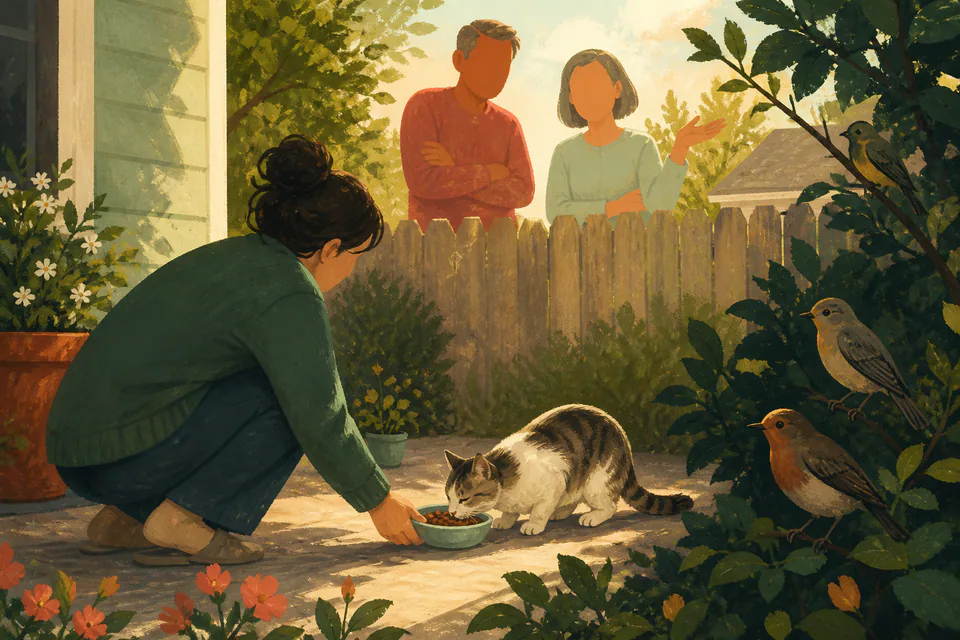
A stray cat adopts you—and starts killing birds. Do you keep feeding it?
A stray cat visits your yard daily and appears to depend on the food you leave out. Neighbors complain that outdoor cats kill birds and say feeding it encourages the problem without taking responsibility for the animal.
Does caring for one visible animal excuse harm to less visible ones?