English-language podcasts

The Veil

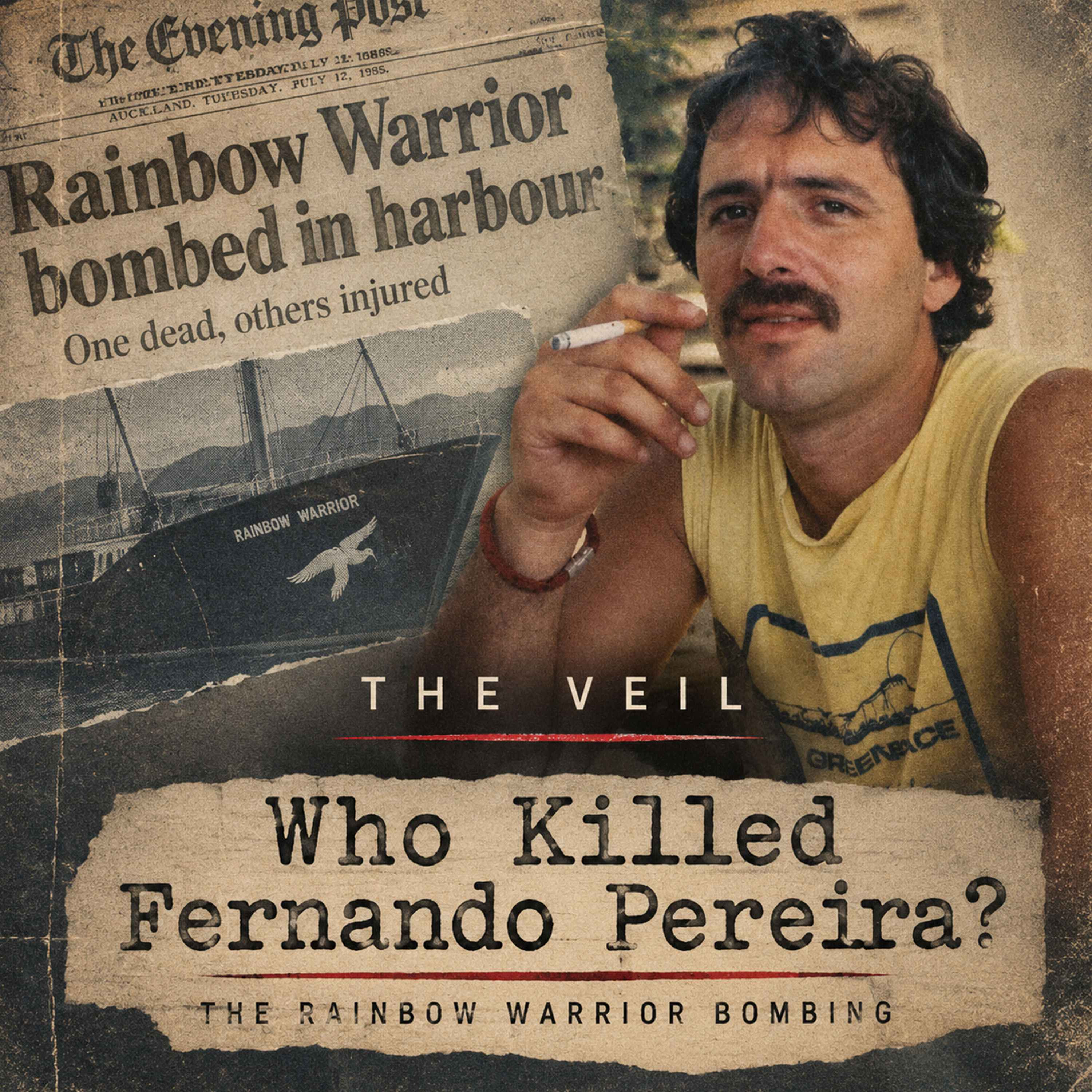
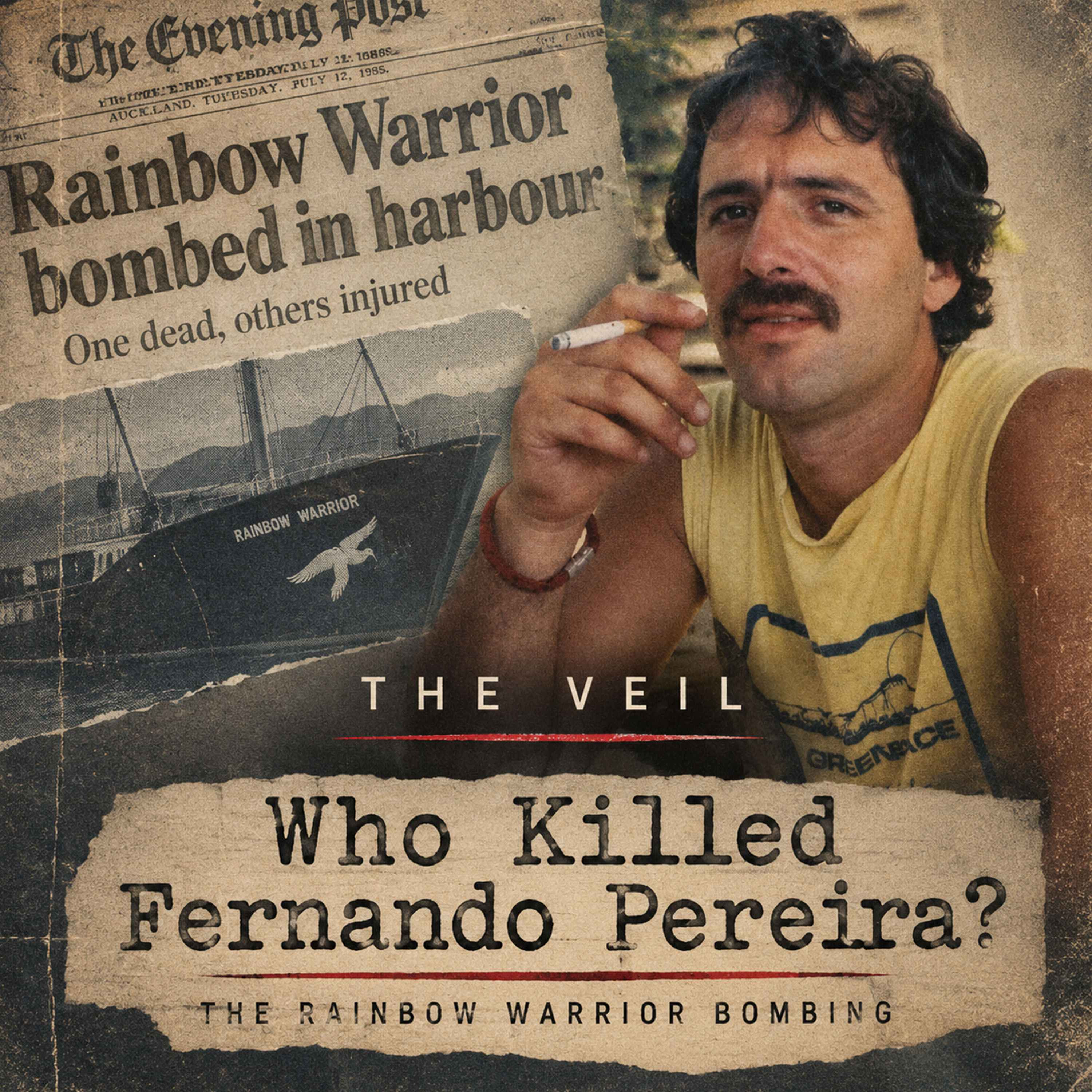
E82 | Who Killed Fernando Pereira? The Bombing of the Rainbow Warrior - Part Three, The Red Stripe
42 min

Listen through the publisher, then discuss the episode here or arrange an in-person Roundtable. Your city determines where to meet.

Roundtables are designed for groups of four, with a shared subject and room for everyone to speak. Come for discussion, with no dating expectation.

In November 1985, in front of the world's press, two French officers plead guilty to manslaughter and are sent to prison for ten years. Within eight months, a trade war and a United Nations ruling have put them on a Pacific atoll, and within three years both are home in France. Then come the arbitration, the arrest in Basel, the apology from a man who placed a bomb, and the question of who gave the order. The final part of A Friendly Country, and a daughter who remembers painting a red stripe. IN MEMORY Fernando Pereira, 1950 to 1985, photographer, father of Marelle and Paul. A national environmental award in Portugal, the Prémio Nacional de Ambiente Fernando Pereira, carries his name. A NOTE ON SOURCING Alain Mafart and Dominique Prieur are the only people ever convicted over the bombing. The man arrested in Basel in 1991 is not named: he was never tried, and New Zealand dropped the case. Jean-Luc Kister is named for his own public statements in 2015, Christine Cabon for her own 2017 interviews, and Pierre Lacoste for his own written note. The sentencing remarks are taken from contemporaneous press reports of Chief Justice Davison's judgment. The 1986 Secretary-General's ruling and the 1990 arbitral award are quoted from the official UN reports. The working theory set out near the end is the host's reading of the public record, not a finding of any court. SOURCES UN Secretary-General's ruling, 1986 (RIAA XIX): legal.un.org/riaa/cases/vol_XIX/199-221.pdf Arbitral award, 1990 (RIAA XX): legal.un.org/riaa/cases/vol_XX/215-284.pdf Mafart v TVNZ, Supreme Court of New Zealand: courtsofnz.govt.nz/assets/cases/2006/mafartvtvnz_000.pdf The Press, sentencing report, 27 November 1985: paperspast.natlib.govt.nz/newspapers/CHP19851127.2.103 NZ Herald, "Man linked to Rainbow Warrior sinking gets away scot free": nzherald.co.nz/nz/man-linked-to-rainbow-warrior-sinking-gets-away-scot-free/3LLQDOTY3BZ5CBMMSL2SAOR42Y NZ Herald, "Papers show Mitterrand approved bombing" (2005): nzherald.co.nz/world/papers-show-mitterrand-approved-rainbow-warrior-bombing/FGIWZQP7Z4ZP5P6MGHN52HXZEY Irish Times, Kister apology (2015): irishtimes.com/news/world/europe/french-spy-apologises-for-fatal-bombing-of-greenpeace-ship-1.2342464 Northern Advocate, "Rainbow's end: 20 years on" (2005): nzherald.co.nz/northern-advocate/news/rainbows-end-20-years-on-anger-and-love-still-linger/L2J4RLE2LGN4IFEIIPB7HUSWWY/ Geoffrey Palmer, "The Rainbow Warrior: a game changer": wgtn.ac.nz/law/about/publications-and-resources/events-and-podcasts/the-rainbow-warrior-a-game-changer/Palmer.pdf Greenpeace Aotearoa, history: greenpeace.org/aotearoa/about/our-history/bombing-of-the-rainbow-warrior/ RNZ, Willcox on the Kister apology (2015): rnz.co.nz/news/national/283432/ Pacific Media Watch on the Sunday Star-Times Cabon interview (2017): pmcarchive.aut.ac.nz/node/4395.html NZ Police, Ten One (2025): police.govt.nz/news/ten-one-magazine/rainbow-warrior-40-years THE BOOKS Michael King, Death of the Rainbow Warrior (Penguin, 1986). The first full account of the police investigation, by one of New Zealand's leading historians, written with access to the investigators. Part of it is available as the BWB Texts ebook Bombing the Rainbow Warrior: bwb.co.nz Peter Willcox with Ronald B. Weiss, Greenpeace Captain (2016). The captain's own account of that night and its aftermath. Available on Kindle and in print. Written and hosted by Ryan Wolf. Researched and written with the assistance of AI tools. A Brevity Studios production. brevityplus.com Please consider subscribing to support our work. Hosted on Acast.

Episode information is provided by the publisher. Listening takes place on the publisher’s service.

Listen at the source ↗

Featured places to meet in Palo Alto, CA

Explore these places and arrange a conversation through ThinkMatch.

City guide for Palo Alto, CA

More from The Veil

The Veil

E81| Who Killed Fernando Pereira? The Bombing of the Rainbow Warrior - Part Two: Remember the Mountain

39 min

The bombing of the Rainbow Warrior, Auckland, New Zealand, 1985 Three days in the interview rooms at Auckland Central. A fisherman called Peter who never turns up, a pair of scars no surgeon made, a horoscope that reads like a police brief, and a young constable who speaks French. Then the passports come back from Switzerland as forgeries. As the Turenges are charged, the investigation chases a yacht to Norfolk Island, a doctor to Sydney, a volunteer to Israel and a pair of black pantyhose to Paris, and France's denials begin to give way. IN MEMORY Fernando Pereira, 1950 to 1985, photographer, father of Marelle and Paul. A NOTE ON SOURCING Alain Mafart and Dominique Prieur, who used the names Alain and Sophie Turenge, are named because they pleaded guilty to manslaughter and wilful damage in November 1985. Christine Cabon is named because her role has been publicly documented and she has spoken about it. The Ouvéa's crew, the yacht's doctor, the divers and their commander are described

Discuss this episode

The Veil

E80 | Who Killed Fernando Pereira? The Bombing of the Rainbow Warrior - Part One: Fantastic, Awful

38 min

The bombing of the Rainbow Warrior, Auckland, New Zealand, 1985 Just before midnight on 10 July 1985, two bombs tore through the Greenpeace flagship Rainbow Warrior as she lay at Marsden Wharf in Auckland, days before she was due to sail to protest French nuclear testing at Moruroa. The ship's photographer, Fernando Pereira, went below for his cameras after the first blast and drowned when the second one hit. Within hours, a stolen-gear watch at a boat club, a camper van registration and a hire company's paperwork gave the police a married Swiss couple called Alain and Sophie Turenge. In Part One: the ship, the man, the night, and the first interviews at Auckland Central. IN MEMORY Fernando Pereira, 1950 to 1985, photographer, father of Marelle and Paul. A national environmental award in Portugal, the Prémio Nacional de Ambiente Fernando Pereira, carries his name. A NOTE ON SOURCING This is a closed case. Two French agents, Alain Mafart and Dominique Prieur, pleaded guilty to manslaugh

Discuss this episode

The Veil

E79 | The Boy in the Chair: The Confessions of Teina Pora - Part Three - Never Met Him

42 min

A professor of false confessions who said no, then yes. A diagnosis nobody had looked for in twenty years. Five judges in London. In the final part of The Boy in the Chair, Teina Pora's case reaches the Privy Council, a retired judge goes through every piece of evidence ever used against him, and the man who said he'd never met him finally stands trial for Susan Burdett's murder. Hear every series on the day it launches, ad free, plus all my other shows and bonus episodes: https://guilt.supportingcast.fm/ A NOTE ON SOURCING This series draws on the Privy Council's 2015 judgment, the 2016 reports of Hon Rodney Hansen QC to the Minister of Justice, later court decisions, contemporaneous reporting, and Michael Bennett's book In Dark Places. Where the official record and other accounts differ, we have followed the official record. THE BOOK In Dark Places: The Confessions of Teina Pora and an Ex Cop's Fight for Justice, by Michael Bennett (Paul Little Books, 2016). Winner of the 2017 Ngaio

Discuss this episode

Community Poll

Street design should prioritize pedestrians and public transport over private cars.

Share your view, then see how readers voted. No sign-in required. This poll is shared across stories.

Do you agree or disagree?

Choose one answer

Common Quandary

A Common Quandary to discuss

Another conversation to explore, separate from this news story.

The night before the wedding, your friend admits serious doubts. Do you tell their partner?

On the night before a wedding, your closest friend says they are unsure they should marry but insists it is ordinary panic. They make you promise secrecy and plan to proceed. Their partner asks you directly whether everything is okay.

When does loyalty require breaking a confidence before an irreversible choice?

Explore this quandary