Evolution: It's a Thing - Crash Course Biology #20
18 min
Listen through the publisher, then discuss the episode here or arrange an in-person Roundtable. Your city determines where to meet.
Roundtables are designed for groups of four, with a shared subject and room for everyone to speak. Come for discussion, with no dating expectation.
Hank gets real with us in a discussion of evolution - it's a thing, not a debate. Gene distribution changes over time, across successive generations, to give rise to diversity at every level of biological organization. Table of Contents 1) The Theory of Evolution 1:49 2) Fossils 2:42 3) Homologous Structures 4:36 4) Biogeography 7:02 5) Direct Observation 8:52 References: Crash Course is on Patreon! Want to find Crash Course elsewhere on the internet? Facebook - http://www.facebook.com/YouTubeCrashCourse Twitter - http://www.twitter.com/TheCrashCourse Instagram - https://www.instagram.com/thecrashcourse/ CC Kids: http://www.youtube.com/crashcoursekids
Episode information is provided by the publisher. Listening takes place on the publisher’s service.
This is a Grave Talks CLASSIC EPISODE! Preserving history is one thing. Preserving it while uncovering ghostly activity is something else entirely. Saving the Old Properties is a nonprofit dedicated to rescuing endangered historic buildings across Indiana. Founded by Richard Allen and Dann Allen, the organization restores architectural treasures that might otherwise be lost to time. But as walls are opened and floors are lifted, something else often emerges—stories, energy, and sometimes spirits that never left. Joining us are Richard Allen, General Manager Kate Thornberg, and Historian Ted Martin, who share what it’s like to breathe life back into centuries-old structures—while encountering unexplained phenomena within their walls. From shadow figures and strange sounds to the emotional weight that lingers in historic spaces, this conversation explores where preservation meets the paranormal—and how history and hauntings often occupy the same foundation. For more information on Saving
So what are you willing to pay for the life you say you want? Because everything has a price. Every single thing worth having in this life carries a cost, and that cost is real, and that cost is non-negotiable. The sooner you make peace with that, the sooner you stop being surprised by a world that was never going to be free. Uploaded 14-10-26 Most people understand this in theory. They'll nod along. Of course there's a price, they say. But there's a difference between knowing something as a slogan and knowing it in your bones — and the difference shows up at exactly the moment the bill actually arrives. Here is the truth: the price of any life is paid in advance. Not at the end. Not along the way. In advance. The people who get the life they want settle the account before they ever begin. The people who don't are the ones who thought they could enjoy the purchase first and figure out the payment later. This seminar unpacks the single mechanic behind why some people finish what they st
PBS Member Stations rely on viewers like you. To support your local station, go to: http://to.pbs.org/DonateSPACE ↓ More info below ↓ Uploaded 12-01-21 Erratum: Figures in episode should be Minev et al. (2019), not Minney et al. (2009). Our apologies to the authors! This is the experiment we talk about: To Catch and Reverse a Quantum Jump Mid-Flight Minev, Mundhada, Shankar, Reinhold, Gutiérrez-Jáuregui, Schoelkopf, Mirrahimi, Carmichael and Devoret (2019), Nature, v.570, p.200 Sign Up on Patreon to get access to the Space Time Discord! Since the very beginning of quantum mechanics, a debate has raged about how to interpret its bizarre predictions. And at the heart and origin of that debate is the quantum jump or quantum leap - the seemingly miraculous and instantaneous transitions of quantum systems that have always defied observation or prediction. At least, until now. Check out the Space Time Merch Store Sign up for the mailing list to get episode notifications and hear special anno
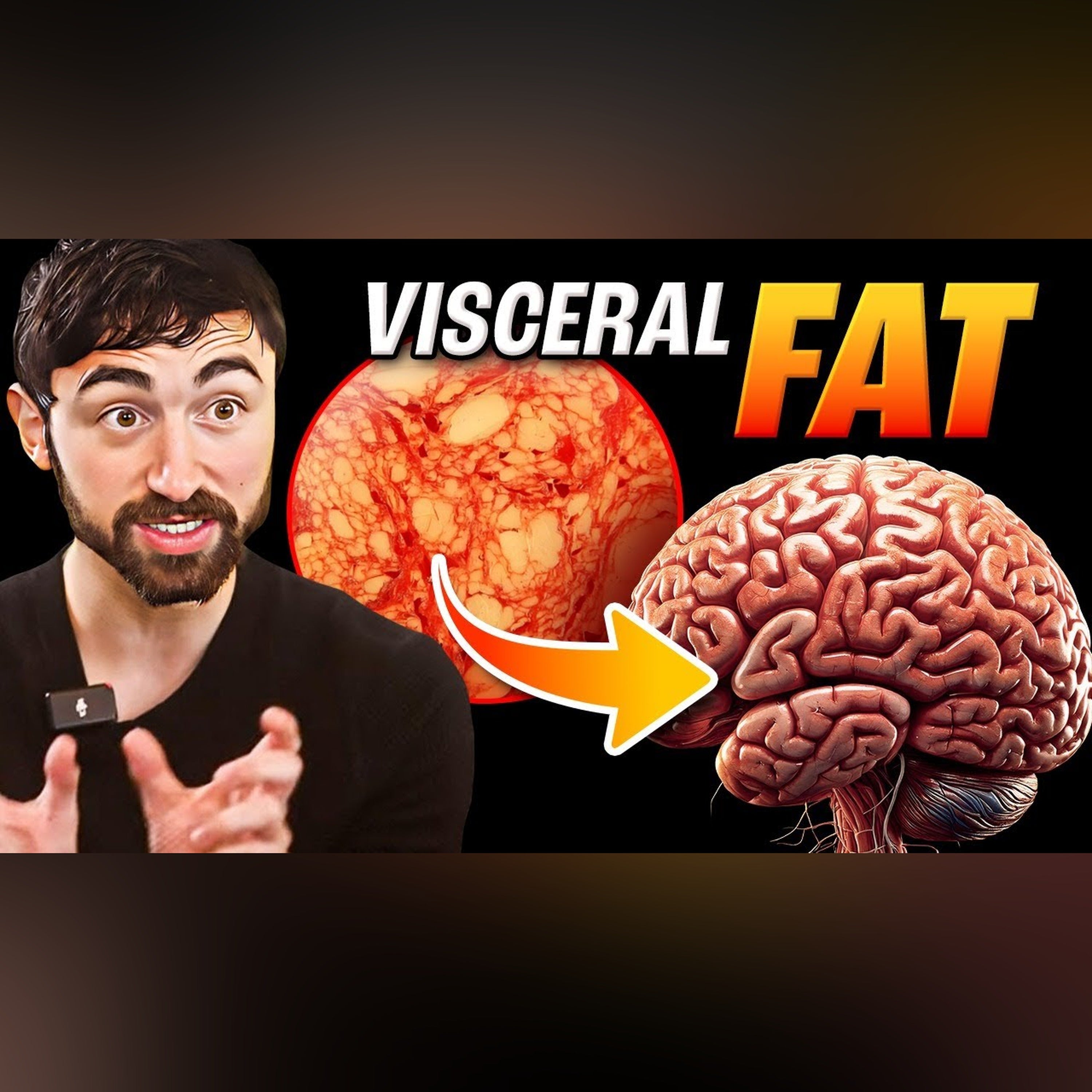
For all references and even deeper nuances, check out the StayCurious Metabolism letter: https://staycuriousmetabolism.substack.com/p/can-visceral-fat-cause-depression?r=40ekz2 Chapter *Call our service line at 815-STAY-CUR (815-782-9287) *Learn more about the data, here: https://staycuriousmetabolism.substack.com/p/life-or-death-in-the-fine-print-the?r=40ekz2 Visceral Fat Randomized Controlled Trial Video: https://youtu.be/lDeegZ1wtAI Description: Most people think of fat as extra weight—something cosmetic or something to “burn off.” But new science is showing something far more profound: visceral fat is an endocrine organ that sends biochemical messages across the entire body, including directly into the brain. And those messages can change mood, increase stress sensitivity, and even promote depression. In this video, we break down a brand-new study revealing how visceral fat releases tiny molecular packages called extracellular vesicles. Inside those vesicles is a specific microRNA—
Master the skills that change lives — enroll in your free human behavior course today: https://nci.university/learn Uploaded 09-01-26 You were never reacting to chaos — you were responding to structure. Outcomes don’t appear suddenly; they’re assembled long before you notice them. Understanding how pressure is built changes how the world feels immediately. All influence follows patterns once you know where to look. Reality doesn’t break — it gets reshaped in layers. Every system depends on predictable human responses. Given the right conditions, behavior becomes almost automatic. Once you see the architecture, panic loses its leverage. Detection beats reaction — every time. Please note that the content provided in this broadcast is for informational and educational purposes only and should not be construed as legal, medical, financial, or professional advice. No material in this communication establishes any form of professional relationship that is privileged or confidential. The insi
How do you get your kids interested in learning without making it feel like homework? In today's episode, we're revisiting some of Ryan's favorite conversations with Kenny Curtis, host of Greeking Out (https://podcasts.apple.com/us/podcast/greeking-out-from-national-geographic-kids/id1483233279) and History Snacks (https://podcasts.apple.com/us/podcast/history-snacks/id1874130976), about how to encourage your kids' interests, nurture their natural curiosity, take those interests beyond a screen, and turn their curiosity into real-world experiences. Check out the full episodes with Kenny Curtis (https://podcasts.apple.com/us/podcast/greeking-outs-kenny-curtis-on-how-ancient-myths-teach/id1430315931?i=1000682597107)! | Apple Podcasts (https://podcasts.apple.com/us/podcast/greeking-outs-kenny-curtis-on-how-ancient-myths-teach/id1430315931?i=1000682597107), Spotify (https://open.spotify.com/episode/2CZPpfwjiwEsvb84EZyyz5), YouTube (https://www.youtube.com/watch?v=qAu5_O-KZNg) Pick up a cop
The majority of the universe is made up of a currently mysterious entity that pervades space: dark energy. We don’t know exactly what it is, but we do know that dark energy accelerates the expansion of space. We think this means the Universe will expand forever, even as our view of it shrinks while space expands faster all the time. Check out the Crash Course Astronomy solar system poster here: http://store.dftba.com/products/crashcourse-astronomy-poster If you want to learn more about the creation and death of the universe, watch Crash Course Big History here: https://youtube.com/playlist?list=PL8dPuuaLjXtMczXZUmjb3mZSU1Roxnrey -- Chapters: Introduction: The Expanding Universe 00:00 The Expansion of Space is Accelerating 2:17 What is Dark Energy? 4:19 Will the Universe Expand Forever? The Geometry of the Universe 5:20 The Cosmic Horizon of the Observable Universe 6:50 Review 10:20 -- GEOMETRY OF THE UNIVERSE RESOURCES Geometry: Expanding faster than light: General expansion: -- PBS Di
Have you ever wondered where cured meats like salami or pepperoni get their bright red color? Of course its from organic chemistry! A chemical called nitric acid gives them that bright color, while also increasing their shelf. It's also involved in some other interesting reactions. In this episode of Crash Course Organic Chemistry we'll see how nitrous acid reacts with primary amines to form diazonium salts, we'll learn about alkyldiazonium salts and aryldiazonium salts, and see what conditions are necessary for nucleophilic aromatic substitutions. Series Sources: Brown, W. H., Iverson, B. L., Ansyln, E. V., Foote, C., Organic Chemistry; 8th ed.; Cengage Learning, Boston, 2018. Bruice, P. Y., Organic Chemistry, 7th ed.; Pearson Education, Inc., United States, 2014. Clayden, J., Greeves, N., Warren., S., Organic Chemistry, 2nd ed.; Oxford University Press, New York, 2012. Jones Jr., M.; Fleming, S. A., Organic Chemistry, 5th ed.; W. W. Norton & Company, New York, 2014. Klein., D., Organ
Like a trendy dance, a fighting combo, or a secret handshake, organic reactions can be broken down into simpler steps. In this episode of Crash Course Organic Chemistry, we’ll specifically be looking at alkene addition reactions, and with each new reaction ask ourselves three questions to help us puzzle through the mechanism and understand what’s going on. Episode Sources: Le Couteur, P, Burreson, J. Napoleon’s Buttons: 17 molecules that changed history., Penguin, New York, 2004, Chapter 1. Whipps, H., “How the Spice Trade Changed the World,” https://www.livescience.com/7495-spice-trade-changed-world.html Last accessed, 3/28/2020. Henriques, Martha, “How spices changed the ancient world,” http://www.bbc.com/future/bespoke/made-on-earth/the-flavours-that-shaped-the-world/ Last accessed, 3/28/2020. Hashimoto, K., Yaoi, T., Koshiba, H., Yoshida, T., Maoka, T., Fujiwara, Y., Yaamoto, Y, Mori, K., “Photochemical Isomerization of Piperine, a Pungent Constituent of Pepper”, Food Sci. Technol.
Moving a contested monument to a museum can be better than leaving it unchanged or destroying it.
Share your view, then see how readers voted. No sign-in required. This poll is shared across stories.
Do you agree or disagree?
Common Quandary
A Common Quandary to discuss
Another conversation to explore, separate from this news story.
An app can text exactly like someone you lost. Would you keep talking to it?
A service can create a conversational likeness from a deceased person's messages and recordings. A grieving family member finds it comforting, although the deceased never consented to this use of their data.
Can comfort justify creating a voice the dead never authorized?