Viewers like you help make PBS (Thank you ) . Support your local PBS Member Station here: https://to.pbs.org/DonateSPACE Uploaded 26-07-17 Unlock the secrets of Feynman Diagrams. Part 5 in our Quantum Field Theory series. And if you're submitting an answer to our challenge question email your answer by August 2nd to pbsspacetime [AT] gmail.com with the subject line "Feynman Diagram Challenge." You can further support us on Patreon at https://www.patreon.com/pbsspacetime Get your own Space Time tshirt at http://bit.ly/1QlzoBi Tweet at us! @pbsspacetime Facebook: facebook.com/pbsspacetime Email us! pbsspacetime [at] gmail [dot] com Comment on Reddit: http://www.reddit.com/r/pbsspacetime Help translate our videos! https://www.youtube.com/timedtext_cs_... Previous Episode: The Real Star Wars Feynman’s path integral shows us that, to properly calculate the probability of a particle traveling from point A to point B, we need to add up the contributions from all conceivable paths between tho
Sign Up on Patreon to get access to the Space Time Discord! Uploaded 18-08-21 The universe is going to end. But of all the possible ends of the universe vacuum decay would have to be the most thorough - because it could totally rewrite the laws of physics. Today I hope to help you understand exactly how terrified you should be. Check out the Space Time Merch Store Sign up for the mailing list to get episode notifications and hear special announcements! Hosted by Matt O'Dowd Written by Matt O'Dowd Graphics by Leonardo Scholzer, Yago Ballarini, Pedro Osinski, Adriano Leal and Stephanie Faria GFX Visualizations: Ajay Manuel Directed by Andrew Kornhaber Assistant Producer: Setare Gholipour Executive Producers: Eric Brown and Andrew Kornhaber End Credits Music by J.R.S. Schattenberg: https://www.youtube.com/user/MultiDroideka Special thanks to Our Patreon Sponsors Big Bang Supporters Ari Paul Kyle Bulloch Charlie Mrs. Tiffany Poindexter Leo Koguan Sandy Wu Matthew Miller Scott Gray Ahmad Jo
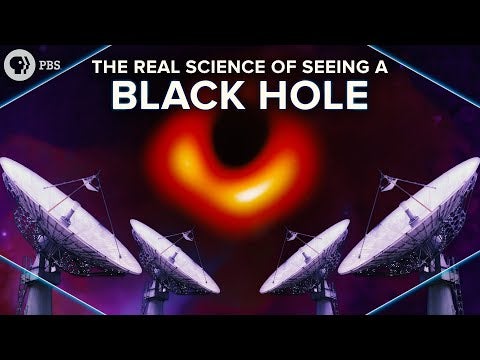
You can learn more about CuriosityStream at https://curiositystream.com/spacetime Uploaded 01-05-19 PBS Member Stations rely on viewers like you. To support your local station, go to: http://to.pbs.org/DonateSPACE How do you take a picture of a black hole and what can we learn from it? Our first ever actual bona fide photo of a black hole, made by the Event Horizon Telescope and revealed to the world in a press conference on April 10th. Since then it’s got plenty of coverage, because … I mean look at it. It’s a freaking black hole. It’s black, it’s holey, it’s everything we hoped it would be. Now that the giddiness has subsided and I personally have stopped spending hours on end staring at a black spot, we can take a breath and actually look at the real science here and discuss exactly how a picture like this could be taken and what we can learn from it. Check out the new Space Time Merch Store! Support Space Time on Patreon Need a Black Hole Refresher #Blackhole #astrophysics #spaceti
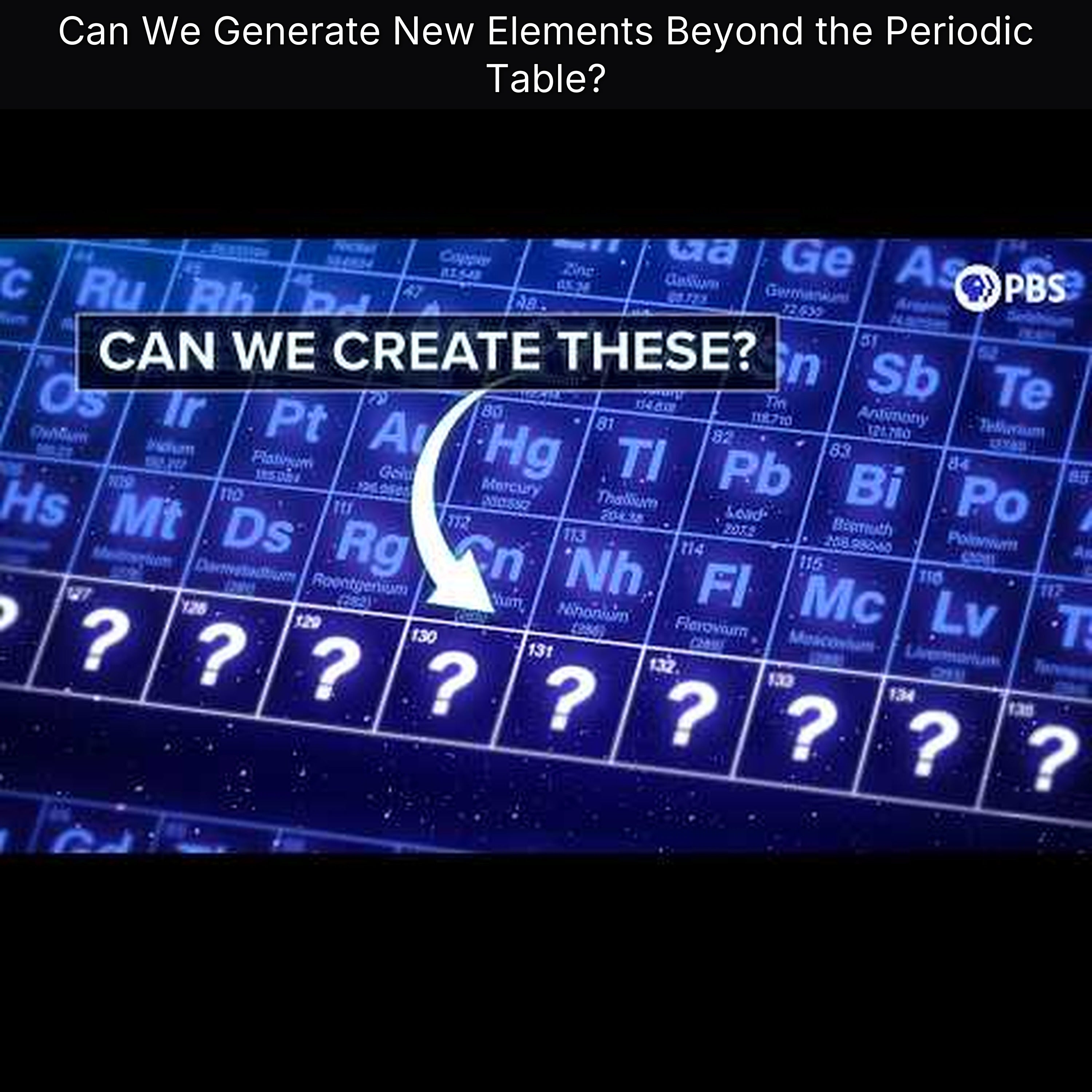
Brought to you by Raycon. Sign Up on Patreon to get access to the Space Time Discord! Scientists have been slowly extending the periodic table one element at a time, pushing to higher and higher masses, and have discovered some incredibly useful materials along the way. But the elements at the current end of the table are so unstable that they decay almost as soon as they’re created in our particle accelerators. Have we reached the end of the line of discoverable elements? There are new rows of the periodic table to unlock, and more stable versions of known heavy elements to synthesize—and while our accelerators are coming up short, astronomers have found a strange cosmic phenomenon that may populate the periodic table beyond our wildest dreams. Check out the Space Time Merch Store Sign up for the mailing list to get episode notifications and hear special announcements! Search the Entire Space Time Library Here: https://search.pbsspacetime.com/ Hosted by Matt O'Dowd Written by Matt Cap
Thank you to Brilliant for Supporting PBS. To learn more go to https://brilliant.org/SpaceTime/ PBS Member Stations rely on viewers like you. To support your local station, go to:http://to.pbs.org/DonateSPACE Sign Up on Patreon to get access to the Space Time Discord! The weird rules of quantum mechanics lead to all sorts of bizarre phenomena on tiny scales— particles teleporting through walls or being in multiple places at once or simultaneously existing and not. Shame all this magical behavior doesn’t happen on scales large enough for us to see. Except that there is a way for us to see large-scale quantum weirdness, and that’s Bose-Einstein Condensates & Superfluids. Check out the Space Time Merch Store Sign up for the mailing list to get episode notifications and hear special announcements! Search the Entire Space Time Library Here: https://search.pbsspacetime.com/ Hosted by Matt O'Dowd Written by Fernando Franco Felix & Matt O'Dowd Post Production by Leonardo Scholzer, Yago Ballari
Take the Space Time Fan Survey Here: https://forms.gle/wS4bj9o3rvyhfKzUA Uploaded 23-02-22 PBS Member Stations rely on viewers like you. To support your local station, go to:http://to.pbs.org/DonateSPACE ***** Sign Up on Patreon to get access to the Space Time Discord! Reality has cracks in it. Universe-spanning filaments of ancient Big Bang energy, formed from topological defects in the quantum fields, aka cosmic strings. They have subatomic thickness but prodigious mass and they lash through space at a close to the speed of light. They could be the most bizarre undiscovered entities that actually exist. Check out the Space Time Merch Store Sign up for the mailing list to get episode notifications and hear special announcements! Hosted by Matt O'Dowd Written by Jason Segall and Matt O'Dowd Post Production by Leonardo Scholzer, Yago Ballarini, Pedro Osinski, Adriano Leal and Stephanie Faria GFX Visualizations: Ajay Manuel Directed by Andrew Kornhaber Assistant Producer: Setare Gholipou
Sign Up on Patreon to get access to the Space Time Discord! Uploaded 15-09-21 We’ve traveled to lots of weird places on this show - from the interiors of black holes to the time before the big bang. But today I want to take you on a journey to what has got to be the weirdest place in the modern universe - a place where matter exists in states I bet you’ve never heard of. Today we take a journey to the center of the neutron star. Check out the Space Time Merch Store Sign up for the mailing list to get episode notifications and hear special announcements! Hosted by Matt O'Dowd Written by Matt O'Dowd Graphics by Leonardo Scholzer, Yago Ballarini, Pedro Osinski, Adriano Leal and Stephanie Faria GFX Visualizations: Ajay Manuel Directed by Andrew Kornhaber Assistant Producer: Setare Gholipour Executive Producers: Eric Brown and Andrew Kornhaber End Credits Music by J.R.S. Schattenberg: https://www.youtube.com/user/MultiDroideka Special thanks to Our Patreon Sponsors Big Bang Sponsors David N
PBS Member Stations rely on viewers like you. To support your local station, go to: http://to.pbs.org/DonateSPACE ↓ More info below ↓ Uploaded 12-01-21 Erratum: Figures in episode should be Minev et al. (2019), not Minney et al. (2009). Our apologies to the authors! This is the experiment we talk about: To Catch and Reverse a Quantum Jump Mid-Flight Minev, Mundhada, Shankar, Reinhold, Gutiérrez-Jáuregui, Schoelkopf, Mirrahimi, Carmichael and Devoret (2019), Nature, v.570, p.200 Sign Up on Patreon to get access to the Space Time Discord! Since the very beginning of quantum mechanics, a debate has raged about how to interpret its bizarre predictions. And at the heart and origin of that debate is the quantum jump or quantum leap - the seemingly miraculous and instantaneous transitions of quantum systems that have always defied observation or prediction. At least, until now. Check out the Space Time Merch Store Sign up for the mailing list to get episode notifications and hear special anno
Viewers like you help make PBS (Thank you ) . Support your local PBS Member Station here: https://to.pbs.org/DonateSPACE Uploaded 25-10-17 For years, astronomers have been unable to find up to half of the baryonic matter in the universe. We may just have solved this problem. You can further support us on Patreon at https://www.patreon.com/pbsspacetime Get your own Space Time tshirt at http://bit.ly/1QlzoBi Tweet at us! @pbsspacetime Facebook: facebook.com/pbsspacetime Email us! pbsspacetime [at] gmail [dot] com Comment on Reddit: http://www.reddit.com/r/pbsspacetime Help translate our videos! https://www.youtube.com/timedtext_cs_panel?tab=2&c=UC7_gcs09iThXybpVgjHZ_7g (https://www.youtube.com/timedtext_cs_panel?c=UC7_gcs09iThXybpVgjHZ_7g&tab=2) Previous Episode: The Nature of Nothing | Space Time https://www.youtube.com/watch?v=X5rAGfjPSWE&t=55s (https://www.youtube.com/watch?t=55s&v=X5rAGfjPSWE) Dark Matter! Dark Energy Playlist We’ve known for some time that around 95% of the energy
PBS Member Stations rely on viewers like you. To support your local station, go to: http://to.pbs.org/DonateSPACE ↓ More info below ↓ Uploaded 27-01-20 Sign Up on Patreon to get access to the Space Time Discord! Sign up for the mailing list to get episode notifications and hear special announcements! Check out the Space Time Merch Store In particle physics we try to understand reality by looking for smaller and smaller building blocks. But what if that has been the wrong philosophy all along? Hosted by Matt O'Dowd Written by Matt O'Dowd and Graeme Gossel Graphics by Leonardo Scholzer and Adriano Leal Post Production: Yago Ballarini, Max Willians, Pedro Osinski Directed by: Andrew Kornhaber Executive Producers: Eric Brown and Andrew Kornhaber End Credits Music by J.R.S. Schattenberg: https://www.youtube.com/channel/UCRl6-nb4iOnsij-vnpAjp0Q In standard use, the S-matrix can be calculated if you understand the forces in the interaction region - for example, in the nucleus of an atom. But
PBS Member Stations rely on viewers like you. To support your local station, go to: http://to.pbs.org/DonateSPACE ↓ More info below ↓ Uploaded 15-07-19 Check out the new Space Time Merch Store! Support Space Time on Patreon When we finally have a quantum internet you’ll be able to simultaneously like and dislike this video. But we don’t. So I hope you like it. The world is widely regarded as being well and truly into the digital age, also called the information age. No longer are economies and industries solely characterised by the physical goods they produce, and in fact some of the largest companies in the world produce no physical goods at all: digital information is a commodity in its own right. As discussed in a previous episode, this worldwide digital economy is fundamentally reliant on certain cryptographic processes. Currently these processes work in the realm of classical cryptography, but one day soon this may not be enough and so quantum cryptographic methods and algorithms
Check Out Untold Earth on PBS Terra: https://www.youtube.com/watch?v=-BVHSUMAWR4&list=PLzkQfVIJun2J5q9CIXPAlL95FSb0tJul7&index=85 PBS Member Stations rely on viewers like you. To support your local station, go to:http://to.pbs.org/DonateSPACE Sign Up on Patreon to get access to the Space Time Discord! We humans have always been explorers. The great civilizations that have arisen across the world are owed to our restless ancestors. These days, there’s not much of Earth left to explore. But if we look up, there’s a whole universe out there waiting for us. Future generations may one day explore the cosmos and even settle entire other galaxies. But there is a hard limit to how much of the universe we can expand into. So, how big can humanity get? Episodes Referenced: How Much Of The Universe Can Humanity Ever See?: https://youtu.be/eVoh27gJgME Is Interstellar Travel Possible?: https://youtu.be/wdP_UDSsuro What If Humanity Is Among The First Spacefaring Civilizations?: https://youtu.be/uTrF
To learn to think like a scientist check out http://Brilliant.org/SpaceTime (http://brilliant.org/SpaceTime) Uploaded 20-12-18 PBS Member Stations rely on viewers like you. To support your local station, go to: http://to.pbs.org/DonateSPACE Check out the new Space Time Merch Store! Support Space Time on Patreon There’s this idea that beauty is a powerful guide to truth in the mathematics of physical theory. String theory is certainly beautiful in the eyes of many physicists. Beautiful enough to pursue even if it’s wrong? Tweet at us! @pbsspacetime Facebook: facebook.com/pbsspacetime Email us! pbsspacetime [at] gmail [dot] com Comment on Reddit: http://www.reddit.com/r/pbsspacetime Help translate our videos! Previous Episode: Quantum Physics in a Mirror Universe https://www.youtube.com/watch?v=UyTqgnKD3sw&t=5s (https://www.youtube.com/watch?t=5s&v=UyTqgnKD3sw) Hosted by Matt O'Dowd Written by Matt O'Dowd Graphics by Luke Maroldi Assistant Editing and Sound Design by Mike Petrow Made by
PBS Member Stations rely on viewers like you. To support your local station, go to: http://to.pbs.org/DonateSPACE ↓ More info below ↓ Uploaded 27-05-20 It’s been 120 years since Henry Cavendish measured the gravitational constant with a pair of lead balls suspended by a wire. The fundamental nature of gravity still eludes our best minds - but those secrets may be revealed by turning back to the Cavendish experiment. That steampunk contraption may even reveal the existence of extra dimensions of space. Sign Up on Patreon to get access to the Space Time Discord! Check out the Space Time Merch Store Sign up for the mailing list to get episode notifications and hear special announcements! Hosted by Matt O'Dowd Written by Katie McCormick and Matt O'Dowd Graphics by Leonardo Scholzer, Yago Ballarini, and Pedro Osinski Directed by: Andrew Kornhaber Camera Operator: Bahaar Gholipour Executive Producers: Eric Brown and Andrew Kornhaber End Credits Music by J.R.S. Schattenberg: https://www.youtu
Viewers like you help make PBS (Thank you ) . Support your local PBS Member Station here: https://to.pbs.org/DonateSPACE Uploaded 12-09-18 There’s quite a bit of stuff in the universe, to put it mildly. You can further support us on Patreon at https://www.patreon.com/pbsspacetime Get your own Space Time t-shirt at http://bit.ly/1QlzoBi Tweet at us! @pbsspacetime Facebook: facebook.com/pbsspacetime Email us! pbsspacetime [at] gmail [dot] com Comment on Reddit: http://www.reddit.com/r/pbsspacetime Help translate our videos! Previous Episode: The Black Hole Entropy Enigma Hosted by Matt O'Dowd Written by Matt O'Dowd Graphics by Luke Maroldi Assistant Editing and Sound Design by Mike Petrow Made by Kornhaber Brown (www.kornhaberbrown.com) Twitter: @pbsspacetime Instagram: @matt_of_earth Hundreds of billions of galaxies, each with hundreds of billions of stars, each with … rather a lot of particles in them. And then there’s all the stuff that isn’t stars. The dark matter, black holes, plan
Viewers like you help make PBS (Thank you ) . Support your local PBS Member Station here: https://to.pbs.org/DonateSPACE Uploaded 11-07-18 In simple terms a gauge theory is one that has mathematical parameters, or “degrees of freedom” that can be changed without affecting the predictions of the theory. You can further support us on Patreon at https://www.patreon.com/pbsspacetime Get your own Space Time t-shirt at http://bit.ly/1QlzoBi Tweet at us! @pbsspacetime Facebook: facebook.com/pbsspacetime Email us! pbsspacetime [at] gmail [dot] com Comment on Reddit: http://www.reddit.com/r/pbsspacetime Help translate our videos! Previous Episode: Will A New Neutrino Change The Standard Model? https://www.youtube.com/watch?v=0mXW1zPlxEE&t (https://www.youtube.com/watch?t=&v=0mXW1zPlxEE) As far as we can tell, mathematics is the language in which the universe is written. Our laws of physics are equations of motion, along with some associated constants. Previously we’ve talked a bit about the sy
Check out the Space Time Merch Store Sign Up on Patreon to get access to the Space Time Discord! Black holes are inevitable predictions of general relativity—our best theory of space, time and gravity. But they clash in multiple ways with quantum mechanics, our equally successful description of the subatomic world. One such clash is the black hole information paradox—and a proposed solution—black hole complementarity—may forced us to radically rethink what it even means to say that something to exists. PBS Member Stations rely on viewers like you. To support your local station, go to:http://to.pbs.org/DonateSPACE Sign up for the mailing list to get episode notifications and hear special announcements! Search the Entire Space Time Library Here: https://search.pbsspacetime.com/ Hosted by Matt O'Dowd Written by Matt O'Dowd Post Production by Leonardo Scholzer, Yago Ballarini & Stephanie Faria Directed by Andrew Kornhaber Associate Producer: Bahar Gholipour Executive Producers: Eric Brown
Check Out All PBS Earth Episodes: https://www.youtube.com/playlist?list=PLnNZYWyBGJ1F8ofFm4H9UTrHxqU8zngK4 Planet Earth is the jewel of the solar system—the shimmery blue oceans, the verdant green forests, the wispy whimsical cloud formations. Saturn is the only competitor for most gorgeous planet with that giant ring system. Hmm… what if we could put the jewel of the Earth in its own ring? Then no contest. Well, there’s an extremely good chance that Earth once DID have a ring system. At least, that’s the proposal by a recent study that has evidence that a mysterious burst in meteor activity nearly half a billion years ago was actually caused by that ancient ring system collapsing onto the Earth. And, you know, if we had a ring once maybe we can have one again. Check Out Joe Scott’s: What Would Happen If The Earth Had Rings? Sign Up on Patreon to get access to this Month’s Livestream Interview with Dr. Matt Caplan! Check out the Space Time Merch Store Sign up for the mailing list to ge
Viewers like you help make PBS (Thank you ) . Support your local PBS Member Station here: https://to.pbs.org/DonateSPACE Uploaded 10-08-17 Could it be that all the electrons in the universe are simply one, single electron moving back and forth through time? You can further support us on Patreon at https://www.patreon.com/pbsspacetime Get your own Space Time tshirt at http://bit.ly/1QlzoBi Tweet at us! @pbsspacetime Facebook: facebook.com/pbsspacetime Email us! pbsspacetime [at] gmail [dot] com Comment on Reddit: http://www.reddit.com/r/pbsspacetime Previous Episode: Dark Flow In the spring of 1940, the great physicist John Archibald Wheeler had a flash of insight. He picked up the phone and called Richard Feynman. The fateful conversation began, “Feynman, I know why all electrons have the same charge and the same mass." "Why?" asked Wheeler’s former graduate student. "Because, they are all the same electron!" Wheeler went on to describe the One-Electron Universe idea: that there exist
PBS Member Stations rely on viewers like you. To support your local station, go to:http://to.pbs.org/DonateSPACE Sign Up on Patreon to get access to the Space Time Discord! Astrophysicists have discovered a black hole that for millions of years has been blasting vast particle beams in opposite directions across the sky. And has recently swiveled to point its one of these jets directly at us. Is this an intergalactic death ray of an alien civilization that has suddenly noticed us? Absolutely not, and there’s no danger at all. But it’s a pretty cool phenomenon anyway, and something we’ve never seen before. Check out the Space Time Merch Store Sign up for the mailing list to get episode notifications and hear special announcements! Search the Entire Space Time Library Here: https://search.pbsspacetime.com/ Hosted by Matt O'Dowd Written by Matt O'Dowd Post Production by Leonardo Scholzer, Yago Ballarini, Pedro Osinski, Caique Oliveira, Adriano Leal & Stephanie Faria Directed by Andrew Korn
Check out the Space Time Merch Store Sign Up on Patreon to get access to the Space Time Discord! So you’ve decided to jump into a black hole. Good news: as long as the black hole is big enough you can sail through the event horizon without harm and get to experience the interior of the black hole before you’re annihilated by the central singularity. Or so we once thought. These days, quite a few physicists believe that the only way to avoid horrible contradictions in fundamental physics generated by black holes is for all them to be surrounded by screens of extreme energy that prevent anything from ever entering the event horizon. Sounds outlandish? Welcome to black holes. So let’s find out why many of our most brilliant physicists take these black hole firewalls deadly seriously. PBS Member Stations rely on viewers like you. To support your local station, go to:http://to.pbs.org/DonateSPACE Sign up for the mailing list to get episode notifications and hear special announcements! Searc
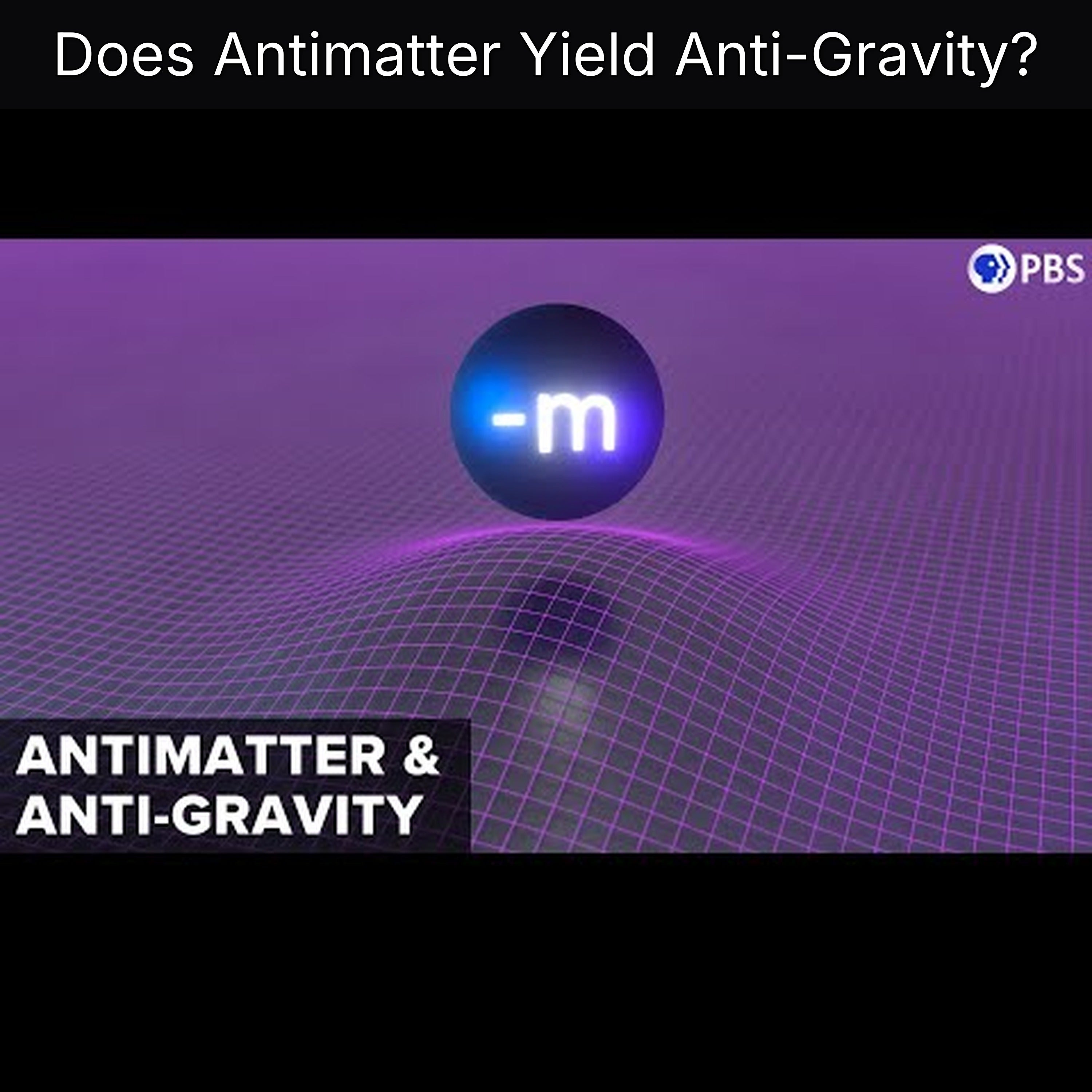
Learn More About 80,000 Hours at: https://www.80000hours.org/spacetime PBS Member Stations rely on viewers like you. To support your local station, go to:http://to.pbs.org/DonateSPACE Sign Up on Patreon to get access to the Space Time Discord! From hoverboards to flying cars to cloud cities, anti-gravity is a staple of science fiction and our dream of a less Earth-bound future. But in the real universe gravity appears to be a purely attractive force. Feels like its main MO is keeping us stuck to the surface of this lonely rock. But maybe if we science hard enough we can remove the fiction from science fiction. For the sake of our flying cars we should at least try. And for many years, physicists have wondered whether a certain well-known exotic material may experience gravitational repulsion from the Earth. That material is antimatter, and physicists at CERN have just completed a very long and very difficult experiment to answer a seemingly simple question: does antimatter fall down, o
Take the Space Time Fan Survey Here: https://forms.gle/wS4bj9o3rvyhfKzUA Uploaded 20-04-22 PBS Member Stations rely on viewers like you. To support your local station, go to:http://to.pbs.org/DonateSPACE Sign Up on Patreon to get access to the Space Time Discord! Imagine you’re leading a game of 20 questions and you forget the thing you chose half way through. You have to keep answering yesses and nos and hope that you think of something that’s consistent with all your previous questions before the game is done. Well it could be that’s what the entire universe is doing. I hope it thinks of something good before we run out of questions. Check out the Space Time Merch Store Sign up for the mailing list to get episode notifications and hear special announcements! Hosted by Matt O'Dowd Written by Katie McCormick and Matt O'Dowd Post Production by Leonardo Scholzer, Yago Ballarini, Pedro Osinski, Adriano Leal and Stephanie Faria GFX Visualizations: Ajay Manuel Directed by Andrew Kornhaber A
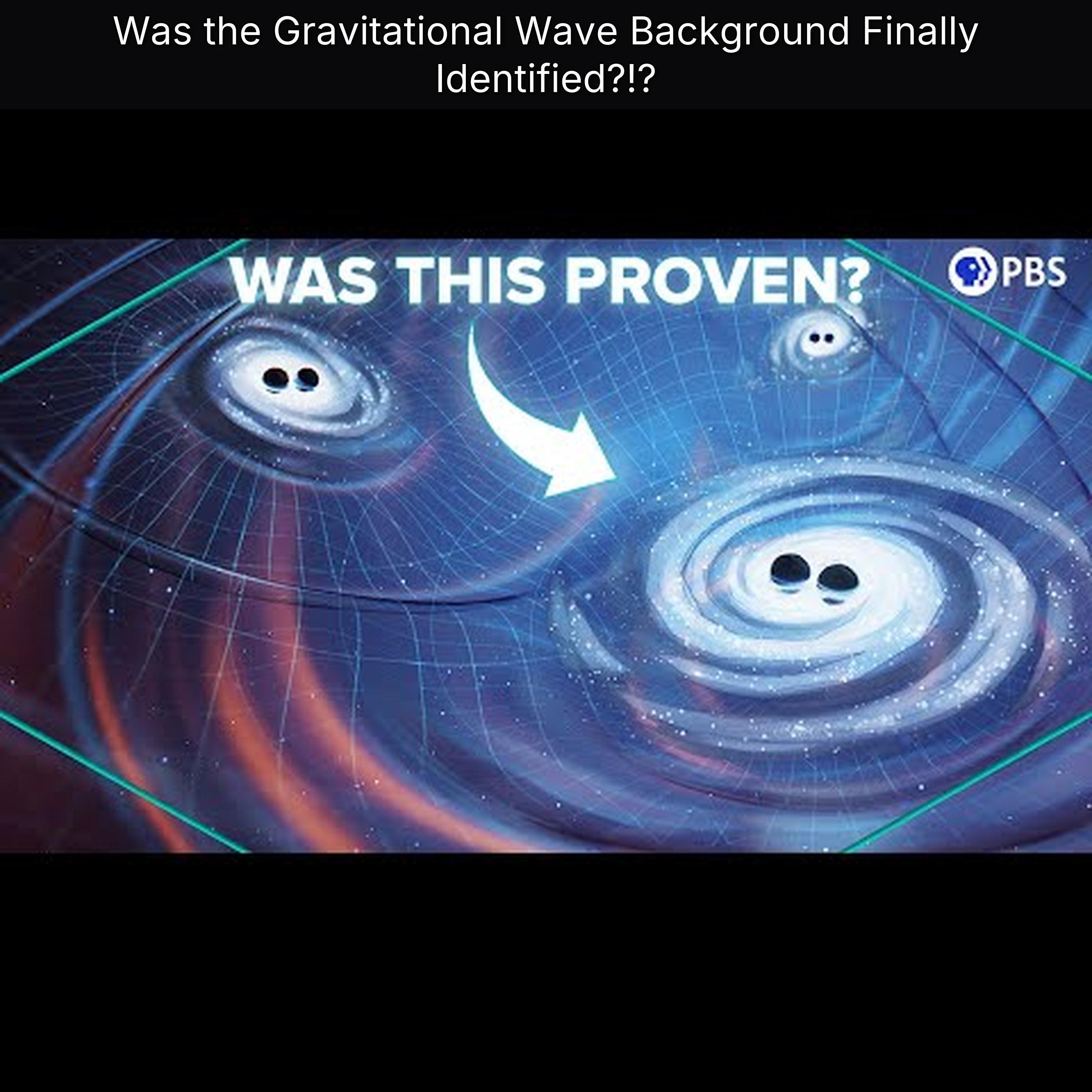
Learn More About Opera One: https://opr.as/Opera-browser-PBS-Space-Time PBS Member Stations rely on viewers like you. To support your local station, go to: http://to.pbs.org/DonateSPACE Sign Up on Patreon to get access to the Space Time Discord! A few weeks ago a large team of gravitational wave astronomers announced something pretty wild. The moderately confident detection of pervasive ripples in the fabric of space time that presumably fills the cosmos, detected by watching for subtle connections between the signals from rapidly spinning cores of dead stars in our galactic neighborhood. In other words, the gravitational wave background has probably been detected using a pulsar timing array. Thumbnail Image Illustration Credit: Olena Shmahalo for NANOGrav Check out the Space Time Merch Store Sign up for the mailing list to get episode notifications and hear special announcements! Search the Entire Space Time Library Here: https://search.pbsspacetime.com/ Hosted by Matt O'Dowd Written