Listen through the publisher, then discuss the episode here or arrange an in-person Roundtable. Your city determines where to meet.
Roundtables are designed for groups of four, with a shared subject and room for everyone to speak. Come for discussion, with no dating expectation.
PBS Member Stations rely on viewers like you. To support your local station, go to: http://to.pbs.org/DonateSPACE ↓ More info below ↓ Uploaded 15-07-19 Check out the new Space Time Merch Store! Support Space Time on Patreon When we finally have a quantum internet you’ll be able to simultaneously like and dislike this video. But we don’t. So I hope you like it. The world is widely regarded as being well and truly into the digital age, also called the information age. No longer are economies and industries solely characterised by the physical goods they produce, and in fact some of the largest companies in the world produce no physical goods at all: digital information is a commodity in its own right. As discussed in a previous episode, this worldwide digital economy is fundamentally reliant on certain cryptographic processes. Currently these processes work in the realm of classical cryptography, but one day soon this may not be enough and so quantum cryptographic methods and algorithms are being developed. However, it’s one thing to design a protocol, it’s something else entirely to build a system to support it. To understand what needs to be done we need to get to the foundations of quantum mechanics - we need to talk about quantum information theory. Hosted by Matt O'Dowd Written by Graeme Gossel and Matt O'Dowd Graphics by Leonardo Scholzer Directed by Andrew Kornhaber Produced By: Kornhaber Brown Big Bang Supporters: Anton Lifshits David Nicklas Fabrice Eap Juan Benet Justin Lloyd Morgan Hough Quasar Supporters: Mark Heising Mark Rosenthal Tambe Barsbay Vinnie Falco Hypernova Supporters: Chuck Zegar Danton Spivey Donal Botkin Edmund Fokschaner Hank S John Hofmann John R. Slavik Jordan Young Joseph Salomone kkm Mark Heising Matthew Matthew O'Connor Syed Ansar Gamma Ray Burst Supporters: Adrien Hatch Alexey Eromenko Andreas Nautsch Bradley Jenkins Brandon Labonte Carlo Mogavero Daniel Lyons David Behtala DFaulk Dustan Jones Geoffrey Short James Flowers James Quintero John Funai John Pollock Jonah Jonathan Nesfeder Joseph Dillman Joseph Emison Josh Thomas Kevin Warne Kyle Hofer Malte Ubl Mark Vasile Nathan Hitchings Nick Virtue Paul Rose Ryan Jones Scott Gossett Sigurd Ruud Frivik Tim Jones Tim Stephani Tommy Mogensen Yurii Konovaliuk سلطان الخليفي
Episode information is provided by the publisher. Listening takes place on the publisher’s service.
Travel into a computer chip to explore how these devices are manufactured and what can be done about their environmental impact. -- Globally, we produce more than a trillion computer chips every year. Which means about 20 trillion transistors are built every second— and this process is done in fewer than 500 fabrication plants. How do we build so many tiny, intricately-connected devices, so incredibly fast? George Zaidan and Sajan Saini explore how photolithography helps build these devices and its environmental impact. Lesson by George Zaidan and Sajan Saini, directed by Kozmonot Animation Studio. Support Our Non-Profit Mission ---------------------------------------------- Support us on Patreon: http://bit.ly/TEDEdPatreon Check out our merch: http://bit.ly/TEDEDShop ---------------------------------------------- Connect With Us ---------------------------------------------- Sign up for our newsletter: http://bit.ly/TEDEdNewsletter Find us on Twitter: http://bit.ly/TEDEdTwitter Peep u
Obsessions, Addictions, and Compulsions | The Dangers of Your Smartphone Addiction | Tony Robbins Podcast Uploaded 30-05-19 Did you know that the average American checks email within 6 seconds of arriving at work? Or that 75% of adults say they spend the entire day within an arm’s reach of their phones? Whether we want to admit it or not, the smartphone has become a critical extension of our lives. And it’s easy to understand why. Smartphone technology allows us a number of communication options including voice calls, text messages, video chat and instant messenger. We have immediate access to the information and are constantly connected to the web. And with the advancement of mobile technology, we can do our banking, shop online, check movie times, check our heart rates, edit photos, publish blog posts – anytime, anywhere. But what is this convenience really costing us? In this episode of the Tony Robbins Podcast, we’re talking with renowned social psychologist, Adam Alter. Adam is an
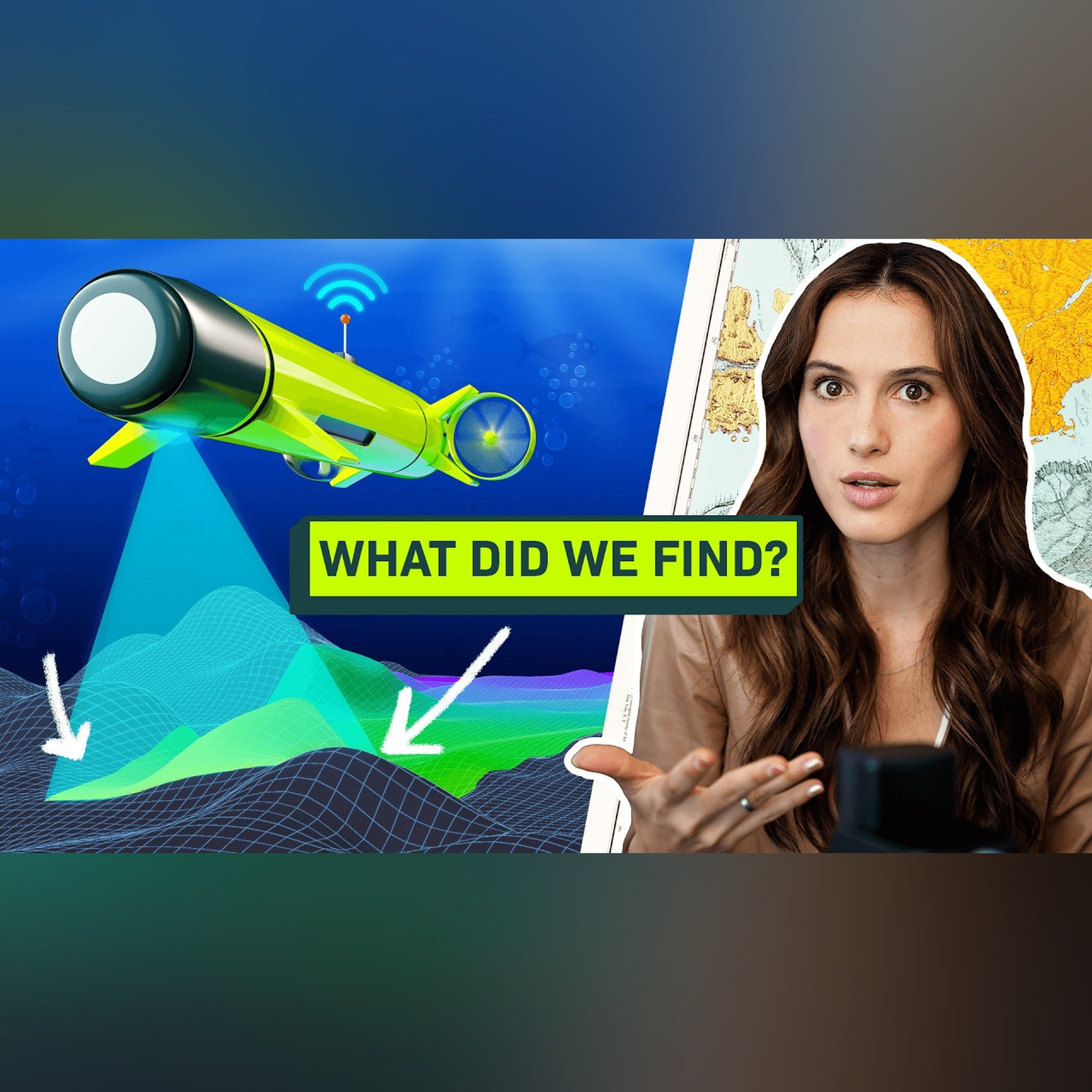
Why deep sea maps are SO BAD (and how to fix it)... Our maps of the ocean are surprisingly bad! On Google Maps it looks like we know so much… but we know less about the ocean floor than we do the surface of Mars. And that’s a big problem, because we are using the ocean all the time: We’re laying internet cables across it, we fight wars in it, we search it during a crisis - like the imploded OceanGate Titan submersible or the missing Malaysia Airlines Flight 370. 71% of the surface of the Earth is water! And yet we have a surprisingly limited view of what’s below it. But that’s also understandable. Because cartographically speaking, water sucks. For Mars or Earth’s surface, we can take pictures. But light doesn’t get to the ocean floor, so we need other ways to see it. The good news is, we’re developing that tech right now, and an international group called Seabed 2030 is working to piece together a better map. There is a terrifying, incredible, alien world on our own planet, and we’re
For a written breakdown, early access to content like this, and extra nuances, see the associated StayCurious Metabolism newsletter: https://open.substack.com/pub/staycuriousmetabolism/p/stop-chasing-8-hours-of-sleep?r=40ekz2&utm_campaign=post&utm_medium=web&showWelcomeOnShare=true (https://open.substack.com/pub/staycuriousmetabolism/p/stop-chasing-8-hours-of-sleep?r=40ekz2&showWelcomeOnShare=true) Pinealon Letter: https://staycuriousmetabolism.substack.com/p/why-im-trying-this-peptide-for-sleep?r=40ekz2 No Sleep Letter: https://staycuriousmetabolism.substack.com/p/what-if-you-didnt-need-to-sleep-this?r=40ekz2 Deep Sleep Masterclass: https://staycuriousmetabolism.substack.com/p/how-to-help-your-brain-clean-itself?r=40ekz2 I review several gamma entrainment devices in the Deep Sleep letter, along with the evidence supporting this tool. The only device I have personal experience with is Gamma Light Therapy, which was developed based on some of the early Nature research and is also one of
In some cultures, being well at home is all about making sure that others feel well when visiting, by welcoming them in the right way. In Japan, for example, hospitality is like an art form, and even has a name: omotenashi. You can’t really translate the concept into English; the meaning of the term goes a lot deeper than “hospitality”. It also has connotations of mindfulness. In Japanese culture, knowing how to welcome others and being totally focused on your guest go hand in hand. So you could say omotenashi is the ability to anticipate a guest’s needs before they can even think of them themselves. Hence the idea of being fully available for your guest, right from the moment they arrive. The most obvious example in Japanese culture is serving tea. Where does omotenashi come from? So you’re saying it’s not limited to the home environment, are you? In under 3 minutes, we answer your questions! To listen to the last episodes, you can click here: How can I beat my smartphone addiction? (
Master the skills that change lives — enroll in your free human behavior course today: https://nci.university/learn Uploaded 14-03-26 During the first ninety seconds of any interaction, a window opens in the human brain that most people never notice. A specific sequence of neurological events unfolds — predictable, exploitable, and almost never taught outside of military and intelligence training. Very few people alive understand the full mechanics of what happens inside that window. Only operators, interrogators, and behavioral scientists with the right access have ever had this mapped out for them. Someone made sure it stayed that way. Every interaction you've ever had — every negotiation, every first impression, every moment you walked into a room — was governed by this sequence. You were either running it or it was being run on you. Most people spend their entire lives on the receiving end without ever knowing it. Language is the delivery system. But language isn't where it starts.
Viewers like you help make PBS (Thank you ) . Support your local PBS Member Station here: https://to.pbs.org/DonateSPACE Uploaded 26-07-17 Unlock the secrets of Feynman Diagrams. Part 5 in our Quantum Field Theory series. And if you're submitting an answer to our challenge question email your answer by August 2nd to pbsspacetime [AT] gmail.com with the subject line "Feynman Diagram Challenge." You can further support us on Patreon at https://www.patreon.com/pbsspacetime Get your own Space Time tshirt at http://bit.ly/1QlzoBi Tweet at us! @pbsspacetime Facebook: facebook.com/pbsspacetime Email us! pbsspacetime [at] gmail [dot] com Comment on Reddit: http://www.reddit.com/r/pbsspacetime Help translate our videos! https://www.youtube.com/timedtext_cs_... Previous Episode: The Real Star Wars Feynman’s path integral shows us that, to properly calculate the probability of a particle traveling from point A to point B, we need to add up the contributions from all conceivable paths between tho
Sign Up on Patreon to get access to the Space Time Discord! Uploaded 18-08-21 The universe is going to end. But of all the possible ends of the universe vacuum decay would have to be the most thorough - because it could totally rewrite the laws of physics. Today I hope to help you understand exactly how terrified you should be. Check out the Space Time Merch Store Sign up for the mailing list to get episode notifications and hear special announcements! Hosted by Matt O'Dowd Written by Matt O'Dowd Graphics by Leonardo Scholzer, Yago Ballarini, Pedro Osinski, Adriano Leal and Stephanie Faria GFX Visualizations: Ajay Manuel Directed by Andrew Kornhaber Assistant Producer: Setare Gholipour Executive Producers: Eric Brown and Andrew Kornhaber End Credits Music by J.R.S. Schattenberg: https://www.youtube.com/user/MultiDroideka Special thanks to Our Patreon Sponsors Big Bang Supporters Ari Paul Kyle Bulloch Charlie Mrs. Tiffany Poindexter Leo Koguan Sandy Wu Matthew Miller Scott Gray Ahmad Jo
You can learn more about CuriosityStream at https://curiositystream.com/spacetime Uploaded 01-05-19 PBS Member Stations rely on viewers like you. To support your local station, go to: http://to.pbs.org/DonateSPACE How do you take a picture of a black hole and what can we learn from it? Our first ever actual bona fide photo of a black hole, made by the Event Horizon Telescope and revealed to the world in a press conference on April 10th. Since then it’s got plenty of coverage, because … I mean look at it. It’s a freaking black hole. It’s black, it’s holey, it’s everything we hoped it would be. Now that the giddiness has subsided and I personally have stopped spending hours on end staring at a black spot, we can take a breath and actually look at the real science here and discuss exactly how a picture like this could be taken and what we can learn from it. Check out the new Space Time Merch Store! Support Space Time on Patreon Need a Black Hole Refresher #Blackhole #astrophysics #spaceti
Organizations should collect less personal information rather than simply promise stronger security.
Share your view, then see how readers voted. No sign-in required. This poll is shared across stories.
Do you agree or disagree?
Common Quandary
A Common Quandary to discuss
Another conversation to explore, separate from this news story.
The luxury hotel charges too much and will never miss one robe. Do you pack it?
After an expensive hotel stay, you notice a plush robe without a price tag or warning. The room cost more than expected, several promised amenities were unavailable, and you convince yourself the robe is probably included.
When does feeling overcharged become permission to compensate yourself?