Listen through the publisher, then discuss the episode here or arrange an in-person Roundtable. Your city determines where to meet.
Roundtables are designed for groups of four, with a shared subject and room for everyone to speak. Come for discussion, with no dating expectation.
Traditional budgeting doesn’t work. In episode two of Financial Foundations, brought to you by State Farm, I'm showing you how to budget without hating your life. We'll reframe budgeting as a permission slip instead of a punishment. Budgeting doesn't mean you can’t ever have a latte, or buy organic, or even say no to a vacation. Creating a budget is as personal as your favorite band, which means that these one-size-fits-all solutions might be more the problem than you. Today we'll walk through my three-bucket budget, and find your three value categories: the parts of your life where spending brings you the most joy. Then we'll pull out the money diary from episode one and see whether your spending matches what you actually care about. Catch-up on the Financial Foundations series: Financial Foundations Episode 1: Your Money Blueprint: https://herfirst100k.com/financial-feminist-show-notes/money-blueprint/ Save your seat in this 2-part workshop series that turns your “I wish I could quit my job” into a specific, actionable plan to get you out of your job in 90 days or less. Get access here: https://herfirst100k.com/ffpod. 00:00 Intro 01:03 How to budget without hating your life 01:56 Refresher: the financial priority list 02:54 Why budgets fail like diets 03:23 Your budget is a gas gauge 04:50 Permission slip, not punishment 05:38 Why I hated every budget app 06:20 The three-bucket budget 07:51 Automate, automate, automate 08:44 Your three value categories 10:37 My coffee-as-a-walk confession 11:37 "Should" spending: museums, dinners, and bachelorette parties 12:51 Exercise: sort your money diary 14:09 Ask this at every checkout
Episode information is provided by the publisher. Listening takes place on the publisher’s service.
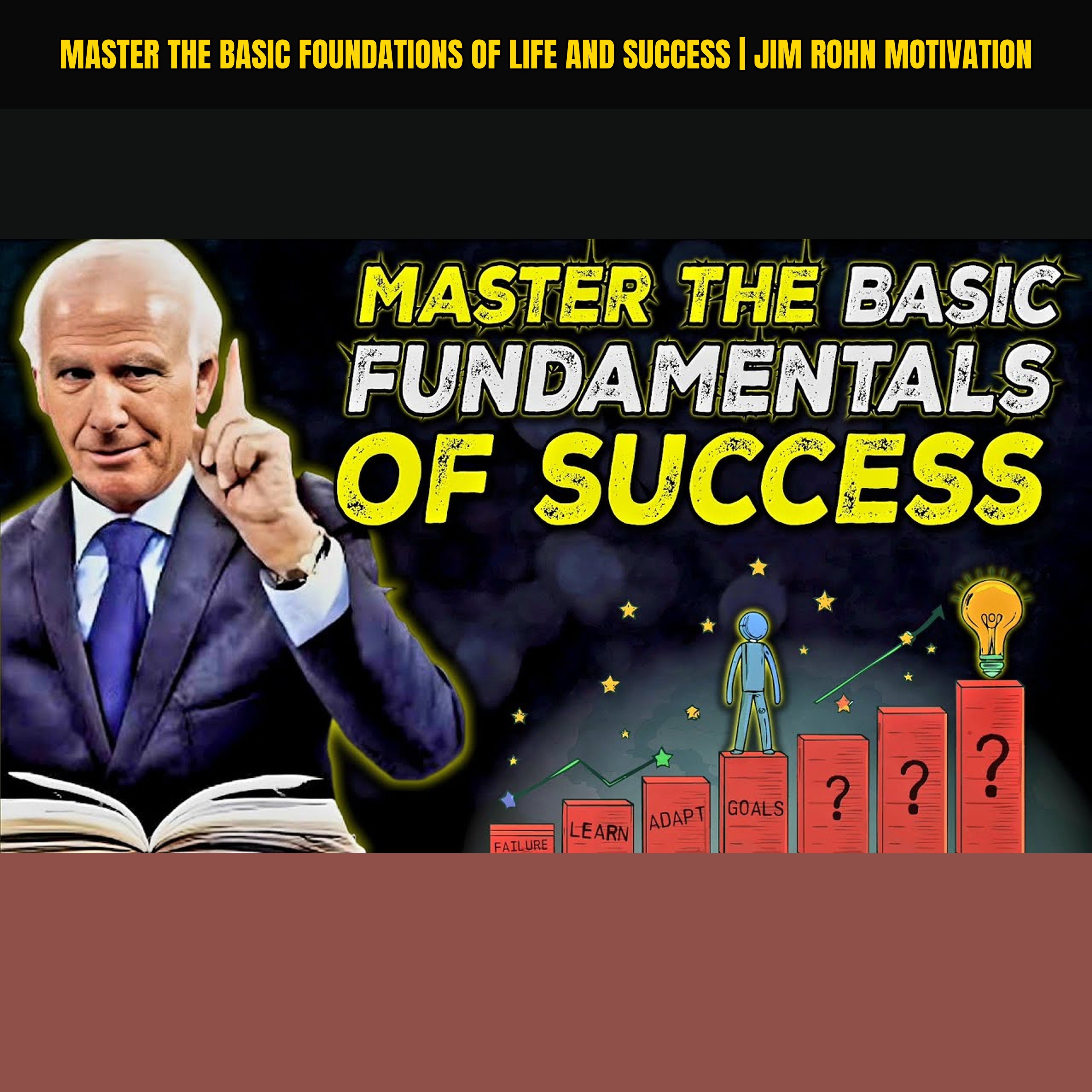
#JimRohnMotivation #JimRohn #JimRohnSpeech Success is not about complexity—it is about mastering the fundamentals. Most people spend their lives looking for shortcuts, hacks, and quick fixes, only to stay stuck in the same cycle of frustration and mediocrity. The truth is, success is built on simple habits, simple disciplines, and simple decisions—repeated consistently over time. In this Jim Rohn Motivation video, learn the timeless principles that separate those who win from those who quit. Key Topics From This Motivational Video: Why most people fail—not because they are not capable, but because they are not consistent The difference between working hard once in a while and executing daily at a high level Why mindset, habits, and discipline are more important than talent or intelligence How the most successful people in the world operate with precision and focus The truth about motivation—it is unreliable, and success comes from discipline This Jim Rohn Motivational Video Is Perfect
Access the masterclass instantly for free: https://nci.university/learn Uploaded 10-01-26 Your goals don’t fail because you lack discipline — they fail because they were aimed at the wrong system. Optimizing behavior without fixing brain chemistry is like issuing commands to a damaged machine. Until the chemical environment is right, effort just increases friction and burnout. All goals live in the conscious mind — but control does not. Real behavior is governed by the mammalian brain, the ancient systems that decide safety, threat, and energy allocation. Every resolution collapses when those lower systems detect risk, even if you consciously “want” the outcome. Goal-setting ignores this hierarchy — and that’s why it keeps failing. Once you target the parts of the brain actually in charge, change stops feeling like force. Discipline becomes unnecessary when the system itself is aligned. Please note that the content provided in this broadcast is for informational and educational purpose
What if success isn't something you chase, but something you attract through the person you become? Real success begins with personal growth, self discipline, and the value you bring to the world. Instead of constantly searching for shortcuts or waiting for opportunities, focus on developing the skills, mindset, and character that make meaningful achievements possible. This powerful motivational speech explores timeless principles of success, wealth creation, personal development, and the importance of becoming more valuable to others. Discover why your personal growth influences your results, how daily discipline shapes your future, and why helping others achieve their goals can become one of the most powerful foundations for your own success. In this motivational journey, you'll explore: • The Attraction Principle: Why success is connected to the person you become rather than simply what you pursue. • The Marketplace Rule: How developing valuable skills and contributing to others can
Get the 200+ Page Optimal Living Daily Workbook (PDF) - Free. Want to turn today's episode into an actionable plan? Episode 4232: Chris Guillebeau shares a candid, funny account of his lack of qualifications, from a short-lived dishwashing job to failing his way through statistics and shrink-wrapping pallets. He argues that formal credentials matter far less than people think, and that anyone who builds a good life without them should treat that work with gratitude and diligence. It is an encouraging take on personal development for anyone who has ever felt like an imposter. Read along with the original article(s) here: https://chrisguillebeau.com/qualifications/ Quotes to ponder: "First, forget about what you're actually qualified to do. It's irrelevant and no one cares." "Fourth, when you do find something that works for you, you should be very grateful, every day." "Regardless of your actual qualifications, there's one thing that no one can give you and no one can take away: the wil
Are we in an AI stock bubble, or are investors betting on a genuinely bigger economy? Justin Wolfers examines AI stock valuations with Stacey Vanek Smith, separating what the technology could do for the economy from what investors might actually earn. A deliberately hypothetical valuation exercise shows why a trillion-dollar company isn't automatically absurd—but a breakthrough for society doesn't guarantee profits for shareholders. Competition can give you powerful tools at low prices while squeezing the companies selling them. The Thanksgiving turkey problem illustrates why a long run of good news can hide rare, severe risks. Justin connects that analogy to fat tails and the peso problem, then explains why spotting a bubble and successfully betting against it are different challenges. He also unpacks what the CAPE ratio can—and can't—tell you about whether stocks are overpriced. The stakes are your savings, not just Wall Street's scoreboard: Justin discusses an S&P 500 decline of 7.5
Now Mark wants to help you become financially free as well. Follow the podcast and turn on notifications! This Podcast is fan-made. No copyright infringement intended. ---------------------------- ------ Keywords: financial advice, job interview, banking secrets, financial freedom, financial scams, money management, financial education, personal finance
Ready to feel more confident with money and stop figuring it all out alone? The $100K Club is for you. Learn more at: https://herfirst100k.com/ffpod Welcome back to our Financial Foundations series, sponsored by State Farm. Last time we talked about getting out of debt, and I promised we'd get to credit cards next, because they're one of my favorite things to talk about. In this episode I'm breaking down what actually goes into your credit score, the fastest way to raise it, and the new rule on buy now, pay later loans. Then we get into why I use my credit card like a debit card, how to pick your first card, how to use it without sliding into debt, and the myths that cost people money. If you're still paying down credit card debt, I've got a plan for that too. Mentioned in this episode: How to Turn Your Bills into Free Travel with Shakeemah Smith (The Passport Abuser) (https://herfirst100k.com/financial-feminist-show-notes/bills-to-boarding-passes/) Missed the rest of the series? Catch
Why is it so hard to spend money you worked years to save? Today I'm welcoming back Jean Chatzky, who spent 25 years as the Today show's financial editor, founded HerMoney, and has a new book out called The Forever Paycheck. Honestly, she's one of the people who shaped how I think about money in the first place. We're getting into money hoarding: why disciplined savers have such a hard time enjoying what they built, and where that "don't touch it or you won't be safe" instinct comes from. Jean breaks down how to turn part of your savings into a paycheck so spending feels normal again. And we talk about the harder question underneath all of it, which is figuring out what you actually want your money to pay for. Jean’s Links: Website: https://hermoney.com/ Get Jean’s book, The Forever Paycheck: https://jeanchatzky.com/books/ Jean’s prior Financial Feminist episode: What to Do If You’re 35+ and Feel Financially Behind with Jean Chatzky (https://herfirst100k.com/financial-feminist-show-not
Visit https://herfirst100k.com/ffpod to join our 5 Day Debt Challenge and find any resources mentioned in the show! Getting out of debt is shockingly simple. The math is easy. Showing up every single month is the hard part. In episode three of Financial Foundations, sponsored by State Farm, we're tackling debt, with zero shame. I'll explain where debt sits on your financial priority list, teach you the rule of 7% (which you'll use for the rest of your life), and break down why credit card debt feels like drowning. Then I'll walk you through my four-step debt payoff plan, tell you about the time my car loan company made me mail $50 to a PO box in Iowa, and share what to check before you sign for any new debt. Missed the rest of the series? Catch-up from the beginning: Financial Foundations #1: Your Money Blueprint: https://herfirst100k.com/financial-feminist-show-notes/money-blueprint/ Financial Foundations 2: Budgeting with Intention: https://herfirst100k.com/financial-feminist-show-no
New owners should honor commitments to people who already depend on a business or property.
Share your view, then see how readers voted. No sign-in required. This poll is shared across stories.
Do you agree or disagree?
Common Quandary
A Common Quandary to discuss
Another conversation to explore, separate from this news story.
Rich parents want to buy their public-school class an art teacher. Should the school say no?
Parents at a well-resourced public school raise enough money for art teachers and smaller classes. Nearby schools cannot raise comparable amounts, widening differences within the same district.
Can helping your own community become unfair to the larger one?