Listen through the publisher, then discuss the episode here or arrange an in-person Roundtable. Your city determines where to meet.
Roundtables are designed for groups of four, with a shared subject and room for everyone to speak. Come for discussion, with no dating expectation.
Are you the kind of grocery shopper who clips coupons and compares prices across stores? Do you sometimes splurge on the nicer olive oil, only to regret the extravagance? It’s easy to feel like you spent too much, wasted food or prioritized the wrong things, especially now that groceries cost so much more (https://apnews.com/article/grocery-shopping-prices-food-affordability-8468c1d6532ca762bbcfa17e3c7707d1) than they used to and wages haven’t necessarily kept pace (https://www.marketplace.org/story/2026/09/04/wage-growth-cant-compete-with-inflation-right-now). And of course, even having choices about what to buy or the luxury of worrying about food waste is a privilege when so many people are struggling just to put food on the table. This week, Reema is joined by neuroeconomist Uma Karmarkar (https://gps.ucsd.edu/faculty-directory/uma-karmarkar.html) and wellness editor Miranda Larbi (https://www.stylist.co.uk/author/miranda-larbi) to unpack our complicated feelings around food spending, why it can feel so emotionally loaded and whether some of that guilt can actually help us make better choices. If you like this episode, share it with a friend! Support This Is Uncomfortable with your donation today:https://bit.ly/mkp_tiu_podhttps://mktplc.org/support-thisisuncomfortable
Episode information is provided by the publisher. Listening takes place on the publisher’s service.
Ever notice how much of life gets built around getting away? Away from the job. Away from the routine. Away from the very life you made for yourself. And nobody stops to ask the obvious question: why did you build a life you keep needing to escape? Uploaded 22-08-26 The weekend became the reward for surviving the week. The vacation became the reward for surviving the year. But a reward for survival is not the same as a life worth living. You cannot escape your way to a good life. You have to build one. Here is the truth: a life you constantly want to run from is a life you constructed wrong — decision by decision, mostly by default, until you woke up inside a place you never actually chose. This seminar walks through 10 things you must understand about building a life you'd never want to escape from. CHAPTERS 0:00 Intro — Why did you build a life you keep escaping? 1:40 How a life actually gets built 4:15 #1 — Protect what you'd do for free 8:26 #2 — Stop mortgaging the present 8:44 #3
When you’re feeling a little blue, eating to feel better can be an appealing proposition. But the reality is we often turn to junk food or sugary treats that are high in calories and packed with salt or saturated fats. Of course, our mood can be impacted by a number of factors and there’s no magic fix that will instantly make us feel better. But there are actually types of food out there that have been proven to improve brain health and thereby beat mood disorders. Which foods are proven to improve brain health? Avocados are rich in Omega 3, aren’t they? Don’t bananas also contain tryptophan? In under 3 minutes, we answer your questions! To listen to the last episodes, you can click here: Do tongue scrapers actually help with bad breath? (https://originals.bababam.com/do-you-really-know/202406140300-do-tongue-scrapers-actually-help-bad-breath) Do our brains really tell the whole story about us? (https://originals.bababam.com/do-you-really-know/202406130300-do-our-brains-really-tell-who
Obsessions, Addictions, and Compulsions | The Dangers of Your Smartphone Addiction | Tony Robbins Podcast Uploaded 30-05-19 Did you know that the average American checks email within 6 seconds of arriving at work? Or that 75% of adults say they spend the entire day within an arm’s reach of their phones? Whether we want to admit it or not, the smartphone has become a critical extension of our lives. And it’s easy to understand why. Smartphone technology allows us a number of communication options including voice calls, text messages, video chat and instant messenger. We have immediate access to the information and are constantly connected to the web. And with the advancement of mobile technology, we can do our banking, shop online, check movie times, check our heart rates, edit photos, publish blog posts – anytime, anywhere. But what is this convenience really costing us? In this episode of the Tony Robbins Podcast, we’re talking with renowned social psychologist, Adam Alter. Adam is an
WORRIED ABOUT THE MARKET? SCHEDULE YOUR FREE PORTFOLIO REVIEW with Thoughtful Money's endorsed financial advisors at https://www.thoughtfulmoney.comWell, last week's ugly action got a lot uglier this week.Tech stocks continued to drag the S&P and the NASDAQ downwards, wiping out much of their returns for 2026.Is this the big correction the bears have been warning about? Has the AI bubble popped?Or are things so oversold in the near term that a sharp recovery rally is due?Lance and I discuss the odds in this week's Market Recap.For everything that mattered to markets this week, watch this video.#aistocks #marketcorrection #technicalanalysis _____________________________________________ Thoughtful Money LLC is a Registered Investment Advisor Promoter.We produce educational content geared for the individual investor. It’s important to note that this content is NOT investment advice, individual or otherwise, nor should be construed as such.We recommend that most investors, especially if in
Project Synapse: Markets in Freefall, Fragile Infrastructure, and AI's Perfect Storm The hosts banter through the show's intro before focusing on a sense that "things are out of control," citing a WallStreetBets suicide-hotline post amid a market crash and discussing cascading system failures involving Microsoft, the FAA, and a reported NSA internal communications outage. They argue politicians and leadership lack technical competence and clear messaging, increasing panic, while emphasizing that many problems stem from aging, underfunded infrastructure and complex, brittle software (PHP, NGINX, Java), not proven AI attacks—more a "perfect storm" of crises. They debate whether AI should help fix complexity, stressing critical thinking, accountability, and using multiple AIs to verify each other. In a lightning round they cover Anthropic's IPO performance, mixed reactions and token limits with ChatGPT 6.2 (favoring "Sol" over "Astra"), Google's cheaper Neon model and confusing UX, Loblaw
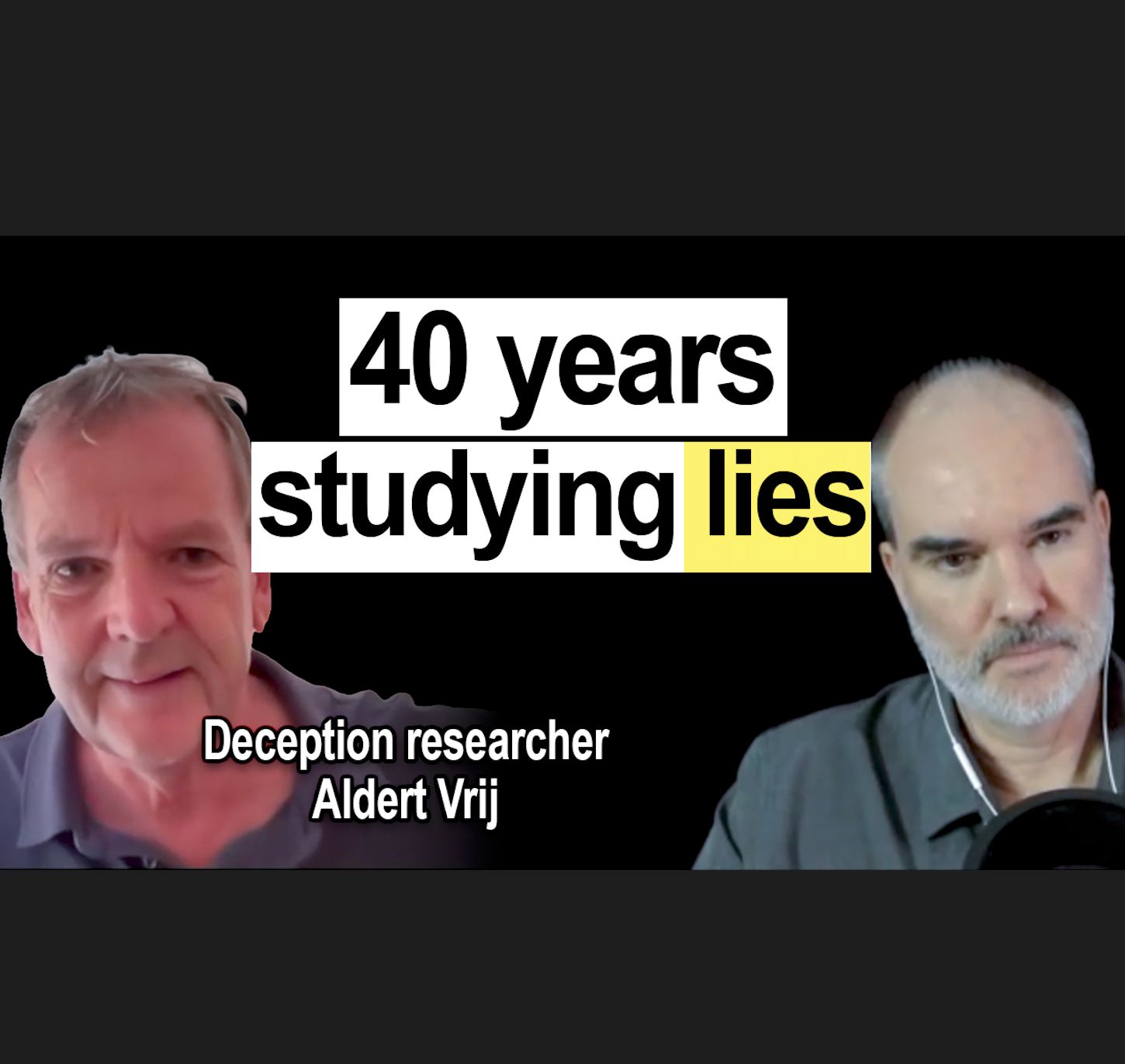
What actually works when it comes to detecting lies, and why are so many popular ideas about reading people and nonverbal behavior at odds with the scientific research? I talk with Aldert Vrij, one of the world's leading deception-detection researchers, who has spent almost four decades studying these topics. We discuss why what people say is far more revealing than their body language; why the perceived “sexiness” of reading nonverbal behavior has contributed to widespread myths and misconceptions; whether vocal behaviors like pitch, volume, and hesitation contain meaningful clues; and whether there's value in analyzing minor word choices and turns of phrase, as is done in so-called “statement analysis.” We discuss Paul Ekman's legacy as a source of faulty ideas about deception, micro-expression-based deception detection training, and the strategies that popular “body language experts” use to appear scientifically credible while simultaneously promoting ideas that conflict with the sc
You’ve got savings. You’re paying your bills. You’re hitting your financial goals. On paper, you’re doing fine. So why does it still feel like you’re just one step away from financial disaster? This week, Reema talks with writer Lindsey Stanberry and financial therapist Amanda Clayman about money dysmorphia – the disconnect between how much money we have and how secure we actually feel – and how we can build a healthier relationship with money when the future feels impossible to predict. Plus, another edition of “Alice Gets Her Life Together,” where producer Alice Wilder shares the details of her largest purchase yet: a home. If you like this episode, share it with a friend! Support This Is Uncomfortable with your donation today (https://mktplc.org/support-thisisuncomfortable%20).
As more former child stars come forward about the pain they experienced, does it still make sense to put kids in the spotlight? This week on the show, guest host Jasmine Romero speaks with actor Mara Wilson (of “Mrs. Doubtfire” and “Matilda”) and journalist Kate Taylor about how to protect child stars. If you like this episode, share it with a friend! Support This Is Uncomfortable with your donation today: https://mktplc.org/support-thisisuncomfortable
Art should be available in ordinary community spaces, not only specialist venues.
Share your view, then see how readers voted. No sign-in required. This poll is shared across stories.
Do you agree or disagree?
Common Quandary
A Common Quandary to discuss
Another conversation to explore, separate from this news story.
Someone you love asks, “Do you think I’ll be okay?” What if you do not?
A relative with a poor prognosis asks whether you think they will recover. They seem to need reassurance, but you believe the odds are very low and do not want to spend the remaining time pretending.
Can preserving hope justify saying more than you believe?