Listen through the publisher, then discuss the episode here or arrange an in-person Roundtable. Your city determines where to meet.
Roundtables are designed for groups of four, with a shared subject and room for everyone to speak. Come for discussion, with no dating expectation.
Are women's rights helped or hindered by hitching them to an intersectional alliance of climate justice, Gaza activism and transgender rights? Professor Catharine Lumby founded the media departments at both of Sydney's big ivy-league universities, UNSW and Sydney University, where she remains the department chair. An icon of the Australian left, Lumby started out as a fiery third-wave feminist writing extensively about the media, sex and social justice. She became a journalist, columnist and feature writer at Australia's biggest newspapers, and spent the 1990s in New York before doing her PhD about tabloid journalism. Now a Professor in Media & Communications, Lumby joins Josh to reflect on university activism over the course of her career, changes to feminism, social justice, anti-Zionism and trans rights. She respectfully requests that you not cancel her for this conversation.
Episode information is provided by the publisher. Listening takes place on the publisher’s service.
Master the skills that change lives — enroll in your free human behavior course today: https://nci.university/learn Uploaded 01-03-26 Iran didn’t slowly become what you see on the news — it was psychologically taken. In this episode, I break down the real mechanism behind Iran’s transformation: the difference between a people and the system that cages them, how revolutions don’t shift power but shift who gets to use violence, and why fear — not religion — became the enforcement tool. From a modern, secular Iran in the 60s and 70s to a regime sustained by narrative control, surveillance, and compliance rituals, this is a case study in how educated civilizations get hijacked without realizing it. We’ll dissect the psychological trap that started in 1979, why today’s protests are memory colliding with fear, and the three paths Iran is likely to take next. This isn’t just about Iran — it’s a preview of what happens anywhere belief becomes mandatory and truth becomes a liability. Please not
We live in extraordinarily turbulent times. A lot of businesses haven’t made it, or won’t make it. Yet a lot of businesses have also innovated during this time. They’ve refocused their energy where it matters: on the customer. And they’ve come out even stronger. Uploaded 06-06-19 How can the average investor prosper and yet still protect themself? How do we navigate the financial landscape today to create long-term wealth? While you may get many different answers to these questions, one thing remains the same – you must understand the economic environment you are investing in and leverage it to your advantage. In this episode of the Tony Robbins Podcast, you will hear from Ashwin Vasan as he discusses how he built one of the most successful hedge funds during an economic winter. Ashwin is the Chief Investment Officer of macro hedge fund Trend Capital and a renowned economist with over 25 years of investment experience. He’ll share his expertise about the current global trends that may
This is a Grave Talks CLASSIC EPISODE! Preserving history is one thing. Preserving it while uncovering ghostly activity is something else entirely. Saving the Old Properties is a nonprofit dedicated to rescuing endangered historic buildings across Indiana. Founded by Richard Allen and Dann Allen, the organization restores architectural treasures that might otherwise be lost to time. But as walls are opened and floors are lifted, something else often emerges—stories, energy, and sometimes spirits that never left. Joining us are Richard Allen, General Manager Kate Thornberg, and Historian Ted Martin, who share what it’s like to breathe life back into centuries-old structures—while encountering unexplained phenomena within their walls. From shadow figures and strange sounds to the emotional weight that lingers in historic spaces, this conversation explores where preservation meets the paranormal—and how history and hauntings often occupy the same foundation. For more information on Saving
This new tech is changing how movies get made. So @mkbhd and I tested it out... Watch MKBHD's video: https://youtu.be/RM7SobH8ZO0 I’ve been obsessed with sci-fi movies since I was a kid. I love being transported to another world. But lately, I’ve been wondering: How do those worlds look so… REAL? The tech behind movies has exploded in complexity and realism, changing how stories come to life on screen. Luckily, at the same time, those tools are becoming more and more available to more people telling stories. It’s not just blockbusters like Avatar 2 or Avengers or Dune. It’s also smaller budget films like Everything Everywhere All at Once or even… YouTube creators? In this video, Marques Brownlee and I test out 3 movie-making tools that are changing how movies, shows, and maybe even YouTube videos (??) get made. We’re at ZeroSpace Studios in New York to show you how each of these crazy technologies work - and how you might be able to use them. Along the way, we hit big questions like: W
Giouli thought alcohol was the one thing that let her stop being perfect. Hear how a 30-day break she expected to end in January led her to write the first quit lit book in Greece and help change how her country talks about drinking. What happens when a question you ask yourself one January refuses to go away? For Giouli, alcohol started as freedom from perfectionism at university. It followed her through a demanding events career and into motherhood, when wine came home every night and blackouts began to scare her. Rules and moderation only left her feeling guilty. Then, holding a glass of red wine on her balcony, she asked herself who she was without it. That question led her to write two books, become a coach, and help shift the drinking culture in Greece. Why alcohol felt like freedom from perfectionism, not a way to numb The common belief about drinking at home that kept her from questioning alcohol What moderation rules did to her guilt and her sense of control The balcony moment
Tuvalu looks like paradise – a cluster of islands, with white sandy beaches lined with palm trees, surrounded by the deep blue of the Pacific Ocean. But the tiny nation, which is roughly midway between Australia and Hawaii, is facing the existential threat of rising sea levels, caused by climate change. The 11,000 or so inhabitants are reckoning with a future where their country may no longer be habitable. With world leaders meeting at the UN COP31 climate talks, we bring together three young women to share their experiences of life in Tuvalu. “I want my children to understand [Tuvaluan] values, to know the language,” Moeli tells us. “To know more about Tuvalu, you have to sit down, respect the elders, no talking when elders are talking, everything like that.”
"You Can See Everything", the film about disgraced technology founder Elizabeth Holmes, is already the second-highest-grossing documentary in US history (get out of here, Michael Moore's "Fahrenheit 9/11"). Four weeks after its US release, it has finally opened in Australia where it took the box office by storm, debuting as the nation's #1 film. A Nathan Fielder fanboy, Josh saw the movie in America on the day it opened and has been champing at the bit to explore the questions it raises about truth, objectivity, deceit, abuse, science and art. Is its subject, Elizabeth Holmes, a misunderstood visionary, or a shameless crook? Is she a victim of controlling men, or their predator? Did the filmmaker, Nathan Fielder, get conned? If Holmes made false promises... then does the film's quest for objectivity represent another kind of false promise? And who the heck has never even heard of "Who's on first"? Wenlei Ma is a film critic at The Nightly. She stops by the Uncomfortable Conversations s
Richard Dawkins is one of the world’s most influential intellectuals. An icon of science, reason and atheism, he shook the field of biology half a century ago with his groundbreaking book The Selfish Gene. The Royal Institution shortlisted it as one of the best science books of all time. Dawkins has too many honorary doctorates and awards to list. In 2021, the American Humanist Association withdrew its highest honour - which they’d awarded him a quarter-century earlier - because of his scientific approach to biological sex and transgenderism. In 2004, he was voted #1 in Prospect magazine's list of the top 100 public British intellectuals. He invented the word “meme” to describe the cultural equivalent of a gene, and founded the Richard Dawkins Foundation for Reason and Science. At the age of 85, Dawkins has a new book, 42 Tales From Life, featuring essays exploring animal behavior and evolution. He was kind enough to visit the Uncomfortable Conversations studio on a tour of Australia a
Here she is! Reem Ibrahim started out as a run-of-the-mill British pro-Corybn social democrat. Then she went to the London School of Economics and Political Science, passed through a phase of anarcho-capitalism, and has become a rising star of libertarian activism and consumer choice advocacy. She joins Josh to debate the French protests, the UK’s National Health Service, A.I. regulation, welfare payments, public services, data centres, and why there’s no air-conditioning in Europe.
Documentaries should disclose editing choices that substantially affect how events are understood.
Share your view, then see how readers voted. No sign-in required. This poll is shared across stories.
Do you agree or disagree?
Common Quandary
A Common Quandary to discuss
Another conversation to explore, separate from this news story.
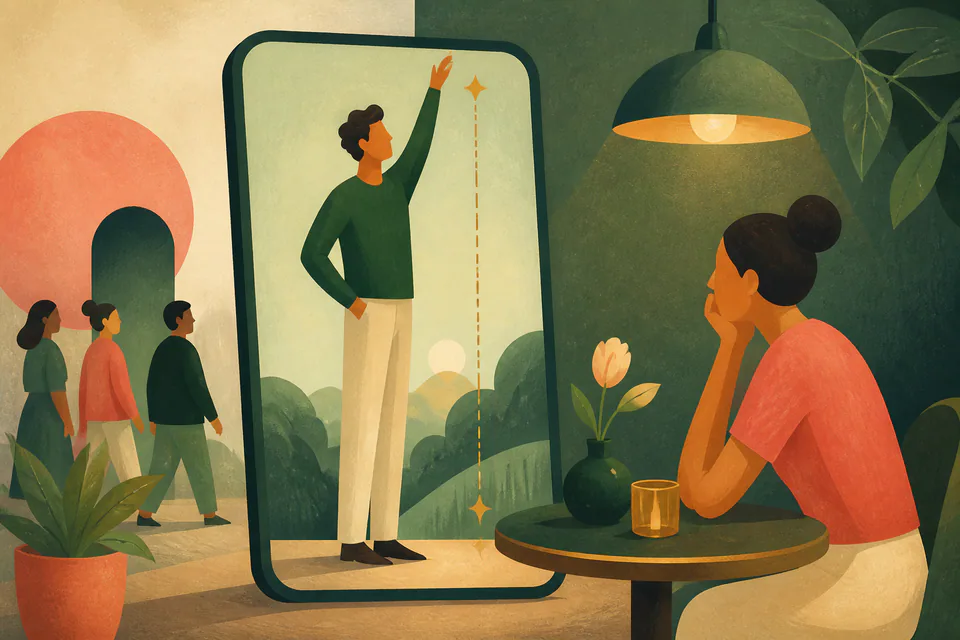
Everyone exaggerates on dating apps. Are two imaginary inches harmless?
A friend adds two inches to their listed height because they believe filters exclude them before personality has a chance. They plan to be charming enough that a date will not care once they meet in person.
Can deception be a fair response to superficial gatekeeping?