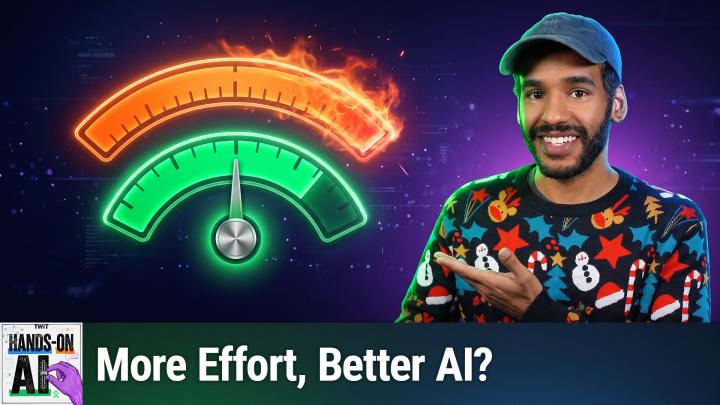
HOAI 7: Should You Just Crank It to Max? - How to Pick a Claude Model and Effort Level
51 min
Listen through the publisher, then discuss the episode here or arrange an in-person Roundtable. Your city determines where to meet.
Roundtables are designed for groups of four, with a shared subject and room for everyone to speak. Come for discussion, with no dating expectation.
Which AI model should you use, and how much effort should it put in? Using Claude as the example, Mikah Sargent explains its four model families, Haiku, Sonnet, Opus, and Fable, and its five effort levels, and shows that ChatGPT and Gemini have the same two dials. He explains what an AI model's "thinking" actually is and what changes when you switch models or turn up the effort. He compares an easy job on a light setup and a heavy one, tests a logic puzzle with one right answer at two effort levels, and explains why the top setting isn't automatically the best one. Then he shares a way to choose that works in any chatbot. Send your AI questions to [email protected] Host: Mikah Sargent (https://twit.tv/people/mikah-sargent) Download or subscribe to Hands-On AI at https://twit.tv/shows/hands-on-ai Want access to the ad-free audio and video and exclusive features? Become a member of Club TWiT today! https://twit.tv/clubtwit Club TWiT (https://twit.tv/clubtwit) members can discuss this episode and leave feedback in the Club TWiT Discord (https://twit.memberful.com/account/discord/authorize). joindeleteme.com/twit-biz (http://joindeleteme.com/twit-biz)
Episode information is provided by the publisher. Listening takes place on the publisher’s service.
Alex and Sam cover Claude Code 2.1.329 and a review workflow that names the pull request, pins the changes, separates findings from tests and checks that the right code was examined. All worked scenarios are hypothetical. Includes a Railway affiliate advertisement. Sources: https://github.com/anthropics/claude-code/releases/tag/v2.1.329 Includes a Railway affiliate advertisement. Find our links at https://aishows.cc; we may earn a commission.
Your body doesn't work like you think... Take your personal data back with Incogni. How and when people are having kids is changing, but our bodies aren't. As we get older, it can get harder to have kids when we want to. So smart people figured out it’s possible to remove eggs, freeze them, and unfreeze them to use later. They can even fertilize those eggs to make embryos and freeze those. Basically, humans invented cryosleep! … Just for tiny cells. It’s totally sci-fi - and you need to know about it. This is a level of control over our bodies no species has ever had before. It’s already changing people’s lives - and how our species can reproduce. But there are real concerns about whether it’s worth it. Because let me tell you, the process is not easy. I’ve been taking medication for two weeks. And at the same time, I’ve been doing research, talking to doctors, and learning as much as I can about the cutting edge of fertility tech. In this video, I'm going to take you behind the scenes
A.I. for Starting to Exercise: Building a Routine That Actually Sticks, a practical, beginner-friendly look at how artificial intelligence can help you build a routine that actually sticks this time. Starting to Exercise? Press play on Episode 429 of A.I. for Beginners and learn exactly how artificial intelligence, especially ChatGPT, alongside Nike Training Club, can help you build a routine that actually sticks this time. WHAT YOU WILL LEARN IN THIS EPISODE - Why starting to exercise is so hard to handle alone, and what is actually going on underneath it - A specific way to use Nike Training Club to work through it, step by step - An example prompt you can copy word for word: "Here is my current fitness level and schedule, help me build a realistic beginner routine" - A second practical technique, with another ready-to-use prompt: "Give me a simple way to track my progress that doesn't rely on willpower alone" WHO THIS EPISODE IS FOR - Anyone currently working on starting to exercise
Project Synapse: Markets in Freefall, Fragile Infrastructure, and AI's Perfect Storm The hosts banter through the show's intro before focusing on a sense that "things are out of control," citing a WallStreetBets suicide-hotline post amid a market crash and discussing cascading system failures involving Microsoft, the FAA, and a reported NSA internal communications outage. They argue politicians and leadership lack technical competence and clear messaging, increasing panic, while emphasizing that many problems stem from aging, underfunded infrastructure and complex, brittle software (PHP, NGINX, Java), not proven AI attacks—more a "perfect storm" of crises. They debate whether AI should help fix complexity, stressing critical thinking, accountability, and using multiple AIs to verify each other. In a lightning round they cover Anthropic's IPO performance, mixed reactions and token limits with ChatGPT 6.2 (favoring "Sol" over "Astra"), Google's cheaper Neon model and confusing UX, Loblaw
Are you a YouTuber? Let Pod Agency™️ turn your YouTube videos into revenuegenerating audio episodes just like this podcast you're listening to. Click here or Visit podagency.carrd.co to get started before we reach full capacity for this offer. Follow the podcast & turn on notis Leave your review for this episode in the Q&A Section. Join the 10k Accelerator Course -------- --------------- Keywords: men's self improvement, men's confidence, male entrepreneurship
Apollo Research CEO and co-founder Marius Hobbhahn joins Theo to break down Apollo’s new embedded evaluation pilot with OpenAI, including the four core claims they are testing around model subversion and monitorability. They also discuss how the Hugging Face incident shifted his threat models toward single-episode scheming, why he now views a rapid AI takeover in 2027 as plausible, and the access limits holding current third-party lab audits back. -- -- MTS chronicles the singularity, live. Monitoring the situation of tech and AI. Follow MTS: Spotify |https://open.spotify.com/show/4HUNNmV1pjV7CW6Lphm1rM Apple |https://podcasts.apple.com/us/podcast/mts/id1891088763 – Brought to you by: Mongo DB - Anyone can prototype an agent. Lovable - Turn ideas into software people love with Lovable. Start today at https://lovable.dev/ Factory - A 24/7 system turning signals into production software. Visithttps://factory.com/ Neon (by Databricks) - Scale your startup on Neon. The Postgres backend for
Chatbots have a reputation for telling you what you want to hear. Mikah Sargent tests that by telling ChatGPT it's wrong when it's right. Then he tells one made-up argument twice, with the same facts and only the teller changed, and pushes back on the verdict. He explains what researchers call sycophancy, one way training can encourage the habit, and why it can be easy to miss. Then he shares four habits for questioning the answer. Send your AI questions to [email protected] Host: Mikah Sargent (https://twit.tv/people/mikah-sargent) Download or subscribe to Hands-On AI at https://twit.tv/shows/hands-on-ai Want access to the ad-free audio and video and exclusive features? Become a member of Club TWiT today! https://twit.tv/clubtwit Club TWiT (https://twit.tv/clubtwit) members can discuss this episode and leave feedback in the Club TWiT Discord (https://twit.memberful.com/account/discord/authorize). ZipRecruiter.com/twit (http://ziprecruiter.com/twit)
Local gatherings should prioritize relationships over attendance numbers.
Share your view, then see how readers voted. No sign-in required. This poll is shared across stories.
Do you agree or disagree?
Common Quandary
A Common Quandary to discuss
Another conversation to explore, separate from this news story.
Everyone loves the group photo except you. Can you forbid them from posting it?
At a reunion, someone takes a joyful group photo that captures the night perfectly. Everyone looks wonderful except you, caught at an awful angle. The group wants to post it publicly and promises nobody else will care.
How much control should one person have over a memory shared by many?