Listen through the publisher, then discuss the episode here or arrange an in-person Roundtable. Your city determines where to meet.
Roundtables are designed for groups of four, with a shared subject and room for everyone to speak. Come for discussion, with no dating expectation.
Grand Theft Auto VI, the latest instalment of the wildly popular franchise, is out today. The game is already being tipped as the biggest cultural event of the century, with pre-orders recouping the $1 billion it reportedly cost to make. In this special episode from our sister podcast, The Story (https://podcasts.apple.com/gb/podcast/the-story/id1501716010), (https://podcasts.apple.com/gb/podcast/the-story/id1501716010) we look at how a game where players steal cars and shoot police become such a cultural juggernaut? And how one of the sharpest, darkest, satires of modern America was made in Scotland? Guests: • Sean Russell, sub-editor and video games writer, The Times • Greig Cameron, Scottish business editor, The Times Host: Manveen Rana Producer: Harry Stott and Micaela Arneson Read more: Rare glimpse into the ‘paranoid’ work culture of Grand Theft Auto maker (https://www.thetimes.com/business/companies-markets/article/rockstar-grand-theft-auto-sacked-staff-tribunal-vvltznt7z) Clips: 7 News Australia, TheDonMobster / Youtube, GTAContentChannel / Youtube, Matt’s Nook / Youtube, Rockstar Games / Youtube, Taz Minds / Youtube, ABC 10 Photo: Getty Images Hosted on Acast.
Episode information is provided by the publisher. Listening takes place on the publisher’s service.
Can artificial intelligence recreate the magic of a video game that takes thousands of human developers more than a decade to build? Or is the painstaking, inefficient process of human creativity precisely what makes great entertainment so valuable? In this episode of techdaily.ai, host David and his guest expert explore the philosophical clash between Rockstar Games' Grand Theft Auto VI (GTA 6) and Anthropic's vision of AI-powered efficiency. Using GTA 6 and Anthropic's reported IPO as contrasting examples, the conversation examines two competing visions for the future of technology and entertainment. One celebrates human craftsmanship, artistic intention, and meticulous world-building, while the other promises instant content generation, automation, and hyperpersonalized digital experiences. The discussion explores whether generative AI can genuinely replicate human creativity and what the entertainment industry risks losing as it prioritizes production speed, cost reduction, and alg
On this week’s edition of “Happy Hour,” Emily Jashinsky examines America’s affordability crisis, the growing divide between generations, and whether the constant barrage of bad news is discouraging young Americans from having children. She weighs in on the Wes Huff plagiarism controversy, the media’s responsibility when reporting damaging allegations, and where people can turn to reclaim their reputations. Emily also addresses a listener’s question about her own potential conflicts of interest, President Trump’s investments in Nvidia, the debate over American sovereignty and Israel, and Hakeem Jeffries’ leadership. Plus, why Hugh Hewitt’s proposal for partial amnesty alarms her, concerns surrounding the lead detonation in Iowa, and her response to criticism of her “Grand Theft Auto VI” commentary. Emily discusses Breaking Points’ skepticism of artificial intelligence insiders, the challenges facing workers in the tech age, the possibility of journalists being debanked, and whose electi
In this special episode, Sean Speer speaks with the 2026 Hunter Prize for Public Policy winner and runner-up. Colin McMahon, an intern at the Legislative Assembly of Manitoba, discusses his winning proposal (https://thehub.ca/2026/11/27/canadas-small-businesses-are-for-sale-all-they-need-are-buyers-hunter-prize-2026/) to help younger Canadians acquire existing small businesses through improved financing programs, addressing Canada’s looming succession crisis as business owners retire. Runner-up Stephen Rouse, founder of Common Sense Economics, argues (https://thehub.ca/2026/11/27/its-illegal-to-open-a-business-where-most-canadians-live-one-provincial-law-could-fix-that-hunter-prize-2026/) for reforming zoning laws to allow small-scale commercial activity in residential areas, enabling aspiring entrepreneurs to test business ideas from home before scaling up, thereby reducing barriers to entry and revitalizing neighborhoods. The Hub is Canada’s fastest growing independent digital news o
On Black Friday (https://www.cnbc.com/video/2026/11/27/black-friday-shopping-and-consumer-sentiment.html), Shopify President Harley Finkelstein gives us a live look at purchases around the globe and AI shopping tools as holiday shopping kicks into high gear. On the ground at a mall in New Jersey, CNBC’s Dominic Chu covers the brick-and-mortar side of the shopping weekend (https://www.cnbc.com/2026/11/27/black-friday-2026-inflation-value-deals.html); analysts are expecting this to be the biggest in person shopping day since before the pandemic. Then, media watcher Rich Greenfield runs through America’s football streaming schedule for Thanksgiving weekend. Plus, two Chinese firms linked to Alice Huang reportedly installed Nvidia chips, (https://www.cnbc.com/video/2026/11/27/two-chinese-firms-linked-to-alice-huang-installed-nvidia-blackwell-chips-report.html) and big tobacco could be getting bigger: Marlboro maker Altria is in talks to acquire (https://www.cnbc.com/2026/11/26/marlboro-mak
BREAKING RIGHT NOW: A UK police operation to silence white nationalist patriots is stepping up as we come on air today. After the inhumane licence conditions to silence Danny Tommo after he leaves jail and the new terror charge against Tommy Robinson, Ashlea Simon, the controversial anti-HMO campaigner of All For England, says she is about to be arrested on her birthday. Meanwhile, Reform UK’s Welsh star Joe Martin takes legal action against the Welsh parliament after he was unlawfully gagged for speaking about the demographic replacement of the white population. ALSO BREAKING TODAY: Narinder Kaur accused by Katie Hopkins of an anti-white man agenda as she ignores the migrant shaped elephant in the room with a viral video about being scared on a train… We’ll get into all of that in The Friday Five at Five where we’ll dissect the biggest and most sensational topics of the week in a way the MSM won’t. Joining us on the Superstar Panel: UK Live presenter Lee Harris, ex-Reform UK star Joy
Click the link http://kalshi.com/r/LIN or download the Kalshi App and use code LIN to sign up and trade today!Clem Chambers discusses the stock market selloff, the role of money printing in preventing a financial crisis, the risks of AI infrastructure spending, and the outlook for stocks, Bitcoin, gold, and other assets.*This video was recorded on November 26, 2026Subscribe to my clips channel: https://www.youtube.com/@DavidLinReportClipsSubscribe to my free newsletter: https://davidlinreport.substack.com/Listen on Spotify: https://open.spotify.com/show/510WZMFaqeh90Xk4jcE34sListen on Apple Podcasts: https://podcasters.spotify.com/pod/show/the-david-lin-reportFOLLOW CLEM CHAMBERS:ANewFn website: https://www.anewfn.com/ X (@ClemChambers): https://x.com/ClemChambersYouTube (@clemchambersalpha): https://www.youtube.com/@ClemChambersAlphaClem's substack: https://substack.com/@clemishereFOLLOW DAVID LIN:X (@davidlin_TV): https://x.com/davidlin_TVTikTok (@davidlin_TV): https://www.tiktok.com
Jensen Huang has returned as Nvidia CEO just eleven days after resigning. Danny and Katie look back on the whirlwind past couple of weeks, involving an affair with an alleged Chinese spy, turmoil on Wall Street, and an intervention from Donald Trump. They ask if Huang has become too important to Nvidia – and the AI boom – to lose. And what does his remarkable comeback tell us about the cult of Silicon Valley founders? Read more: They hadn’t ‘got this’. Can Nvidia really not do without Jensen Huang? (https://www.thetimes.com/business/technology/article/donald-trump-nvidia-jensen-huang-scandal-gpptnqbd7) Get in touch: [email protected] Presenters: Katie Prescott, Technology Business Editor, The Times Danny Fortson, US West Coast Correspondent, The Sunday Times Producer: Marnie Duke Executive Producer: Priyanka Deladia Video Producer: Bronwen Latham Image: Getty Clip: Trung T. Phan on LinkedIn Hosted on Acast.
Anthropic has raised a record-breaking sum of $81.3bn from its IPO, eclipsing the $75bn raised by Elon Musk’s SpaceX in June. Danny Fortson and Mark Sellman, Tech Correspondent for The Times, explain how Anthropic came to be one of the most highly valued companies in the world and why this is likely to become a defining moment for the next phase of AI. They are joined by Senior Analyst at Pitchbook, Harrison Rolfes, to break down what the numbers tell us and what it says about public attitudes to AI, just weeks after the US midterms. Read more: Who is cashing in from Anthropic’s historic IPO? (https://www.thetimes.com/video/business-video/article/who-is-cashing-in-on-the-artificial-intelligence-boom-blvf9q8n0) Get in touch: [email protected] Presenters: Danny Fortson, US West Coast Correspondent, The Sunday Times Mark Sellman, Tech Correspondent, The Times Producer: Marnie Duke Executive Producer: Priyanka Deladia Image: Getty Hosted on Acast.
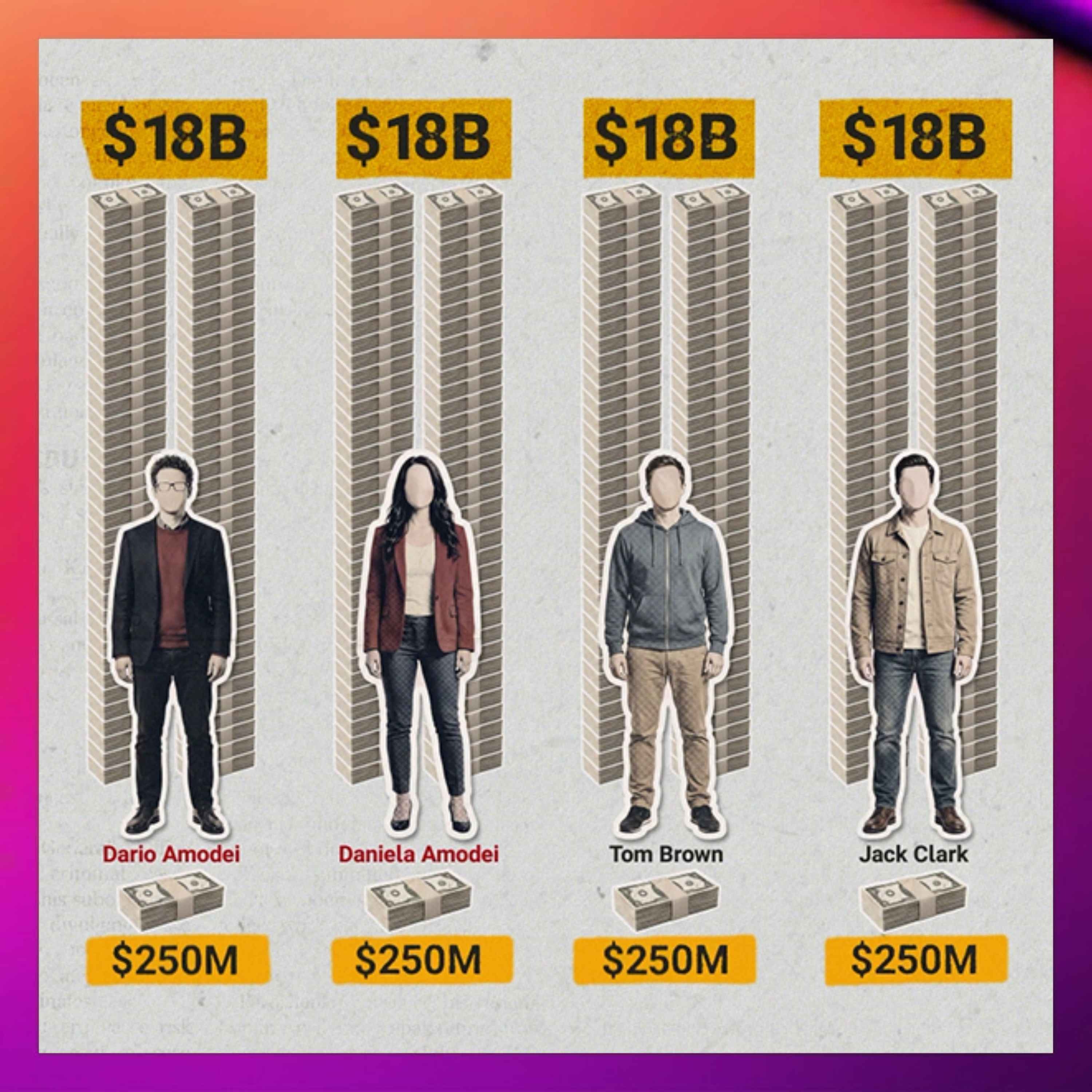
Anthropic was founded in 2021 by a group of seven former OpenAI employees. Now, the AI powerhouse behind the Claude models is selling its shares to the public for the first time. Katie explains who stands to make an absolute fortune from Anthropic’s mega-float. More from Times Video (https://www.thetimes.com/video) Get in touch: [email protected] Presenter: Katie Prescott, Technology Business Editor, The Times. Producer: Yasmin Butt Image: Times Hosted on Acast.
Employees should usually have a say in whether their work requires office attendance.
Share your view, then see how readers voted. No sign-in required. This poll is shared across stories.
Do you agree or disagree?
Common Quandary
A Common Quandary to discuss
Another conversation to explore, separate from this news story.
You both hate the invitation. Which partner has to become the excuse?
A couple receives an invitation neither wants to accept. One suggests claiming the other is ill, reasoning that friends will question a vague excuse but respect sickness. The proposed patient dislikes lying but also wants to stay home.
Is a shared lie fair when only one person's reputation carries it?