Listen through the publisher, then discuss the episode here or arrange an in-person Roundtable. Your city determines where to meet.
Roundtables are designed for groups of four, with a shared subject and room for everyone to speak. Come for discussion, with no dating expectation.
For years, his outrageous persona made him almost untouchable. But Russell Brand is now behind bars after being sentenced to 10 years and six months in jail for rape and multiple sexual assaults. He also remains under investigation over two further allegations of rape. Today, Jacqueline Maley, columnist at the Sydney Morning Herald on whether the disgraced actor will be the last celebrity predator to hide in plain sight. Featured: Jacqueline Maley, Sydney Morning Herald senior writer and columnist
Episode information is provided by the publisher. Listening takes place on the publisher’s service.
In a controversial broadcast to his millions of YouTube followers, the wife of the convicted rapist Russell Brand read out a letter that he sent her from prison. In it, he protests his innocence. So what is Laura Brand up to and exactly how deluded is she? Times writer Polly Vernon reflects. Guest: Polly Vernon, feature writer, The Times Producer: Sophie McNulty We want to hear from you - email: [email protected] Read more: Brainwashed or complicit: what’s going on with Laura Brand? (https://www.thetimes.com/life-style/celebrity/article/brainwashed-or-complicit-whats-going-on-with-laura-brand-nmwx2pkzn) Further listening: I’m Alice | The Trial of Russell Brand (https://podfollow.com/the-story/episode/23b2347a9044d66b2a18530c8fbaf2ea9c1e6f4d/view) Photo: YouTube - Russell Brand. Hosted on Acast.
In this episode of Americano, Freddy Gray welcomes journalist and author David Aaronovitch into the studio for a candid, wide-ranging, and frequently fiery debate as the two clash over whether the media frenzy surrounding Brand is driven by genuine moral reckoning or political hypocrisy, while also locking horns over the legacy and excesses of the MeToo era. Hosted on Acast.
Before William Farwell wore a Stoughton badge, he had a flashing light on his own Crown Victoria. Sandra Birchmore's family says the department knew the twins had pretended to be cops and hired them anyway, and their lawsuit against Stoughton is back in court after Matthew Farwell's conviction. I tell the story of how the twins got their badges and who vouched for them. Robert Devine, who ran the Explorers program, assured the chief the twins' childhood pranks were cured by the military. The Army had discharged William for going AWOL. Seven months after Matthew was hired, he sent a friend request to Sandra, who was 15 and in that same program. A staff member warned Devine about how it looked to meet a female student in his office, and he kept running the program. Later, Chief Shastany wanted Devine fired after an investigation found he wasn't truthful. Town officials worried about civil service protections, so Devine was demoted and went back to work. William and Devine can both be mad
Project Synapse: Markets in Freefall, Fragile Infrastructure, and AI's Perfect Storm The hosts banter through the show's intro before focusing on a sense that "things are out of control," citing a WallStreetBets suicide-hotline post amid a market crash and discussing cascading system failures involving Microsoft, the FAA, and a reported NSA internal communications outage. They argue politicians and leadership lack technical competence and clear messaging, increasing panic, while emphasizing that many problems stem from aging, underfunded infrastructure and complex, brittle software (PHP, NGINX, Java), not proven AI attacks—more a "perfect storm" of crises. They debate whether AI should help fix complexity, stressing critical thinking, accountability, and using multiple AIs to verify each other. In a lightning round they cover Anthropic's IPO performance, mixed reactions and token limits with ChatGPT 6.2 (favoring "Sol" over "Astra"), Google's cheaper Neon model and confusing UX, Loblaw
In this episode of the Weekend T, Michael Deacon and Tim Stanley debate whether Robert Pattinson has what it takes to be James Bond (https://www.telegraph.co.uk/films/2026/11/18/unlikely-rise-007-oddball-robert-pattinson/), why the franchise should return to its Cold War roots and whether modern 007 films have lost their sense of fun. They also question why grown men are taking time off work to play Grand Theft Auto VI (https://www.telegraph.co.uk/news/2026/11/18/school-send-minibus-truants-playing-grand-theft-auto/), and discuss Russell Brand’s right to maintain his innocence after his convictions. Plus, David Beckham’s Poundland perfume problem, a royal who boils eggs in hotel kettles and a taste test of this year’s Christmas sandwiches – including Gail’s (https://www.telegraph.co.uk/news/2026/03/17/gails-anti-semitism-and-far-left-conspiracy-theories/) £7.80 offering. ► Subscribe to our new Daily T YouTube channel: youtube.com/@dailytpodcast ► We want to hear from you! ► Sign up to
After a deluge of speculation, the next James Bond has been chosen: British actor Robert Pattinson will be the next face of the franchise. The public response has been overwhelming, if somewhat divided. To celebrate, we’re revisiting an episode from June, about a behind-the-scenes David and Goliath battle between the family business which has held creative control of the franchise since the 1960s and its new owners, Amazon. It is now up to Jeff Bezos’s tech conglomerate to decide how to run the series. In an era when Hollywood studios are desperate to eke out every last dollar from movie franchises, can James Bond retain its mystique and appeal to a new generation of cinema-goers? We speak to Wall Street Journal enterprise reporter Erich Schwartzel. Producers: Xandra Ellin and Lucy Pawle Video producers: Richard Kenny and Jem Westgate Mixed by: Travis Evans Executive producers: James Shield and Martine Powers Senior news editor: China Collins Photo: Robert Pattinson as James Bond. Jaap
Over the past week, a series of tech outages at major companies around the world have caused chaos. There was the Microsoft glitch which caused a mass disruption of services; an aviation update grounded every plane across the US, an Apple outage crashed its platforms, and there was a software bug at JP Morgan Chase, just to name a few. Then there was a string of cyberattacks, including at supermarkets in Europe and this week at Coles. Today, cyber security expert Alastair MacGibbon on why we need to be better prepared for outages that could be far worse in the future. Featured: Alastair MacGibbon, cyber security expert and the founding head of the Australian Cyber Security Centre. ABC News Daily SURVEY LINK: https://forms.cloud.microsoft/r/guHgnjKm4b
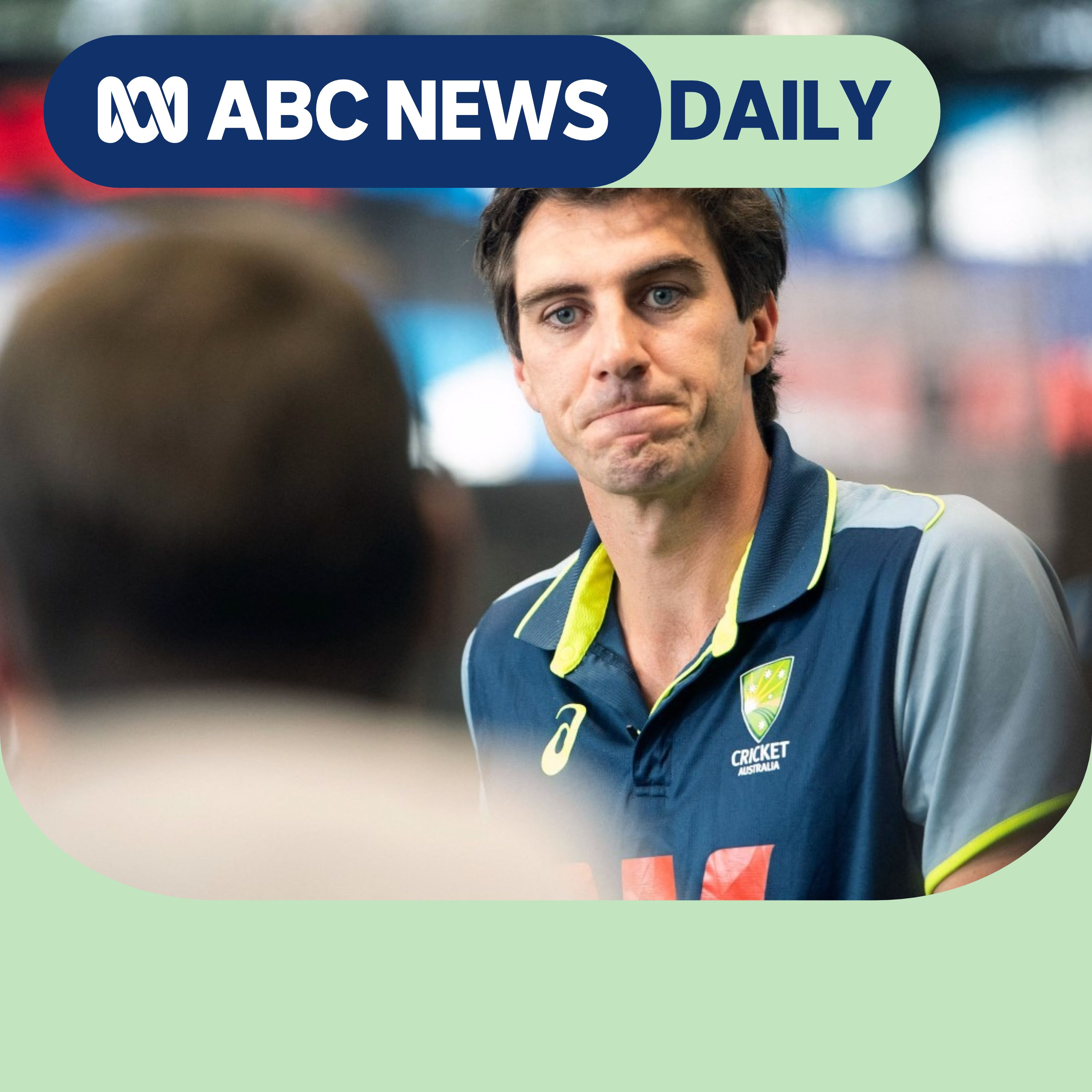
Just days after denying any involvement, Australian Test cricket captain Patrick Cummins is under pressure following an explosive 4,000-word essay by Cameron Bancroft, the man at the centre of the 2018 Sandpaper scandal, claiming the whole team knew about the ball tampering. It's the latest in a string of bombshell revelations, which began when Usman Khawaja shed new light on the scandal in his new book, eight years after it rocked Australian cricket. Today, ABC national sport reporter David Mark on the wound that never healed, and whether Australian cricket can ever recover. Featured: David Mark, ABC National Sport reporter
For the first time the leaders of the US, Russia and China are set to be in the same room. The meeting, at the APEC summit in China, is being compared to the 1945 Yalta conference, when world leaders gathered to shape the post-war world order. So, what are Donald Trump, Vladimir Putin and Xi Jinping hoping to get out of this meeting? Today, Samir Puri, author of Westlessness: The Great Global Rebalancing, on what each leader wants and what this gathering could mean for the global balance of power. Featured: Samir Puri, author of Westlessness: The Great Global Rebalancing ABC News Daily SURVEY LINK: https://forms.cloud.microsoft/r/guHgnjKm4b
Research participants' welfare should take priority over possible benefits to society.
Share your view, then see how readers voted. No sign-in required. This poll is shared across stories.
Do you agree or disagree?
Common Quandary
A Common Quandary to discuss
Another conversation to explore, separate from this news story.
One coffee, four hours, last table. Can the café ask you to leave?
A neighborhood café has become a popular remote workplace. Some guests buy one drink and occupy tables for hours, while families and friends regularly leave because they cannot sit together.