How to Let Go of Control: Going From Judging Good and Bad to Delighting in the Outcome
7 min
Listen through the publisher, then discuss the episode here or arrange an in-person Roundtable. Your city determines where to meet.
Roundtables are designed for groups of four, with a shared subject and room for everyone to speak. Come for discussion, with no dating expectation.
We see a situation as good or bad, but we never see what might have come of it actually working out. In this Afternoon Vibe from The Positive Mindset Podcast, Henry Lawrence talks about how quickly we judge a situation as good or bad, and everything we never see, like the pain an outcome might have brought if it had worked out. There's a perspective on everything. He shares why it's so hard to let go of control over your life, what it means to delight in the outcome no matter what it is, and how deciding who you will be in every situation starts changing your whole life. This doesn't mean you stop pursuing your dreams. You become an asset, and what feels like it's taking you away from your goal is refining you. In this episode: • "So there's a perspective on everything." • "It's really hard to let go of control over your life." • "What I have to do at this point is delight in the outcome, no matter what it is." • "Deciding who you will be in every situation versus being who you want to be based on how the situation turns out starts changing your whole life." • "You're not controlling, you're now an asset." • "Things might happen that you feel are taking you away from your goal, but in reality it's refining you." More from Henry Lawrence: https://vibeabundant.com (https://vibeabundant.com/) Follow @realhenryg on Instagram and TikTok. Pulled from the full episode "How to Have Perspective When You Have No Direction: Going From Life Feeling Upside Down to Becoming the Rising Tide" (Nov 11): https://podcasters.spotify.com/pod/show/positive-mindset-podcast/episodes/How-to-Have-Perspective-When-You-Have-No-Direction-Going-From-Life-Feeling-Upside-Down-to-Becoming-the-Rising-Tide-e3s83mj
Episode information is provided by the publisher. Listening takes place on the publisher’s service.
You've gotten very good at pretending you don't feel it. Uploaded 21-08-26 Maybe it's a conversation with someone you love. Someone you work for. A partner, a parent, a friend who's been quietly taking more than they give. Or the hardest one of all — a conversation with yourself, the one where you finally admit something you've refused to say out loud for years. You know exactly which one I'm talking about. You felt it the moment I said the word. A name came up, or a face, and your stomach did something small and unpleasant, and you pushed it back down where it's been living. That flinch is the most honest thing that's happened to you all day. Here is the truth: the life you say you want — the freedom, the peace, the relationship, the income, the respect — there's a very good chance it's on the other side of one conversation you keep refusing to have. Not ten. One. This seminar unpacks the single mechanic behind a stuck life: the necessary conversation you keep treating like a locked d
Imagine if every big change in our lives came with a whole community stepping up beside us… In this episode, I sit down with Dr Arne Rubinstein, former GP and emergency doctor, founder of the Rites of Passage Institute, and a man who's spent more than 30 years walking young people across the threshold into adulthood. Arne's work began around a fire at his very first men's gathering, listening to a hundred men wrestle with the same handful of wounds. Then in the Emergency Dpt, he kept meeting teenagers who'd pushed it one step too far... kids trying to become adults with nobody there to hold them. He came to believe every young person will go through a rite of passage either way. The question is whether we leave them to create their own, or gather around and help. We talk about why our culture is so good at turning away from the big moments - from first periods to menopause to death - and what opens up when we turn towards them. We explore: Separation, transformation and integration, an
There’s a big problem with gravity… Build and learn with KiwiCo! Gravity is a lie. I went into zero gravity to explain why… But it won't be easy because gravity is actually one of the most controversial subjects in all of physics. This is not some philosophical debate. A huge amount of the tech you use every day depends on our current (limited) understanding of gravity. If we can understand gravity a little bit better, we can build more things that are huge if true! So in this video, I joined the European Space Agency on a real zero gravity flight and interviewed theoretical physicists to understand: What really IS gravity? And what are the real life sci-fi ways we might use it in the future? Chapters: 0:00 The big problem with gravity 0:58 What is a zero gravity flight? 1:40 What is gravity? 2:49 What’s Einstein’s equivalence principle? 3:40 What does zero gravity feel like? 5:52 Why is falling the same as floating? 6:58 How did gravity disappear? 9:28 Why is gravity not a force? 11:3
Your free behavior course: https://nci.university/learn Uploaded 10-05-25 Exclusive NCI-4 (Grad School) Vault Release This is Behavioral Magnetics—the hidden force that draws you back to chaos, to patterns you swore you’d outgrow, to people who echo your oldest pain. It’s why peace feels boring. Why CALM makes you anxious. It’s not intuition—it’s your nervous system recycling what it knows. In this Grad School lecture, we uncover the 4 emotional magnets that shape who you trust, chase, or sabotage... even when it hurts. If you've ever said, “Why do I keep doing this?”—this is your answer. Why you're attracted to the wrong people The 4 types of emotional magnets How trauma rewires your compass Why peace can feel like withdrawal How to break free from recycled patterns Please note that the content provided in this broadcast is for informational and educational purposes only and should not be construed as legal, medical, financial, or professional advice. No material in this communication
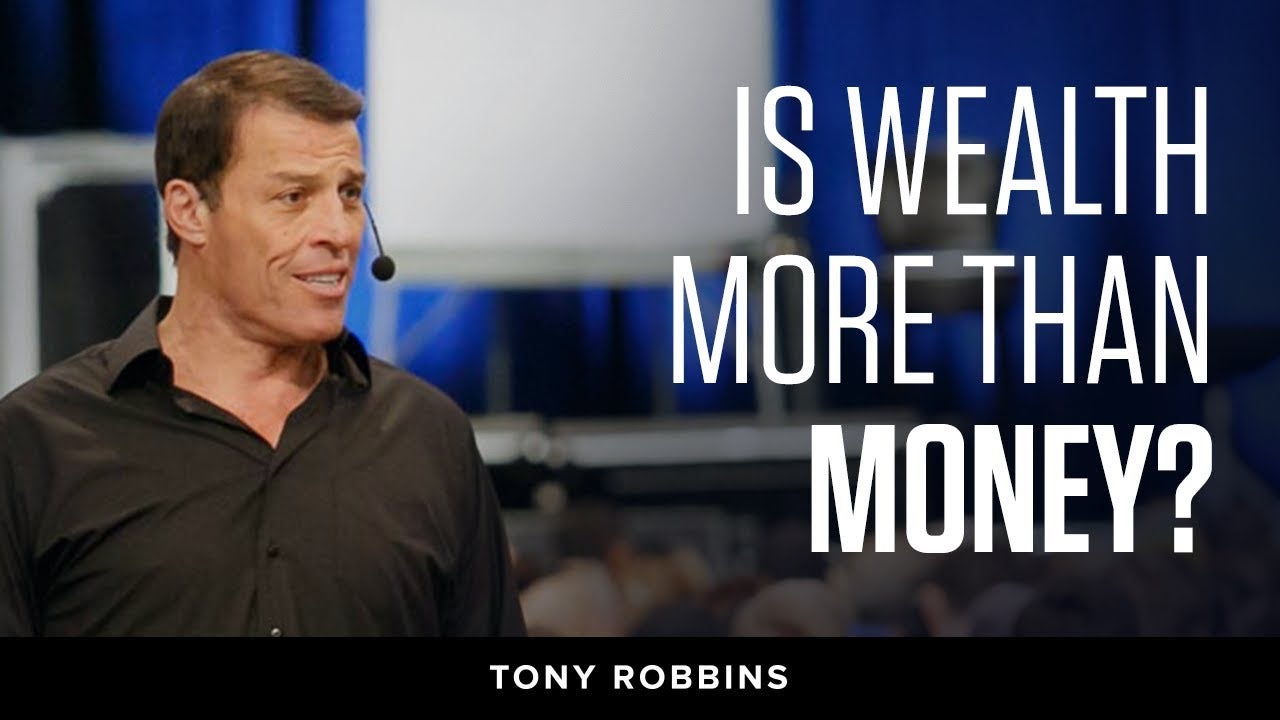
How will you know when you’ve reached true wealth? Is it when you have your dream home? Once you own an expensive car? Perhaps the signifier is when you’re wealthy enough to have your own private airplane? In Tony’s opinion, these are the wrong things to use when measuring your wealth. Uploaded 12-09-19 The people with mansion-sized homes, with three sports cars sitting in the garage, with a private plane that takes them to and from their vacation home – these people may not necessarily have access to true wealth. None of these are indicators of true wealth; they’re indicators of monetary wealth. True wealth is the ability to live life on your own terms. It’s freedom. Tony explains that money itself isn’t wealth, it’s a vehicle – a tool you can use to achieve financial freedom, to go after the dreams you didn’t think were possible, to design your life in a way that makes you feel alive and fulfilled. While Unshakeable is a financial freedom playbook, the process of becoming unshakeable
Get the 200+ Page Optimal Living Daily Workbook (PDF) - Free. Want to turn today's episode into an actionable plan? Episode 3779: Joshua Fields Millburn and Ryan Nicodemus of The Minimalists explain the first steps they took to regain control of their money after years of six-figure debt. It starts with a written monthly budget that sorts every expense into essentials, nonessentials and junk, plus a small safety net for emergencies, and then reframes investing as simply paying your future self, automated so you never miss the money. Read along with the original article(s) here: https://www.theminimalists.com/freedom/ Quotes to ponder: "Most of us have no idea where our money is going. We think we know, but we don't really know." "The stricter you are, the sooner you'll be free." "Right now is the best time to start planning for your future." Airwallex is a financial technology company, not a bank. Services in the US are provided by Airwallex US, LLC, a licensed money transmitter (NMLS
What if the change you've been asking for is already knocking? In this best-of compilation from The Positive Mindset Podcast, Henry Lawrence pulls together his best moments on letting go and being restored to who God made you to be, from six episodes: the stirring you feel when it's time to change; an opening prayer for anyone who feels alone right now; why your higher self is the true you, the one designed by God, not a more productive version of you; the cast on a broken arm that protected you and now limits you; the old painted-over furniture that gets restored, not rebuilt; why so much of our tiredness comes from holding too tight; how God moves what you couldn't; why everything is borrowed; and choosing to keep believing when it feels like a war broke out around you. It includes a prayer near the start and closes with the rising tide, a blessing and a thank-you. In this episode: • "That stirring is the truth knocking on a door that you've been leaning on with your whole weight." •
What if the storm in your life is showing you what you've been building on? In this best-of compilation from The Positive Mindset Podcast, Henry Lawrence pulls together his best moments on rebuilding your life on a foundation that holds, from five episodes: why real change has two parts, taking something apart and then building something new; why the first thing you rebuild is the foundation; the two houses, one built on the sand and one built on the rock; asking "who am I becoming?" instead of "what do I want?"; the potter and the clay; why a level 10 hurt can become a level 10 strength when you let it refine you; and why rebuilding happens one brick at a time, with routines that feel like scaffolding until the new you can stand on its own. It includes a centering deep breath and closes with the rising tide, a thank-you and a prayer. In this episode: • "Most of us have been building on sand and calling it rock." • "The rock is where my faith is." • "If you don't choose who you're beco
Why is life so hard? In this episode, Henry talks about realigning your view, your perspective, and most importantly your heart, so you can stop the cycle of repetitive difficulties, loss, hurt, and grief, and start moving into the life you were actually meant to have. He says this is an honest conversation from what's on his mind, not something he wrote down first. Instead of staying lost in the question of why, Henry encourages putting purpose over everything, and becoming that purpose even on the hard days. He shares that his own purpose, as he is learning, is to be a disciple of Christ, and that alignment is not conditional on whether things are good or bad. Along the way he talks about refining moments, why your reaction becomes your path, why you still get to decide who you are in every situation, and why the exchange is worth it even when it hurts. He also talks about not negotiating your purpose, and why a relationship with God makes this work easier than doing it on your own.
Environmental transitions should include financial help for people least able to afford change.
Share your view, then see how readers voted. No sign-in required. This poll is shared across stories.
Do you agree or disagree?
Common Quandary
A Common Quandary to discuss
Another conversation to explore, separate from this news story.
Your boss offers lessons to make you sound “more professional.” Do you take them?
Clients sometimes ask an employee to repeat themselves during calls. Their manager offers company-paid speech coaching framed as clearer communication, but the employee experiences the request as pressure to hide part of their identity.
When does improving communication become demanding conformity?