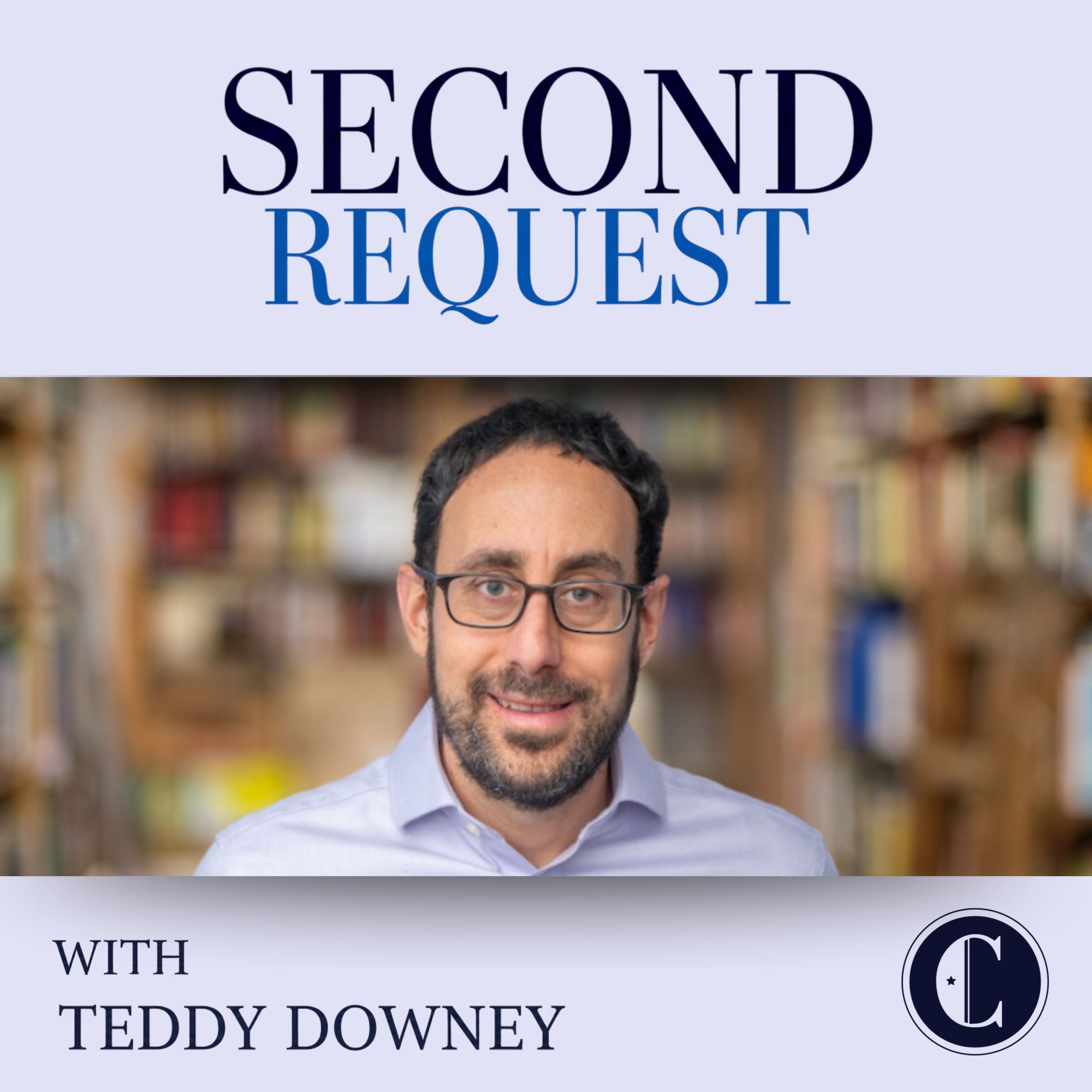
Listen through the publisher, then discuss the episode here or arrange an in-person Roundtable. Your city determines where to meet.
Roundtables are designed for groups of four, with a shared subject and room for everyone to speak. Come for discussion, with no dating expectation.
When a private credit fund tells you what its loans are worth, how much should you believe it? Today on Private Credit Crisis, Executive Editor Teddy Downey talks with Drexel University finance professor Chuck Fang, whose research finds that funds that lock investors’ money in inflate their loan values the most. The funds that do let investors out, the kind Wall Street is now pitching for retirement accounts, face a different risk: something that looks a lot like a bank run.
Episode information is provided by the publisher. Listening takes place on the publisher’s service.
The Ninth Circuit hears a consumer class action against Sazerac over Fireball. The buyers say the small bottles of Fireball Malt looked so much like Fireball Whisky that they thought they were buying whisky, rather than a lower-alcohol malt beverage. Their claim is that the packaging misled them into paying more than the product was worth. The district court certified a class, allowing buyers to pursue their claims together. Sazerac now challenges that decision, focusing on how the consumers propose to estimate their losses. You will hear about conjoint analysis: a survey that asks people to choose among products with different features and prices, to measure what they value. The difficult question is how those preferences translate into a market price, where sellers as well as buyers affect what a product costs. Sazerac will argue that the proposed model does not reliably account for how sellers would respond if buyers knew exactly what the drink contained. The consumers will counter
In this video, Disability Attorney Walter Hnot of the Disability Resolution Law Firm goes over the rental home that will replace the lost retirement benefits I will likely face one day. Like the content? Review us here: https://g.page/r/CcwyektC7nCPEAg/review . If the link does not work, Google: Disability Resolution, P.A. Welcome to the largest Social Security Disability Tutorial Video Library On Earth. PRIVATE ONE HOUR PHONE CALL THIS IS HOW YOU CAN GIVE BACK TO HELP GROW THE CAUSE: Option 1: Leave 5 |==================5 STAR REVIEWS==================| Google (Search Disability Resolution Orlando, FL)- https://www.google.com/search?authuse... (https://www.google.com/search?authuse...=) AVVO (Search Walter Hnot) - https://www.avvo.com/attorneys/32817-... BBB (Search Disability Resolution Orlando, FL)- https://www.bbb.org/us/fl/orlando/pro... MARTINDALE (Search Walter Hnot Orlando, FL) - https://www.martindale.com/attorney/w... Option 2: Donate Student Loans : https://www.gofundme.com/
Looking back at the past seven days… A dark moment for the rule of international law as Trump, Putin and Xi rub their power in the world’s face at a trilateral summit blandly dubbed “Yalta 2.0”. Can the three strongmen keep their egos in check? And who gets what in the battle to carve up the world? Plus: Andy Burnham faces hurdles as he visits Brussels to shore up ties with Europe. Alan Milburn’s long-awaited report into the NEET crisis finally lands. The tech world goes into meltdown as service outages ripple across the world. And Grand Theft Auto brings out new levels of cringe from Reform. Jonn Elledge and Andrew Harrison look at the biggest, strangest and most under-reported stories of the week. Back The Bunker on Patreon (https://www.patreon.com/bunkercast/membership?vanity=bunkercast) to help keep the podcast going – and get early, ad-free episodes, merch and more. Written and presented by Group Editor Andrew Harrison. Producer: James Liddell. Audio production: Tom Taylor. Managi
Shubham Vashist, founder of Calgary-based energy research firm Insight Stream (https://insightstreamco.base44.app/), joins Alberta Edge to examine Canada's race to capture a narrow window of opportunity in the global LNG market. With competitors rushing to lock in long-term contracts with Asian buyers, Canada has some distinct advantages—but can it build quickly and cheaply enough to capitalize on them? Why are some of the world's fastest-growing economies also among the most price-sensitive energy buyers? And what happens when a global LNG supply glut arrives? Vashist looks beyond the headlines about Canada's ambitious export plans to explain the commercial realities of selling energy to Asia, including the surprising connections between LNG, propane, condensate, and oilsands production. This podcast is generously supported by Don Archibald and Mac Van Wielingen. The Hub thanks them for their ongoing support. The Hub is Canada’s fastest-growing independent digital news outlet. https:/
The world appears to be falling apart, and the Trawl ladies are beginning to wonder whether anyone is actually in charge. From America's air traffic control system grinding to a halt, banking glitches and our ever-growing dependence on technology, Jemma and Marina are asking what happens when the infrastructure we rely on is run by systems, and people, we can't trust. Trump's America is proving quite the masterclass in chaos. There's Transportation Secretary Sean Duffy, whose career has taken him from reality TV to running America's transport network; questions over the new AI technology, the FAA's failures and the government's handling of the crisis; and another extraordinary display of Trump's blame-shifting when things go wrong. We also look at Markwayne Mullin's rather unfortunate timing when it comes to a trip to a college football game, the questions surrounding donations to Trump's enormous new ballroom and the companies subsequently winning government contracts. Are these isola
After a week of tech chaos with flights grounded, plus outages at Microsoft, Apple, US banks, and the National Security Agency, questions continue to be asked about the cause of the disruption and whether it’s more than a series of coincidences. Now the government’s top cyber security official, Sean Cairncross, is leaving his post, with CBS reporting he was fired. Trump says these were “individual events”. But Republican Senator Josh Hawley says if it is all a coincidence, “it’s like the greatest coincidence in the history of the world”. So who’s right? In this episode, Sarah, Marianna and Anthony discuss the doubts over the official explanation, cuts to America’s cyber defences, and whether people trust what they’re being told by the White House. Plus, Sarah talks to the cybersecurity and cyberespionage expert Dmitri Alperovitch about the fall of Nvidia’s Jensen Huang and the race with China over AI chips. Are rushed fixes for problems found by AI behind the disruption? HOSTS • Sarah
The first votes of the new Congress don’t make headlines, but they decide who holds power for the next two years. Before any bills move in January, members vote on their caucus rules and the House rules, and those votes settle who gets committee seats, how much control the speaker has, and how much say rank-and-file members get. In this episode of Second Request, Teddy Downey sits down with Daniel Schuman, executive director of the American Governance Institute, to talk about why the opening weeks of a new session are when members have the most leverage to win some of that back.
State regulators haven’t reined in private equity’s takeover of life insurance. Can Washington? Today on Private Credit Crisis, Executive Editor Teddy Downey talks with Renita Marcellin, a senior economic advisor to the Senate Banking Committee on Senator Elizabeth Warren’s staff, in a conversation recorded live at The Capitol Forum’s conference at the National Press Club.
Democrats won big on Tuesday, and many of them won by running against billionaires, data centers, and corporate corruption. What happens when that message gets subpoena power? In this episode of Second Request, Executive Editor Teddy Downey sits down with Jeff Hauser, executive director of the Revolving Door Project, to talk about what the election means for corporate accountability.
Synthetic images and videos should carry clear labels when presented as real events.
Share your view, then see how readers voted. No sign-in required. This poll is shared across stories.
Do you agree or disagree?
Common Quandary
A Common Quandary to discuss
Another conversation to explore, separate from this news story.
Rich parents want to buy their public-school class an art teacher. Should the school say no?
Parents at a well-resourced public school raise enough money for art teachers and smaller classes. Nearby schools cannot raise comparable amounts, widening differences within the same district.
Can helping your own community become unfair to the larger one?