Listen through the publisher, then discuss the episode here or arrange an in-person Roundtable. Your city determines where to meet.
Roundtables are designed for groups of four, with a shared subject and room for everyone to speak. Come for discussion, with no dating expectation.
Iris van Herpen is a fashion designer, but it’s a title that barely captures the scope of her imagination (https://news.artnet.com/art-world/iris-van-herpen-sculpting-the-senses-brooklyn-museum-2772234). Her practice reaches far beyond the runway, drawing on everything from the natural sciences to astronomy. The results are extraordinary garments that seem to belong to some otherworldly ecosystem. You might know Van Herpen’s work from her groundbreaking 3D-printed dress, or her biomorphic creations for Bjork or Lady Gaga, or the bubble dress that Eileen Gu wore to the Met Gala. She’s even created a garment that incorporates living, bioluminescent algae. These couture designs take their cues from the natural world, and use cutting-edge technology to bring to life often overlooked forms like the intricate structures of fungi or the undulations of the ocean. And while we tend to think of biology and technology as two separate realms, van Herpen sees them as much more closely intertwined. In fact, she believes the distinction between them may not be so clear-cut. That’s something we explored when Culture Editor, Min Chenm caught up with her at the Brooklyn Museum, which is currently hosting “S (https://www.brooklynmuseum.org/exhibitions/iris-van-herpen)culpting the Senses (https://www.brooklynmuseum.org/exhibitions/iris-van-herpen).” It’s a retrospective (https://news.artnet.com/art-world/iris-van-herpen-sculpting-the-senses-brooklyn-museum-2772234) featuring more than 140 of her designs. The exhibition opened in May and has been so popular that it's been extended through January 2027. In their conversation, we talked about her lifelong fascination with nature, her discovery of technology, and the curiosity that continues to power her practice. We also explored a question that lies at the heart of her work: What happens when technology doesn't take us further away from nature, but brings us closer to it?
Episode information is provided by the publisher. Listening takes place on the publisher’s service.
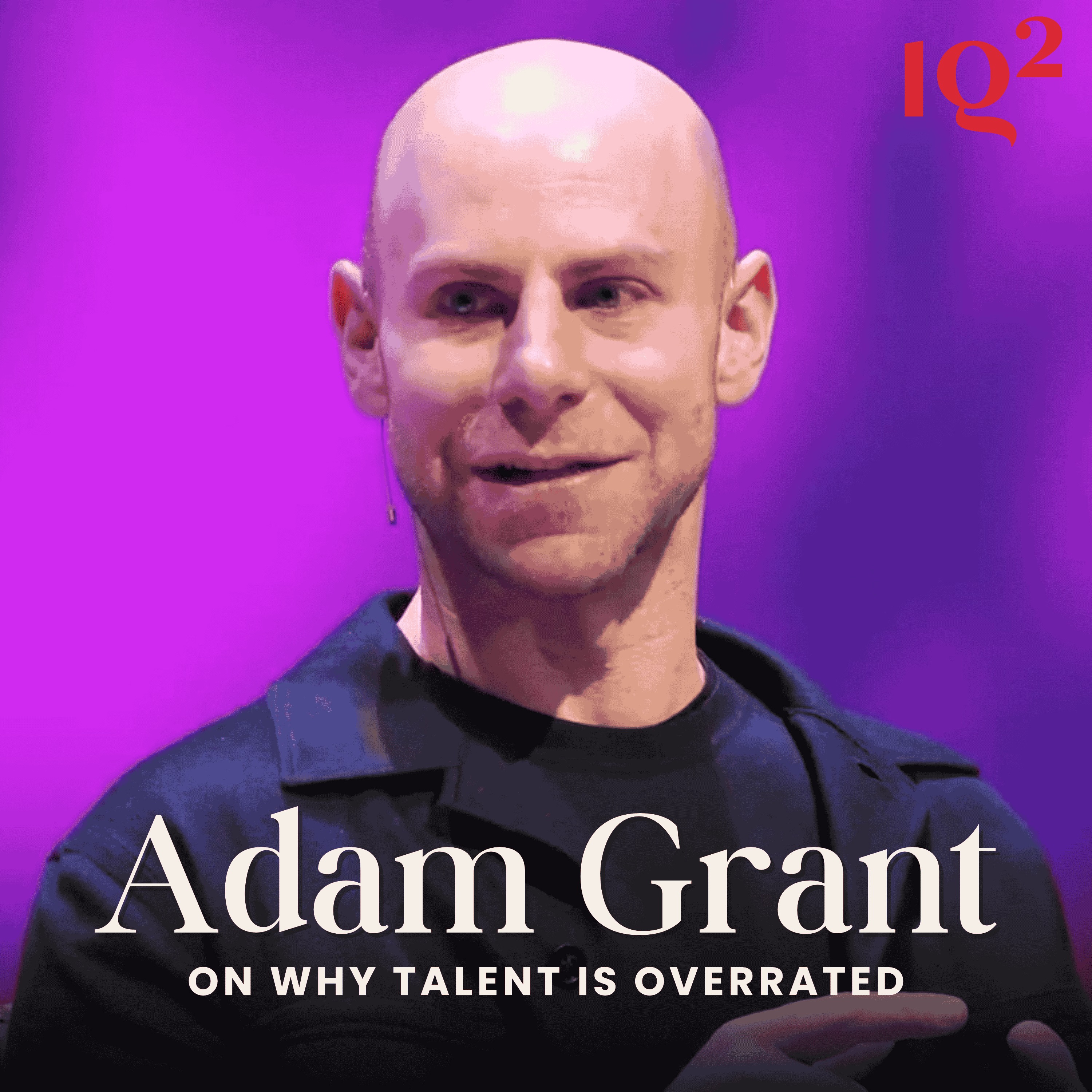
Adam Grant is one of the most sought after organisational psychologists in the world. He has provided expert advice to many of the world’s greatest business leaders, including Bill Gates and Sheryl Sandberg, equipping them with the mental tools to find motivation and meaning, rethink assumptions, and achieve greatness in their business and personal lives. In January 2024 Grant came to the Intelligence Squared stage for a rare, exclusive London event where he shared his revolutionary framework for how we can all exceed the expectations and aspirations we have set for ourselves. Drawing on his new book Hidden Potential he explained that despite living in a world that tends to admire people who start out with innate talent, there is clear scientific evidence that we can all bridge the biology gap and improve ourselves dramatically. In conversation with economist and FT columnist Tim Harford, Grant wove together groundbreaking evidence, surprising insights, and vivid story telling to take
The world appears to be falling apart, and the Trawl ladies are beginning to wonder whether anyone is actually in charge. From America's air traffic control system grinding to a halt, banking glitches and our ever-growing dependence on technology, Jemma and Marina are asking what happens when the infrastructure we rely on is run by systems, and people, we can't trust. Trump's America is proving quite the masterclass in chaos. There's Transportation Secretary Sean Duffy, whose career has taken him from reality TV to running America's transport network; questions over the new AI technology, the FAA's failures and the government's handling of the crisis; and another extraordinary display of Trump's blame-shifting when things go wrong. We also look at Markwayne Mullin's rather unfortunate timing when it comes to a trip to a college football game, the questions surrounding donations to Trump's enormous new ballroom and the companies subsequently winning government contracts. Are these isola
When you’re feeling a little blue, eating to feel better can be an appealing proposition. But the reality is we often turn to junk food or sugary treats that are high in calories and packed with salt or saturated fats. Of course, our mood can be impacted by a number of factors and there’s no magic fix that will instantly make us feel better. But there are actually types of food out there that have been proven to improve brain health and thereby beat mood disorders. Which foods are proven to improve brain health? Avocados are rich in Omega 3, aren’t they? Don’t bananas also contain tryptophan? In under 3 minutes, we answer your questions! To listen to the last episodes, you can click here: Do tongue scrapers actually help with bad breath? (https://originals.bababam.com/do-you-really-know/202406140300-do-tongue-scrapers-actually-help-bad-breath) Do our brains really tell the whole story about us? (https://originals.bababam.com/do-you-really-know/202406130300-do-our-brains-really-tell-who
Alex Murdaugh's murder retrial has a new question hanging over it, and it starts with a shirt. The defense says SLED's lead agent, David Owen, described blood spatter to the grand jury even though the agency's own lab had found no human blood in tested stains. It also challenges his claim that shotguns at Moselle were loaded like the weapon used to kill Paul. At the November 13 hearing, Judge Debra McCaslin heard the arguments and did not toss the charges. She said she would try to issue a written decision by November 20. Before adjourning, she asked whether prosecutors could return to a grand jury and keep the April 5, 2027 retrial date. That's a practical question, not a verdict about anyone's honesty. Creighton Waters argued that Owen's statements were not intentionally deceptive and that the spatter expert continued to stand by his interpretation. The State also points to the kennel video and other evidence it says supports the indictment. The defense counters that the grand jury s
Newsround Part 2. Lewis Aspinall returns for the final section of Newsround on Anfield Index, focusing on Ronald Araújo's Liverpool future and why the Reds should make his move from Barcelona permanent. With Araújo enjoying his time at Anfield, the defender has spoken positively about the welcome he has received from Liverpool's players, staff and supporters. However, the Uruguay international remains cautious about his future, admitting that any permanent transfer will depend on several parties reaching an agreement. Lewis examines Barcelona's position, including comments from sporting director Deco, and explains why Liverpool could have an opportunity to secure a defender who has quickly become an important part of Andoni Iraola's system. From his physicality and aerial dominance to his ability to operate at right-back and drop into a back three, Lewis believes Araújo offers Liverpool something their defence has been missing. But what happens when Conor Bradley returns? Lewis explain
**SOCIAL SECURITY BEFORE AGE 62? YES! YOU COULD QUALIFY AT 43, 53, 60, OR EVEN YOUNGER!** Think you have to wait until age 62 to start receiving Social Security benefits? **Think again!** Millions of Americans know about Social Security retirement benefits, but many don't realize that certain people can receive monthly Social Security payments years, or even decades, before reaching retirement age. Need help with Medicare? Contact our friends at Chapter Medicare for FREE HELP!! 352-841-0632 **Could YOU qualify for Social Security benefits earlier than you think?** In today's video, **Dr. Ed Weir, a former Social Security Administration District Manager**, explains the often-overlooked Social Security rules that allow certain individuals to qualify for benefits in their 40s, 50s, and even younger. You may be surprised by who's eligible, which benefits are available, and what circumstances could allow you to start receiving payments. **IN THIS VIDEO, WE'LL ANSWER:** Can you really start
The Gilded Age is back! I’m not just talking about the billionaires of today, or the hit HBO series (https://news.artnet.com/art-world/john-singer-sargent-the-gilded-age-hbo-2660432), but a new exhibition (https://www.metmuseum.org/exhibitions/designing-the-gilded-age-drawings-from-the-studios-of-louis-c-tiffany) at the Metropolitan Museum of Art dedicated to the spectacular designs of Louis Comfort Tiffany (https://news.artnet.com/art-world/louis-comfort-tiffany-met-nassau-market-2799918). That name will ring a bell for anyone with a passion for decorative arts. Around the turn of the 20th century, Tiffany and his studio revolutionized the field, creating dazzling stained-glass windows, lamps, and other decorative objects. These works were marvels of their time, transforming private homes and public buildings. Today, they’re touchstones of American decorative arts and remain highly sought-after by collectors. The Met's exhibition takes us behind the scenes of these enduring designs. I
Central Asia has a deep artistic heritage, from Silk Road craft traditions to a vibrant early 20th century avant-garde. But Soviet rule left a legacy that included the repression of artistic expression, and for decades after independence, the region was often defined by that past. That’s changing now, in a big way, and the international art world has started paying more attention to the five countries colloquially known as “the Stans.” The region is seeing a ton of growth. Young populations, diversifying trade, and rapid digital adoption are turning its cities into serious markets and destinations. Cities like Tashkent and Almaty are modernizing, while heritage sites like Bukhara and Samarkand are taking on bigger economic and tourism roles. Last year, the European Bank for Reconstruction and Development said the region is expected to grow faster than China. Amid this economic momentum, Uzbekistan and Kazakhstan in particular seem keen on building soft power, pouring major money into c
Publicly funded stadiums should provide clear, measurable benefits to local residents.
Share your view, then see how readers voted. No sign-in required. This poll is shared across stories.
Do you agree or disagree?
Common Quandary
A Common Quandary to discuss
Another conversation to explore, separate from this news story.
Your grandfather brought home an ancient artifact. A museum wants it back. Do you surrender it?
In your grandfather's attic you discover a beautiful ancient object he brought home while working overseas decades ago. Your family treasures it and his papers suggest the rules were murky. A museum from that country says it belongs to their collection and asks for its return.
Can a family inherit clear ownership of something acquired through unclear power?