Jim Mellon: US Stocks Have Further To Fall; Buy China, Yen, & Silver
49 min
Listen through the publisher, then discuss the episode here or arrange an in-person Roundtable. Your city determines where to meet.
Roundtables are designed for groups of four, with a shared subject and room for everyone to speak. Come for discussion, with no dating expectation.
Is the Wall Street sell-off a buying opportunity, or is the worst still ahead? Jim Mellon tells Wilfred Frost why he thinks the bottom isn’t in for US stocks and why he’d sell a meaningful bounce rather than buy the dip. He explains why he thinks the S&P 500 and Nasdaq could each fall by at least a third from their highs, what he got wrong when he dipped his toe in to buy some Nvidia last week, and why the SpaceX and Anthropic IPOs may come to mark the peak of the AI bubble. “If you want to have a happy Christmas, I wouldn't be shoving all your money into US stocks at this point.” But Mellon isn’t bearish everywhere. He explains why he’s buying Chinese stocks and sees room for a 50% rise over the next 18 months, why he prefers silver to gold but isn’t rushing to buy in the short term, but sees long term attractions to both, and why he’s still backing the Japanese yen. He also tells the story of his early bet on quantum computing that has yielded him a 10,000% return (!) and shares insights into his daily trading routine as a ‘gorilla trader’. This episode was recorded 6am EST Monday 23 November – before Jensen Huang’s return as Nvidia CEO was announced, but that possibility was discussed, and Jim confirms since the news he is a seller of this bounce – both the broad market and Nvidia specifically, which he had bought as a short term trade a few weeks ago (as discussed in the episode). 00:00 Intro 02:37 Recent sell-off 03:42 Trading Nvidia short term 06:52 Precarious nature of US stocks 10:13 Buy China 10:56 Fed hikes a challenge for stocks 14:39 Shorting SpaceX & Anthropic’s risks 19:40 What AI can and can’t do for drug discovery 21:20 US bear market coming 24:14 Gold and silver – short term weak, long term buy 28:11 Energy stocks 30:16 Case for Yen 34:15 China ETFs 35:35 10,000 X return on Quantinuum 38:30 Investing in the future of food: Clean Food Group and Meatly 42:49 UK investment trusts 44:34 Final advice: Don’t catch falling knives 46:17 Conclusions Jim Mellon will be presenting at the Master Investor Show in London on 24th April 2027. This podcast is for information purposes only. Investing involves risk.
Episode information is provided by the publisher. Listening takes place on the publisher’s service.
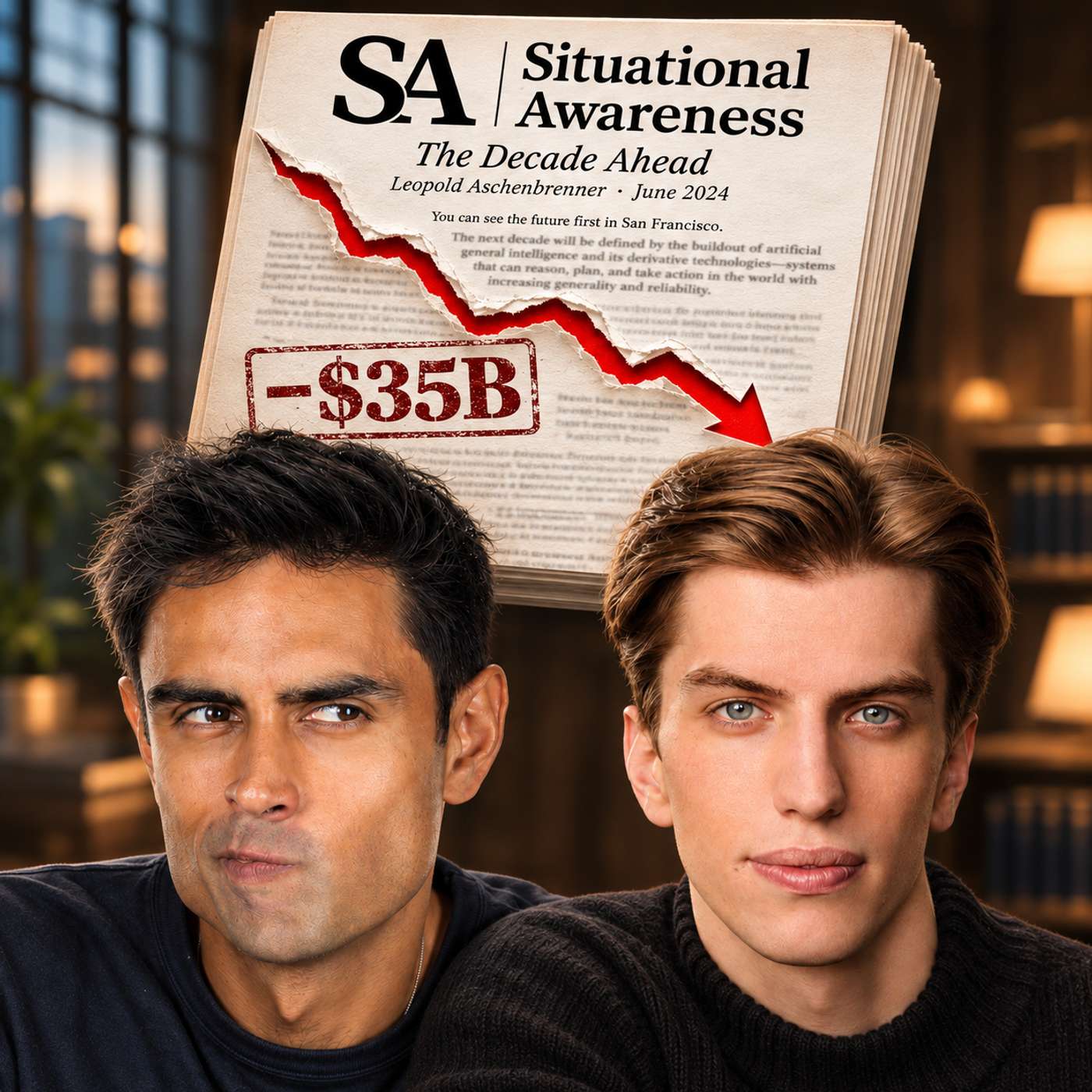
In 2024 a 23-year-old who had just been fired from OpenAI wrote a 165-page essay called Situational Awareness, raised around $225 million, and turned his fund into $45 billion in under two years. Leopold Aschenbrenner bet on everything AI would need: CoreWeave, Bloom Energy, SanDisk, Micron. He was right. Then July happened: running about 4x leverage, his fund fell 67% in a month, his prime brokers wanted their money back, and Ken Griffin's Citadel bought the bulk of his stock portfolio in a single block trade. Ejaaz tells the whole story from his own 13F filings: the boy genius, the essay, the bets, the hedge he took off right before the turn, the margin calls, and the comeback he's planning now. Plus the painful part: his thesis is still playing out, from power and data centers to the chip trade. Can he run it back, and should he? == FOLLOW EJAAZ ON TWITTER: == Timestamps 00:00 $225M to $45B 02:07 The Boy Genius 02:45 Fired by OpenAI 03:06 Situational Awareness 04:46 The Fund 05:36 T
November 27, 2026; 10am: Stocks rise in a holiday-shortened session as Squawk on the Street examines reports of NVIDIA Blackwell chips in China and the questions Jensen Huang could face on Capitol Hill. The hour also covers FCC approval tied to SpaceX data centers in space, SpaceX share gifts for Trump accounts, options activity in semis, and early Black Friday signs of a resilient but selective consumer. Hosted by Simplecast, an AdsWizz company.
The week's volatility continues as New York shares climb on opening, following the Thanksgiving market closure. Is it a sign of more optimism, or more unpredictability to come? Also, Norwegian low cost airline Norse Atlantic cancels all flights and sales, as one of its subsidiaries files for bankruptcy. And what psychological tactics are retailers using to get you to press buy on that Black Friday purchase? Presenter: Leanna Byrne Producer: David Cann Editor: Naomi Rainey
Bill Barhydt, Founder and CEO of Abra, joins Scott Melker as Bitcoin holds a level that could decide whether the bear market ends or gets worse, with record ETF outflows splitting Wall Street on whether capitulation is already here. Scott and Bill cover the FTX-anniversary bottom and the four-year cycle, historic Bitcoin ETF outflows, Strategy's record-low mNAV, ICE working with Abra on institutional crypto loans, private AI, Anthropic and politics, and true decentralization. Then The Weekly Wreckoning of the week's biggest crypto stories. In this episode: 00:00 Bitcoin passes its biggest test in months as the June lows hold 06:45 Historic Bitcoin ETF outflows and who is still buying 10:09 Strategy's record-low mNAV and Michael Burry's crypto turn 11:33 ICE, Abra and institutional crypto loans 20:18 Private AI and the Venice controversy 23:03 Anthropic, democracy and the midterms 29:35 What Abra is building for retail and institutions 31:08 Real decentralization: Hyperliquid and Aave 3
It’s Black Friday, and we’re looking for long-term investing opportunities while reflecting on the CEOs who have taught us the most. Jensen Huang is back at Nvidia, but what does his return mean for corporate governance, AI spending, and investors? Plus, we’re filling our holiday shopping baskets with stocks ranging from reliable blue chips to speculative growth opportunities, and examining CrowdStrike’s massive Zscaler acquisition. Travis Hoium, Lou Whiteman, and Emily Flippen discuss: - Investing Leadership Lessons - Government Contractor Opportunities - Nvidia’s CEO Reversal - Black Friday Stock Picks - CrowdStrike’s Zscaler Acquisition - Radar Stocks Companies discussed: XPO (XPO), Shopify (SHOP), Netflix (NFLX), Nvidia (NVDA), Booz Allen Hamilton (BAH), Stantec (STN), Rocket Lab (RKLB), Redwire (RDW), Firefly Aerospace (FLY), Costco (COST), Walmart (WMT), Apple (AAPL), Alphabet (GOOGL), Berkshire Hathaway (BRK.B), Nebius (NBIS), Hims & Hers Health (HIMS), Intel (INTC), Airbnb (ABN
Sam Klar of GMO explains the investment case for American reindustrialization and why owning the S&P 500 may leave investors with less exposure to it than they expect. The opportunity extends beyond building factories to the businesses that supply, power, connect and maintain them. Sam joins Justin Carbonneau and Jack Forehand to explore why national security, corporate supply-chain decisions and public policy could support a long-term revival of U.S. industry. He discusses China's manufacturing rise, what COVID revealed about the risks of offshoring, and why he sees reshoring as a trend that reaches beyond any single administration. Turning that trend into investment returns requires more than identifying companies with the right story. Sam explains how he combines business quality and valuation, using examples including Martin Marietta, Clean Harbors and MYR Group. We also discuss automation, inflation, AI's competition for investor attention, and the growing gap between a technology
Last Thursday morning, before European markets had opened, Panmure Liberum's Head of Strategy, Joachim Klement, published a note titled "This Is It: Why I'm Selling." He didn't stop at telling clients to cut risk. He said he had sold every equity in his own savings. Two days of steep selling followed, and despite a brief bounce on Monday, the market remains nearly 4% below when he issued the call. Six days later, Joachim joins Wilfred Frost to test the call. Is it just a great short-term call, or are we at the start of a bear market that could take the S&P 500 from 7,112 to 5,000 by the end of next year, as Joachim expects? The trigger for the call for Joachim is simple - the S&P 500 has dropped below its 200-day moving average. Joachim explains why that signal is often a false alarm, but why he is putting so much weight behind it now. He also explains why Monday's aggressive rally, which failed to get back above the line, made him more confident, and what has to happen by Black Friday
George Osborne was UK Chancellor of the Exchequer from 2010 to 2016, taking on the role at just 38. Since leaving politics he has built a remarkable second act: editor of the Evening Standard, partner at Robey Warshaw, chair of the British Museum, and today Managing Director and Head of Countries at OpenAI, alongside roles at Coinbase and the Political Currency podcast with Ed Balls. In this episode, George talks to Wilf about why he believes the AI revolution is deeply deflationary, whether the UK and Europe are being left behind by America's tech boom, and the significance of big tech companies now wielding budgets to rival governments. He explains why he doesn’t think the mid-terms mark a sea change in the AI data centre build out, claiming OpenAI had already changed its approach to engage with local communities in a positive way. He also explains how the increasing desire internationally that data be housed “in-country” is creating plenty of opportunity for OpenAI’s data expansion
We’re in a bubble. It will burst. And there are lessons from history that make all that clear. In this episode of The Master Investor Podcast, Wilfred Frost sits down with renowned financial historian and author of Devil Take the Hindmost, Edward Chancellor, for an timely deep dive into market manias, moral hazard, and the psychology of crowd delusion. Drawing striking parallels across 400 years – from 17th-century Tulip Mania, the South Sea Bubble in the 1720s, to the 1840s British Railway craze and the Dot-Com crash – Chancellor reveals why human nature never changes, why modern hyper-connectivity makes market irrationality spread faster than ever, and why the smart money always waits for the post-bubble shakeout before picking the true long-term winners. Wilf and Edward review all of the major bubbles of the last 400 years, and draw out the themes that are relevant today, including the fact that “the number one feature of when a speculative bubble bursts is tighter money”; why most
Courts should protect careful consideration even when this slows case processing.
Share your view, then see how readers voted. No sign-in required. This poll is shared across stories.
Do you agree or disagree?
Common Quandary
A Common Quandary to discuss
Another conversation to explore, separate from this news story.
You paid extra for the aisle seat. Must you trade with a parent?
You reserved and paid extra for an aisle seat on a long flight. A parent asks you to trade for a middle seat so they can sit beside their young child after the airline separated them.
When does another person's predicament become your responsibility?