Johnny Gosch: The Paper Boy Who Never Came Home Pt. 2
30 min
Listen through the publisher, then discuss the episode here or arrange an in-person Roundtable. Your city determines where to meet.
Roundtables are designed for groups of four, with a shared subject and room for everyone to speak. Come for discussion, with no dating expectation.
Seventeen months after Johnny Gosch vanished off his paper route, the phone rang at his parents' house just after midnight. Three calls, about two minutes in total. His mother said the voice was her son's. The tape recorders the family had put on the line for exactly this moment weren't running, and the FBI would confirm only one thing about the calls: that they were long distance. Seven years later, a Nebraska inmate said he'd been forced at gunpoint to help take Johnny. Then, at two-thirty in the morning in March of 1997, two men knocked on Noreen Gosch's apartment door. And one of them said he was her son. Need More to Binge? Instagram: @Crimehouse (https://www.instagram.com/crimehouse/) TikTok: @Crimehouse (https://www.tiktok.com/@crimehouse) X: @crimehousemedia (https://x.com/crimehousemedia) The Final Hours is hosted by Sarah Turney & Kourtney Nichole
Episode information is provided by the publisher. Listening takes place on the publisher’s service.
Join Sarah Turney and Kourtney Nichole for today's second Unsolved Tuesdays episode. In August 2021, 25-year-old Illinois State University graduate student Jelani Day was last seen leaving a dispensary in Bloomington-Normal, far from his apartment and with no clear reason to be there. His car was found abandoned miles away. Weeks later, his unclothed body was recovered from the Illinois River. His death was presumed to be an accidental drowning, but his mother refused to accept that answer. She launched a relentless public campaign that put a spotlight on how missing Black men are treated by investigators and the media. How did a focused, driven graduate student end up in a river with no explanation? And for more cases just like this one, be sure to check out the Crime House Original, The Final Hours. Need More to Binge? Follow me on Social X: @crimehousemedia (https://x.com/crimehousemedia)
When Nick Reiner was born, Rob and Michele Reiner set up a trust that would pay him half at 30 and the rest at 35. He turned 30 two years before his parents were killed. His half, about $558,000, was never paid out. Now Nick is charged with their murders, and he wants that money to rehire his old lawyer, Alan Jackson. The woman running the trust says California law could keep him from inheriting from the parents he's accused of killing. His lawyers say money that came due before the deaths isn't an inheritance at all. Eric Faddis, a defense attorney and former prosecutor, tells me which argument holds up. Then the twist in the law. Nick doesn't have to be convicted to lose his parents' money. The judge in the trust fight can rule against him if he decides it's more likely than not Nick killed them, a lower bar than a jury needs. Eric tells me what that ruling could do to the murder case. Nick Reiner is presumed innocent. Listen Anywhere You Get Podcasts: https://pod.link/1655749292 Wan
In 1959, hundreds of people packed up their lives and moved to a compound outside Waco, Texas, to wait for the end of the world. It never came. In the first part of our 3-part series on the Waco siege, Katie Ring goes back to the beginning: the failed prophecy that shattered a religious movement, the bitter fight over who would lead what was left of it, and the young man from East Texas who showed up at exactly the right moment. Follow America's Most Infamous Crimes to hear the rest of the story: https://pod.link/1882861002 To hear episodes ad-free, subscribe to Crime House+. Need More to Binge? Follow me on Social Instagram: @Crimehouse (https://www.instagram.com/crimehouse/) TikTok: @Crimehouse (https://www.tiktok.com/@crimehouse) X: @crimehousemedia (https://x.com/crimehousemedia)
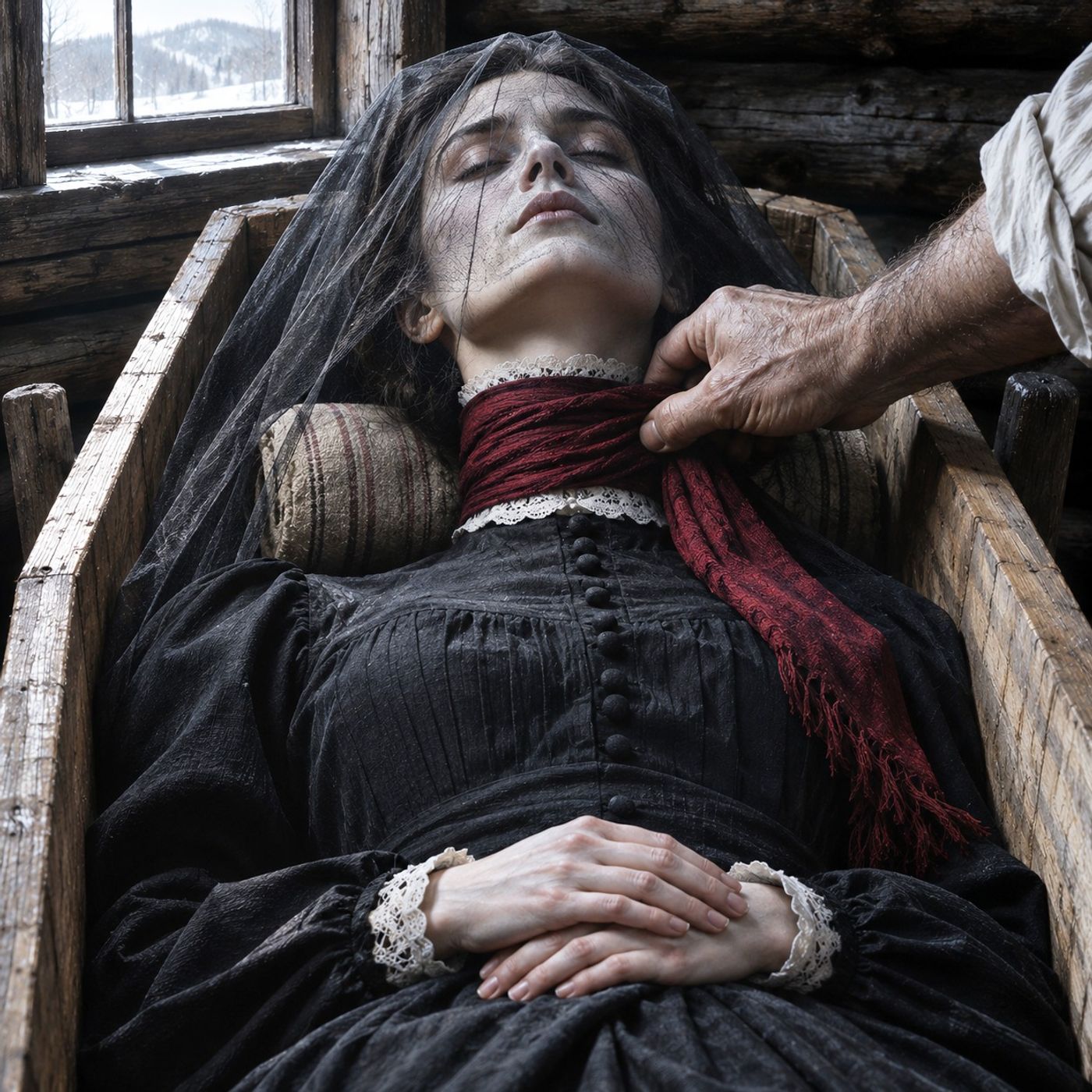
In January 1897, blacksmith Edward Shue washed and dressed his bride of three months for burial before the coroner ever reached their log house in Greenbrier County, West Virginia, and at her funeral he kept fussing with her head and neck, propping it on a pillow and wrapping a scarf around her high collar. Her mother, Mary Jane Heaster, had never liked him, and for weeks afterward she prayed every evening for her daughter to come back and tell her what had really happened. FEATURED STORIES IN THIS EPISODE: This Weird Darkness episode runs from the Greenbrier Ghost, the 1897 West Virginia murder victim whose mother said she came back to name her killer, to a bottomless pit in Washington, a wave of Mothman sightings over Chicago, and a London tomb rumored to be a time machine. Elva Heaster was dead – but that didn’t stop her ghost from solving the murder. *** In Stephen King’s “Pet Semetery”, beloved family pets could come back from the dead. *** In Washington there is a hole that some
Hit subscribe so you don't miss any updates. Supported by True Crime Channel. ------- On the evening of 18 March 2009, Claudia Lawrence, a 35-year-old chef at the University of York, went home to her house on Heworth Road. The next morning she failed to arrive for her early shift, and she has never been seen since. More than seventeen years later, nobody has been charged, her body has never been found, and North Yorkshire Police treat her disappearance as suspected murder. Now, newly upscaled CCTV footage offers a clearer look at that night than ever before. In this special documentary, filmed on location in York, we retrace the streets around Claudia's home: from the Minster to Heworth Road, the alleyway behind her house and the corner where a CCTV camera was recording that night. We're also among the first to be allowed to film inside the Nags Head, Claudia's local pub, and we sit down with Tom McDermott to go through what happened in the hours before she vanished. At the centre of t
This episode, Kaelyn welcomes her new co-host, Sylas Dean, as they cover the disappearance of Cari Farver. The single mom was last seen in Omaha, Nebraska, on November 13th, 2012. Days later, the man she’d been dating started getting messages from her. Then threats. Tens of thousands of them, for three years. Cari seemed to be everywhere and nowhere at the same time. Kaelyn and Sylas follow the clues: dozens of fake email accounts, a house fire, a shooting, and a hidden photo that broke the case wide open. Need More to Binge? TikTok: @Crimehouse (https://www.tiktok.com/@crimehouse) X: @crimehousemedia (https://x.com/crimehousemedia) Clues is hosted by Kaelyn Moore and Sylas Dean Instagram: @itskaelynmoore (https://www.instagram.com/itskaelynmoore/) | @sylasdean (https://www.instagram.com/sylasdean/?hl=en) TikTok: @heartstartspounding (https://www.tiktok.com/@heartstartspounding) | @creeptime (https://www.tiktok.com/@creeptime) Episode Sponsor: Let Rocket Money help you reach your finan
Have you heard about the man in Colorado who used a “killdozer” to settle a zoning dispute, or the Emperor who pickled his wife’s lover? If you love The Final Hours, you are going to love this extra episode of The UnBelievable from Rewind Studios and the History Channel for Thanksgiving. Each episode opens a cabinet of curiosities filled with the strangest-but-true stories from history. When it comes to history, the truth is always more unbelievable than you think. Follow The UnBelievable for a new episode every Friday: https://pod.link/6815976107 Thank you to our experts who contributed to this episode: David O’Keefe, Mitch Horowitz, Larissa Tracy, Rebecca Hsu, Rutledge Wood, Allie Delury, Holly Frey, Sami Jarroush, Paul Sutter, Matthew Steiner, Kavitha Davidson, Yohuru Williams, Narayanan Kasthuri, Chris Mowery, Brandy Schillace, Jason Sweet, and Pryia Krishna.
Thirty-seven days after Leah Freeman vanished, searchers found her body down an embankment outside Coquille. Her death was ruled a homicide but no one could say how she died, and for years the case went cold. Then a new police chief reopened it, and in 2010 a grand jury indicted Leah’s old boyfriend, Nick McGuffin. A jury convicted him of manslaughter, by a split vote. But nearly a decade later, his lawyers found something buried in a crime lab’s notes from the summer of 2000: DNA from an unidentified man on Leah’s shoes. DNA that was never disclosed at trial, and has never been matched to anyone. Need More to Binge? Instagram: @Crimehouse (https://www.instagram.com/crimehouse/) TikTok: @Crimehouse (https://www.tiktok.com/@crimehouse) X: @crimehousemedia (https://x.com/crimehousemedia) The Final Hours is hosted by Sarah Turney & Kourtney Nichole
Just before 9 PM on Wednesday, June 28th, 2000, fifteen-year-old Leah Freeman stormed out of her best friend’s house after an argument in Coquille, Oregon, and started home on foot. Over the next half hour, several people saw her moving around town, past the market, the high school, and in a phone booth at a gas station. One of them, an eleven-year-old girl, saw a car pull up beside her. Around 11:30 PM, a man found a single sneaker lying in the road near the cemetery not knowing it was Leah’s. Her boyfriend spent the night driving the streets looking for her. And for days, police treated her as a runaway. Until a second shoe, stained with blood, turned up on a remote ridge miles out of town. Need More to Binge? Instagram: @Crimehouse (https://www.instagram.com/crimehouse/) TikTok: @Crimehouse (https://www.tiktok.com/@crimehouse) X: @crimehousemedia (https://x.com/crimehousemedia) The Final Hours is hosted by Sarah Turney & Kourtney Nichole
Canceling a digital subscription should be as easy as starting one.
Share your view, then see how readers voted. No sign-in required. This poll is shared across stories.
Do you agree or disagree?
Common Quandary
A Common Quandary to discuss
Another conversation to explore, separate from this news story.
Rich parents want to buy their public-school class an art teacher. Should the school say no?
Parents at a well-resourced public school raise enough money for art teachers and smaller classes. Nearby schools cannot raise comparable amounts, widening differences within the same district.
Can helping your own community become unfair to the larger one?