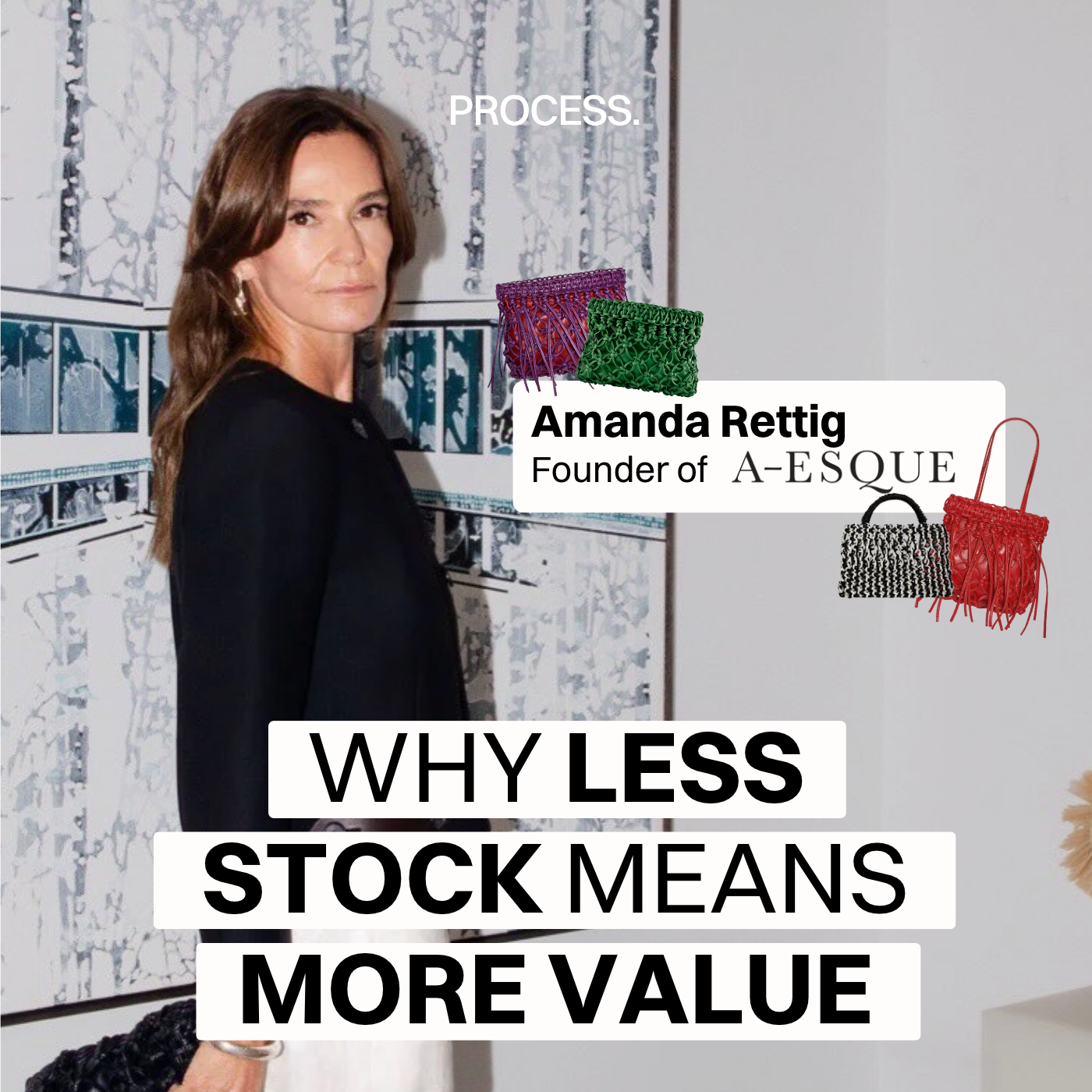
“The only time I would get scared is if I didn’t really believe in something.” - Amanda Rettig Australian designer and founder Amanda Briskin-Rettig has spent 30 years building fashion brands. She founded Mimco in 1996, sold it in 2007, and 13 years ago started A-esque, a self-funded leather goods brand handmade in small batches in Melbourne. Its philosophy is simple: build slowly, create intentionally, and make things that last. In this episode, Amanda shares how to start a fashion brand and grow it sustainably. She covers product development and product architecture, small-batch manufacturing inspired by Toyota’s lean model, and how to avoid excess inventory, deadstock and discounting. She also talks about local manufacturing, building a direct-to-consumer business, brand storytelling, collaborations, and what she learned from building and selling a business. If you want to start a handbag or accessories brand, build a sustainable fashion business, or grow a brand without compromisin
A 7% drop in Australian wine exports doesn’t sound huge until you put it next to the reality of a small local market and a massive national crush. We dig into what’s driving the latest numbers, including tariffs and cost pressures in the US, a lift in Canada as US wine disappears from government-controlled shelves, and why China’s “restocking” story is more complicated than the headlines. We also talk about the uncomfortable truth that a big slice of what we export is bulk wine, which can be cheaper and lower carbon, but can also mean less control over the final bottle and the way your wine shows up for consumers. Then we compare how the major wine states are responding to the squeeze and why their approaches barely resemble each other. South Australia throws serious money at oversupply and vineyard transition, while New South Wales focuses on tourism and consumer demand, Tasmania doubles down on premium, and Victoria prioritises efficiency, risk management, biosecurity and sustainabil
Anthony opens with a crash course on the Booker Prize before welcoming poet and novelist Luke Kennard to discuss his novel on the Booker Prize short list, ‘Black Bag,’ the story of a struggling actor hired to sit silently inside a leather bag during university lectures. The guys explore what it’s like to be short-listed for the Booker, the case for taking comedy seriously, and the real-life experiment that inspired the novel. They also discuss the history of the male loneliness epidemic, the indignities of acting, and whether men should try sitting in a bag before starting a podcast. (00:00) - Open: The Booker Prize 101 (09:23) - Introduction: Poetry, Prose, and Finding Success (18:55) - Chapter 1: Being Short-Listed for the Booker Prize (29:35) - Chapter 2: ‘Black Bag,’ the Mere-Exposure Effect, and Tasteful Comedy (54:03) - Chapter 3: Jeselnik Book Club Gauntlet (1:02:48) - Chapter 4: One Additional Question—Are Leather Pants Cool? (1:06:04) - Acknowledgments: Luke’s gift and book re
Merriam-Webster's Word of the Day for November 21, 2026 is: meet-cute • \MEET-kyoot\ • noun Meet-cute refers to a cute, charming, or amusing first encounter between romantic partners. A meet-cute can be such an encounter as shown in a movie or television show, or one that happens in real life. // Their meet-cute felt as if it came straight out of a romantic comedy. See the entry > (https://www.merriam-webster.com/dictionary/meet-cute) Examples: “Two women, Dylan and Melanie, cross paths on an artificial beach in a near-apocalyptic meet-cute: one has emerged from the underwater pod in which she was raised, the other works at a luxury resort as a bartender… and may also be a robot.” — Natalie Zutter, Literary Hub, 2 Jan. 2026 Did you know? Isn’t it cute how two words can be introduced to each other and become an inseparable pair soon after? Well, that’s exactly what happened when meet and cute got together in the early 1950s. The duo was spotted in The New York Times Book Review in 1952
As a member of the notoriously eccentric Mitford family, Jessica Mitford was raised to marry well, not fight for others' rights. And yet, even as her sisters became infamous for their glamorous dalliances with Nazis (and others), Jessica rejected her upbringing, running away to America and plunging into anti-fascist and anti-racist causes. How did this blue-blooded Englishwoman wind up as a resident of Oakland, California, the best friend of Maya Angelou, and a best-selling author whom Time magazine called "the Queen of the Muckrackers"? In this episode, Jacke talks to biographer Carla Kaplan about her book Troublemaker: The Fierce, Unruly Life of Jessica Mitford (https://hurstpublishers.com/book/troublemaker/). PLUS Morgan Lloyd Malcolm (who adapted Henry James's Turn of the Screw (https://www.bloomsbury.com/us/turn-of-the-screw-9781350685499/) for the London stage) stops by to discuss her choice for the last book she will ever read. SPECIAL OFFER! The music in this episode is by Gabr
This week the Deadpod returns to the Providence Civic Center for the second set of the November 4, 1979 show. Last week's first set had four songs that were only a few months old, and set two opens with one that was brand new. This is the first Alabama Getaway the Dead ever played. It already sounds finished on its first night, and it went on to be a regular rocker through most of the 1980s. Greatest Story Ever Told follows. The band had just brought it back in 1979 after more than four years away, and the two songs were often paired after this. Ship of Fools slows things down before Estimated Prophet leads into He's Gone. Instead of the usual opening, Jerry, Brent and Bobby trade licks on the riff that normally comes near the end of He's Gone, then settle into the song. The jam that follows goes in several directions, with a few sudden bursts of speed, before Space and Drums. The Other One and Wharf Rat carry the late part of the set, and Around and Around and U.S. Blues close the nig
A company's growth matters less than whether its customers receive better service.
Share your view, then see how readers voted. No sign-in required. This poll is shared across stories.
Do you agree or disagree?
Common Quandary
A Common Quandary to discuss
Another conversation to explore, separate from this news story.
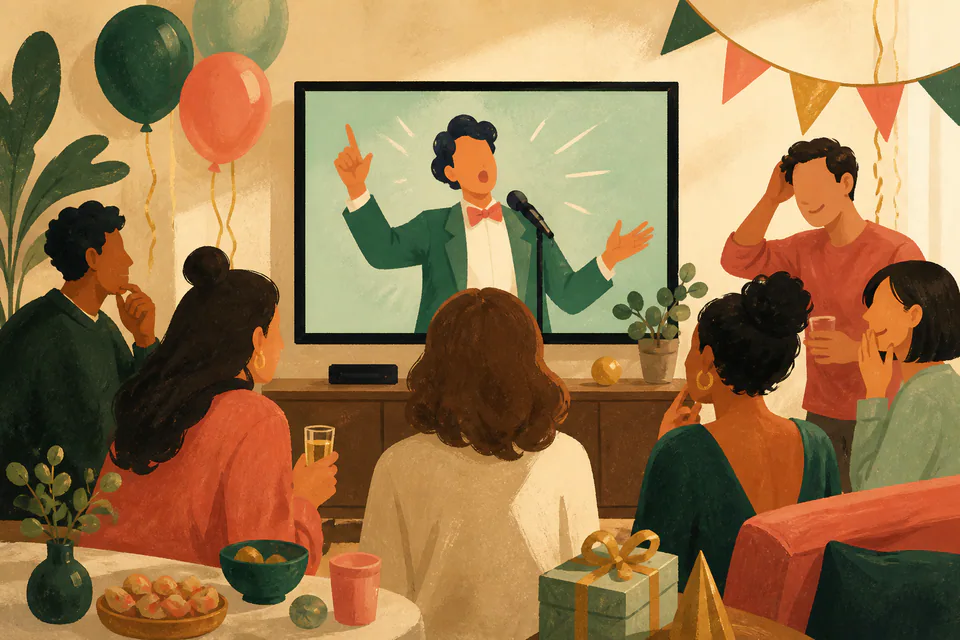
You make a hilarious deepfake of a friend for their birthday. Must you ask first?
For a private birthday party, someone creates a convincing video of a mutual friend delivering an absurd speech. Everyone, including the subject, will immediately understand that it is fake.
Does obvious fiction eliminate the need for consent?