English-language podcasts

IIEA Talks

Kosovo’s Journey from Statehood to European Integration
19 min

Listen through the publisher, then discuss the episode here or arrange an in-person Roundtable. Your city determines where to meet.

Roundtables are designed for groups of four, with a shared subject and room for everyone to speak. Come for discussion, with no dating expectation.

Since declaring independence in 2008, Kosovo has made significant progress in consolidating its statehood, strengthening democratic institutions, and advancing its European agenda. However, this pathway has been met with domestic and geopolitical challenges. In his first ever address at the IIEA, the Prime Minister of Kosovo, H.E. Mr. Albin Kurti, reflects upon the country's reform efforts, especially during his time in office. The Prime Minister also considers Kosovo's MR. opportunities and ongoing challenges, while outlining the country’s aspirations to transition from being one of Europe's most pro-European countries to becoming a full member of the EU. H.E. Mr. Albin Kurti was elected Prime Minister of the Republic of Kosovo for the fourth time in September 2026, being elected first in February 2020. Before his time as prime minister, Mr. Kurti led the massive student protests in 1997 against the repressive Milosevic regime. Having been politically active during the war and serving as Secretary of the Office of the General Political Representative of the Kosovo Liberation Army (KLA/ UÇK). Mr Kurti was arrested by Serbian armed forces in April 1999 and he was released in December 2001, after spending two and a half years in Serbian prisons. Following his release, Albin Kurti continued his studies and in 2003 graduated with a degree in Computer Science and Telecommunications, from the University of Prishtina. H.E. Prime Minister Kurti is the President of the biggest political party in the country, Lëvizja VETËVENDOSJE! (Self-Determination Movement) established initially as a citizens movement in 2005. In 2010 the party shifted its strategy, contesting the elections and securing the third place. Albin Kurti served as Member of Parliament in three legislature terms between 2010 and 2019, during which he served as Chair of the Committee on Foreign Affairs.

Episode information is provided by the publisher. Listening takes place on the publisher’s service.

Listen at the source ↗

Featured places to meet in Palo Alto, CA

Explore these places and arrange a conversation through ThinkMatch.

City guide for Palo Alto, CA

More from IIEA Talks

IIEA Talks

A Keynote Address by Nikol Pashinyan, Prime Minister of the Republic of Armenia

37 min

Nikol Pashinyan has served as Prime Minister of the Republic of Armenia since May 2018, leading the country through a period of significant political, economic, and social transformation. He entered parliamentary politics in 2012, when he was elected to the National Assembly as a representative of the Armenian National Congress Alliance. In 2018, he initiated the My Step movement, which led to Armenia’s peaceful Velvet Revolution. On May 8, 2018, he was elected Prime Minister by the National Assembly. His Civil Contract party won the 2021 elections, leading to his reappointment as Prime Minister. In 2026, Civil Contract won the elections, and Nikol Pashinyan was appointed Prime Minister for another term. Among his international honors are the Knight Grand Cross of the Order of Pope Pius IX, awarded by Pope Francis in 2023; the Gold Medal of the Hellenic Parliament in 2024; Kazakhstan’s Order of the Altyn Qyran in 2025; the Zayed Award for Human Fraternity in 2026; and the Gernika Award

Discuss this episode

IIEA Talks

Albania’s European Journey: From Aspiration to Integration

34 min

Edi Rama is the Prime Minister of the Republic of Albania and Chairman of the Socialist Party of Albania. Before entering politics, Edi Rama established himself as a painter, professor, writer and public intellectual. He has served as Prime Minister since 2013 and is currently serving his fourth consecutive term in office. His fourth government, sworn in in September 2025, continues to place European Union membership, economic development, institutional modernization, digital transformation and Albania’s Euro-Atlantic partnerships among its central priorities. Albania is undergoing a period of significant institutional, economic and social transformation, with a strong focus on justice reform, public services modernisation, public administration, as well as citizen centric and social welfare reforms. Albania obtained EU candidate status in 2014 and formally opened accession negotiations in 2022. Between mid-2022 and 2026, Albania made remarkable progress in its EU accession process. Th

Discuss this episode

IIEA Talks

Ensuring Digital Policy Coherence: Achieving Effective Coordination, Cooperation, and Implementation

87 min

Amidst transforming regulatory frameworks, rapid technological change, and complex interactions between regulations and new technology, digital policy issues now span across traditional economic sectors and regulatory spheres. Ensuring cross-sectoral coherence is thus vital for a successful digital policy framework. This event explores the coordination, cooperation, and collaboration necessary to ensure that digital policy regulations can be effectively implemented to protect citizens and benefit society while facilitating innovation and certainty for business. The panel for this event examine cooperation, coordination and engagement between regulatory agencies, businesses, academia, and civil society, both within Ireland and across borders. This event is organised by the IIEA in collaboration with the Digital Regulators Group (DRG). The DRG works to support a coherent and cohesive approach to digital regulation in Ireland. The DRG consists of Coimisiún na Meán, the Commission for Comm

Discuss this episode

Community Poll

Sports eligibility rules should be based on transparent evidence and allow meaningful appeal.

Share your view, then see how readers voted. No sign-in required. This poll is shared across stories.

Do you agree or disagree?

Choose one answer

Common Quandary

A Common Quandary to discuss

Another conversation to explore, separate from this news story.

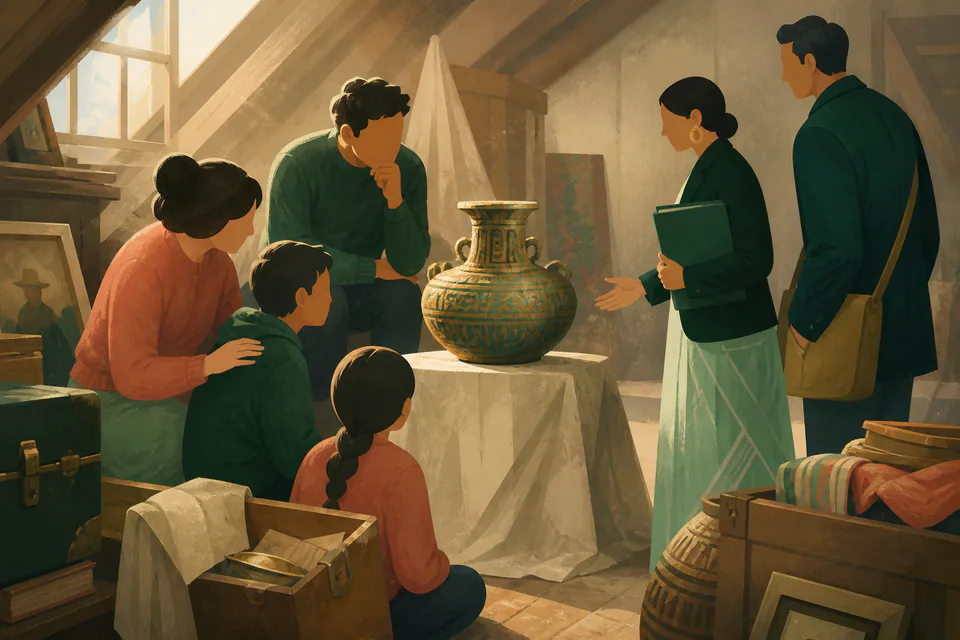
Your grandfather brought home an ancient artifact. A museum wants it back. Do you surrender it?

In your grandfather's attic you discover a beautiful ancient object he brought home while working overseas decades ago. Your family treasures it and his papers suggest the rules were murky. A museum from that country says it belongs to their collection and asks for its return.

Can a family inherit clear ownership of something acquired through unclear power?

Explore this quandary