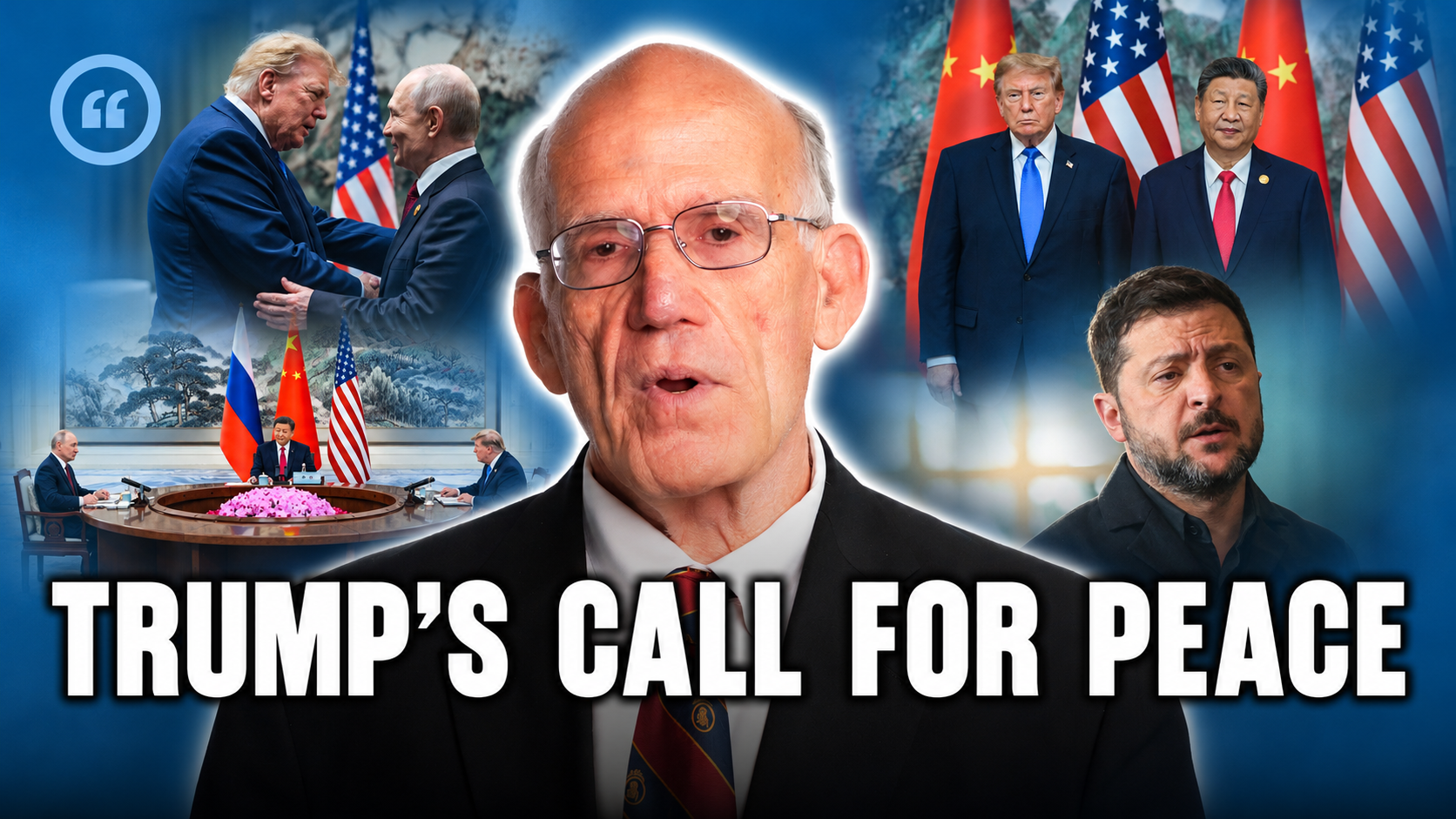
President Donald Trump's first ever trilateral summit with Vladimir Putin and Xi Jinping raises questions about the future of the war in Ukraine and whether a peace agreement could finally be within reach. Victor Davis Hanson and Sami Winc examine the summit on today’s edition of “Victor Davis Hanson: In His Own Words,” discussing Russia's declining influence, potential territorial concessions in Ukraine, and Europe's frustration over Trump's peace negotiations. Hanson criticizes Hillary Clinton's attacks on Trump's diplomacy; he also argues that European leaders have weakened their influence by neglecting defense spending and relying on American military protection. They discuss Elon Musk's shifting political allegiances, and Hanson warns that distancing himself from MAGA may not protect him from Democrat investigations. They also discuss the potential economic benefits of artificial intelligence and the challenges facing Hakeem Jeffries as Democrats prepare to take control of the Hou
What is really happening behind the explosive Nvidia controversy? Has Washington used a personal scandal to wage an even bigger war against China's technological rise? In this conversation, Carl Zha joins Rachel Blevins to unpack the controversy that surrounds Nvidia CEO Jensen Huang. Carl explains why Chinese technology companies increasingly turn toward domestic semiconductor manufacturers such as Huawei and SMIC, why Beijing wants its major tech companies not to purchase Nvidia chips, and how American export restrictions accelerate China's drive toward technological self-reliance. China's open-source AI models now challenge Silicon Valley's business model, which depends on control over expensive computer infrastructure and proprietary AI systems. Does America's semiconductor blockade actually help China become stronger? In This Interview we Discuss the Nvidia controversy: what is behind the allegations that involve Jensen Huang and Alice Wong? Observe Alibaba's AI Ambitions: Chinese
For review: 1. Iraq has reached a compromise with the powerful Iran-backed militia Kataeb Hezbollah, three senior security officials said, after Prime Minister Ali al-Zaidi readied security forces to move against the group. Reflecting the gravity of the situation, Iraqi Shiite political sources said Esmail Qaani, commander of Iran’s elite Revolutionary Guards’ Quds Force, arrived in Baghdad late on Monday to help defuse tensions with Kataeb Hezbollah, Tehran’s most powerful militia ally in Iraq. 2. Lebanese President Joseph Aoun launched a lengthy rebuke of Iran in an Independence Day address, arguing that the Islamic Republic does not have the right to interfere in Lebanon’s internal affairs, as it long has via support for its local terror proxy, Hezbollah. 3. Yemen’s Houthis launched strikes on the Saudi capital Riyadh on Saturday, after vowing reprisals for a “special operation” by the Saudi-led coalition fighting them. The coalition later said it had “intercepted and destroyed” thr
Billions in taxpayer dollars allegedly lost to fraud, Chinese-backed efforts to undermine American energy production, and a growing wave of AI-powered cyber threats. Is America doing enough to protect itself? John Solomon and Amanda Head are joined by Minnesota Congressman Pete Stauber, who discusses the expanding welfare fraud scandal, efforts to hold those responsible accountable, and allegations that Chinese-funded organizations are working to obstruct American mining and energy projects. Stauber also addresses permitting reform and the battle over America's critical mineral independence. Then, American Energy Institute CEO and former Texas state representative Jason Isaac warns that proposed electricity price controls could discourage investment, threaten grid reliability, and ultimately drive energy costs even higher. He also examines China's influence over global oil markets, America's growing energy production, and how AI data centers could generate their own electricity rather
Hey everybody, Tom Bilyeu here. On today’s episode of Impact Theory, we’re taking on a topic that’s got the whole world holding its breath: the escalating crisis between the United States and Iran. As tensions ratchet up, we’re asking the tough questions—how did we get stuck in this “escalation trap,” and what does it mean for America’s global leverage, our economy, and our very sense of security? The conversation focused on why the traditional idea of “strategy” might be failing policymakers, using powerful analogies—like chess versus roulette—to show how doubling down in conflict can spiral out of control. We’ll break down the risks of tactical “wins” that create even bigger crises, the real leverage Iran holds with control of the Strait of Hormuz, and the mounting pressure on President Trump as political support erodes and legacy hangs in the balance. A key theme that emerged is what happens when military might runs into decentralized opposition, and why high-stakes gambles—like the
President Trump meets with Xi Jinping and Vladimir Putin in an unprecedented show of three leaders who understand the power of grand diplomatic gestures. On a special edition of Compass Points, Nick Schifrin is in Shenzhen, China, and has details on the historic meeting and the message it's sending. Plus, Stephanie Sy analyzes the summit with Heather Conley, Patricia Kim and Charles Kupchan. Hosted on Acast. See acast.com/privacy
This week’s EU-UK reset has been long in the making. After the final squeeze by negotiators, will the summit pave the way for a closer relationship and maybe even lead to Britain rejoining the bloc – or are the strains of the Brexit divorce still too raw to overcome? As British Prime Minister Andy Burnham arrives in Brussels to sign off on a deal covering agri-food, energy and youth mobility, Anne McElvoy asks how Europe sees Britain’s desire to move closer to the fold and what might come next. She's joined by Sandro Gozi MEP, who chairs the EU delegation to the EU-UK Parliamentary Partnership Assembly and is a member of the centrist Renew Europe Group. Gozi previously sat in Italy’s parliament and was Secretary of State for European Affairs in the Renzi and Gentiloni governments from 2014 to 2018. Later in the podcast, she'll talk to Nick Thomas-Symonds, who until a few months ago led the UK’s negotiations on the reset deal. He made way for the current EU Relations Minister Hamish Fal
European leaders gather in Berlin for a high-stakes meeting on Ukraine, just as Donald Trump, Vladimir Putin and Xi Jinping hold talks in China. With Washington and Moscow sending conflicting signals about Europe's role in peace negotiations, can the Coalition of the Willing secure a seat at the table — and find the money to keep Ukraine fighting? Also on the podcast: Host Zoya Sheftalovich and Kathryn Carlson discuss the upcoming EU–UK summit in Brussels, where British Prime Minister Andy Burnham is promising a fresh start after Brexit. And mysterious cyber incidents disrupt the European Commission's internal systems. Questions? Comments? Message us on WhatsApp here (https://api.whatsapp.com/send/?app_absent=0&phone=32491050629&text=Hey+Zoya+and+crew%21+&type=phone_number) or at +32 491 05 06 29.
Kaja Kallas may be the EU’s top diplomat, but her role in key diplomatic discussions —whether on Ukraine or Israel — remains murky. Today on the show, Zoya Sheftalovich and Ian Wishart examine the increasingly overlapping job descriptions of Kaja Kallas and the EU’s Commissioner for the Mediterranean, Dubravka Šuica, and unpack what that says about EU diplomacy. Also on the podcast: Is Russian President Vladimir Putin serious about peace? Lithuania’s Foreign Minister Kęstutis Budrys doesn’t think so. And finally, nobody seems to want to live in Luxembourg — which is problematic for the institutions based there looking to recruit more people. How would you feel about moving to Luxembourg? Let us know by messaging us on WhatsApp here (https://api.whatsapp.com/send/?app_absent=0&phone=32491050629&text=Hey+Zoya+and+crew%21+&type=phone_number) or at +32 491 05 06 29. Articles mentioned in this episode: Faking it: Europe thinks Putin isn’t serious about peace. (https://www.politico.eu/articl
Experiencing art in person offers something that online viewing cannot fully replace.
Share your view, then see how readers voted. No sign-in required. This poll is shared across stories.
Do you agree or disagree?
Common Quandary
A Common Quandary to discuss
Another conversation to explore, separate from this news story.
Software says a student cheated with AI. Is that enough to fail the paper?
A teacher suspects several essays were written with AI. Detection software marks one student's work as highly likely to be generated, but the software is known to make mistakes and the student denies using it.
How should responsibility be assigned when evidence is powerful but unreliable?