Listen through the publisher, then discuss the episode here or arrange an in-person Roundtable. Your city determines where to meet.
Roundtables are designed for groups of four, with a shared subject and room for everyone to speak. Come for discussion, with no dating expectation.
Eric Lofgren and Matt McGregor cover a wide range of defense acquisition, industrial base, and technology news. Highlights include the Department of War’s (DOW) new commercial-first procurement policy, the rise of venture-backed “roll-up” platforms for legacy defense suppliers, major funding for Ukrainian unmanned systems (UFORCE’s $700M Series A), and DoD efforts to expand alternative launch capacity via loans to Rocket Lab and Stoke Space. Other key topics: Anduril’s preference for flexible human manufacturing over heavy automation for low-volume/high-complexity systems; the “chicken-and-egg” challenge of demand signals versus production capacity for non-traditionals; Drone Dominance Program Gauntlet 2.5 (dominated by Ukrainian firms); B-21 weapons-release progress; Hermeus–Northrop Grumman partnership; CDAO’s rebrand to Super Intelligence Office; containerized micro-factories for Lucas drones; Lockheed’s $8B missile-production investment (and the disparity in government risk-sharing between traditional and non-traditional firms); Path Robotics’ AI welding scale-up; contested logistics architectures; M-SHORAD palletized short-range air defense requirements; Columbia-class and undersea systems progress versus China’s XLUUV push; C-17 palletized munitions; Golden Dome funding politics; and lessons from Ukraine’s unmanned forces model.
Episode information is provided by the publisher. Listening takes place on the publisher’s service.
Tonight on America At Night with McGraw Milhaven, we explore the legacy of humanity's journey into interstellar space, the cultural phenomenon surrounding one of gaming's most anticipated releases, and the lessons behind a legendary broadcasting career. Ann Druyan, co-creator of Cosmos, Creative Director of the Voyager Interstellar Messaging Project, and widow of Carl Sagan, joins us for Part 2 of our Voyager 1 series. She reflects on the "soul" of Voyager, the Golden Record, and the message humanity sent into the cosmos. Professor Edward Castronova of Indiana University Bloomington examines the extraordinary anticipation surrounding Grand Theft Auto VI, its cultural influence, and the economic power of the gaming industry. Pat Piper, author and former producer for Larry King, discusses his book The Quiet Teacher, sharing its themes and the experiences that shaped his writing. Plus, Mathew Wolfe, our entertainment guru, returns with the latest box office results, movie news, and Hollyw
U.S. Special Operations Command is investing $13.8 million in a limited purchase of the Zeus, a lightweight, shoulder-fired guided missile developed by Aeon Industrial. Weighing approximately 20 pounds, the weapon is intended to give small military units a precision-strike capability against threats that may include armored vehicles, personnel, and drones. This episode examines why SOCOM is exploring smaller guided weapons, the challenges of fighting in dense urban environments, and how the Zeus could fit into the changing arsenal of American special operations forces.
How does a status-sensitive China approach international order—the hierarchical institutional and/or normative orders that can either elevate or demote its positions? Conventional wisdom often accredits rising powers’ strategies to their treatment by established powers, whose (mis)recognition can swing these status-seekers between cooperation or revisionism. However, this simple dynamic between destabilizing rising powers and their superior status-quo-defenders risks truncating a status hierarchy—the vertical ordering of super- and subordination. This project thus theorizes the dynamic of multiple-audience status-seeking to comprehensively capture the diverse sources and consequences of China’s status (dis)satisfaction. Navigating recognitiongranting great powers and deference-paying smaller powers, China chooses its international order strategy according to four status scenarios with distinct socio-psychological and social forces: (1) cooperation vis-à-vis status satisfaction (high re
A China-linked cyberespionage group known as Vapor Panda reportedly used artificial intelligence to accelerate attacks against more than 200 organizations across at least 14 countries. According to CrowdStrike’s October 2026 findings, the attackers employed an AI-assisted penetration-testing framework called ARTEX, combining DeepSeek with another commercial AI model to automate portions of their operations. This episode examines how artificial intelligence is changing the speed of intelligence collection, why autonomous hacking tools concern counterintelligence agencies, and what happens when cyberoperatives can conduct reconnaissance and exploitation at a scale far beyond traditional human teams.
For review: 1. President Trump Meets with Russian & Chinese Leaders; Agreement on Four points: promoting reform” at the UN; increasing the production and supply of refined petroleum products; warning the ICChttps://www.nbcnews.com/world/europe/role-international-criminal-court-icc-rcna604499“and similar bodies” not to abuse their power, and reducing the risk of nuclear war. 2. Saudi Arabian authorities say the Houthis have targeted a tower in the financial centre of the capital, Riyadh, hours after the Saudi-led coalition says it has intercepted missiles fired towards Riyadh and the country’s southern region. 3. Israeli Prime Minister Benjamin Netanyahu has claimed in recent meetings with top ministers and security officials that “an operation against Iran is unavoidable,” Channel 13 (Israel) said Wednesday,. The network also quoted an unnamed senior IDF officer as saying the Israeli military and the US military’s Central Command have “shared and approved plans” and that “the question
John and Victor revisit some of the Military Retirement Podcast’s most useful conversations from 2025: how to find purpose after military service, recover from the pace and mission focus of military life, reconnect with family, and build a meaningful next chapter. This wide-ranging retrospective also covers practical AI use, civilian job searching and networking, reading recommendations, Space-A travel, a Camino de Santiago pilgrimage, veteran organizations, USO access, VA-related education and care discussions, and pending veterans legislation. It is designed for service members preparing to separate or retire, military retirees, veterans, spouses, and anyone navigating the transition to civilian life. The discussion returns often to a simple idea: retirement is not only a financial or administrative milestone. It can be a period for rest, reflection, relationships, learning, travel, service, and intentional planning. Episode Timestamps 00:01:20 Podcast origins and 2025 review 00:03:2
In this episode of Acquisition Talk, host Eric Lofgren debates the proposal to create Autonomous Warfare Command (AUTOWARCOM), a new four-star functional combatant command intended to accelerate the fielding of unmanned and autonomous systems. The target stand-up date is October 1, 2027, with interim work led by Project Agen Corps. Bryan Clark (Hudson Institute) argues in favor of a CYBERCOM-like model: a functional combatant command that serves as a central demand-signal and clearinghouse for the geographic combatant commands without becoming an independent service or owning its own personnel and acquisition pipelines. He contends the core problem is one of demand, not supply—the services already have funding and mature commercial technologies, but lack a clear joint customer and operational problem set to prioritize against. A focused AUTOWARCOM could help define kill chains, force packages, and concepts of employment so the services can field systems more quickly, ideally working it
In this week’s episode of Acquisition Talk, hosts discuss a packed slate of defense tech and acquisition headlines with Matt McGregor of the Defense Tech and Acquisition Substack. Topics include the delivery of more than 25,000 autonomous and counter-unmanned systems to CENTCOM, a new world speed record for a small jet-powered drone, Shield AI’s ExBat VTOL concept and its $5.3 billion acquisition of Echodyne, General Atomics’ hybrid-electric stealth drone, SOCOM’s low-cost Zeus shoulder-fired missile, and Lockheed’s Lamprey undersea vehicle that recharges from host ships. The conversation also covers subterranean and fiber-optic drone experiments, the role of super-intelligence in military decision-making, challenges unifying the fragmented S&T enterprise, expeditionary robotic factories for Lucas drones, private equity versus venture capital in the AI era, the potential I-81 defense industrial corridor, an Office of Strategic Capital loan to a drone company, and the implications of De
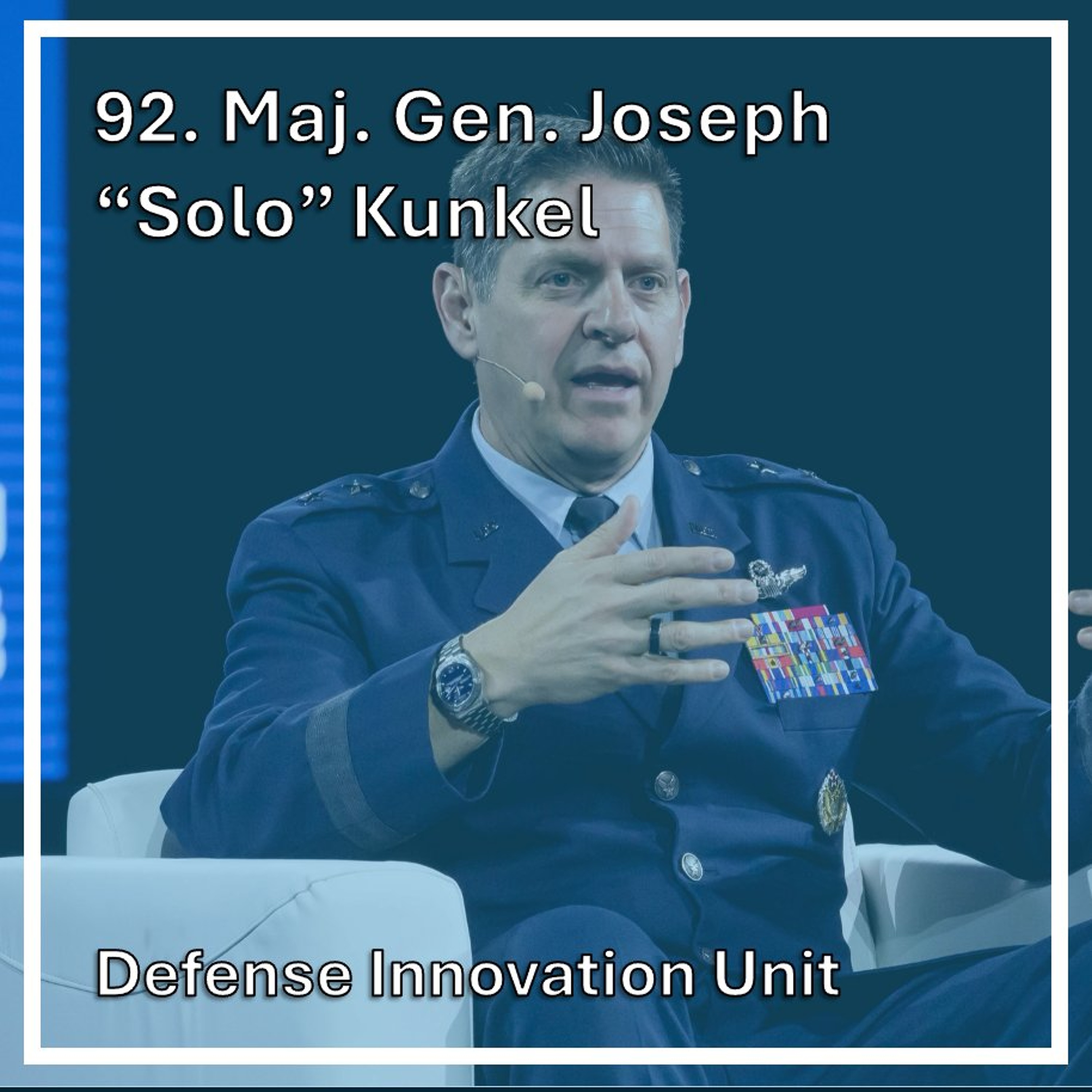
In this episode, Major General Joseph “Solo” Kunkel, military deputy to the Defense Innovation Unit, discusses how operational problems in the Pacific are driving a new approach to force design and acquisition. He explains the Mission Area 1/2/3 framework (and the emerging “Edge force”), why Collaborative Combat Aircraft are better understood as extensions of the traditional force rather than pure Edge capabilities, and how smaller, posturable systems change basing and partner relationships. Solo outlines the thinking behind an Autonomous Warfare command focused on rapid adaptation cycles measured in days and weeks rather than years, its nesting relationship with the Direct Reporting Program Manager for Unmanned Systems and DIU, and why decisive mass requires deep integration with the services rather than a pure SOCOM-style model. He also covers DIU’s deliberate shift to carry promising capabilities past the prototype stage into LRIP—until a service can absorb them in its own budget—an
Retraining programs should provide financial support as well as new skills.
Share your view, then see how readers voted. No sign-in required. This poll is shared across stories.
Do you agree or disagree?
Common Quandary
A Common Quandary to discuss
Another conversation to explore, separate from this news story.
An old friend refuses to use someone's new name. Do you correct them at the reunion?
At a reunion, an old friend repeatedly uses the name a former classmate had years ago. They say shared history gives the old name affectionate meaning; the classmate has clearly introduced themselves with a different name.
When does preserving your shared past deny who someone is now?