In this episode of Acquisition Talk, host Eric Lofgren debates the proposal to create Autonomous Warfare Command (AUTOWARCOM), a new four-star functional combatant command intended to accelerate the fielding of unmanned and autonomous systems. The target stand-up date is October 1, 2027, with interim work led by Project Agen Corps. Bryan Clark (Hudson Institute) argues in favor of a CYBERCOM-like model: a functional combatant command that serves as a central demand-signal and clearinghouse for the geographic combatant commands without becoming an independent service or owning its own personnel and acquisition pipelines. He contends the core problem is one of demand, not supply—the services already have funding and mature commercial technologies, but lack a clear joint customer and operational problem set to prioritize against. A focused AUTOWARCOM could help define kill chains, force packages, and concepts of employment so the services can field systems more quickly, ideally working it
Eric Lofgren and Matt McGregor cover a wide range of defense acquisition, industrial base, and technology news. Highlights include the Department of War’s (DOW) new commercial-first procurement policy, the rise of venture-backed “roll-up” platforms for legacy defense suppliers, major funding for Ukrainian unmanned systems (UFORCE’s $700M Series A), and DoD efforts to expand alternative launch capacity via loans to Rocket Lab and Stoke Space. Other key topics: Anduril’s preference for flexible human manufacturing over heavy automation for low-volume/high-complexity systems; the “chicken-and-egg” challenge of demand signals versus production capacity for non-traditionals; Drone Dominance Program Gauntlet 2.5 (dominated by Ukrainian firms); B-21 weapons-release progress; Hermeus–Northrop Grumman partnership; CDAO’s rebrand to Super Intelligence Office; containerized micro-factories for Lucas drones; Lockheed’s $8B missile-production investment (and the disparity in government risk-sharing
In this week’s episode of Acquisition Talk, hosts discuss a packed slate of defense tech and acquisition headlines with Matt McGregor of the Defense Tech and Acquisition Substack. Topics include the delivery of more than 25,000 autonomous and counter-unmanned systems to CENTCOM, a new world speed record for a small jet-powered drone, Shield AI’s ExBat VTOL concept and its $5.3 billion acquisition of Echodyne, General Atomics’ hybrid-electric stealth drone, SOCOM’s low-cost Zeus shoulder-fired missile, and Lockheed’s Lamprey undersea vehicle that recharges from host ships. The conversation also covers subterranean and fiber-optic drone experiments, the role of super-intelligence in military decision-making, challenges unifying the fragmented S&T enterprise, expeditionary robotic factories for Lucas drones, private equity versus venture capital in the AI era, the potential I-81 defense industrial corridor, an Office of Strategic Capital loan to a drone company, and the implications of De
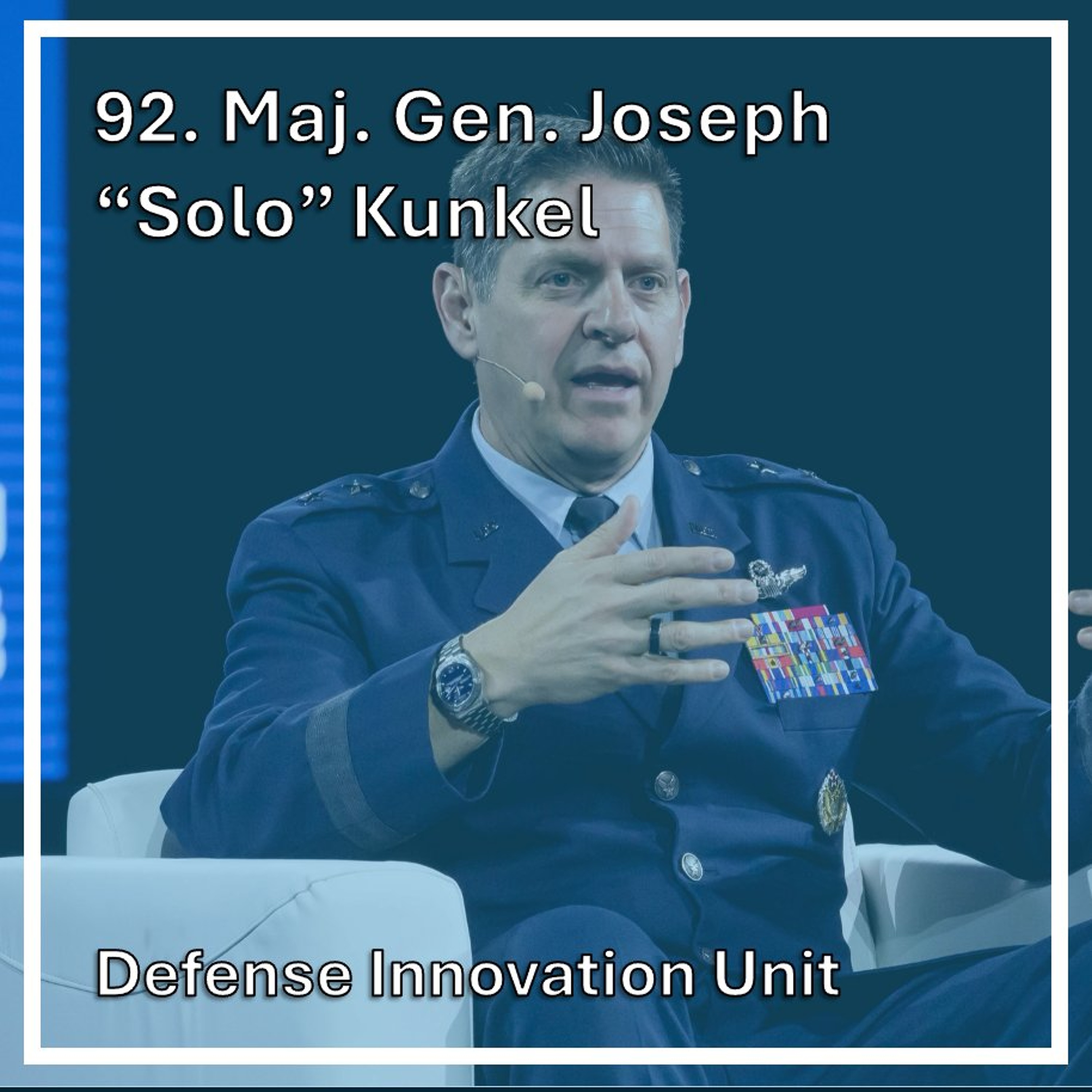
In this episode, Major General Joseph “Solo” Kunkel, military deputy to the Defense Innovation Unit, discusses how operational problems in the Pacific are driving a new approach to force design and acquisition. He explains the Mission Area 1/2/3 framework (and the emerging “Edge force”), why Collaborative Combat Aircraft are better understood as extensions of the traditional force rather than pure Edge capabilities, and how smaller, posturable systems change basing and partner relationships. Solo outlines the thinking behind an Autonomous Warfare command focused on rapid adaptation cycles measured in days and weeks rather than years, its nesting relationship with the Direct Reporting Program Manager for Unmanned Systems and DIU, and why decisive mass requires deep integration with the services rather than a pure SOCOM-style model. He also covers DIU’s deliberate shift to carry promising capabilities past the prototype stage into LRIP—until a service can absorb them in its own budget—an