Nobody Said Those Were Your Only Options (Jo Moment)
7 min
Listen through the publisher, then discuss the episode here or arrange an in-person Roundtable. Your city determines where to meet.
Roundtables are designed for groups of four, with a shared subject and room for everyone to speak. Come for discussion, with no dating expectation.
You can spend years perfecting choices that were never yours to begin with. We found a surprisingly sharp way to spot that pattern using nothing more than a plate of snacks and one instruction: choose three things. What happens next is the real insight. When we pressure test the “obvious” pick, some of us realise we don’t actually want any of what we selected, we just chose what was available. From there, we dig into the mindset shift that changes everything: the difference between optimising what’s in front of you and naming what you truly want. We connect it to Stephen Bartlett’s idea of paper walls, the invisible rules that feel like brick until you touch them. Careers, relationships, living arrangements, everyday decisions: so many of us are pros-and-consing ourselves into a life that looks sensible while our real desire sits on the next table. We also talk about permission, and why it comes in two steps. First, letting yourself want something that hasn’t been presented yet. Second, backing yourself enough to ask, even when your old conditioning says it makes you greedy, entitled, or “too much”. Not everything is possible, but far more is possible than we assume, and the fastest way to find out is to ask the question. If you’ve been settling for the strawberry, this is your nudge to go looking for your cashews. We start 4th December. We know high achievers, because we are one. If something landed today, there's more where that came from. ️https://www.balanceinstitute.com/podcastwww.balanceinstitute.com (http://www.balanceinstitute.com/) @therealjostone (https://www.instagram.com/therealjostone/)
Episode information is provided by the publisher. Listening takes place on the publisher’s service.
There's a certain kind of silence that follows a sentence you wish you could take back. You know the one. The room goes quiet. The other person's face changes. And in that instant you'd give almost anything to reach into the air, grab those words, and stuff them back into your mouth. But you can't. Once they leave you, they belong to the world. Uploaded 20-08-26 Most people never examine this. They treat the tongue as something automatic, something that runs on its own like breathing. Something happens, they feel a reaction, and out comes the reply. No gap. No pause. No decision. Just stimulus and response, thousands of times a day. Here is the truth: almost every serious wound in a relationship didn't come from something you did. It came from something you said. A fist bruises a body. A sentence breaks a spirit. The body forgets. The spirit remembers everything. This seminar walks through the things you must understand about governing your own mouth — the gap, the true cost, the pause
This week on The Necessary Conversation, it's Chad, Haley, and Mary Lou. Bob is still recovering but sent in a video message about Trump calling Putin his friend that we watch together. 🇷🇺 Trump held the first-ever three-way talks with Putin and Xi, called it a "12 out of 10," and produced nothing. Then at a press conference he called Putin his friend — and when asked if Putin is a friend to America, the president of the United States said, "I can't speak to America." That same day, Trump's friend Putin launched massive strikes into Ukraine, hit Poland with two missiles — an act of war against a NATO ally — then struck near a Ukrainian restaurant and drone-bombed the first responders, killing a 7-year-old child and a 20-year-old paramedic. We watch Bob's video and ask Mary Lou: is Russia our friend? 🇨🇳 The House Foreign Affairs Committee revealed Trump's Commerce Department approved nearly 880,000 advanced AI chips for Chinese military-linked companies including Alibaba, Tencent, a
Master the skills that change lives — enroll in your free human behavior course today: https://nci.university/learn Uploaded 15-01-26 EXECUTIVE SUMMARY: Video: What It Feels Like to See Into People Purpose: Reframe how human behavior is actually driven and perceived Outcome: Permanent shift in how you experience people and conversations CORE IDEA: Human behavior is not driven by beliefs, opinions, or logic. Those are after-action reports. Behavior is driven by the nervous system’s constant assessment of: • safety • approval • power • avoidance of shame Decisions are made before conscious thought. Beliefs are constructed afterward to justify what already happened. WHY THIS MATTERS: Most people spend their lives interacting with: • beliefs • arguments • explanations • surface narratives As a result, they miss the layer where real decisions are made. This video focuses on that lower layer — the one that actually governs: • conflict • influence • attraction • resistance • leadership • trus
Happy Sunday! Welcome to Heal Squad’s The Sunday Set Up. Life lessons to help you start the week. How much of success comes down to simply showing up? This week, we talk keeping an open mind, taking chances, and recognizing the doors that open along the way. From Olympic athletes appearing on national television alongside Mercedes Moné to performers who keep showing up week after week hoping for their big break, we explore why success isn't always about talent or luck. Sometimes it's about making connections, putting in the effort, and being willing to try without knowing what we'll get in return. We talk knowing when to stop investing time in people who aren't willing to help themselves, and why even experiences that don't work out can teach us something valuable. The takeaway: don't wait for the perfect moment or expect someone else to make things happen. Be willing to take a chance, walk through the doors that open, and remember that half of life is just showing up. Plus, a little b
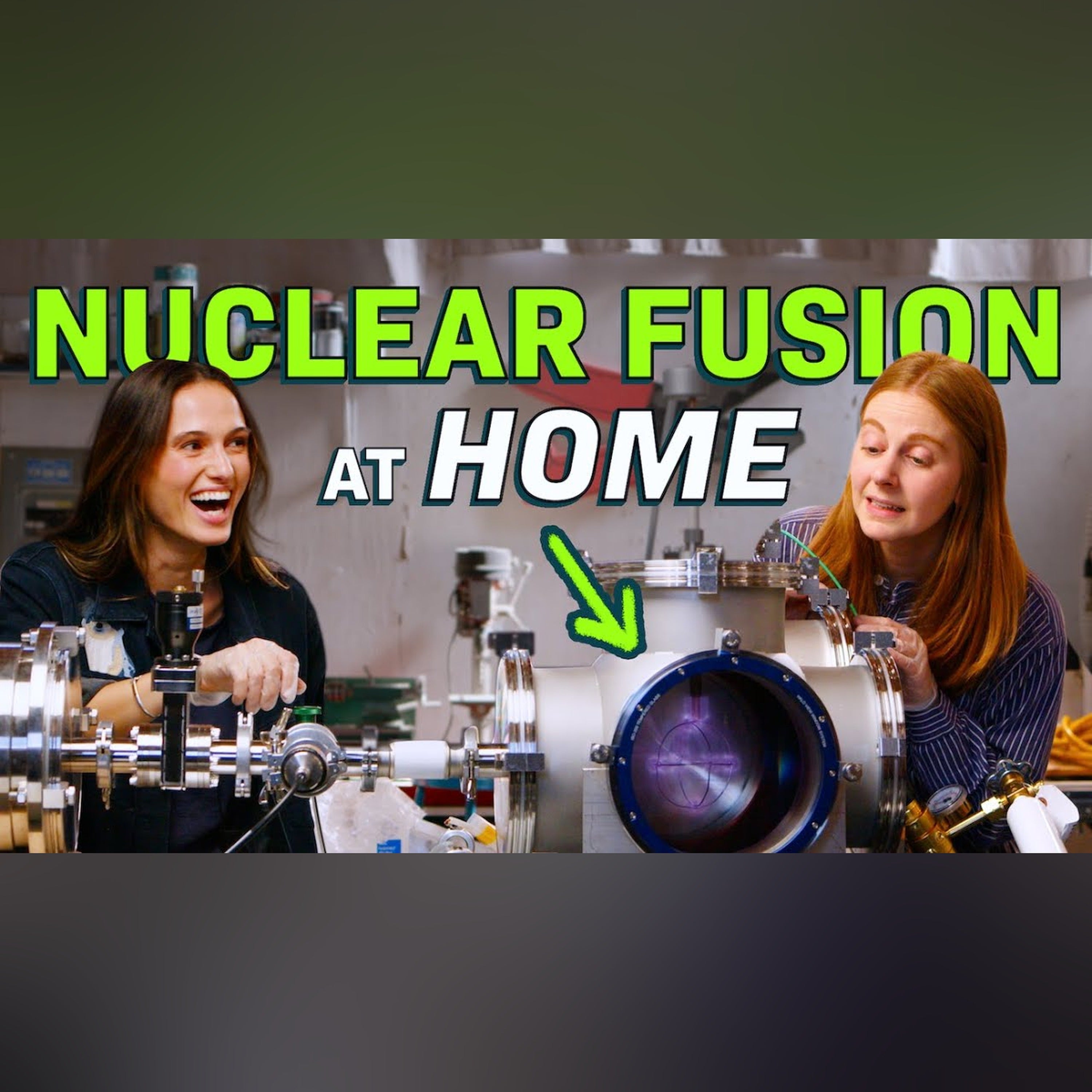
We attempted nuclear fusion. In Simone’s workshop. Disclaimer: This build was supervised by experts at Helion. Do not try this at home. I still can’t believe this video really happened. Back in May, I interviewed Helion CEO David Kirtley. I was trying to understand nuclear fusion: Is nuclear fusion possible now? How does fusion actually work? And most importantly, is nuclear fusion the future? Then, at the end of the interview, I asked David about headlines I’d seen about people building nuclear fusion devices in their backyards - what were they doing? “Oh,” David replied, “you can build one.” What followed is the biggest adventure yet on Huge If True. Together with the team at Helion and my friend fellow YouTuber Simone Giertz, we BUILT A NUCLEAR FUSION DEVICE to show how nuclear fusion works, what the big remaining challenges are, and how it might help us all in the future. Then, the last step was to try to turn it on… WATCH "FUSION, EXPLAINED: PART 1" HERE: https://youtu.be/piPbnKdv
Get the 200+ Page Optimal Living Daily Workbook (PDF) - Free. Want to turn today's episode into an actionable plan? Episode 4233: Kate Galliett explains three reasons we make health, fitness and life harder than they need to be: ignoring how the body works as a connected system, trusting only extreme intensity, and leaking the energy that fuels motivation and discipline. She makes the case that appropriate effort, not maximum effort, is the only sustainable path to lasting results. Read along with the original article(s) here: https://fitforreallife.substack.com/p/why-you-make-everything-harder-than Quotes to ponder: "The better way is to give appropriate effort and get appropriate results. This is the only sustainable way." "If you try and live at the extremes, you will constantly ping-pong back and forth from one extreme to the other." "Just imagine - you might not actually lack discipline after all, you just might be leaking energy that feeds your ability to be disciplined." We spen
Everyone’s looking to you for answers. Your team is frightened, angry, or both. And quietly, you’re wondering what the hell is going to happen too. With restructures, redundancies and re-orgs rolling through workplaces right now, this one is for the woman holding everyone steady while her own certainty disappears. I talk about over-responsibility, the pattern that gets turned right up during organisational change: anticipating everyone’s emotions, smoothing things over, trying to make a horrible decision feel less horrible. We look at why being useful can be a way of not feeling helpless, and at the distinction that changes how you lead through uncertainty: you can care without carrying. Then there’s the part nobody plans for. The org chart is final, the names are in the boxes, and you’re expected to re-engage the team and hit KPIs you’re already behind on. Meanwhile you’ve been running on cortisol and adrenaline for months, and the crash is coming. Sometimes the person who looked stro
“Busy” is the word we reach for when we don’t know what else to say, but it’s also a word that can quietly steal the colour from our lives. I’ve noticed how often it shows up as a reflex answer, especially as the year ramps up, and I wanted to challenge it head-on. Not with a prettier replacement word, and not with productivity guilt, but with a simple reset: say what’s actually true. We unpack where “busy” got its power, especially early in our careers when a full workload looked like trust and competence. The problem is we often keep that old equation running long after it stops serving us. I also explore the idea that busyness is used as a signal, and how the message we think we’re sending (“I’m important, I’m in demand”) can land very differently (“I’m overwhelmed, I’m not on top of things”). Then we bring it home to the Australian end-of-year reality: deadlines before holiday shutdowns, school concerts, graduations, Christmas logistics, social catch-ups, and the traditions we actu
A day full of emails, quick fixes and crossed-off tasks can feel wildly productive, but it can also be the perfect hiding place. I’m talking about the moment so many senior women recognise: your real value is no longer what you can tick off a list, it’s the outcomes you create through judgement, direction, decisions, and the courage to say no. I explore why the workplace trains us to equate visible effort with worth, then quietly changes the rules as we rise. The higher you go, the more “invisible work” becomes the job: getting someone unstuck with one conversation, spotting what others miss, preventing months of wrong turns, and leaving space so your team can learn instead of being rescued. We also look at the productivity trap that keeps brilliant leaders in the weeds, and how constant responsiveness can become an avoidance strategy when the most valuable problems are ambiguous and uncomfortable. Then I challenge a belief that fuels burnout for high achievers: if it was easy, it must
Sporting rivals should be able to enjoy competition without hostility between supporters.
Share your view, then see how readers voted. No sign-in required. This poll is shared across stories.
Do you agree or disagree?
Common Quandary
A Common Quandary to discuss
Another conversation to explore, separate from this news story.
A disgraced billionaire's name is on the beloved campus library. Does it come down?
A major donor funded a beloved public building decades ago. New evidence shows they also caused serious harm that was legal and accepted by many peers at the time. Removing the name may jeopardize future donations.
What does an institution owe the truth when its history funded the present?