Listen through the publisher, then discuss the episode here or arrange an in-person Roundtable. Your city determines where to meet.
Roundtables are designed for groups of four, with a shared subject and room for everyone to speak. Come for discussion, with no dating expectation.
View full lesson: http://ed.ted.com/lessons/plato-s-allegory-of-the-cave-alex-gendler Uploaded 17-03-15 Twenty four hundred years ago, Plato, one of history’s most famous thinkers, said life is like being chained up in a cave forced to watch shadows flitting across a stone wall. Beyond sounding quite morbid, what exactly did he mean? Alex Gendler unravels Plato's Allegory of the Cave, found in Book VII of "The Republic." Lesson by Alex Gendler, animation by Stretch Films, Inc.
Episode information is provided by the publisher. Listening takes place on the publisher’s service.
Unock the free Masterclass: https://nci.university (https://nci.university/) Uploaded 03-07-25 Before you spoke your first word, the world had already assigned you an identity—names, roles, expectations, and limitations. This video is a decoding of that lie. In this 10-minute deep dive, we explore the hidden machinery behind identity—psychologically, philosophically, and socially. With insight from Carl Jung, Plato, and Social Identity Theory, we confront the truth: most of what you think of as “you” was scripted for you. ⸻ In this video: • Carl Jung’s Shadow and the hidden self • Plato’s Allegory of the Cave and waking up to illusion • The roots of identity through memory, tribe, and opposition • How we’re trained to obey, belong, and perform • The psychological cost of not knowing who you are • The path to reclaiming authorship over your life ⸻ For the Seekers: This is not self-help. This is not motivation. This is for those who suspect the story they’re living isn’t their own. ⸻ If
You've gotten very good at pretending you don't feel it. Uploaded 21-08-26 Maybe it's a conversation with someone you love. Someone you work for. A partner, a parent, a friend who's been quietly taking more than they give. Or the hardest one of all — a conversation with yourself, the one where you finally admit something you've refused to say out loud for years. You know exactly which one I'm talking about. You felt it the moment I said the word. A name came up, or a face, and your stomach did something small and unpleasant, and you pushed it back down where it's been living. That flinch is the most honest thing that's happened to you all day. Here is the truth: the life you say you want — the freedom, the peace, the relationship, the income, the respect — there's a very good chance it's on the other side of one conversation you keep refusing to have. Not ten. One. This seminar unpacks the single mechanic behind a stuck life: the necessary conversation you keep treating like a locked d
Have you ever told someone, "Thanks a million!" or claimed you have "a million toys to clean up"? We use the word "million" all the time to mean "a whole lot," but have you ever stopped to wonder just how big a real million actually is? Join Mira and Finn on a mind-blowing math adventure as they discover the quiet power of giant numbers! Imagine counting one number every single second without ever stopping to eat or sleep. It wouldn't take a few hours or a long weekend—it would take you about eleven and a half days just to reach one million! And what about its giant neighbor, the billion? Counting to a billion the exact same way would take a whopping thirty-two years. That's a grown-up's whole life so far! In this amazing episode, we won't just look at numbers on a page; we’ll learn to feel their true size. Find out how much space a million grains of rice would take up, and discover exactly how far a million footsteps would carry you. Get ready to stretch your brain and learn why being
In 1620, a small ship called the Mayflower crossed the Atlantic carrying English settlers in search of a new life. Their arrival in North America became one of the most familiar stories in American history, but the reality behind the legend was far more complicated than the traditional Thanksgiving tale suggests. Discover why the Pilgrims left England, what their dangerous voyage was really like, and how they survived their first winter in an unfamiliar land. Explore their encounters with the Wampanoag people, the role of Tisquantum, also known as Squanto, and the assistance that helped the struggling settlers establish their colony. Uncover what happened at the harvest gathering of 1621, who actually attended, what was served, and how this event became connected to the modern Thanksgiving holiday. Follow the history beyond the familiar celebration and discover the people, cultural encounters, and historical realities behind the Mayflower story. Boring History for Sleep — Soft stories
Have you ever seen pictures of giant stone heads sitting in the grass and wondered how they got there? Get ready for a mind-blowing adventure to one of the most remote places on Earth: Rapa Nui, also known as Easter Island! About 800 years ago, expert Polynesian sailors found this tiny island in the middle of the Pacific Ocean using only the stars and ocean currents to guide them. Once there, they carved nearly a thousand massive stone statues called moai! But here is the biggest surprise: these statues aren't just heads—they have full bodies buried underground! Some weigh as much as 40 cars, and the islanders moved them without wheels, cranes, or metal tools. How did they do it? The local legends say the statues literally walked to their places, waddling side to side with the help of ropes and incredibly smart human engineering! Join Mira and Finn as they uncover the secrets of the moai, find out how the island got its English name from a Dutch captain, and learn all about the giganti
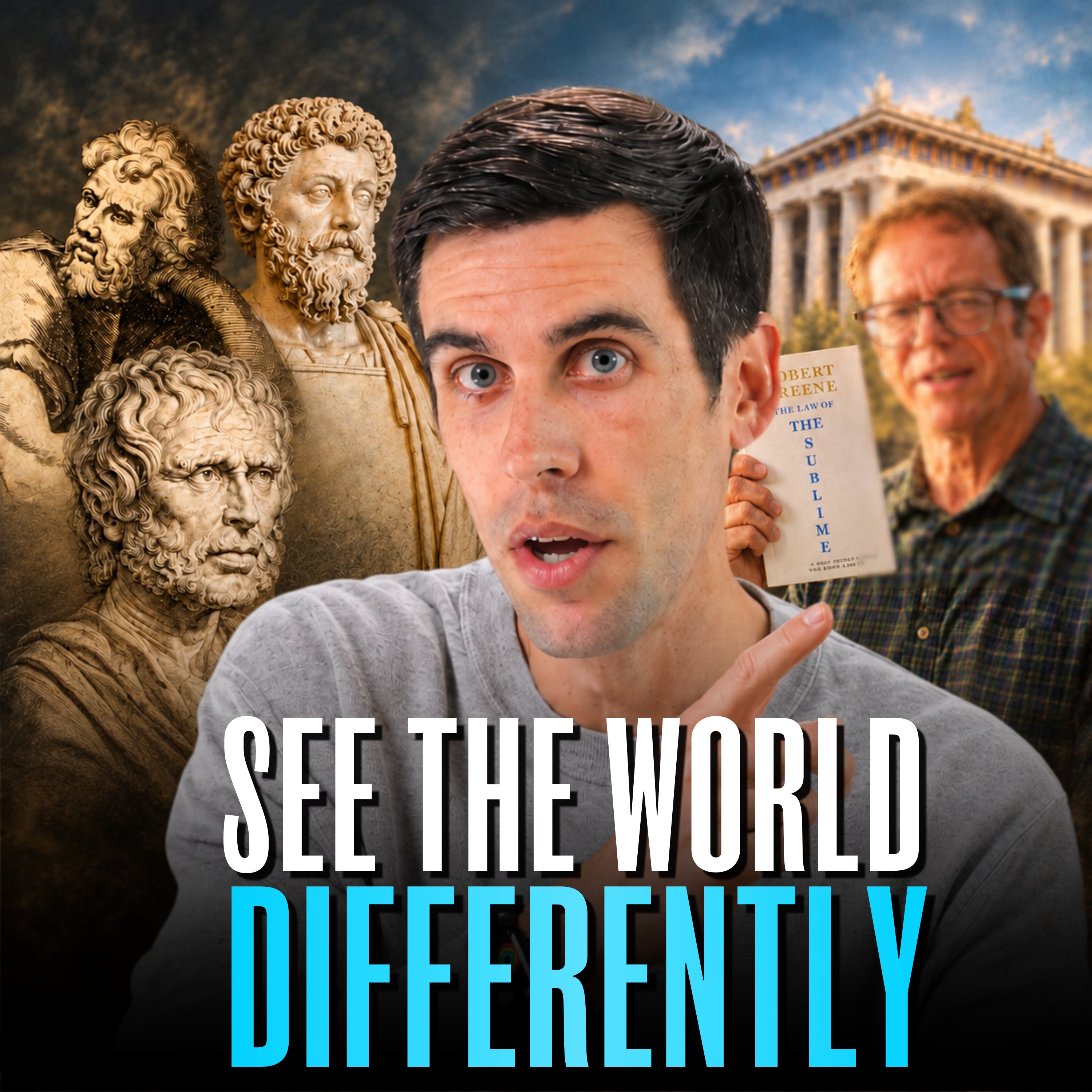
We spend so much time caught up in the demands of everyday life that we forget to appreciate how extraordinary it is to be alive. Inspired by Robert Greene's new book, The Law of the Sublime (https://www.thepaintedporch.com/products/the-law-of-the-sublime?_pos=13&_sid=e0d7a8c03&_ss=r), Ryan explores what the Stoics understood about finding beauty in the ordinary, seeing life from a different perspective, recognizing our connection to something bigger than ourselves, and remembering just how lucky we are to be alive. Watch this episode (https://www.youtube.com/watch?v=eCjqWcbsK1M) on YouTube: https://www.youtube.com/watch?v=eCjqWcbsK1M Watch the NEW Robert Greene Daily Stoic Podcast Episode HERE (https://www.youtube.com/watch?v=Kp_wYiuPD_o): https://www.youtube.com/watch?v=Kp_wYiuPD_o If you want to get your own dedicated privacy specialist and an emergency threat response team who can protect the privacy of you and your family, go to https://incogni.com/dailystoic Hosted on Acast.
View full lesson: http://ed.ted.com/lessons/surviving-a-nuclear-attack-irwin-redlener The face of nuclear terror has changed since the Cold War, but disaster-medicine expert Irwin Redlener reminds us the threat is still real. He looks at some of history's farcical countermeasures and offers practical advice on how to survive an attack. Talk by Irwin Redlener.
Explore what makes polio so dangerous, what is causing the 21st century resurgence of cases, and how we can eradicate the disease. -- In 1952, polio was everywhere: killing or paralyzing roughly half a million people annually. Yet just 10 years later, paralytic polio cases in the US dropped by 96% and we were on track to get rid of polio for good. But in recent years, the virus started striking back. So, what’s behind these recent spikes? Explore the dangers of poliovirus and the possibility of eradicating this deadly disease. Directed by Anton Bogaty. This video made possible in collaboration with Gates Ventures Learn more about how TED-Ed partnerships work: https://bit.ly/TEDEdPartner A special thanks to Ananda Bandyopadhyay, Amber Zeddies, and Kathleen O'Reilly who provided information and insights for the development of this video. Support Our Non-Profit Mission ---------------------------------------------- Support us on Patreon: http://bit.ly/TEDEdPatreon Check out our merch: htt
Todd Humphreys forecasts the near-future of geolocation when millimeter-accurate GPS "dots" will enable you to find pin-point locations, index-search your physical possessions ... or to track people without their knowledge. And the response to the sinister side of this technology may have unintended consequences of its own. (Filmed at TEDxAustin.) Uploaded 26-06-13 Talk by Todd Humphreys.
Public spaces should allow peaceful disagreement while preventing intimidation.
Share your view, then see how readers voted. No sign-in required. This poll is shared across stories.
Do you agree or disagree?
Common Quandary
A Common Quandary to discuss
Another conversation to explore, separate from this news story.
You love the free sample but will never buy it. How many times may you circle back?
A warehouse store is offering delicious samples. You have no intention of purchasing the product, but the employee seems bored and has trays to spare. After taking two, you consider removing your jacket and returning for a third.
Is exploiting generosity wrong when the giver appears not to care?