Listen through the publisher, then discuss the episode here or arrange an in-person Roundtable. Your city determines where to meet.
Roundtables are designed for groups of four, with a shared subject and room for everyone to speak. Come for discussion, with no dating expectation.
The late Marty Rosenblatt, MS, was a computational physicist who spent his career working in the military and industrial sectors. He was the president of the Applied Precognition Project. In this video rebooted from 2016, he traces the origin of his work in applied precognition to the development of “remote viewing” and its use by the U.S. military intelligence establishment in the mid-1970s. He specifically points to the associative remote viewing (ARV) methodology used for financial forecasting. Several published studies have used this methodology successfully for financial forecasting. He discusses some paradoxes associated with precognition and how he, personally, has come to resolve them. (Recorded on January 6, 2016) Check out New Thinking Allowed's AI chatbot. To order a copy of Charles T.
Episode information is provided by the publisher. Listening takes place on the publisher’s service.
In this conversation I’m speaking to Rebecca Olive. Rebecca is a feminist cultural studies researcher whose work explores how everyday sport and leisure are shaped by cultural politics, relationships between humans and non-humans, environmental wellbeing, and social media. My understanding of her research is she looks very closely at why people do things that make up a culture, and the meaning of everyday practices in people’s lives. We chatted about why people are drawn to the ocean in the first place and what keeps us coming back. How swimming and surfing becomes more than recreation, and into an emotional relationship that shapes how we understand risk, shark risk, and our place in it. She also discusses how storytelling, social media and drone footage may influence our perception of danger and coexistence. Apologies, I’m a Bit under the weather in this one and in the opening couple of minutes, probably would have been a good idea to have the microphone turned on. Recorded at 3pm on
Your data is being sold right now. My sponsor Aura will find the brokers selling it and remove you automatically. Try 14 days for free: https://aura.com/nci Uploaded 27-08-26 DISCOVER NCI-1: https://nci.university/nci-1v2?utm_source=chase_youtube&utm_medium=social_video&utm_campaign=nci1_promo (https://nci.university/nci-1v2) Please note that the content provided in this broadcast is for informational and educational purposes only and should not be construed as legal, medical, financial, or professional advice. No material in this communication establishes any form of professional relationship that is privileged or confidential. The insights and opinions expressed herein solely reflect the personal views of the speaker based on his extensive expertise and academic background in his field of study. These are purely personal opinions and should not be taken as direct statements of fact about any individuals, whether stated explicitly or implied. Any opinion shared in this broadcast is dr
Merriam-Webster's Word of the Day for November 22, 2026 is: copacetic • \koh-puh-SET-ik\ • adjective Copacetic (less commonly spelled copasetic or copesetic) describes things that are very satisfactory. // Worry not: I assure you that everything’s copacetic. See the entry > (https://www.merriam-webster.com/dictionary/copacetic) Examples: “We will be blessed with a second lunar eclipse on this night, but it won’t quite be total: at maximum, a little more than 90 percent of the moon will fall into Earth’s shadow. The event will start at 10:35 P.M. EDT, and the maximum eclipse will occur just after midnight. It won’t be as cool as the March eclipse, but the timing will be a lot more copacetic.” — Phil Plait, Scientific American, 9 Jan. 2026 Did you know? Copacetic (with many variant spellings) is probably better known for competing theories of its origin than for any record of unconscious everyday use in American English. The first written occurrence of the word thus far detected (as copa
This week on The Necessary Conversation, it's Chad, Haley, and Mary Lou. Bob is still recovering but sent in a video message about Trump calling Putin his friend that we watch together. 🇷🇺 Trump held the first-ever three-way talks with Putin and Xi, called it a "12 out of 10," and produced nothing. Then at a press conference he called Putin his friend — and when asked if Putin is a friend to America, the president of the United States said, "I can't speak to America." That same day, Trump's friend Putin launched massive strikes into Ukraine, hit Poland with two missiles — an act of war against a NATO ally — then struck near a Ukrainian restaurant and drone-bombed the first responders, killing a 7-year-old child and a 20-year-old paramedic. We watch Bob's video and ask Mary Lou: is Russia our friend? 🇨🇳 The House Foreign Affairs Committee revealed Trump's Commerce Department approved nearly 880,000 advanced AI chips for Chinese military-linked companies including Alibaba, Tencent, a
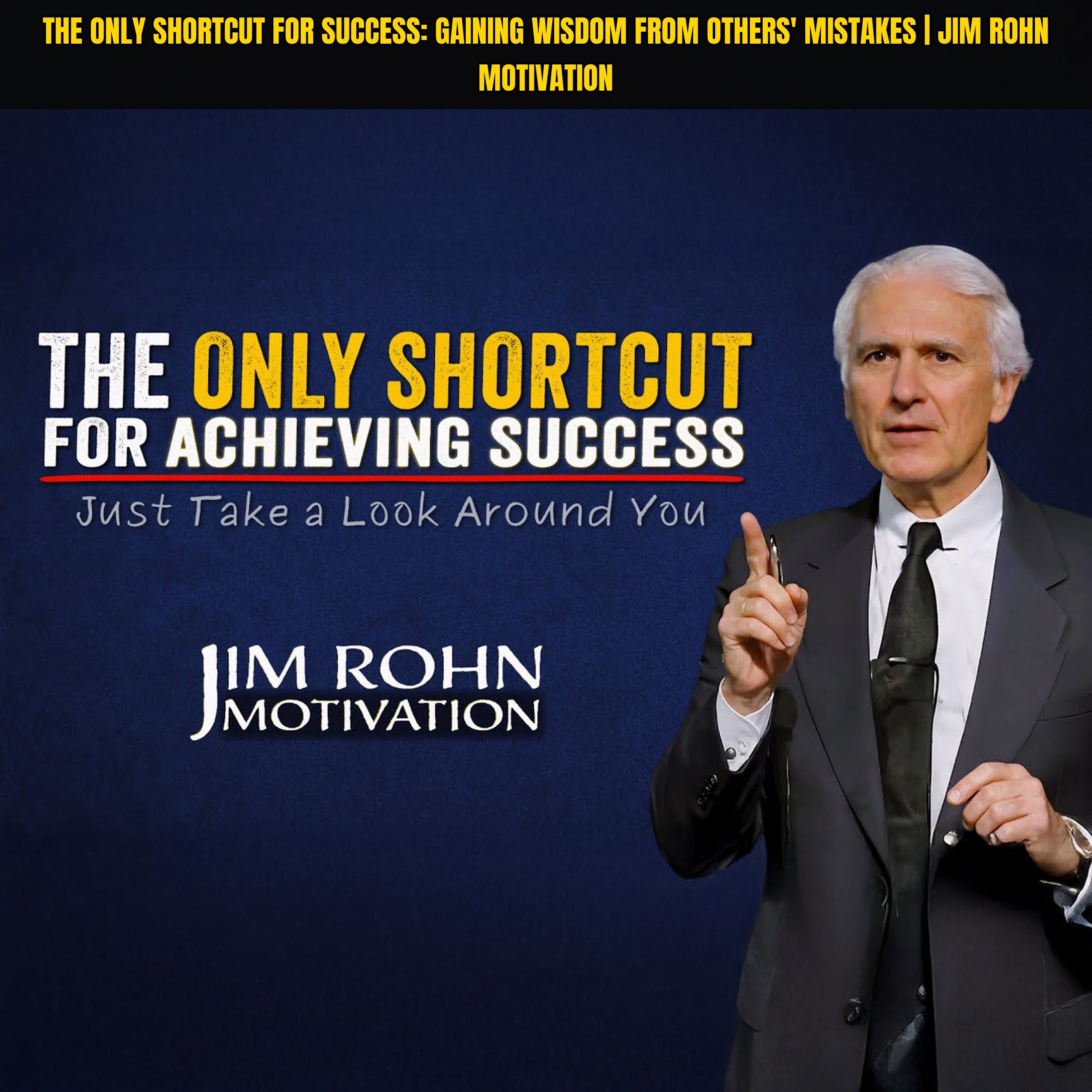
In this Jim Rohn Motivation speech, Jim Rohn reveals the truth about shortcuts to success — and why the only real shortcut is learning from mistakes that aren’t your own. Discover how to compress decades into days by leveraging wisdom, not just effort. Key Topics From This Motivational speech: The illusion of shortcuts and the truth about discipline Why learning from others’ mistakes saves years of struggle The real cost of personal errors and how to avoid them The power of mentorship, books, and biographies How wisdom accelerates your journey to success Jim Rohn teaches that while hard work and discipline are essential, wisdom is the real multiplier. Success doesn’t come from skipping effort but from skipping unnecessary pain. When you learn from the experiences of others — their scars, their failures, their lessons — you buy back time and move faster toward your goals. Every borrowed lesson saves energy, money, and years of recovery. This Jim Rohn Motivational speech Is Perfect For:
A.I. for Starting to Exercise: Building a Routine That Actually Sticks, a practical, beginner-friendly look at how artificial intelligence can help you build a routine that actually sticks this time. Starting to Exercise? Press play on Episode 429 of A.I. for Beginners and learn exactly how artificial intelligence, especially ChatGPT, alongside Nike Training Club, can help you build a routine that actually sticks this time. WHAT YOU WILL LEARN IN THIS EPISODE - Why starting to exercise is so hard to handle alone, and what is actually going on underneath it - A specific way to use Nike Training Club to work through it, step by step - An example prompt you can copy word for word: "Here is my current fitness level and schedule, help me build a realistic beginner routine" - A second practical technique, with another ready-to-use prompt: "Give me a simple way to track my progress that doesn't rely on willpower alone" WHO THIS EPISODE IS FOR - Anyone currently working on starting to exercise
Steve Taylor, PhD, is the author of Extraordinary Awakenings, The Leap: The Psychology of Spiritual Awakening, Spiritual Science, Back to Sanity, Out of the Darkness and many other books. He’s senior lecturer in psychology at Leeds Beckett University. Steve’s articles and essays have been published in over 100 academic journals, magazines, and newspapers and he blogs for Scientific American and Psychology Today. His website is https://www.stevenmtaylor.com/ In this video, rebooted from 2021, he defines spiritual awakening as an opening to a larger understanding of oneself. Ultimately, he maintains that our deepest self is at one with the entire universe. Many human problems result from a sense of separation, of being stuck at an ego level. He describes several types of awakenings. Often they result from a sense of acceptance, even in the aftershock of trauma. (Recorded on December 5, 2021) Check out New Thinking Allowed's AI chatbot. To order a copy of Charles T. To order Extraordinary
Richard Silberstein is Emeritus Professor of Neuroscience at Swinburne University in Melbourne, Australia. He is author of Stranger and Stranger: The Neuroscience of How Mind and Cosmos Communicate. Richard presents a conceptual framework of nested hierarchies of consciousness and time that accounts for precognition and other psi phenomena through retrocausal loops, in which collective consciousness encodes information into the future matrix. He explores how near-death experiences transform ethical frameworks and personality by connecting people to a deeper compassionate reality, and discusses evidence that focused human intention—including collective meditation—can produce measurable real-world effects such as reduced crime rates. Drawing on his book, Stranger and Stranger: The Neuroscience of How Mind and Cosmos Communicate, Silberstein argues that the universe is conscious and responsive to human intent. 00:00:00 Introduction 00:04:00 Nested hierarchies of consciousness 00:08:00 Ret
Callum Cooper, PhD, is a lecturer in psychology at the University of Northampton in the United Kingdom. He is author of Telephone Calls From the Dead. He is coeditor, with Steven Parsons, of Paracoustics: Sound and the Paranormal. And, he is coauthor (with Alex Tanous) of Conversations With Ghosts. His website is www.callumecooper.com. This conversation, rebooted from 2022, introduces Cal as a new Guest Host for New Thinking Allowed. It focuses on parapsychology. Cal discusses his own work as an educator in the field and questions Jeff about his early work, including his book, Psi Development Systems. The discussion focuses on J. B. Rhine and the origins of modern parapsychology. Other topics includ remote viewing, skeptical hostility toward the field, and the various personalities with whom each has interacted. Check out New Thinking Allowed's AI chatbot. To order a copy of Charles T. To order Conversations with Ghosts, visit https://amzn.to/2zZZSJ8. To order Paracoustics: Sound and t
Users should have access to human review when a platform restricts their account.
Share your view, then see how readers voted. No sign-in required. This poll is shared across stories.
Do you agree or disagree?
Common Quandary
A Common Quandary to discuss
Another conversation to explore, separate from this news story.
Your coworker's religious holiday means you work the unpopular shift again. Is that fair?
A workplace accommodates religious observances by asking other employees to cover unpopular shifts. One coworker objects that nonreligious commitments can be equally meaningful but receive less formal protection.
Does equal respect require treating every kind of commitment identically?