Listen through the publisher, then discuss the episode here or arrange an in-person Roundtable. Your city determines where to meet.
Roundtables are designed for groups of four, with a shared subject and room for everyone to speak. Come for discussion, with no dating expectation.
Rhythm plays an important role in our financial lives, especially when it comes to the familiar routine of receiving a paycheck. But what happens when that paycheck disappears in retirement? In this episode, Roger sits down with Jean Chatzky, founder of HerMoney and longtime financial editor for NBC's Today show, to discuss her new book, The Forever Paycheck. They explore the psychology of spending retirement savings, the role of guaranteed income, and how creating a consistent paycheck in retirement can help you spend with confidence and enjoy the life you've worked so hard to build. OUTLINE OF THIS EPISODE OF THE RETIREMENT ANSWER MAN (00:00) Roger introduces the importance of rhythm in retirement and how creating a consistent paycheck can help ease the transition from working to retirement. INTERVIEW WITH JEAN CHATZKY (06:00) Jean Chatzky joins Roger to discuss the psychology of retirement spending, why retirees struggle to spend down their savings, and how creating a predictable retirement paycheck can help reduce anxiety. SMART SPRINT (36:16) Review your retirement paycheck plan. If you're still working, think about how you'll establish a consistent income stream in retirement. If you're already retired, make sure your income arrives automatically and predictably. Look for opportunities to improve your system and create a rhythm that makes spending feel more comfortable. CLOSING THOUGHTS (37:53) Roger wraps up with a reminder to check out the latest video on the Retirement Answer Man YouTube channel about his near phone scam experience and the importance of staying vigilant. REFERENCES HerMoney with Jean Chatzky (https://hermoney.com/) The Forever Paycheck: The New Retirement Strategy to Spend More, Worry Less, and Never Run Out of Money by Jean Chatzky (https://www.goodreads.com/book/show/244714231?ref_src=ios_share) Submit a Question for Roger (http://askroger.me/) Rock Retirement Club (https://www.rockretirementclub.com/) Sign up for the Noodle! (http://thenoodle.me/)
Episode information is provided by the publisher. Listening takes place on the publisher’s service.
A kiss can be wonderful. It can create an instant connection, spark romance, or make you feel closer to someone. But a kiss can also have the opposite effect — and sometimes ruin everything. So what makes kissing so powerful, and why can one kiss make such a difference? There's some fascinating science behind it. https://www.scientificamerican.com/article/why-we-kiss/ We spend an enormous amount of time worrying about what's going to change. What's next? What's coming? How do we prepare? But what if we're paying attention to the wrong things? Some of the most important forces shaping our lives never change, and understanding them may be far more valuable than trying to predict the future — something humans are notoriously bad at. Morgan Housel, partner at The Collaborative Fund and author of Same as Ever: A Guide to What Never Changes (https://amzn.to/3SwWn6u) (https://amzn.to/3SwWn6u)), joins me to explain why the things that stay the same may be the most important things to understan
Master the skills that change lives — enroll in your free human behavior course today: https://nci.university/learn Uploaded 14-03-26 During the first ninety seconds of any interaction, a window opens in the human brain that most people never notice. A specific sequence of neurological events unfolds — predictable, exploitable, and almost never taught outside of military and intelligence training. Very few people alive understand the full mechanics of what happens inside that window. Only operators, interrogators, and behavioral scientists with the right access have ever had this mapped out for them. Someone made sure it stayed that way. Every interaction you've ever had — every negotiation, every first impression, every moment you walked into a room — was governed by this sequence. You were either running it or it was being run on you. Most people spend their entire lives on the receiving end without ever knowing it. Language is the delivery system. But language isn't where it starts.
The same complaint takes another hour of your week. You may have every reason to be upset. What change would you want that time and attention to help create? In this episode of The Level Up Podcast, Paul Alex breaks down how to turn recurring frustration into a direction you can begin working toward. Paul makes room for unfair situations and appropriate ways to address them. A necessary conversation, request for help, or formal concern may deserve action. Repeating the same argument in your head can still leave your own future waiting. Name the change beneath the complaint, whether it involves time, a role, or a boundary. Then look for movement that does not require someone else to apologize or agree. The step can matter while you are still upset; you do not have to resolve every feeling before acting. In this episode, you’ll learn: • How to notice when replaying a complaint has stopped providing useful information. • Why naming the desired change gives frustration a practical directio
In this Jim Rohn Motivation video, The Discipline That Changes Everything, you’ll discover why success isn’t built on inspiration—it’s built on habits, clarity, and structure. Discipline isn’t just a skill; it’s the operating system of your life. And Jim Rohn breaks down the seven techniques that turn discipline into your greatest advantage. Key Topics From This Motivational Video: How to eliminate negotiation and build unshakable self-leadership Why micro-commitments drive lasting momentum The truth about recovery as a strategy—not a reward How to anchor behavior to identity for automatic follow-through How to train fast action, shorten hesitation, and create rhythm This Jim Rohn motivational video is a blueprint for personal excellence. It’s not about hype—it’s about mastery. These seven techniques teach you how to build habits you can trust, eliminate the drag of indecision, and live like the version of you who already wins. Discipline doesn’t make life harder—it makes your mission
Get the 200+ Page Optimal Living Daily Workbook (PDF) - Free. Want to turn today's episode into an actionable plan? Episode 4232: Chris Guillebeau shares a candid, funny account of his lack of qualifications, from a short-lived dishwashing job to failing his way through statistics and shrink-wrapping pallets. He argues that formal credentials matter far less than people think, and that anyone who builds a good life without them should treat that work with gratitude and diligence. It is an encouraging take on personal development for anyone who has ever felt like an imposter. Read along with the original article(s) here: https://chrisguillebeau.com/qualifications/ Quotes to ponder: "First, forget about what you're actually qualified to do. It's irrelevant and no one cares." "Fourth, when you do find something that works for you, you should be very grateful, every day." "Regardless of your actual qualifications, there's one thing that no one can give you and no one can take away: the wil
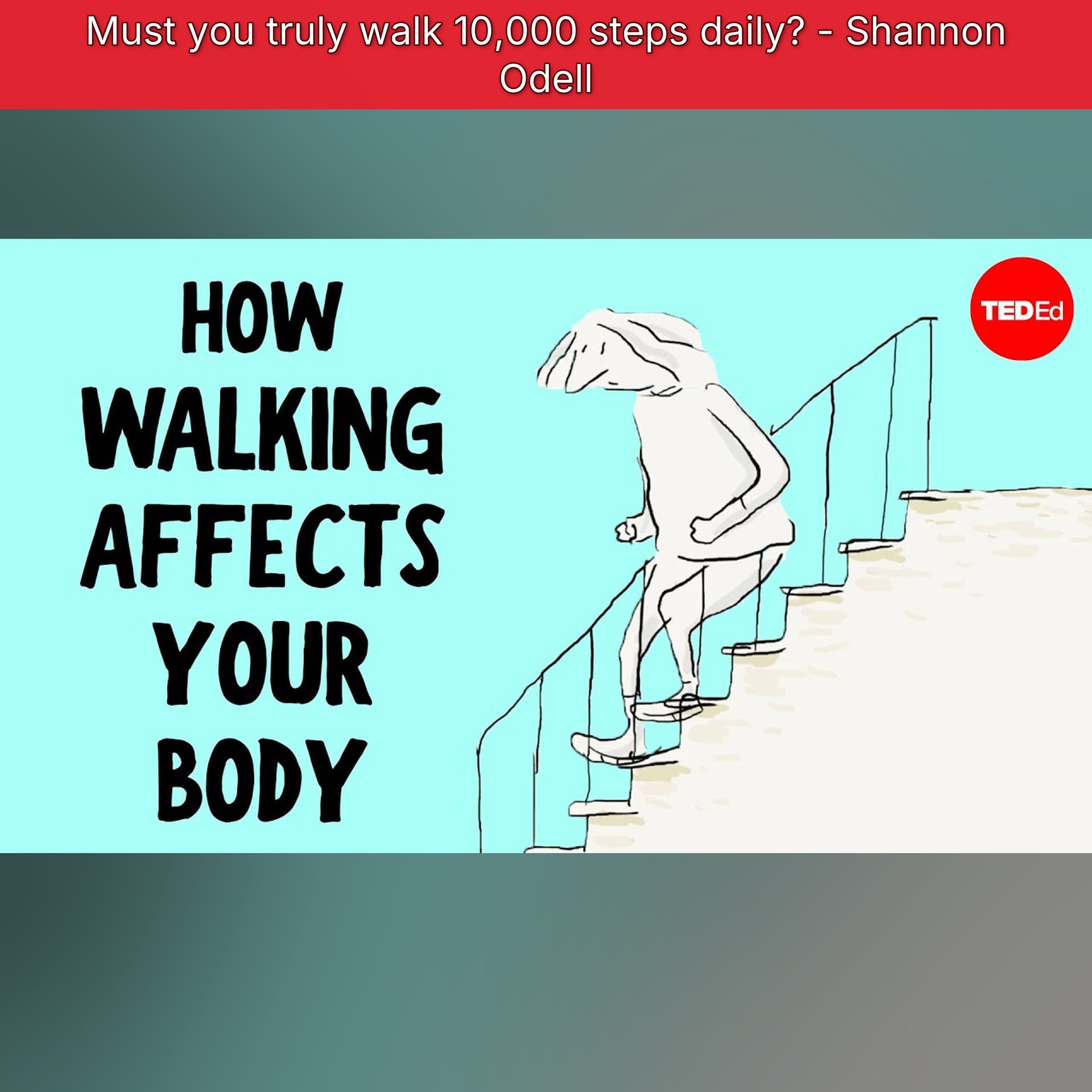
Discover the benefits of walking, and how this simple exercise can positively impact the health of your body and brain. -- For years, Jean Béliveau walked from country to country, with the goal of circumnavigating the globe on foot. While few people have the time or desire to walk such extreme lengths, research shows that adding even a modest amount of walking to your daily routine can dramatically improve your health. So, what exactly happens to your body when you increase your step count? Shannon Odell investigates. Lesson by Shannon Odell, directed by Avi Ofer. This video made possible in collaboration with Speed & Scale Learn more about how TED-Ed partnerships work: https://bit.ly/TEDEdPartner A special thanks to James Sallis and Lawrence Frank who provided information and insights for the development of this video. Support Our Non-Profit Mission ---------------------------------------------- Support us on Patreon: http://bit.ly/TEDEdPatreon Check out our merch: http://bit.ly/TEDED
Year-end planning brings plenty of decisions to work through, and Roth conversions are one of them. Should you convert in 2026, or is it better to wait? This week, Roger walks through a practical framework for evaluating Roth conversions, including the factors to consider, potential tax implications, and how to make a decision that fits your retirement plan. He also answers listener questions about simplifying investment portfolios, IRMAA surcharges, Roth conversion strategies, and asset location for early retirees. OUTLINE OF THIS EPISODE OF THE RETIREMENT ANSWER MAN (00:00) Introduction and why it's time to close the loop on Roth conversion decisions for 2026 PRACTICAL PLANNING SEGMENT (01:05) Roger walks through a framework for deciding whether a Roth conversion makes sense in 2026. He covers the factors to weigh, including current and future tax brackets, required minimum distributions, tax implications, and potential impacts on healthcare costs. The goal is to evaluate your option
In this episode, Roger explains how to rebalance your portfolio before retirement and why it's important to align your investments with the changing purpose of your money. He discusses how guaranteed income, your retirement plan's fundedness, and your comfort with market volatility influence your approach. Roger also shares a practical framework for organizing your assets into three layers to provide financial flexibility, fund your retirement paycheck, and support long-term growth. Plus, he answers listener questions about finding a retirement planner and preparing for the nonfinancial aspects of retirement. OUTLINE OF THIS EPISODE OF THE RETIREMENT ANSWER MAN (00:00) Roger introduces the episode and discusses why rebalancing your portfolio before retirement is important, particularly as the purpose of your money changes. He previews the discussion on retirement portfolio allocation, listener questions, and a Rockin' Retirement in the Wild story. RETIREMENT TOOLKIT: HOW TO REBALANCE Y
Predictable working hours are more important than maximum scheduling flexibility.
Share your view, then see how readers voted. No sign-in required. This poll is shared across stories.
Do you agree or disagree?
Common Quandary
A Common Quandary to discuss
Another conversation to explore, separate from this news story.
A coworker tells you their salary in confidence—and proves everyone else is underpaid. Do you share it?
A coworker privately tells you their salary and asks you not to repeat it. You later realize the figure is strong evidence that several equally experienced colleagues are being underpaid.
When does fairness outweigh a promise of confidentiality?