Listen through the publisher, then discuss the episode here or arrange an in-person Roundtable. Your city determines where to meet.
Roundtables are designed for groups of four, with a shared subject and room for everyone to speak. Come for discussion, with no dating expectation.
In 1960, a prediction was made that today 13th November sixty six years later was going to be the end of the world. This prediction wasn’t made by some lone cult leader holed up in a remote farmhouse with a few followers, but by a group of respected scientists, concerned about population growth and birth rates. The title of the article published in Science Magazine on 4th November 1960 was arresting: Doomsday Friday 13th November AD 2026. It wasn’t a calculation to see when humanity would run out of food, but their prediction instead was that due to sheer numbers, human beings would be ‘squeezed to death.’ Striking in the article is their use of imagery more often associated with religion. They speak of paradise and doom, all underpinned by serious mathematical calculation. They predicted that by today’s date, there would have been great progress – resulting in living conditions that would come close to what they described as paradise. There would be “no environmental hazards, unlimited food supply”, and no war. In these conditions, our fate as a population – they argued - would be entirely determined by just two things… fertility and mortality. The article was contested from the start by demographers but its influence continued to be felt; it was cited for example in a court case concerning abortion in 1971, 2 years before Roe v Wade. And it wasn’t until as recently as1993 that its predictions of human population growth and the reality began to part company. The irony of their argument was that it was the very paradise conditions they predicted that would produce the circumstances for doomsday. But neither has yet come to pass. Although, yes there is enough food in the world to feed everyone, we don’t share it equally. The environmental hazards they predicted would be gone – are not gone at all, as COP 31 delegates in Turkey are debating this week. And all the while, more people are living longer but are being born at a slower rate than before. I find it sobering to read their article today, on the day they predicted that I, and many others, would die. The themes they addressed in good faith are the deepest of our existence: our birth and our death; our ability to cooperate as well as compete; our capacity for imagining a better world that doesn’t inevitably mean the survival of only the strongest, with the weakest condemned to perish. Today I’m living the day they warned would be the last for everyone. This is the day others have both dreamed of and dreaded. Prayed for and feared. The very best of human endeavour is needed now to ensure we don’t just avoid doomsday but avoid making real our own paradise lost.
Episode information is provided by the publisher. Listening takes place on the publisher’s service.
Friday 20 November 2026 Today is Friday the 20th of November, in the 33rd week of Ordinary Time. Continuum Choir sings, ‘Upon Your Heart’ by Eleanor Daley: Set me as a seal upon your heart, As a seal upon your arm, For love is strong as death. Many waters cannot quench love, Neither can the floods drown it. If you keep my commandments, You shall abide in my love, Love one another as I have loved you, Then shall your joy be complete. As you hear these words sung, let them carry you into prayer... Today’s reading is from the Book of Revelation. Revelation 10:8-11 Then the voice that I had heard from heaven spoke to me again, saying, ‘Go, take the scroll that is open in the hand of the angel who is standing on the sea and on the land.’ So I went to the angel and told him to give me the little scroll; and he said to me, ‘Take it, and eat; it will be bitter to your stomach, but sweet as honey in your mouth.’ So I took the little scroll from the hand of the angel and ate it; it was sweet as
Join David Bayer's FREE Mindset Month: You can know exactly where a limiting belief came from and still organize your whole life around it. Knowing the origin has never been the same as changing it. In this episode, I break down the power of decision. Walking on the beach in Sarasota with my wife, I realized that beliefs are just decisions, ones you made unconsciously before you were seven and have been collecting evidence for ever since. Which means you can make a new one. I share the friend who never showed up at the drinking fountain in first grade, the belief it created, and the Harvard piano study that explains why the decision has to come first and the how comes second. Then I walk you through the Decision Matrix, three columns on a sheet of paper, and the one question that does most of the work. Discover why you have been living inside a choice you do not remember making, and how fast it changes once you make a new one. What We Explored This Episode 01:45 Neville Goddard and Liv
What if the scale isn't telling you the whole story? Have you ever been consistent with your workouts, making better food choices, and really trying to take care of yourself, only to step on the scale and see absolutely no change? And just like that, your motivation takes a hit. You start questioning whether your workouts are working, whether you're doing enough, or whether you need to change something. But here's what I want you to understand: The scale is only measuring one small piece of your health and fitness journey. It doesn't measure how much stronger you've become, how much better your endurance is, how much energy you have, or how much easier it is to do things that used to feel difficult. And if you're only using the scale to determine whether you're making progress, you could be missing some pretty amazing changes happening in your body. Today, we're talking about five ways to measure your fitness progress beyond the scale so you can start recognizing the changes that actua
SAVE THE BEES. SWEETEN YOUR LIFE. THE PUREWAVE REVOLUTION CONTINUES! MICHAEL JACO welcomes BRENT KNUDSEN back for an extraordinary conversation about PureWave® Cell technology, the sacred geometry of the Flower of Life, magnetic fields, and the growing movement to support honeybee colonies worldwide! ⚡ THREE YEARS OF RESEARCH — A MAJOR MILESTONE FOR PUREWAVE! Brent discusses a newly published, peer-reviewed, three-year study examining the PureWave Cell's potential effects on honeybee resilience. With research published in Electromagnetic Biology and Medicine, the team is celebrating an important milestone in its mission to explore how magnetic technology may influence the natural environment. THRIVING BEE COLONIES — REAL STORIES FROM THE FIELD! Hear firsthand accounts from beekeepers using PureWave technology and reporting encouraging changes in their colonies. From hive resilience and colony development to the challenges facing pollinators, Michael and Brent explore why protecting hon
Growing up in her family's home, a young girl experienced things she couldn't explain. It began with a voice whispering directly into her ear. Years later, she awoke to find a little boy standing in her bedroom, staring into a mirror. The experiences frightened her, but she eventually learned to live with the possibility that her childhood home was haunted. When she returned years later with a child of her own, the strange activity continued. Her son made an unsettling comment about people he claimed to see, mysterious voices called out through the house, and a family photograph appeared to capture something unexpected. For years, the family accepted that unexplained things sometimes happened there. But following a death in the family, something changed. The house suddenly felt different, and the activity seemed to disappear. Had the spirits finally moved on—or had they been there for someone all along? #RealGhostStoriesOnline #TrueGhostStories #HauntedFamilyHome #ChildhoodHaunting #Gh
Good morning, “I’m the king, and she’s my queen… she doesn’t get to usurp the throne.” Not words from a Shakespearian tragedy, but the words of Aaron Edwards, the Christian theologian and father of seven who features in a new documentary on the BBC this week. Edwards and his wife Molly are one of the families in filmmaker Poppy Jay’s Young British and Tradwife, exploring women embracing traditional gender roles, often showcased on Instagram. For some, this is more than a choice to stay at home rather than go to work – feminism’s aim was to give women choice, after all. But rather for some it’s also a belief rooted in their reading of the Bible that wives should submit to their husbands. As a Christian feminist, I won’t get into the debate here, but what struck me was how questions of sovereignty, submission and power are finding their ways into much of our public debate. In the home, in the Church, in the nation, in our politics, we’re asking: who exactly is in charge? Who should submi
Good morning. The World Bank recently reported that India pulled nearly 500 million people out of poverty between 2011 and 2023. Lauded as a ‘remarkable achievement’, it is interesting to note that the same report mentions a growth in inequality. With Diwali fast approaching, many Hindus around the world will be celebrating by offering worship to the goddess of wealth, Lakshmi. When we hear the word ‘wealth’, for most of us, what comes to mind is the monetary kind. In Hinduism, material wealth is recognised as a necessity, but not a guarantee. It is neither to be shunned nor hoarded. It is a means to security, enjoyment, and the performance of one’s duty, and therefore is sought by all people in all walks of life. As we see in the world, when wealth is limited, there is naturally an unequal distribution. This is between different sections of society; and between different regions of the world. We may not think it is right or fair, but that is the reality of the world that we live in. A
Students should help shape decisions about what and how they learn.
Share your view, then see how readers voted. No sign-in required. This poll is shared across stories.
Do you agree or disagree?
Common Quandary
A Common Quandary to discuss
Another conversation to explore, separate from this news story.
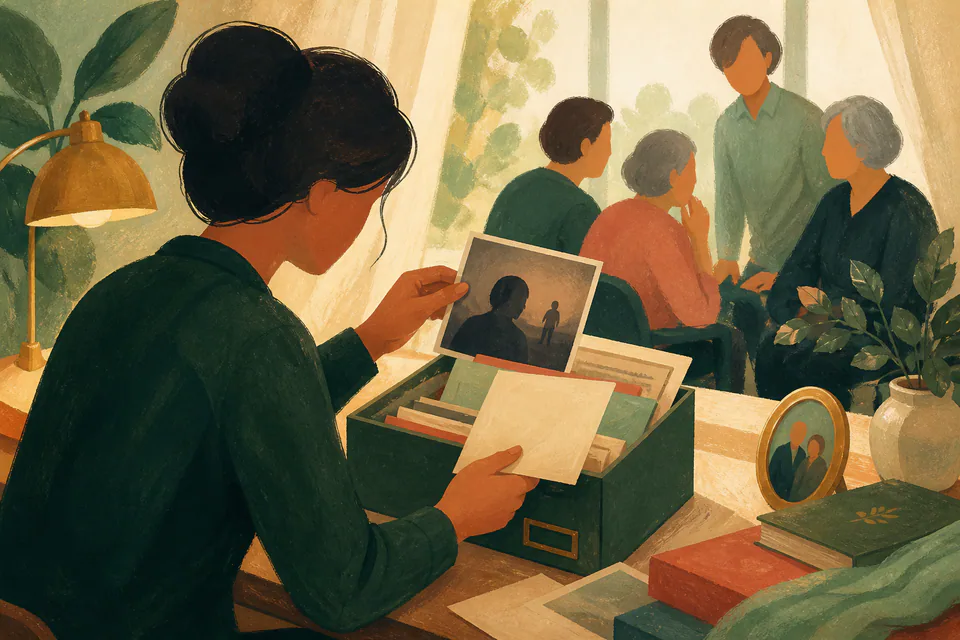
You find a family secret after a relative dies. Does the truth come out?
Sorting through a deceased relative's papers, you discover evidence of a serious betrayal that would change how the family remembers them. Revealing it could answer old questions—and cause fresh pain.