Listen through the publisher, then discuss the episode here or arrange an in-person Roundtable. Your city determines where to meet.
Roundtables are designed for groups of four, with a shared subject and room for everyone to speak. Come for discussion, with no dating expectation.
Good morning, “I’m the king, and she’s my queen… she doesn’t get to usurp the throne.” Not words from a Shakespearian tragedy, but the words of Aaron Edwards, the Christian theologian and father of seven who features in a new documentary on the BBC this week. Edwards and his wife Molly are one of the families in filmmaker Poppy Jay’s Young British and Tradwife, exploring women embracing traditional gender roles, often showcased on Instagram. For some, this is more than a choice to stay at home rather than go to work – feminism’s aim was to give women choice, after all. But rather for some it’s also a belief rooted in their reading of the Bible that wives should submit to their husbands. As a Christian feminist, I won’t get into the debate here, but what struck me was how questions of sovereignty, submission and power are finding their ways into much of our public debate. In the home, in the Church, in the nation, in our politics, we’re asking: who exactly is in charge? Who should submit? Who is king? We’ve had 10 years of Brexit debate on what national sovereignty looks like. We’ve seen crowds at Unite the Kingdom rallies waving banners with proclaiming “Christ is king” alongside appeals to national identity. Here the paradox between the sovereignty of the nation and the sovereignty of Christ come into tension. This week, Britain’s actual sovereign – King Charles – opened the general synod, the gathering of the Church of England’s governing body, with an encouragement to seek after justice, mercy, patience but also notably humility in an anxious world. On Sunday, churches will mark the feast of Christ the king. The first celebration took place 100 years ago, after Pope Pius XI initiated the celebration during a climate of increased secularism and nationalism, to remind the Church of its belief in Christ’s sovereignty in the politically fraught years following the First World War. Yet at the centre of the Christian story is a king who exercises power in a counter-cultural way. The Jesus of the gospels washes his disciples’ feet; says it’s the servants that are the greatest, and that he came to serve and not to be served, and as former Archbishop of Cape Town Thabo Mkagbo puts it, “at no point does Jesus ever force us to follow his rule.” There’s quite a difference between choosing to serve and being told to submit. Christ’s example is not an instruction for vulnerable people to endure mistreatment. It’s a challenge to those who claim authority: power includes a responsibility to serve others, not a right to demand their submission. Maybe the challenge posed in questions of sovereignty – whether inside or outside the home – isn’t who gets to sit on the throne, but how the person who sits on the throne can help those who don’t flourish.
Episode information is provided by the publisher. Listening takes place on the publisher’s service.
The debate over Christian nationalism raises some uncomfortable questions about faith, politics, and the role of government. Al, Zach, John Luke, and Christian examine how Christianity transformed the Roman Empire and why the early church flourished despite intense persecution. The guys also revisit the Garden of Eden, questioning whether Adam's failure to protect Eve was the first sin and what his actions reveal about responsibility and obedience. They consider what history teaches us about the dangers of unchecked power and why Christians must put their allegiance to God's kingdom above any earthly government. In this episode: Genesis 2, verses 15–17; Genesis 3, verses 1–7; Daniel 2; John 1, verses 4–5; Matthew 5, verses 27–30; Matthew 28, verses 18–20; John 11, verses 49–52; Luke 23, verses 6–12; Galatians 3, verse 28; 1 Timothy 2, verses 11–14; Romans 13, verses 1–7 Today’s conversation is about Lesson 6 of Western Heritage: From the Book of Genesis to John Locke taught by various
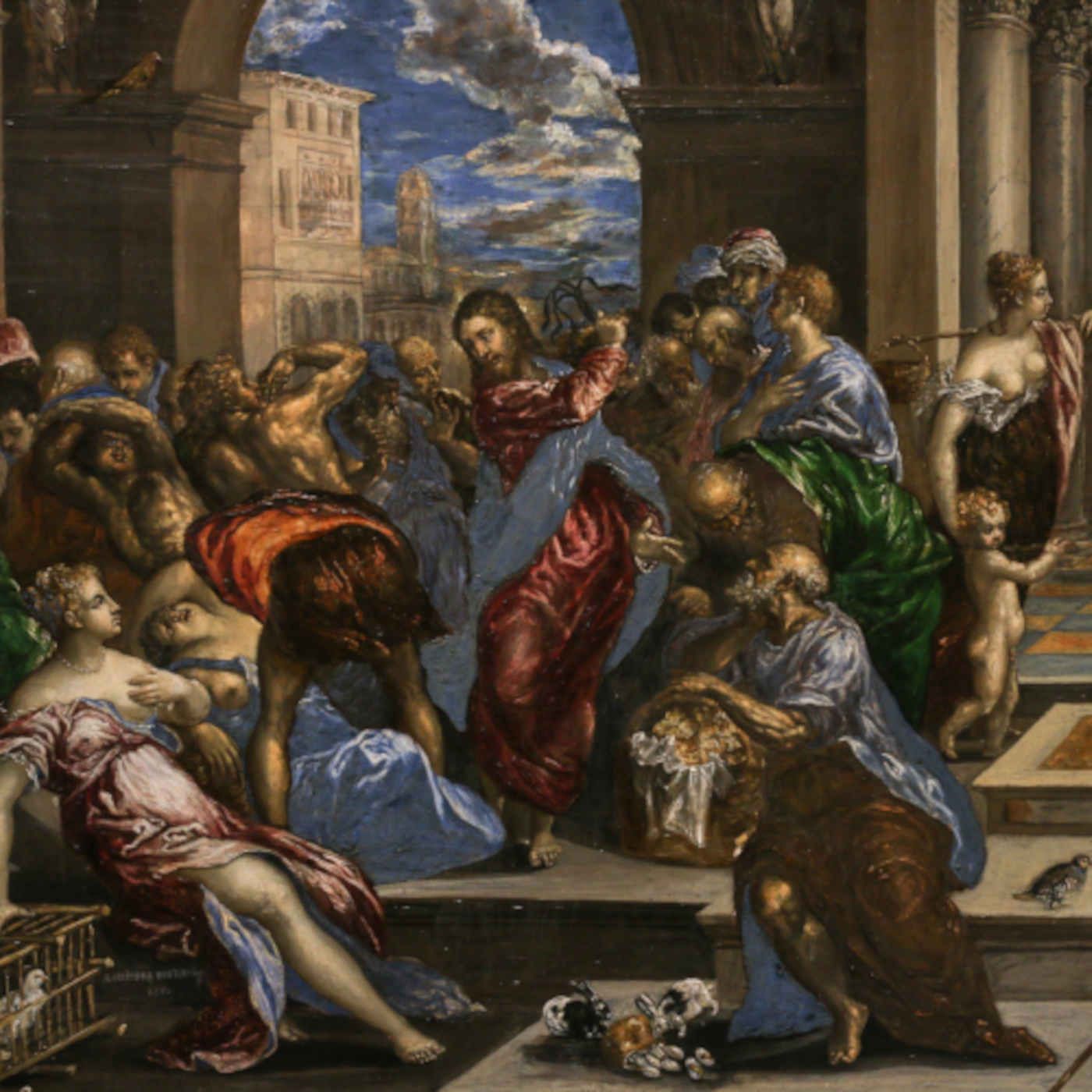
Read Online (https://catholic-daily-reflections.com/2026/11/19/restoring-sacred-worship/) Restoring Sacred Worship Jesus entered the temple area and proceeded to drive out those who were selling things, saying to them, “It is written, My house shall be a house of prayer, but you have made it a den of thieves.” And every day he was teaching in the temple area. Luke 19:45–47 Today’s Gospel opens what is arguably the most dramatic and consequential week in human history. Jesus arrives in Jerusalem for the weeklong Feast of Passover, welcomed with jubilation by the crowds who had become His disciples over the previous three years of public ministry. The city is alive with expectation. Many wonder if this is the moment He will assert His Kingship and restore the United Kingdom of Israel. However, on the first day of the feast, Jesus takes a startling action: He enters the Temple and drives out the merchants, rebuking them for turning His Father’s house into a “den of thieves.” Passover was
What if God's love for you isn't merely an abstract theology, but the relentless, heartbreaking devotion of a faithful spouse refusing to walk away from an unfaithful partner? In Hosea and Joel, we meet two prophets whose words cut through the noise of superficial religion. Through an astonishing marriage that mirrors the covenant and apocalyptic visions of swarming locusts, the Lord reveals how He transforms our "No Mercy" into everlasting lovingkindness. Summary: In this poignant study of Hosea and Joel, we launch into the Minor Prophets, discovering why the Lord raises up prophetic witnesses during seasons of acute political, social, and spiritual collapse. While Isaiah spoke in majestic poetry and Jeremiah endured public stocks, Hosea's very home became the message. Paired with Joel's piercing trumpet blasts toward the Day of the Lord, these books offer a roadmap back to intimate covenant connection. An Emodied Parable of Mercy: In Hosea 1–3, Hosea is commanded to marry Gomer and t
Friday 20 November 2026 Today is Friday the 20th of November, in the 33rd week of Ordinary Time. Continuum Choir sings, ‘Upon Your Heart’ by Eleanor Daley: Set me as a seal upon your heart, As a seal upon your arm, For love is strong as death. Many waters cannot quench love, Neither can the floods drown it. If you keep my commandments, You shall abide in my love, Love one another as I have loved you, Then shall your joy be complete. As you hear these words sung, let them carry you into prayer... Today’s reading is from the Book of Revelation. Revelation 10:8-11 Then the voice that I had heard from heaven spoke to me again, saying, ‘Go, take the scroll that is open in the hand of the angel who is standing on the sea and on the land.’ So I went to the angel and told him to give me the little scroll; and he said to me, ‘Take it, and eat; it will be bitter to your stomach, but sweet as honey in your mouth.’ So I took the little scroll from the hand of the angel and ate it; it was sweet as
Join David Bayer's FREE Mindset Month: You can know exactly where a limiting belief came from and still organize your whole life around it. Knowing the origin has never been the same as changing it. In this episode, I break down the power of decision. Walking on the beach in Sarasota with my wife, I realized that beliefs are just decisions, ones you made unconsciously before you were seven and have been collecting evidence for ever since. Which means you can make a new one. I share the friend who never showed up at the drinking fountain in first grade, the belief it created, and the Harvard piano study that explains why the decision has to come first and the how comes second. Then I walk you through the Decision Matrix, three columns on a sheet of paper, and the one question that does most of the work. Discover why you have been living inside a choice you do not remember making, and how fast it changes once you make a new one. What We Explored This Episode 01:45 Neville Goddard and Liv
️ TODAY'S RESOURCE: BOOKS - for adults and kids, fiction and non-fiction : https://CareyGreen.com/books TODAY'S SCRIPTURE: Deuteronomy 10:12–22 - And now, Israel, what does the LORD your God require of you, but to fear the LORD your God, to walk in all his ways, to love him, to serve the LORD your God with all your heart and with all your soul, [13] and to keep the commandments and statutes of the LORD, which I am commanding you today for your good? [14] Behold, to the LORD your God belong heaven and the heaven of heavens, the earth with all that is in it. [15] Yet the LORD set his heart in love on your fathers and chose their offspring after them, you above all peoples, as you are this day. [16] Circumcise therefore the foreskin of your heart, and be no longer stubborn. [17] For the LORD your God is God of gods and Lord of lords, the great, the mighty, and the awesome God, who is not partial and takes no bribe. [18] He executes justice for the fatherless and the widow, and loves the
In 1960, a prediction was made that today 13th November sixty six years later was going to be the end of the world. This prediction wasn’t made by some lone cult leader holed up in a remote farmhouse with a few followers, but by a group of respected scientists, concerned about population growth and birth rates. The title of the article published in Science Magazine on 4th November 1960 was arresting: Doomsday Friday 13th November AD 2026. It wasn’t a calculation to see when humanity would run out of food, but their prediction instead was that due to sheer numbers, human beings would be ‘squeezed to death.’ Striking in the article is their use of imagery more often associated with religion. They speak of paradise and doom, all underpinned by serious mathematical calculation. They predicted that by today’s date, there would have been great progress – resulting in living conditions that would come close to what they described as paradise. There would be “no environmental hazards, unlimite
Good morning. The World Bank recently reported that India pulled nearly 500 million people out of poverty between 2011 and 2023. Lauded as a ‘remarkable achievement’, it is interesting to note that the same report mentions a growth in inequality. With Diwali fast approaching, many Hindus around the world will be celebrating by offering worship to the goddess of wealth, Lakshmi. When we hear the word ‘wealth’, for most of us, what comes to mind is the monetary kind. In Hinduism, material wealth is recognised as a necessity, but not a guarantee. It is neither to be shunned nor hoarded. It is a means to security, enjoyment, and the performance of one’s duty, and therefore is sought by all people in all walks of life. As we see in the world, when wealth is limited, there is naturally an unequal distribution. This is between different sections of society; and between different regions of the world. We may not think it is right or fair, but that is the reality of the world that we live in. A
Experiencing art in person offers something that online viewing cannot fully replace.
Share your view, then see how readers voted. No sign-in required. This poll is shared across stories.
Do you agree or disagree?
Common Quandary
A Common Quandary to discuss
Another conversation to explore, separate from this news story.
You know the relationship is over, but the vacation is nonrefundable. Do you wait to break up?
You have decided to end a year-long relationship. In five days, you are both leaving on an expensive vacation that cannot be refunded or transferred. Your partner is excited and believes the relationship is thriving.
Can avoiding financial waste justify delaying a painful truth?