Listen through the publisher, then discuss the episode here or arrange an in-person Roundtable. Your city determines where to meet.
Roundtables are designed for groups of four, with a shared subject and room for everyone to speak. Come for discussion, with no dating expectation.
If you would prefer to skip Jim and Chris chatting about Jim’s end-of-season garden update and what home-grown produce he’s going to try to get through TSA (and why), you can skip to 7:45. Chris’s Summary Jim and I continue our run of IRA topics with seven IRA mistakes that cannot be fixed once they are made. The list spans inherited IRA transfers, rollover limits and requirements, Roth conversions, net unrealized appreciation, and 72(t) distributions. In at least one case, nothing improper occurred at the time. We also distinguish these seven from errors that may still be corrected, such as certain missed 60-day rollovers. Jim’s “Pithy” Summary Chris and I keep the IRA conversation going this week. With all the rules attached to these accounts, I like to picture the Peanuts character Pigpen, with a cloud of rules, regulations, taxes, and penalties following the IRA from custodian to custodian and owner to beneficiary until it is finally closed. Plenty of slip-ups, like a missed RMD or an excess contribution, can be fixed. But some IRA mistakes, once made, you are stuck with. Their simplicity is sometimes their downfall, because people think they understand the rule and don’t quite. Spouses and non-spouses do not get the same options for moving inherited dollars, and using the wrong method may create two problems at once. I put your feet in the shoes of a 40-year-old surviving spouse who makes a perfectly legal move that cannot be taken back. Chris tackles the one-rollover-per-year rule, earns a grade for it, and we discuss the 2014 tax court case that changed how that rule is counted. I also worked hard to come up with a realistic way someone could violate the same property rule, and it involves fat fingers. We get into Roth conversion regrets and why I am still irked about losing my old cup of flour and butter knife approach. We touch on net unrealized appreciation and the moves that can wipe it out, along with the 72(t) payment schedule and the single word in its rules that people tend to miss. Chris also explains why he thinks a 72(t) calls for a compelling reason and careful precautions. The post Seven Unfixable IRA Mistakes: EDU #2644 (https://www.theretirementandirashow.com/podcast/seven-unfixable-ira-mistakes-edu-2644/) appeared first on The Retirement and IRA Show (https://www.theretirementandirashow.com/).
Episode information is provided by the publisher. Listening takes place on the publisher’s service.
Most people spend more time researching a new TV or a pair of running shoes than they spend looking at the retirement portal they log into on their first day at a new job — and that gap costs W-2 employees tens of thousands of dollars. Stephen and Andrew translate workplace benefits into plain English: the power of compounding, the employer match that doubles your money on day one, and the difference between a traditional and a Roth account. They also run the numbers most people never see: the 2026 contribution limits, why money sitting unallocated in a money market account is a slow leak, and how a 0.85% fee versus a 0.04% fee turns into more than a hundred thousand dollars over thirty years. The challenge at the end is simple — log into your benefits portal this week, make sure you're getting the match, and make sure your money is allocated where you want it. What You Will Learn The employer match is a 100% return on day one — no investor, not even Warren Buffett at 25% a year, earns
Twenty years. Multiple miscarriages. Seven rounds of IVF. A rare genetic disorder. A global pandemic. And then a miracle. In this deeply personal and moving conversation on The Unplanned Podcast, Sage and Tony Robbins open up about one of the most tender chapters of their life together, the long, humbling, and ultimately beautiful journey to becoming parents. Uploaded 08-04-26 Sage shares what it was like to carry the longing to be a mother across two decades, what changed when she finally surrendered that longing, and how, through an extraordinary act of love from a dear friend, their daughter arrived in the most unexpected and perfect way. Tony reflects on what it means to become a father again at 60+, why wisdom makes you a better parent, and the unique family they've built with three legal parents, all deeply devoted to their little girl. In this conversation: - Sage's 20-year journey through miscarriage, IVF, and a rare genetic disorder - How surrendering the dream opened the door
There are two kinds of people sitting in this room tonight. They look the same. They talk almost the same. They want almost the same things out of life. But one of them is going to have a very different life than the other. Uploaded 16-10-26 And the gap between them has nothing to do with talent, nothing to do with luck, nothing to do with where they started. It has to do with what they do every single day. The small things. The things nobody claps for. The things nobody sees. One of them is a dreamer. He can describe the business he's going to build, the body he's going to have, the house he'll live in. And five years from now, he'll describe the very same life, in the very same words, still not having it. The other is a doer. He may stumble over his words, but he's been quietly building the thing while the dreamer talked about it. Here is the truth: a dream without a habit attached to it is just a wish. The habit is the bridge, and most people never build it, so they stand on one sid
We talk to anyone who feels like they did everything right with money but still cannot get ahead, and we explain why that frustration is not your fault. We break down how the old plan of salary, buy and hold, and passive compounding was built for a world that changed fast, then we lay out what to watch now that inflation and interest rates are back. • feeling stuck despite saving and investing • why wages matter less than purchasing power • housing and asset prices outpacing income over decades • why compound interest math hides lumpy market returns • the 20 year rule behind buy and hold • how falling interest rates lifted portfolios for 40 years • what higher rates and persistent inflation change for investors • why “diversified” index funds can be concentrated in mega cap tech • building a more active mindset without quitting long term investing Use coupon 99PC at checkout https://felixfriends.org/stocks
There is a point where cutting expenses stops working and you have to change something bigger. Andrew lays out the full catch-up plan, from the five places money actually leaks to the one move that could be worth seven figures over a career. Want personalized help from Andrew? Join Master Money Academy athttps://www.skool.com/mastermoneyacademy/about What You'll Learn in This Episode Whether you are truly behind, measured against real net worth data instead of your friend’s new house The single order to attack emergency savings, debt, and investing so you stop making progress on nothing Where $750 a month in recovered spending ends up after ten, twenty, and thirty years How much interest a $15,000 credit card balance costs you, and how fast it disappears at different payment levels What skipping your employer match quietly costs over a thirty-year career Why chasing a single stock or crypto bet to catch up usually sets you back further How to reverse-engineer your monthly investing num
The best deal of the holiday season is walking into January with your budget still intact. Joe Saul-Sehy, OG, and Doug kick off Thanksgiving week with returning guest Regina Conway of Slickdeals, who shares what her community of deal hunters votes the best of the best. Then the trio build a holiday budget that leaves room for the fun, and play a round of Deal or No Deal to test whether a sale is saving you money or just giving you permission to spend more. What You'll Walk Away With Why waiting for a better price often backfires, and when it actually pays to hold off How Black Friday, Cyber Monday, and "cyber week" have blurred together, and what that means for your timing Which categories tend to have the strongest deals, from toys and books to tools and everyday essentials Why a holiday gift is often the best way to stock up on things you would buy anyway How to check a too-good-to-be-true TV deal before it ends up on your wall How to start with your total number first, then divide i
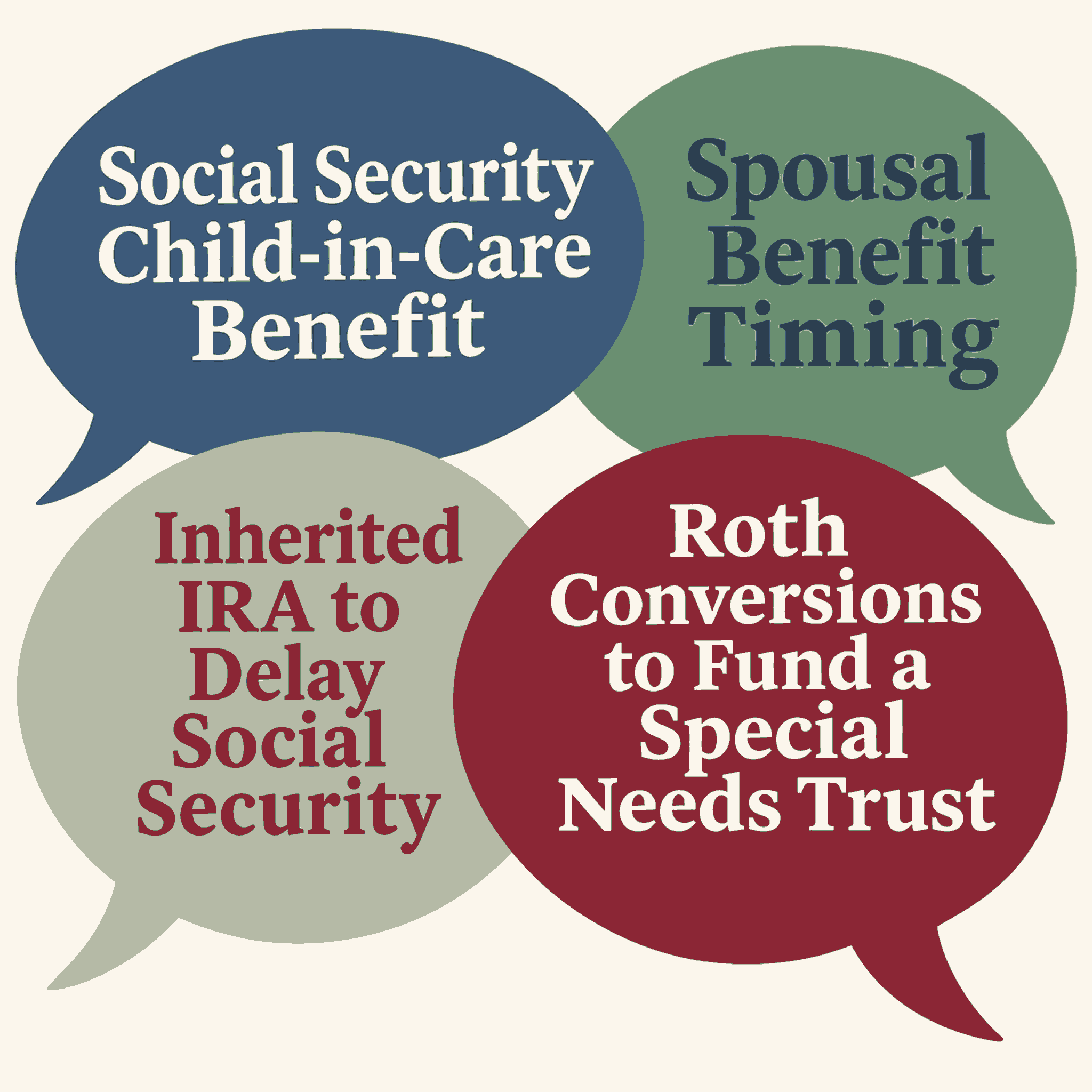
Jim and Chris discuss listener emails on Social Security child-in-care and spousal benefits, drawing from an inherited IRA to delay Social Security, and Roth conversions to fund a Special Needs Trust. (7:15) A listener caring for a disabled adult daughter wonders whether a child-in-care spousal benefit could allow the higher-earning spouse, to delay her own benefit until age 70. (16:45) The guys field a question from a 68-year-old waiting until 70 to claim, who asks whether a wife already collecting since 62 can add a spousal benefit and, if so, when to file. (23:45) Jim and Chris weigh whether a single 68-year-old ready to leave a stressful job should start Social Security now or draw from an inherited IRA until age 70. (44:30) George asks whether Roth conversions, paired with a tax-efficient place to hold the cash for conversion taxes, are the right way to protect an inheritance left to two children through a special needs trust. The post Social Security, Special Needs Trust: Q&A #26
If you would prefer to skip Jim and Chris chatting about Chris’s mild fall weather in Colorado, Jim’s Nashville trip, and upcoming Cumberland Gap hike and whitetail hunting trip, you can skip to 13:30. Chris’s Summary Jim and I continue our discussion of little-known IRA rules, centered on naming a trust as an IRA beneficiary. We cover when a trust may make sense, compressed trust tax brackets, a recap of see-through trust requirements, master trusts and subtrusts under SECURE, and moving an IRA out of a trust into separate inherited IRAs. We also look at which date starts the 365-day count under the once-per-year rollover rule. Jim’s “Pithy” Summary Chris and I pick back up on our list of little-known IRA rules, and if you want confusion, just involve a trust. A trust is a non-human. It’s a piece of paper. Yet the IRS will let it be treated as human for distribution purposes if certain rules are followed to the T. We’re not huge fans of naming a trust as IRA beneficiary, but I can con
Chris is joined by Jacob to discuss listener emails on withdrawing an early Social Security claim to collect survivor benefits, how Medicare Part A back-dating can affect HSA contributions, details of a liquidity account, buffered ETFs, and buying a protection ETF after its outcome date. (10:00) George asks whether a husband who claimed Social Security at 62 could withdraw his application within 12 months after his wife’s death, collect survivor benefits on her record, and later switch to his own benefit at 70. (20:45) A listener points out that Medicare Part A’s six-month retroactive coverage may be counted back from when a Social Security appointment is made rather than when benefits begin, which can affect when HSA contributions need to stop. (26:00) The guys get a request to define the liquidity account term heard on recent episodes, including how it is funded, how often it is replenished, and how much it should hold. (37:30) Chris and Jacob field a question on how to gauge the his
Universities should protect controversial speech unless it directly threatens or harasses others.
Share your view, then see how readers voted. No sign-in required. This poll is shared across stories.
Do you agree or disagree?
Common Quandary
A Common Quandary to discuss
Another conversation to explore, separate from this news story.
A stranger rings up fancy apples as the cheap kind. Do you mind your own business?
At self-checkout, the shopper beside you labels expensive organic apples as the cheapest variety. An employee is distracted nearby. The difference is only a few dollars, the store is a huge chain, and the shopper notices that you noticed.
When does witnessing a small cheat make it any of your business?