Social Security, Financial Planning, Variable Annuities: Q&A #2647
110 min
Listen through the publisher, then discuss the episode here or arrange an in-person Roundtable. Your city determines where to meet.
Roundtables are designed for groups of four, with a shared subject and room for everyone to speak. Come for discussion, with no dating expectation.
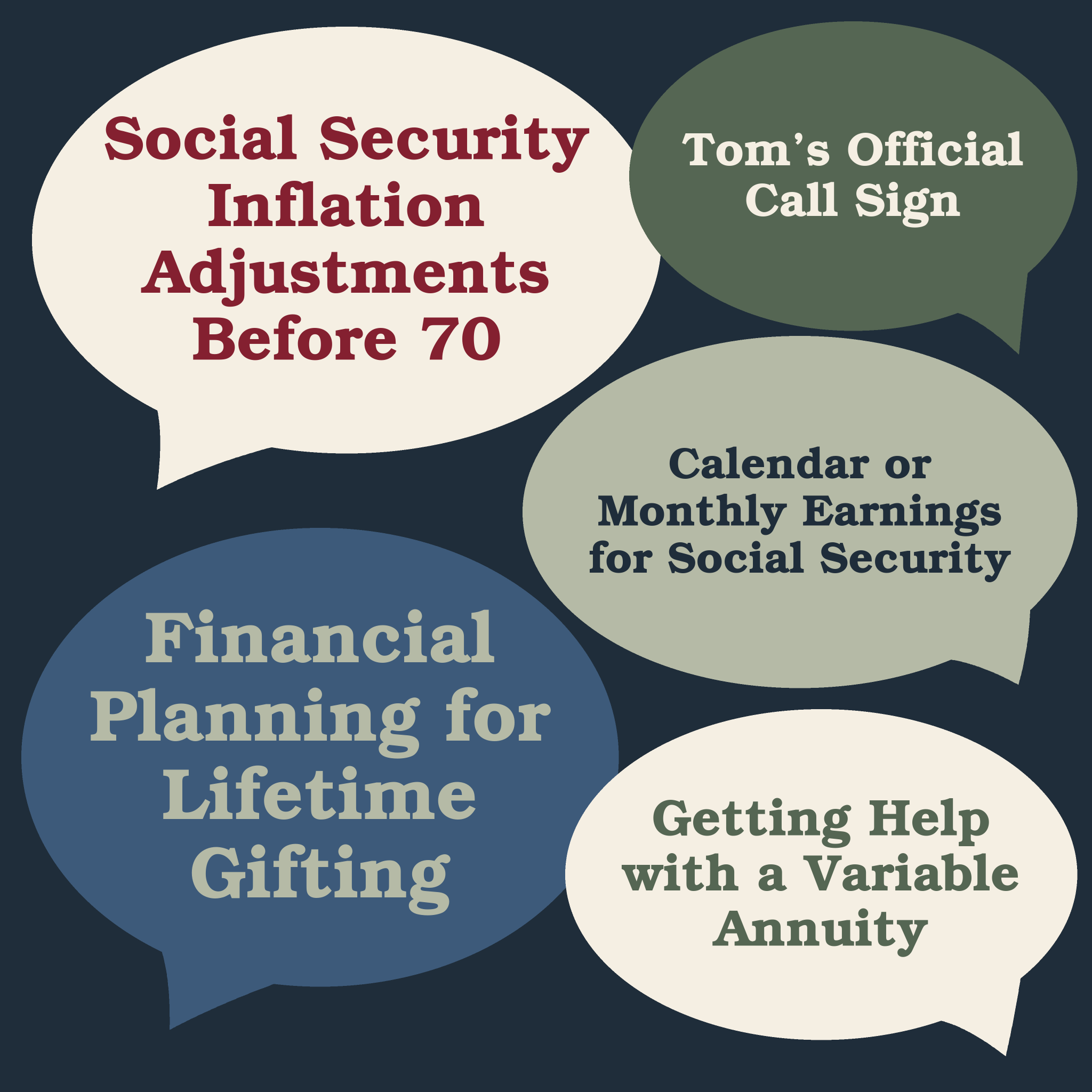
Jim and Chris are joined by Tom Stivers to discuss listener emails on an official call sign for Tom, Social Security inflation adjustments and earnings calculations, financial planning for lifetime gifting, and getting help with a variable annuity. (9:15) The guys get word from the fighter pilot who gave them their call signs, who explains the rules for properly naming Tom and makes a case for one name in particular. (16:45) A listener who plans to delay Social Security until age 70 asks how inflation adjustments apply to a primary insurance amount (PIA) between ages 62 and 70 and requests an example. (25:00) Jim, Chris, and Tom hear from someone planning to claim at 70 next July who wants to know whether the Social Security Administration (SSA) counts earnings by calendar year or by month in the 35-year average, and whether working from January to June would increase the benefit. (44:30) George and Georgette wonder whether there is a planning approach for people who intentionally accept a lower Monte Carlo probability of success after their complimentary financial plan overlooked their goals of gifting to their kids while alive and investing their IRAs more aggressively, since fixed indexed annuities (FIAs) and Social Security cover their essential expenses. (1:16:00) A listener seeks guidance on how a father who owns a variable annuity with complex optional features can find someone to help get the most value from it without a full financial plan, and whether an hourly planner is a good fit. The post Social Security, Financial Planning, Variable Annuities: Q&A #2647 (https://www.theretirementandirashow.com/podcast/social-security-financial-planning-variable-annuities-qa-2647/) appeared first on The Retirement and IRA Show (https://www.theretirementandirashow.com/).
Episode information is provided by the publisher. Listening takes place on the publisher’s service.
Explore the Social Security Administration's efforts toward transparency and new identity verification processes. We discuss the SSA's initiatives, potential challenges, and the impact on benefit recipients. Learn about proving your identity and preventing fraud in government operations. Stay informed about these crucial changes! #SocialSecurityUpdates #SocialSecurity #SSA #GovernmentTransparency #IdentityVerification #BenefitUpdates #FraudPrevention #ElderlyProtection #DisabilityBenefits #FinancialSecurity #GovernmentAccountability
Do you want to achieve financial freedom? Financial freedom is the ultimate dream. It’s the ability, as Tony Robbins says, “to do what you want, when you want, with whom you want, as much as you want.” It’s living the fulfilling life you deserve. It’s a big promise, but this book delivers. When it was first written, Money: Master the Game was Tony’s first book in two decades. It was a passion project, because Tony knew that it could truly transform lives. He spent more than four years interviewing 50 of the most brilliant minds in the financial world, and their advice is all here, including: Carl Icahn, a legend of investing who has delivered his clients 1600% return over 14 years. Jack Bogle, the founder of Vanguard, with 64 years in the financial business. Ray Dalio, the da Vinci of investing, who before retirement required $5 billion to even start investing with him. Tony has taken all of their advice and distilled it into a step-by-step plan anyone can use to achieve financial free
Core PCE inflation — that’s without gas or groceries included — hit a three-year high in October. That’s … not great for consumers. It also means another Fed rate hike is all but a done deal. In this episode, what’s driving inflation and how consumers are coping. Plus: The American Dream was shaped by fossil fuels, utility board elections grow fraught in the age of AI data centers, and a test kitchen chef perfects tariff-proof holiday meals. Every story has an economic angle. Want some in your inbox? Marketplace is more than a radio show. Read the stories in today’s episode: Rising inflation strengthens case for Fed rate hikes (https://www.marketplace.org/story/2026/11/25/core-pce-inflation-hit-a-3year-high-last-month) Why consumers are being more patient and putting off purchases (https://www.marketplace.org/story/2026/11/25/why-this-holiday-season-consumers-are-delaying-purchases) The American Dream, brought to you by fossil fuels (https://www.marketplace.org/story/2026/11/25/the-fos
Vanessa Grellet, Managing Partner of Arche Capital, joins Scott Melker as Bitcoin ETFs head for their worst month on record, with November outflows nearing $5 billion while Bitcoin trades below $60,000 and Nvidia's Jensen Huang rally fades. On "Red Wednesday," Scott and Vanessa cover the hot October PCE print, the Bitcoin ETF outflows and who is still buying, the Treasury and CIA hacks and AI-powered cyberattacks, tokenized pre-IPO shares, tokenized funds as DeFi collateral, privacy for institutions and Zcash, Bitcoin treasury companies, and whether the four-year cycle still holds. In this episode: 00:00 Red Wednesday: hot PCE, Nvidia's fade and Bitcoin below $60K 03:47 Bitcoin ETF outflows near $5B as institutions keep buying 05:48 Crypto rails, the GENIUS Act and the next wave of fintech 08:54 Treasury and CIA hacks and AI-powered cyberattacks 16:47 PCE inflation rises to 3.8% and December rate hike odds 21:17 Tokenized pre-IPO shares and accredited investor rules 24:28 Tokenized fun
Today, a look at risk sentiment nose-diving again as the "Jensen's Back" trade stumbles and other markets and indicators are hitting new lows, suggesting that a broad squeeze on confidence and liquidity continues. Can only a Fed pivot change the tide at this point? This and so much more, including perspectives on why confidence in the AI trade may be crumbling beyond the financing angle. Today's pod hosted by Saxo Global Head of Macro Strategy John J. Hardy Links Jeff Currie with a compelling post arguing that the metals meltdown and pressure on liquidity and financial conditions will continue to tighten until the Fed pivots to easing (https://x.com/CommodMkt/status/2125165627572650061), which won't be easy (https://x.com/CommodMkt/status/2124963846125178965), given inflationary backdrop, and policy priorities. Long form conversation on many things AI, from its constructive uses to limitations on its applicability above certain threshold and even possible signs of the failure of the Je
#JimRohnMotivation #JimRohn #JimRohnSpeech In this Jim Rohn Motivation video, discover why drive without direction is dangerous Energy, ambition, and hard work mean little if they aren’t aligned with vision, planning, and purpose. Many climb the ladder of success only to find it leaning against the wrong wall. True achievement requires clarity of vision, discipline of planning, alignment of drive, and the persistence to stay the course. Key Topics From This Motivational Video: Why being busy doesn’t mean being effective The danger of confusing motion with progress How to define your vision and set clear goals Why planning turns dreams into actionable steps The power of alignment and staying the course How resilience and discipline protect momentum This Jim Rohn motivational video explains how countless people exhaust themselves with relentless activity but end up frustrated because they never chose a clear destination. Drive feels good, but without direction it leads to burnout and emp
Chris’s Summary Jim and I walk through the 60-day rollover conversion, a partial workaround for the Roth conversion recharacterization the Tax Cuts and Jobs Act eliminated. We cover how indirect rollovers work, why the conversion date and the 60-day window can start on different days, and when the once-per-365-day rule does and does not apply. Most people do not need this, which is why we file it under do not try it at home. Jim’s “Pithy” Summary Chris and I go back to the topic we tackle every fall. Back before January 1st, 2018, we would purposely convert way more than a client ever imagined, then zero in on the right number while doing taxes the next spring. I compare it to scooping a measuring cup into a big vat of flour, overfilling it on purpose, and scraping a butter knife across the top. Then the Tax Cuts and Jobs Act ruined that. Recharacterizations are not the dodo bird, though. They’re the Black Knight. They’re still here. They’ve just been greatly reduced. So what do you do
Chris’s Summary Jim and I review a listener-submitted Money.com article by Mark Guberti that frames five monthly bills as essential retirement expenses. We compare its categories against our Minimum Dignity Floor, covering where dining out, multiple vehicles, home maintenance, debt, and insurance may fit, why we put aging and long-term care in a separate reserve, and how we treat taxes in retirement. Jim’s “Pithy” Summary Chris and I got an email from a listener with a link to a Money.com article and a simple note: “Just as you have been saying for decades.” In our Secure Retirement Income Process, it all begins with a core group of expenses every one of us will have for the rest of our lives. I named it the Minimum Dignity Floor in honor of a woman I met in my early 30s, when I was still a police officer, who told me she lived on just her Social Security. She changed my career, and I (re)share how that moment shaped the way I think about these expenses. The author lists five monthly b
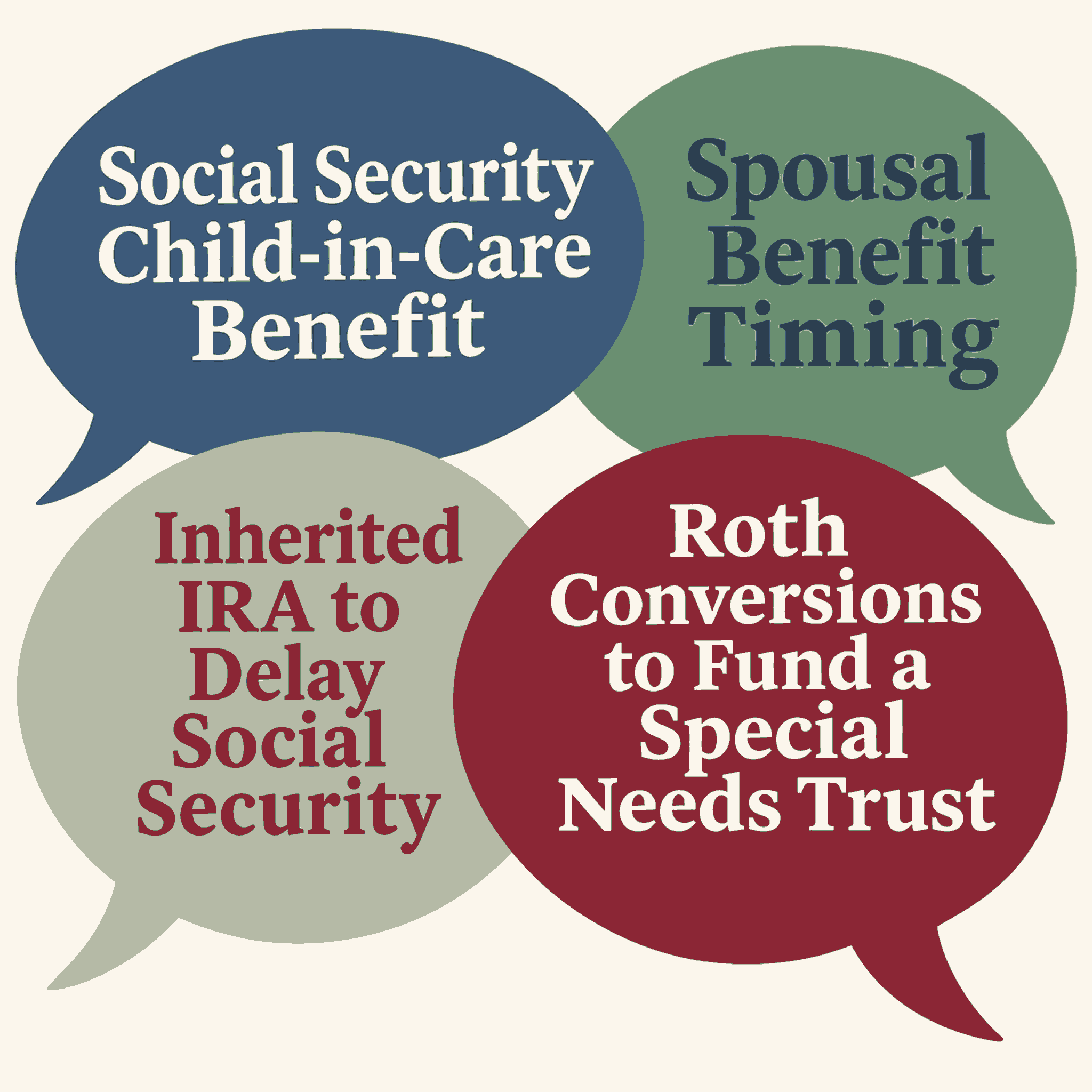
Jim and Chris discuss listener emails on Social Security child-in-care and spousal benefits, drawing from an inherited IRA to delay Social Security, and Roth conversions to fund a Special Needs Trust. (7:15) A listener caring for a disabled adult daughter wonders whether a child-in-care spousal benefit could allow the higher-earning spouse, to delay her own benefit until age 70. (16:45) The guys field a question from a 68-year-old waiting until 70 to claim, who asks whether a wife already collecting since 62 can add a spousal benefit and, if so, when to file. (23:45) Jim and Chris weigh whether a single 68-year-old ready to leave a stressful job should start Social Security now or draw from an inherited IRA until age 70. (44:30) George asks whether Roth conversions, paired with a tax-efficient place to hold the cash for conversion taxes, are the right way to protect an inheritance left to two children through a special needs trust. The post Social Security, Special Needs Trust: Q&A #26
Tourism revenue should help cover the costs visitors create for local residents.
Share your view, then see how readers voted. No sign-in required. This poll is shared across stories.
Do you agree or disagree?
Common Quandary
A Common Quandary to discuss
Another conversation to explore, separate from this news story.
Scientists can edit mosquitoes until a deadly disease disappears. Who gets to say yes?
Scientists can potentially release modified mosquitoes whose genes would spread through wild populations and sharply reduce a deadly disease. The ecological effects could cross borders and may be impossible to reverse.
Who may authorize an irreversible change intended to save lives?