Listen through the publisher, then discuss the episode here or arrange an in-person Roundtable. Your city determines where to meet.
Roundtables are designed for groups of four, with a shared subject and room for everyone to speak. Come for discussion, with no dating expectation.
Chris’s Summary Jim and I walk through the 60-day rollover conversion, a partial workaround for the Roth conversion recharacterization the Tax Cuts and Jobs Act eliminated. We cover how indirect rollovers work, why the conversion date and the 60-day window can start on different days, and when the once-per-365-day rule does and does not apply. Most people do not need this, which is why we file it under do not try it at home. Jim’s “Pithy” Summary Chris and I go back to the topic we tackle every fall. Back before January 1st, 2018, we would purposely convert way more than a client ever imagined, then zero in on the right number while doing taxes the next spring. I compare it to scooping a measuring cup into a big vat of flour, overfilling it on purpose, and scraping a butter knife across the top. Then the Tax Cuts and Jobs Act ruined that. Recharacterizations are not the dodo bird, though. They’re the Black Knight. They’re still here. They’ve just been greatly reduced. So what do you do in December when a bonus, a commission check, or a couple of home closings could land at the last minute and push you over an IRMAA cliff, cost you ACA premium tax credits, or trigger the Social Security tax torpedo? People think software can tell them exactly how much to convert. If it existed, it would be called the crystal ball. What we walk through instead is the 60-day rollover conversion, a roundabout way to buy yourself some time. Depending on how the cards fall, it could buy you a lot more than 60 days, and the reason why might surprise you. My neighbor’s mail plays a part in this story. We jokingly say don’t try this at home, because there are a lot of moving parts. When does the conversion happen? When does the 60-day clock start? When does the 365-day clock start? They are not all the same answer. Chris also keeps me honest on which rule applies where, and I share an offshoot that may help if your custodian stops taking conversion requests in early December. The post 60-Day Rollover Conversion Strategy: EDU #2647 (https://www.theretirementandirashow.com/podcast/60-day-rollover-conversion-strategy-edu-2647/) appeared first on The Retirement and IRA Show (https://www.theretirementandirashow.com/).
Episode information is provided by the publisher. Listening takes place on the publisher’s service.
Grain Markets and Other Stuff Links— TikTok (https://www.tiktok.com/@grainmarketsandotherstuf) 🇺🇸🇨🇳 Tariffs & Trade The Trump administration is getting ready to put new tariffs on most goods from China, the EU and 14 other countries, after an investigation into their industrial subsidies. China is likely to face the steepest rates, though the US and China did hold their first "agriculture working group" meeting this week. Grain Markets Soybeans rose about 5¢ to around $12.34 on strong meal demand, and corn added a penny to about $4.50 in light pre-Thanksgiving trading. Wheat slipped as winter wheat conditions improved for a third straight week, and the strong US dollar is still weighing on grains. Farmer Mental Health Years of high input costs, bad weather and volatile markets are wearing on farmers: 72% report high stress during the growing season, and suicide rates are 2–5x the national average. Check in on your farming friends and neighbors, and if you need help, reach out to Jo
Most people wait for the year to be good to them. They hope. They resolve. They set intentions in January and abandon them in February. And then they wonder why the next December looks exactly like the last one. Uploaded 25-09-26 But the year didn't fail them. They lived it the same way they lived the one before. And a year lived the same way produces the same result. That's not bad luck. That's just arithmetic. Here is the truth: there is a small set of habits that, once you build them, quietly make every year better than the one that came before. Not dramatically. Not overnight. But steadily, so that after five years you're standing somewhere the old version of you could never have reached. This seminar walks through 10 things you must understand about the habits that make every year climb instead of repeat. CHAPTERS 0:00 Intro — a year lived the same way 1:07 The invisible arithmetic underneath every year 5:00 #1 — Review the year before you plan the next 5:24 #2 — Learn one new thi
Canada's 3 territories run on different money rules: a tax deduction just for living there, no provincial sales tax, and a Yukon gold royalty that's been 37.5 cents an ounce since 1906. When I ran all 13 provinces and territories through my Cheaper Province app, the Northwest Territories had the most money left over after the basics of anywhere in Canada. Nunavut, right next door, had the least. Plus the Klondike, the diamond rush, and the Nunavut Trust, now worth more than $2 billion because it pays out a slice each year and keeps the rest. 1 province or territory at a time, starting with the North. If you live there, tell me what I got wrong. calmmoneycoach.com General education for Canadians. 2026 figures. Takeaways 1. Moving north? Price the whole package: housing, the payroll tax, the northern deduction and flights home. 2. Retiring south? Where you live on 31 December sets your tax for the whole year. 3. Windfall or a peak year? Don't plan your life on it, and set money aside for
After years of looking foolish, value investing has suddenly reminded everyone why patient diversification matters. Don and Tom revisit the century-long value premium, the painful stretch when growth dominated, and the sharp 2026 reversal that rewarded investors who stayed disciplined. They compare how broad global funds such as AVGE, DFAW, and VT expose investors to value, size, and profitability. Then a 32-year-old listener with a high tolerance for volatility asks how far he can push risk without simply making a concentrated bet. The final questions cover Roth conversions, Medicare IRMAA surcharges, and a short shelf of investing books that are actually worth reading. 00:49 Value returns after a long drought 08:55 How global funds tilt toward value 13:19 How much risk is too much at 32? 20:16 Roth conversions and IRMAA surcharges 27:57 Investing books worth reading Questions? Comments? Click! (https://www.buzzsprout.com/2607021/fan_mail/new)
Joe Polish is the leader of the Genius Network, an organization that brings together powerful entrepreneurs in a think-tank style environment to discuss breakthroughs, collaboration, connection and more. In this episode of the Tony Robbins podcast, Joe Polish sits down with Tony Robbins and Peter Diamandis, founder and chairman of the X Prize Foundation, to discuss the psychology of success. The challenge in succeeding in business and establishing a successful mindset is finding out what your highest calling in life is. Do you feel like you’re working every day just to chase a paycheck, or do you feel like you’re making progress toward pursuing your passion? If it’s the former, it’s time to switch career paths. What’s the point in working toward someone else’s dream? Find a way to pursue your own. Does this sound impossible? Oftentimes the things that scare us do sound impossible, but they’re not. Reframe your mindset — what can you achieve and what have you put off achieving because y
In his latest weekly chat with Chris Steyn, Solly Moeng urges civic society to unite ahead of the next elections. “We mustn't wait to see what politicians are going to offer us. We must say to them ahead of the next election, we've watched you, we've listened to you, we are tired of what you do, how you do things. Now we're taking over. The people of South Africa must not wait for the next elections. Because by the next elections, the same system will take in either some of the people who are going in now or new ones with the same attitude that once they cross the line into political office, they show us the middle finger. So we, the people, must stand up. Look, all over the world, people have been standing up to say it's enough and governments go down on their knees when people do that. We, the people of South Africa, must do the same. We must show these people that this country doesn't belong to them.” Moeng also comments on the ongoing frenzy to form coalitions and the conduct of Ac
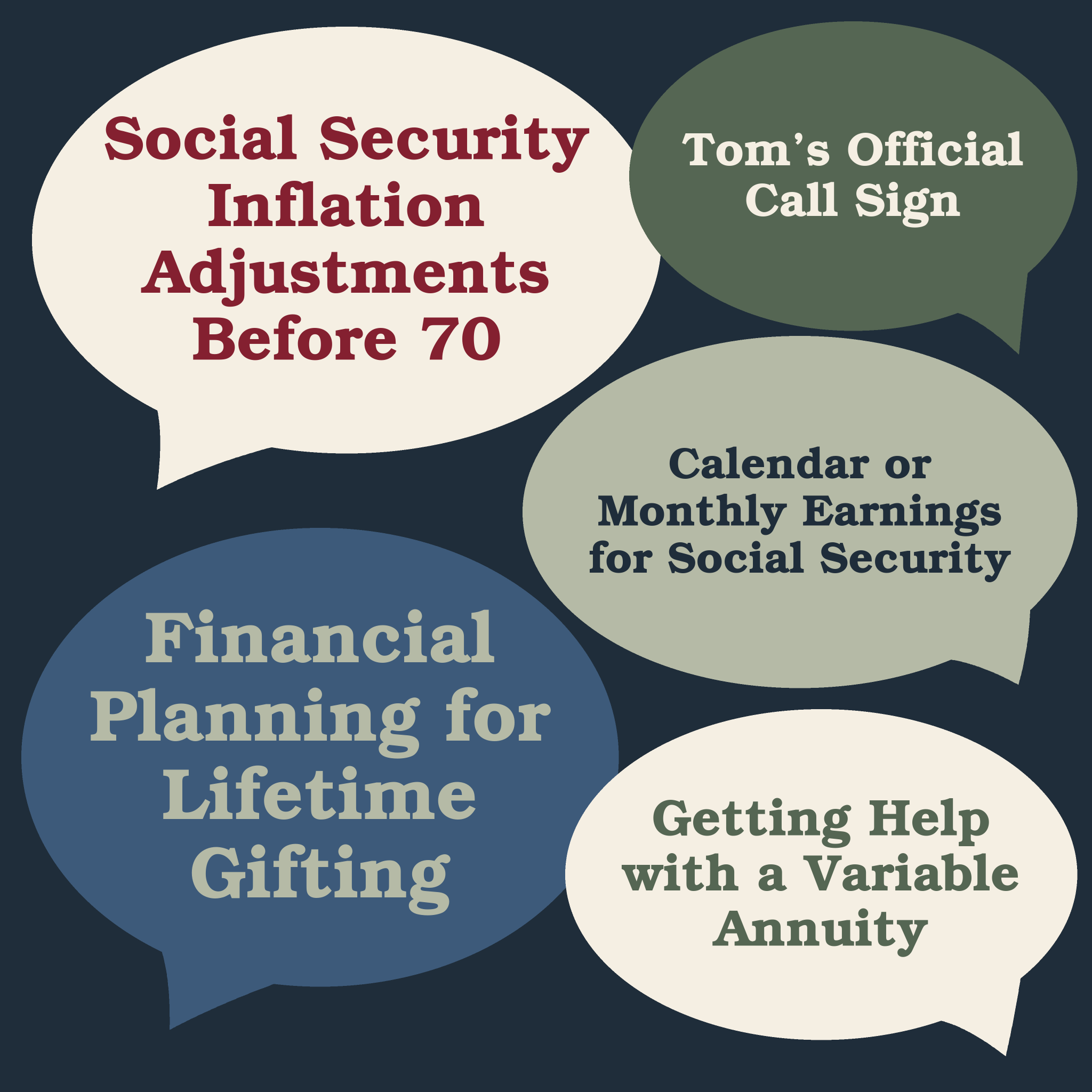
Jim and Chris are joined by Tom Stivers to discuss listener emails on an official call sign for Tom, Social Security inflation adjustments and earnings calculations, financial planning for lifetime gifting, and getting help with a variable annuity. (9:15) The guys get word from the fighter pilot who gave them their call signs, who explains the rules for properly naming Tom and makes a case for one name in particular. (16:45) A listener who plans to delay Social Security until age 70 asks how inflation adjustments apply to a primary insurance amount (PIA) between ages 62 and 70 and requests an example. (25:00) Jim, Chris, and Tom hear from someone planning to claim at 70 next July who wants to know whether the Social Security Administration (SSA) counts earnings by calendar year or by month in the 35-year average, and whether working from January to June would increase the benefit. (44:30) George and Georgette wonder whether there is a planning approach for people who intentionally acce
Chris’s Summary Jim and I review a listener-submitted Money.com article by Mark Guberti that frames five monthly bills as essential retirement expenses. We compare its categories against our Minimum Dignity Floor, covering where dining out, multiple vehicles, home maintenance, debt, and insurance may fit, why we put aging and long-term care in a separate reserve, and how we treat taxes in retirement. Jim’s “Pithy” Summary Chris and I got an email from a listener with a link to a Money.com article and a simple note: “Just as you have been saying for decades.” In our Secure Retirement Income Process, it all begins with a core group of expenses every one of us will have for the rest of our lives. I named it the Minimum Dignity Floor in honor of a woman I met in my early 30s, when I was still a police officer, who told me she lived on just her Social Security. She changed my career, and I (re)share how that moment shaped the way I think about these expenses. The author lists five monthly b
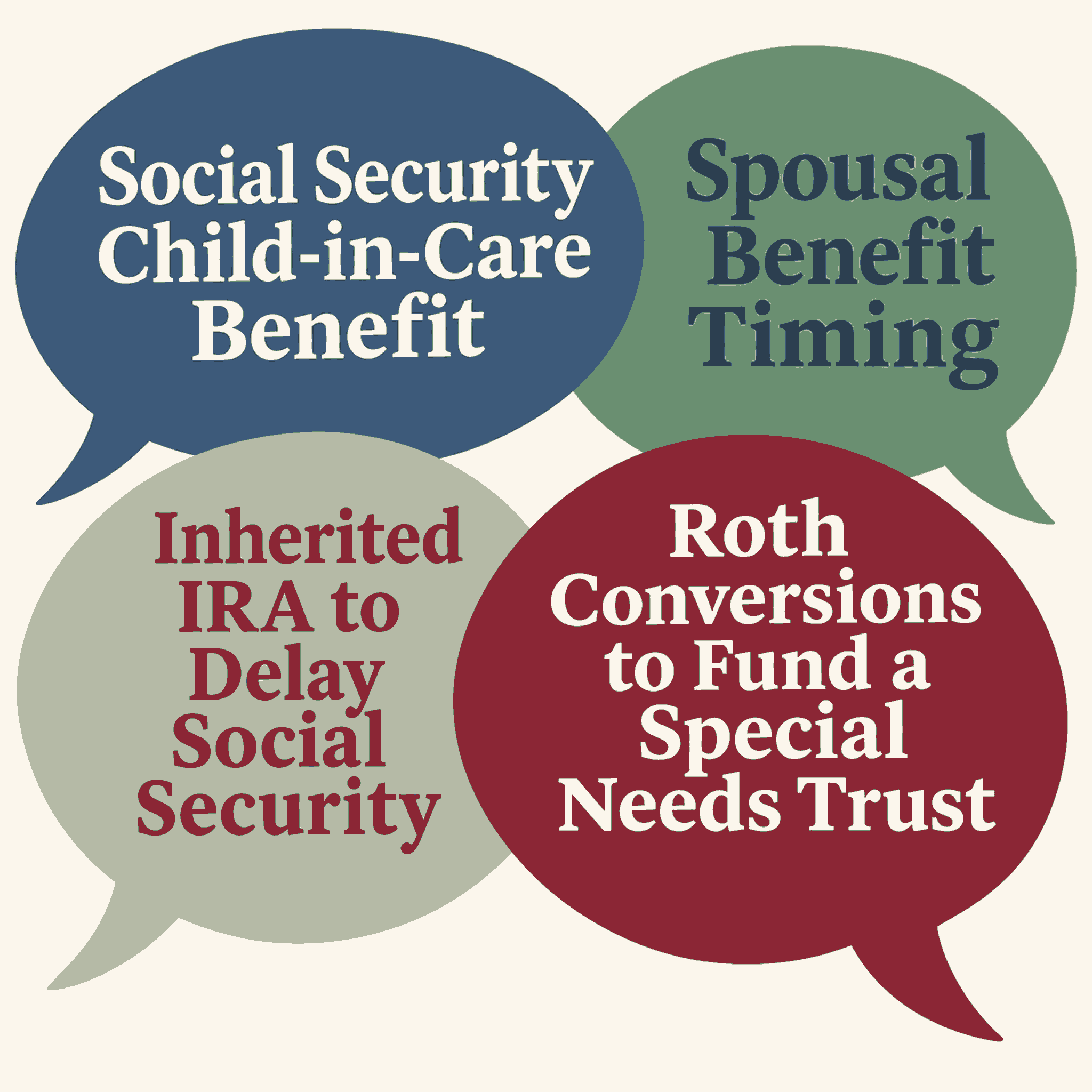
Jim and Chris discuss listener emails on Social Security child-in-care and spousal benefits, drawing from an inherited IRA to delay Social Security, and Roth conversions to fund a Special Needs Trust. (7:15) A listener caring for a disabled adult daughter wonders whether a child-in-care spousal benefit could allow the higher-earning spouse, to delay her own benefit until age 70. (16:45) The guys field a question from a 68-year-old waiting until 70 to claim, who asks whether a wife already collecting since 62 can add a spousal benefit and, if so, when to file. (23:45) Jim and Chris weigh whether a single 68-year-old ready to leave a stressful job should start Social Security now or draw from an inherited IRA until age 70. (44:30) George asks whether Roth conversions, paired with a tax-efficient place to hold the cash for conversion taxes, are the right way to protect an inheritance left to two children through a special needs trust. The post Social Security, Special Needs Trust: Q&A #26
Keeping personal information private is worth giving up some digital convenience.
Share your view, then see how readers voted. No sign-in required. This poll is shared across stories.
Do you agree or disagree?
Common Quandary
A Common Quandary to discuss
Another conversation to explore, separate from this news story.
A stranger takes an emotional call in the quiet car. Do you shush them?
On a crowded train's designated quiet car, a passenger answers a call and begins discussing an apparent family emergency. They are speaking softly but continuously, and everyone nearby is listening despite trying not to.
Do public rules make room for private emergencies?