Listen through the publisher, then discuss the episode here or arrange an in-person Roundtable. Your city determines where to meet.
Roundtables are designed for groups of four, with a shared subject and room for everyone to speak. Come for discussion, with no dating expectation.
Since the U.S. Supreme Court let states legalize betting on sports in 2018, gambling has exploded. More than half of men ages 18 to 49 say they have an active account with an online sportsbook. Want to bet on a game, a play, or even an individual performance? The bookie is always open on your phone, and it sends promo credits to keep you in the game. Young men see the harm up close. The share of men under 30 who call legal sports betting bad for society has more than doubled since 2022, to 47%. Built to be addictive, sports betting is like cigarettes—and deserves a public health response. Chapters: 00:01:02 Announcements 00:02:27 Retcon: Healthcare moral hazard vs. cost-sharing; networks and military branches 00:07:37 Terms & Conditions: Handle, the hold, and the tulip bubble 00:12:52 Big Pilcrow: Sports betting, prediction markets, and addiction 00:41:42 Executive Orders: Free museum entry for union members; kid-sized sink staircases 00:44:26 Spiritual Sponsors: Hermanos Gutiérrez; good procedural movies We are entirely listener supported! Join your Optimist donors here: https://optimisteconomy.com (https://optimisteconomy.com/) Video-curious? Watch clips on the Optimist Economy YouTube channel (https://www.youtube.com/@optimist_economy). We’re also on Instagram at @optimist_economy (https://www.instagram.com/optimist_economy) or TikTok at @optimist_economy (https://www.tiktok.com/@optimist_economy). Want full video? See above about donating. Chat with other Optimists on Substack. (https://substack.com/chat/4604257) Rep your optimism with Optimist Economy merch: https://merch.ambientinks.com/collections/optimisteconomy Got economic questions, concerns, or executive orders? Send them to [email protected]
Episode information is provided by the publisher. Listening takes place on the publisher’s service.
Description Russia is quietly creeping back into international sport. But a fight back is brewing in Ice Hockey which could have huge consequences for the Olympics and FIFA World Cup. Ukraine has fought its way back to the World Championships after 20 years, only to face the prospect of meeting Russia on the ice after a court upheld their right to play — and all the while, the war continues back home. European nations are defying the courts and refusing to play against Russian opposition in what is an acid test for the FIFA World Cup & Olympic Games. Who backs down? The governing bodies welcoming Russia back, or the nations refusing to face them? Gabby Logan and Mark Chapman speak to Ukraine's ice hockey captain Igor Merezhko about a deeply personal dilemma, and journalist Matt Slater about who is behind Russia's return and why it’s happening now. TikTok - https://www.tiktok.com/@thesportsagents (https://protect.checkpoint.com/v2/r02/___https://www.tiktok.com/_@thesportsagents___.YzJlO
In this paid subscriber-only edition of The Roundtable, Rudyard Griffiths and Sean Speer examine Quebecor’s proposed takeover of Telus and what it reveals about Canada’s economic model. They trace the history of the “fourth carrier” policy, debate whether this merger signals the end of telecom competition, and explore how government regulation creates what they call “Laurentian capitalism”—a system where state power and corporate interests intertwine. The discussion also addresses sovereignty arguments, media consolidation, and whether Canada is abandoning market-based competition for state-managed oligopolies across key industries. If you are enjoying free versions of the Hub Roundtable, subscribe to become a Hub Hero or Fellow to access the full version every week: https://thehub.ca/join/ The Hub is Canada’s fastest growing independent digital news outlet. https://tinyurl.com/3a7zpd7e (Apple) https://tinyurl.com/y8akmfn7 (Spotify) Watch a video version on YouTube: https://www.youtube
Training Wednesday is back, and Aaron, Trent, and Peaches spend the live answering Air Force Special Warfare candidate questions — but first, there is an update from the current SWAS class. According to the numbers discussed on the live, 78 candidates failed the initial IFT and 52 still failed the refire. The guys try to understand how that happens after months of development and preparation, discuss reports that some candidates struggled with the swim and high-volume masks, and once again return to the same message they keep giving candidates: you need to arrive ready. From there, the live turns into a full candidate-training clinic. The guys talk about periodizing strength and endurance work, building Zone 2 capacity, gradually increasing mileage, why running with a weighted vest is probably not solving the problem you think it is, preparing for A&S, training with the equipment you will actually use, and why the goal is not simply to pass a minimum standard. They also answer question
Rebuilding the government after Trump and DOGE will take more than rehiring the people they fired last year. The Supreme Court enabled the administration’s assault on services and protections millions of Americans rely upon, and it could still block the rebuilding, too. On this week’s Amicus, Dahlia Lithwick talks with Cornell law professor and former Biden administration official K. Sabeel Rahman about his new book, Remaking the State: A New Blueprint for American Democracy (https://www.amazon.com/dp/1967190208?tag=slatmaga-20&th=1), about why restoring the old machinery of the administrative state won’t be enough. Rahman connects DOGE’s slash-and-burn campaign to a much longer legal project. He explains why doctrines that constrain regulation remain a threat to future policymaking, even as the high court supercharges Trump’s executive power grabs. But this is not just a damage assessment. From stronger consumer protections to easier access to public benefits and a meaningful democrat
The D.C. Circuit hears a dispute about who gets room on Colorado's electric grid. Salsa Solar and another renewable-energy developer planned projects to supply CORE Electric Cooperative. To connect to the grid sooner, they sought provisional service from Public Service Company of Colorado, part of Xcel Energy. But the connection studies treated some capacity on the Colorado Power Pathway as reserved for the utility's own future power supplies. The developers complained to the Federal Energy Regulatory Commission, known as FERC. They said the reservation let lower-priority projects jump ahead of them, delaying their access to the grid. The utility said it needed that capacity to keep serving its customers while replacing coal generation under Colorado's clean-energy requirements. FERC rejected the complaint and maintained that result on rehearing. The question is when a utility must identify the particular power plants that will use reserved transmission capacity. The challengers will a
This episode was available Wednesday for Ark+ members, and posts Friday for everyone else. Join Ark+ today for early access. A genocide case against Myanmar at the International Court of Justice could expand the definition of genocide in ways that impact Israel’s own genocide case, brought by South Africa. Andrew Fox, a military and legal expert, lays out for Dan how what happens if Myanmar is found guilty of genocide--and what Israel could do in the meantime to help prove its innocence. Read Andrew Fox’s Substack,The Legal Road to Israel’s Oblivion. (https://mrandrewfox.substack.com/p/the-legal-road-to-israels-oblivion?has_completed_unsubscribed_unlock=true) Read The Guardian’s story on the Myanmar case. (https://www.theguardian.com/world/2026/nov/15/myanmar-rohingya-genocide-icj) ___ Last year, Dan participated in an auction for the Jewish Food Society, a terrific organization that's close to Ark Media’s hearts and taste buds. The Jewish Food Society uses food as a gateway into Jewis
Somewhere between the green bean casserole and the second glass of wine, an uncle or in-law will announce that raising the minimum wage kills jobs, that France is on fire, or that poor people shouldn’t buy big TVs. We chose a baker’s dozen dinner-table standoffs sent in by optimist listeners addressing unions, the IRS, school vouchers, the K-shaped economy, and the perennial generational debate: Did Boomers rob the Millennials? Also: how to keep from gloating about the election, and what to say when Fox News declares this the strongest economy ever. Serve up facts that make your tablemates stop chewing and think. Chapters: 00:02:11 Controlling gloating 00:04:56 Finding common ground with a MAGA voter 00:08:59 "The economy is the strongest it's ever been" 00:11:42 The minimum wage 00:18:48 Unions 00:22:48 Tax avoidance and the IRS 00:28:55 Government waste and tax revenue 00:35:19 The K-shaped economy 00:42:15 Did Boomers enrich themselves at the young's expense? 00:46:22 France and the
Working from home, a new study in the journal Science says, leaves employees lonelier, sadder, and more likely to be depressed. So does that mean everybody get back to your office desks so morale improves? The authors looked at rates of mental distress among people in jobs that could be done remotely or not before and after the COVID-19 pandemic, and concluded that remote work is responsible for about a third of the overall increase, with the worst results for people who live alone. But before-and-after is not cause-and-effect. Isolation is real. Chaining everyone to a desk for friendship is not the only fix. Chapters: 00:01:44 Announcements 00:02:27 Retcon: Immigrants work in every occupation; occupational crowding; sports betting scandals 00:07:21 Terms & Conditions: Procedural; remotable vs. non-remotable jobs 00:10:00 Big Pilcrow: Does Work From Home Make Us Sad? 00:37:21 Executive Orders: News alerts; more brass! 00:38:28 Spiritual Sponsors: Animal conservation workers; Andrew Bir
Wider communities should help fund hazard protection even when only some properties directly benefit.
Share your view, then see how readers voted. No sign-in required. This poll is shared across stories.
Do you agree or disagree?
Common Quandary
A Common Quandary to discuss
Another conversation to explore, separate from this news story.
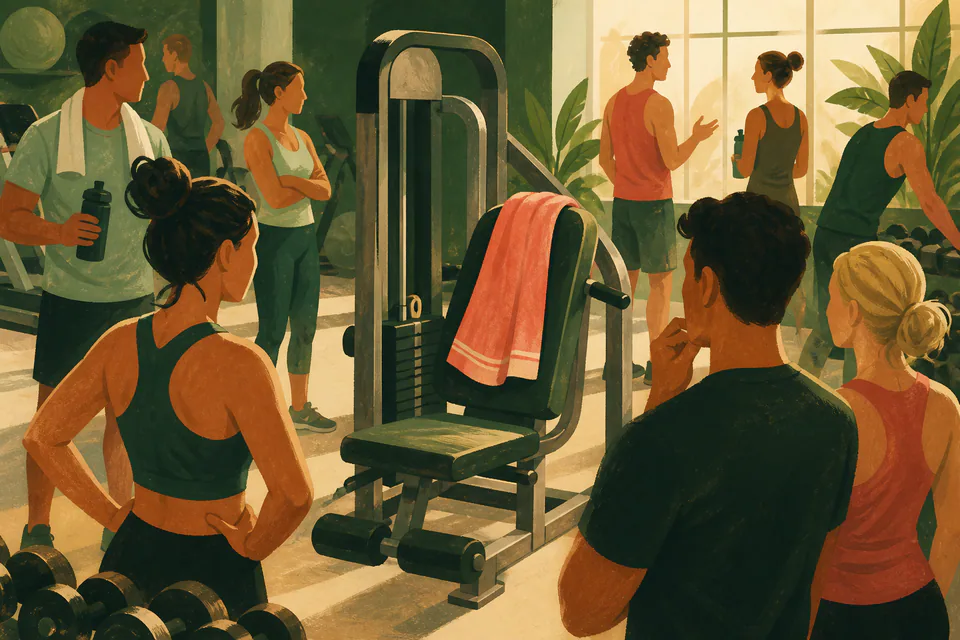
Someone reserves the best gym machine with a towel. When may you move it?
At a crowded gym, a towel has occupied the most popular machine for fifteen minutes while its owner chats across the room. Gym rules prohibit reserving equipment, but everyone occasionally steps away between sets.
How long may convenience masquerade as continued use?