The avalanche that hit math is coming for AI development
45 min
Listen through the publisher, then discuss the episode here or arrange an in-person Roundtable. Your city determines where to meet.
Roundtables are designed for groups of four, with a shared subject and room for everyone to speak. Come for discussion, with no dating expectation.
If you asked me earlier this year how far away we are from superintelligence, I’d probably have said at least the better part of a decade. But over the last three months, from debating people on and off the podcast, I’ve updated my views a ton. Let me walk you through how my thinking has changed. If you want to read the written version (with footnotes and links) you can check it out here: https://www.dwarkesh.com/p/rsi This is a public episode. If you would like to discuss this with other subscribers or get access to bonus episodes, visit www.dwarkesh.com (https://www.dwarkesh.com/)
Episode information is provided by the publisher. Listening takes place on the publisher’s service.
(01:01) - Anthropic Slips After Historic IPO (01:36) - Math Solved Again (07:22) - Market Nukes (10:11) - Lenders Push Back on SpaceX Chips (17:33) - 𝕏 Timeline Reactions (24:48) - THE MANSION SECTION (29:36) - Alex Epstein discusses the urgent need for bipartisan permitting reform to expand America’s freedom to build energy infrastructure, housing, and AI data centers. He argues that the proposed legislation could lower costs and create jobs by removing regulatory barriers, while emphasizing that Congress has only a narrow window to pass it. He also champions widespread AI and energy development while criticizing tariffs and restrictions on overseas data-center construction. (59:11) - David Chang is a renowned chef, restaurateur, and media personality known for founding Momofuku. David Chang discusses his Las Vegas F1 pop-up, his CNN series The Detour, the challenges of the food business, and the need for greater originality and innovation in restaurants. (01:22:23) - Zhou Xian discu
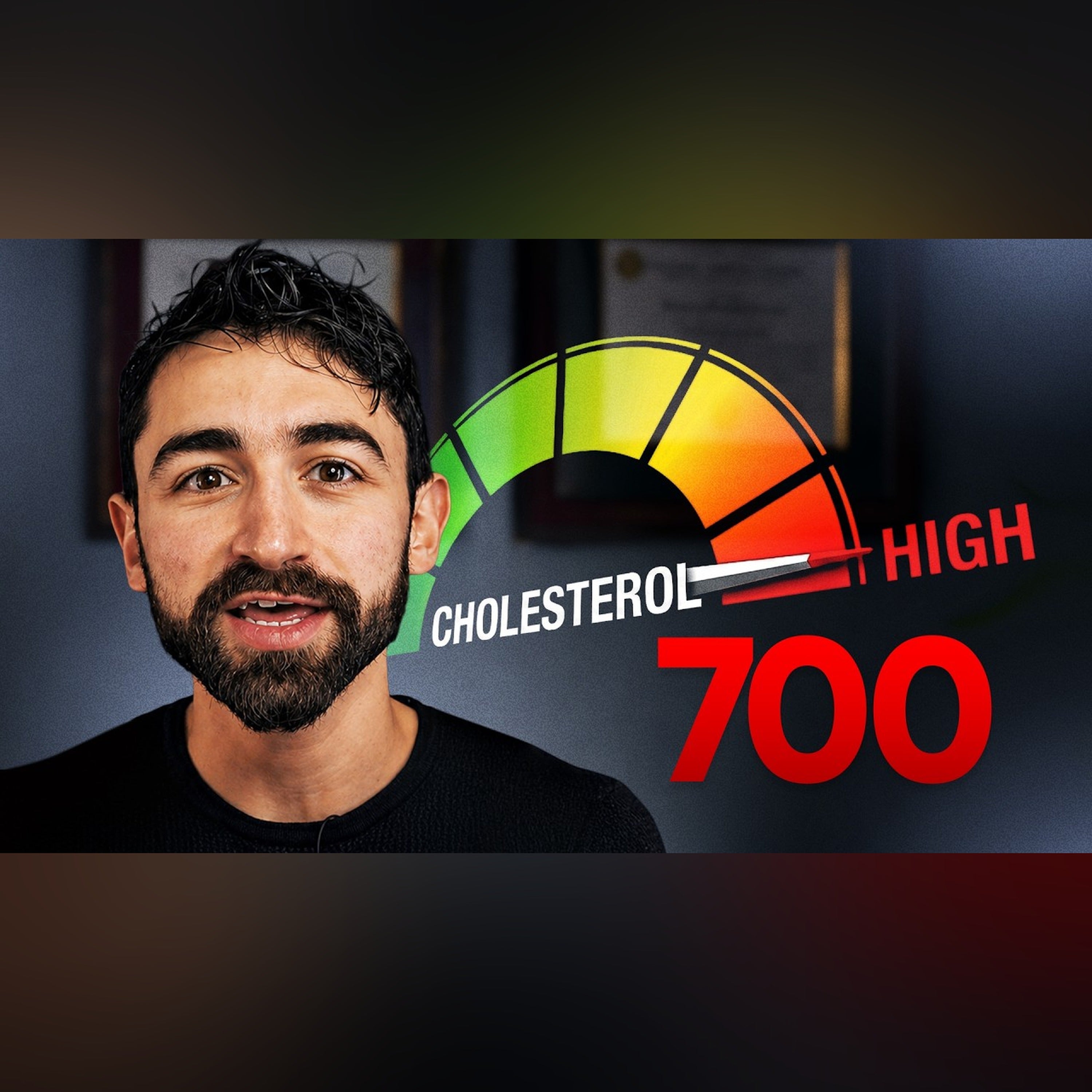
For a written breakdown, more nuances and early access to content, see the associated newsletter: https://open.substack.com/pub/staycuriousmetabolism/p/im-finally-lowering-my-cholesterol?r=40ekz2&utm_campaign=post&utm_medium=web&showWelcomeOnShare=true (https://open.substack.com/pub/staycuriousmetabolism/p/im-finally-lowering-my-cholesterol?r=40ekz2&showWelcomeOnShare=true) Statin RCT Video: https://youtu.be/d9LeDSoYOVc Ezetimibe Video: https://youtu.be/5idzP5ghT7A Bempedoic Acid Letter: https://staycuriousmetabolism.substack.com/p/beyond-cholesterol-the-unfolding?r=40ekz2 Description For the last seven years, despite extremely high cholesterol, I refused cholesterol-lowering medications. But I’ve just changed my mind…sort of. In this video, I walk through the full decision-making process: the risks, the uncertainty, the medical context, and the nuances that made this case unusually complicated. There are three plot twists. This is not medical advice. It’s a detailed look at an unusual
To learn to think like a scientist check out http://Brilliant.org/SpaceTime (http://brilliant.org/SpaceTime) Uploaded 20-12-18 PBS Member Stations rely on viewers like you. To support your local station, go to: http://to.pbs.org/DonateSPACE Check out the new Space Time Merch Store! Support Space Time on Patreon There’s this idea that beauty is a powerful guide to truth in the mathematics of physical theory. String theory is certainly beautiful in the eyes of many physicists. Beautiful enough to pursue even if it’s wrong? Tweet at us! @pbsspacetime Facebook: facebook.com/pbsspacetime Email us! pbsspacetime [at] gmail [dot] com Comment on Reddit: http://www.reddit.com/r/pbsspacetime Help translate our videos! Previous Episode: Quantum Physics in a Mirror Universe https://www.youtube.com/watch?v=UyTqgnKD3sw&t=5s (https://www.youtube.com/watch?t=5s&v=UyTqgnKD3sw) Hosted by Matt O'Dowd Written by Matt O'Dowd Graphics by Luke Maroldi Assistant Editing and Sound Design by Mike Petrow Made by
In Brought to You By: How Corporations Warped the Truth, Conned the Public, and Broke Democracy (https://bookshop.org/a/12343/9781639736331), Amy Westervelt exposes the plot hidden within the familiar story of science denial. Over the last century, Big Industry has built a vast apparatus of think tanks, lobbyists, sponsored university labs, and obliging news networks to con the public and fool decision-makers, poisoning the informational ecosystem and warping the nature of truth along the way. With her signature wit and incisiveness, Westervelt introduces the masterminds of corporate misinformation: Herb Schmertz, the public relations pioneer who made Mobil “the thinking man's oil company;” Richard Edelman, the PR guy who helped the dairy industry vilify oat milk; David Petraeus, the disgraced spy chief using counter-insurgency tactics to discredit climate science; and many more. She shows how these company men have worked to usher in an era of unprecedented corporate control. Only by
A kiss can be wonderful. It can create an instant connection, spark romance, or make you feel closer to someone. But a kiss can also have the opposite effect — and sometimes ruin everything. So what makes kissing so powerful, and why can one kiss make such a difference? There's some fascinating science behind it. https://www.scientificamerican.com/article/why-we-kiss/ We spend an enormous amount of time worrying about what's going to change. What's next? What's coming? How do we prepare? But what if we're paying attention to the wrong things? Some of the most important forces shaping our lives never change, and understanding them may be far more valuable than trying to predict the future — something humans are notoriously bad at. Morgan Housel, partner at The Collaborative Fund and author of Same as Ever: A Guide to What Never Changes (https://amzn.to/3SwWn6u) (https://amzn.to/3SwWn6u)), joins me to explain why the things that stay the same may be the most important things to understan
Théo Mogenet of Bull Bitcoin joins Marty to unpack The Cost of Lies, a manifesto comparing the fiat system to a Chernobyl reactor that was never supposed to explode. They walk through the debt trap math behind why higher interest rates now feed deficits and inflation, the five ways governments try to escape, and why financial repression and capital controls are the likeliest path. Théo zooms in on France's fiscal crisis, Japan's leverage over foreign bond markets, and why self-custodied Bitcoin is the individual's way out. Théo on X: https://x.com/theo_mog Bull Bitcoin: https://www.bullbitcoin.com/ STACK SATS hat: https://tftcmerch.io/ Our newsletter: https://www.tftc.io/bitcoin-brief/ Discord: https://discord.gg/yHGkvYxdqT Opportunity Cost Extension: https://www.opportunitycost.app/ Shoutout to our sponsors: Block: Terms apply. Bitcoin services by Block, Inc. See the Bitcoin disclosures at cash.app/legal/podcast. Aven CrowdHealth Simple Mining Salt of the Earth: Join the TFTC Movement
Paul Christiano (https://paulfchristiano.com/) is head of the Alignment Research Center. Previously, he was head of AI safety at the US AI Safety Institute. Before that, he led alignment at OpenAI, where he invented RLHF. He’s recently joined OpenAI’s board (though here he is speaking as a private citizen). Paul thinks that on the current trajectory (absent any slowing down), there is a 1 in 3 chance that we could have superintelligence powerful enough to overthrow the government within a year. (He articulates a concrete scenario). He argues that the labs should pause further algorithmic progress until they can secure their weights and research secrets. Otherwise China could simply steal the superintelligence in the middle of the intelligence explosion, and the labs would no longer be able to slow down even if they saw their models going off the rails. He also explains how AIs will be trained during the intelligence explosion, and why even a system trained entirely inside a data center
Clubs should reject lucrative sponsors whose activities conflict with their stated values.
Share your view, then see how readers voted. No sign-in required. This poll is shared across stories.
Do you agree or disagree?
Common Quandary
A Common Quandary to discuss
Another conversation to explore, separate from this news story.
The company allows an $80 dinner. Is ordering the lobster fair game?
During work travel, company policy permits an expensive dinner. A modest option is nearby, but colleagues choose the nicest restaurant because the company can easily afford it and everyone is within the stated limit.
Is following a rule enough when you are spending someone else's money?