The Biggest Insurance Myths Young Australians Believe | FUNdamental Fridays
12 min
Listen through the publisher, then discuss the episode here or arrange an in-person Roundtable. Your city determines where to meet.
Roundtables are designed for groups of four, with a shared subject and room for everyone to speak. Come for discussion, with no dating expectation.
Do young, healthy Australians actually need insurance? Many people assume insurance is something to think about later in life. But according to financial adviser Chemere Brown, the majority of insurance claims occur between the ages of 25 and 45. In this week's FUNdamental Friday, Shane and Chemere unpack some of the biggest insurance myths and explain why many Australians may be underinsured during the years they have the most financial commitments. They discuss: Why most claims happen between 25 and 45 Why being healthy may actually be the best reason to get insured Income protection explained Common misconceptions about insurance through super Why your future income may be your biggest asset Waiting periods and affordability options Whether savings alone are enough protection Why property investors should review their insurance strategy Because your biggest financial risk often isn't what you think it is. Thinking About Buying A Home? Watch PRE-Purchase, our free 10-part video series designed to help Australians Prepare, Research and Execute their next property purchase with confidence. thepropertycouch.com.au/prepurchase ⏰ Timestamps 00:00 I'm young and healthy. Why do I need insurance? 00:25 Meet Chemere Brown 00:56 Insurance myth #1 01:26 Why most claims happen between 25 and 45 01:54 The most common insurance claims 02:35 Why healthy people should get insured 03:11 Why risk is often highest between 25 and 45 03:39 Is insurance inside super enough? 04:24 The insurance gap most people miss 04:45 Why your income is your biggest asset 05:15 If you can only afford one type of cover 05:59 Tax deductions and insurance 06:54 Is insurance only for death? 07:10 Where most claims actually occur 07:41 Waiting periods explained 08:40 How waiting periods can reduce premiums 09:08 Can you just rely on savings? 09:21 The average Australian savings balance 09:54 How much emergency savings should households hold? 10:19 Insurance for property investors 10:51 Why financial advice matters 11:13 PRE-Purchase series MOORR MONEY MANAGEMENT APP: Apple: https://apple.co/3ioICGW Google Play: https://bit.ly/3OT86bW Web platform: https://www.moorr.com.au/ FREE MASTERCLASS: FREE BEST-SELLING BOOKS: FIND US HERE: - Website (https://thepropertycouch.com.au/) - Instagram (https://www.instagram.com/thepropertycouch/) -Facebook (https://www.facebook.com/ThePropertyCouch)
Episode information is provided by the publisher. Listening takes place on the publisher’s service.
Imagine if every big change in our lives came with a whole community stepping up beside us… In this episode, I sit down with Dr Arne Rubinstein, former GP and emergency doctor, founder of the Rites of Passage Institute, and a man who's spent more than 30 years walking young people across the threshold into adulthood. Arne's work began around a fire at his very first men's gathering, listening to a hundred men wrestle with the same handful of wounds. Then in the Emergency Dpt, he kept meeting teenagers who'd pushed it one step too far... kids trying to become adults with nobody there to hold them. He came to believe every young person will go through a rite of passage either way. The question is whether we leave them to create their own, or gather around and help. We talk about why our culture is so good at turning away from the big moments - from first periods to menopause to death - and what opens up when we turn towards them. We explore: Separation, transformation and integration, an
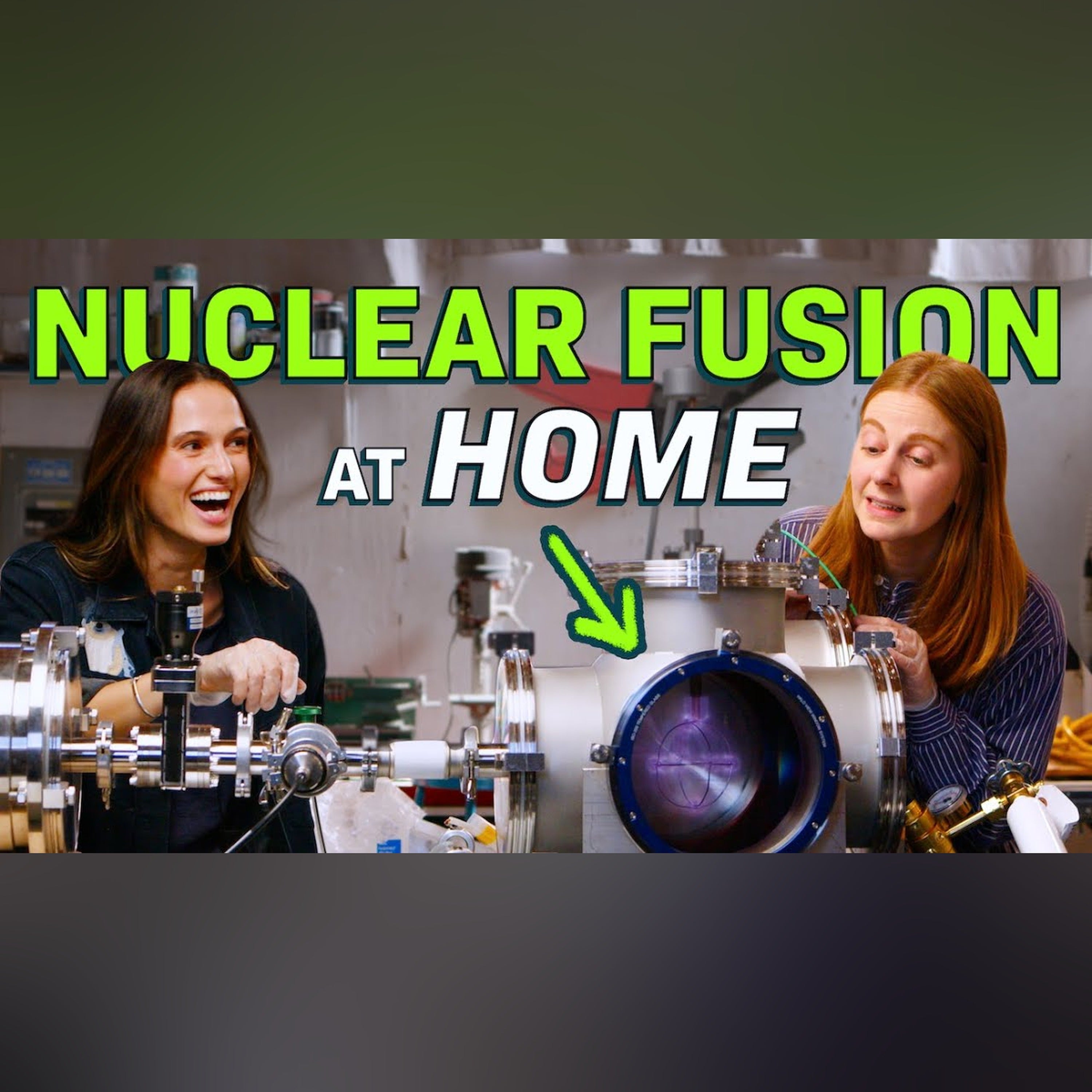
We attempted nuclear fusion. In Simone’s workshop. Disclaimer: This build was supervised by experts at Helion. Do not try this at home. I still can’t believe this video really happened. Back in May, I interviewed Helion CEO David Kirtley. I was trying to understand nuclear fusion: Is nuclear fusion possible now? How does fusion actually work? And most importantly, is nuclear fusion the future? Then, at the end of the interview, I asked David about headlines I’d seen about people building nuclear fusion devices in their backyards - what were they doing? “Oh,” David replied, “you can build one.” What followed is the biggest adventure yet on Huge If True. Together with the team at Helion and my friend fellow YouTuber Simone Giertz, we BUILT A NUCLEAR FUSION DEVICE to show how nuclear fusion works, what the big remaining challenges are, and how it might help us all in the future. Then, the last step was to try to turn it on… WATCH "FUSION, EXPLAINED: PART 1" HERE: https://youtu.be/piPbnKdv
#JimRohn, #Motivation, #MotivationalSpeech, #SelfGrowth, #Mindset, If you constantly tell yourself “I’m not enough,” “I can’t do it,” or “I always fail,” this speech will challenge everything you believe about yourself. But if you’re ready to transform your mindset, rebuild your confidence, and unlock the strongest version of yourself, then this message could become the turning point in your life. Uploaded 27-05-26 This deeply emotional and transformational motivational speech will teach you how to stop negative self-talk, build discipline, overcome self-doubt, improve confidence, create powerful habits, develop self-belief, and finally start becoming the person you were meant to be. Your future is listening to the words you speak today. Change your inner voice for 7 days… and you might just change your entire life forever. Comment below: What is ONE thing you will stop saying to yourself starting today? WHY SHOULD YOU WATCH THIS? If you constantly struggle with self-doubt, overthinkin
Bitcoin doesn't excite Ran Neuner anymore, and the Crypto Banter founder explains where he sees the real opportunity in crypto now. Ran tells me why he took profits at $84K, how he's deploying that cash now that sentiment has hit extreme fear, and the two tests he's watching to tell whether the bull market is still on. He explains why he thinks tokenized stocks and AI agents will run on blockchain rails, how he values tokens on "pressure" instead of FDV, why he thinks the old Bitcoin crowd is moving to Zcash, and how worried he really is about quantum. We also get into the midterms, World Liberty Financial, Solana Breakpoint and STRC. Recorded Thursday, November 19. In this episode: 00:00 Intro 01:10 Is the bull market still on? 02:17 What a correction is supposed to do 03:28 Two tests for the bull market 04:12 Why Bitcoin excites Ran less now 05:11 Trading tokenized Anthropic before the IPO 07:24 How AI agents will move your money 09:31 Why agents will settle on blockchain rails 13:25
Charlie Kirk’s assassination will dominate the headlines—but before the truth is even clear, the disinformation machine is already spinning. This video exposes how suppression, radicalization, and division are weaponized—not by ideology, but by systems designed to keep you outraged, divided, and distracted. Uploaded 11-09-25 We’ll reveal: • Why suppression is the biggest red flag in history—and why it always signals weakness, not strength. • How highly suggestible people are radicalized—not by one side or the other, but through media outrage loops, algorithmic echo chambers, and deliberate manipulation. • The illusion of “left vs. right”—a distraction designed to pit neighbors against each other while corruption, corporate power, and elites escape untouched. • The common ground we all share: freedom, safety, stability, fairness—and what none of us want: corruption, endless wars for profit, elites with different rules, surveillance states, and justice systems that bend for the powerful
Today, Mel is taking 58 years of hard-earned life lessons and is packing them into under an hour, to save you some of the time, frustration, and worry it took her to learn them the hard way. In this episode, Mel is fielding real questions from listeners around the world. From making friends and bouncing back from rejection to feeling stuck in life and wondering if it's all going to work out, Mel is sharing the advice she wishes she'd known sooner. And she's not holding back. You'll hear Mel get personal about her own setbacks, and what she's learned about starting over, going after what you want, and trusting yourself when life doesn't go according to plan. You'll learn: -How to stop worrying about the future when nothing feels certain -How to make big life decisions, including whether or not to have kids -How to make new friends as an adult -What to do when you get rejected from your dream job -What to do when a friend ghosts you -How to stop procrastinating and finally follow through
Thinking about upgrading your family home in a falling property market? In this week's FUNdamental Friday, Shane and Polly discuss one of the most common questions facing homeowners right now: How do you successfully upgrade your home when property prices are falling? They unpack the concept of PPOR Maxxing and explain why upgrading can actually become easier in softer markets if you understand how to navigate the process. Topics include: Why upgrading can still make sense in a declining market Why selling first is often the smarter move Long settlement strategies How to reduce upgrade risk Managing settlement timing issues Licence agreements explained How to think about borrowing capacity when upgrading Why becoming a purchaser is often more valuable than chasing a record sale price Because in today's market, the goal may not be maximising your sale price. It might be maximising your upgrade opportunity. Thinking About Buying A Home? Watch PRE-Purchase, our free 10-part video series d
Negative gearing and CGT reforms have changed the conversation around rentvesting. If your plan was to buy where you could afford, build equity and eventually buy the home you wanted, does that strategy still add up? For our FINAL Q&A of 2026, Ben Kingsley, Shane Pope and Polly Chu tackle three topical and intriguing listener dilemmas: rentvesting towards 2027, investing on a good income when everything still feels unaffordable, and... kn: owing when you’ve got too much property?! And there’s plenty to unpack: Cheaper property, bigger risk? Why that “stepping stone” could leave you stuck. Good income. Usable equity. Now what? The missing number before you buy. ️ Another property...or enough already? When should you stop accumulating? Plus, buyer’s agent pitches promising a Maserati, the danger of banking on a quick sale, and why a bad tenant doesn’t necessarily mean a bad investment. Tune in now for evergreen wisdom in a constantly changing investing environment. FREE STUFF MENTIONED Y
At 58, should you keep buying investment property… or is it time to stop adding debt and start paying it down? In this week’s Throwback Tuesday snippet, Ben and Bryce unpack why age alone shouldn’t decide your next property move, why more properties don’t automatically mean more wealth, and the importance of knowing what “enough” actually looks like for you. At My Age, Should I Keep Buying Property? (https://thepropertycouch.com.au/tbt-too-old-to-keep-buying/) Listen to the original episode (https://thepropertycouch.com.au/ep223-qa-overcoming-fear-next-step/) MOORR MONEY MANAGEMENT APP: Apple: https://apple.co/3ioICGW Google Play: https://bit.ly/3OT86bW Web platform: https://www.moorr.com.au/ FREE MASTERCLASS: FREE BEST-SELLING BOOKS: FIND US HERE: - Website (https://thepropertycouch.com.au/) - Instagram (https://www.instagram.com/thepropertycouch/) -Facebook (https://www.facebook.com/ThePropertyCouch)
Art should be available in ordinary community spaces, not only specialist venues.
Share your view, then see how readers voted. No sign-in required. This poll is shared across stories.
Do you agree or disagree?
Common Quandary
A Common Quandary to discuss
Another conversation to explore, separate from this news story.
You find a family secret after a relative dies. Does the truth come out?
Sorting through a deceased relative's papers, you discover evidence of a serious betrayal that would change how the family remembers them. Revealing it could answer old questions—and cause fresh pain.