The Brussels Bubble: Inside the European Union in the Digital Age with Rebecca Adler-Nissen and Kristin Anabel Eggeling (Cambridge UP, 2026)
48 min
Listen through the publisher, then discuss the episode here or arrange an in-person Roundtable. Your city determines where to meet.
Roundtables are designed for groups of four, with a shared subject and room for everyone to speak. Come for discussion, with no dating expectation.
What happens when European politics goes digital? Behind the scenes in European Union institutions, a quiet transformation is reshaping the way power works. Based on long-term ethnographic research, The Brussels Bubble: Inside the European Union in the Digital Age (https://bookshop.org/a/12343/9781009756808)(Cambridge University Press, 2026) by Dr. Rebecca Adler-Nissen & Dr. Kristin Anabel Eggeling follows diplomats, civil servants, spokespersons, and interpreters through the corridors, meeting rooms, cafés, and smartphone screens of Brussels' European Quarter. Against the backdrop of Brexit, the COVID-19 pandemic, and Russia's war on Ukraine, it reveals how digital technologies have become inseparable from the practice of international politics—reshaping trust, tact, and authority in unexpected ways. Far from a tale of technological revolution, The Brussels Bubble exposes digitalisation as a messy, human negotiation about what diplomacy and Europe itself mean today. Combining vivid narrative with sharp theoretical insight, it offers a rare, inside view of how global governance, technology, and human interaction intertwine at the heart of European power. This book is available open-access. This interview was conducted by Dr. Miranda Melcher whosebook (https://www.bloomsbury.com/uk/securing-peace-in-angola-and-mozambique-9781350407930/) focuses on post-conflict military integration, understanding treaty negotiation and implementation in civil war contexts, with qualitative analysis of the Angolan and Mozambican civil wars. You can find Miranda’s interviews on New Books with Miranda Melcher (https://newbooksnetwork.com/category/special-series/new-books-with-miranda-melcher), wherever you get your podcasts. Hosted by Simplecast, an AdsWizz company.
Episode information is provided by the publisher. Listening takes place on the publisher’s service.
November 20, 2026 On November 19, Trump met with Xi Jinping and Vladimir Putin in Shenzhen, China, The fact that the president of the US would meet with leaders of China and Russia was bizarre since both China and Russia have been helping Iran in its current fight against the US, Trump appeared to want the fanfare and President Xi played that up, Putin wanted the meeting because it would suggest that Russia was a great power, although it is far from being so and Putin’s war on Ukraine is going poorly, The meeting’s purpose seemed to be to produce propaganda for each of the three leaders, Beyond the propaganda is the larger story of the destruction of the post-World War II rules-based international order, In its place is the idea of dividing the world into spheres of influence, The three leaders met for 90 minutes and issued only a vague "joint declaration toward peace," which vowed to reform the UN and weaken the International Criminal Court, where Putin is already under indictment for
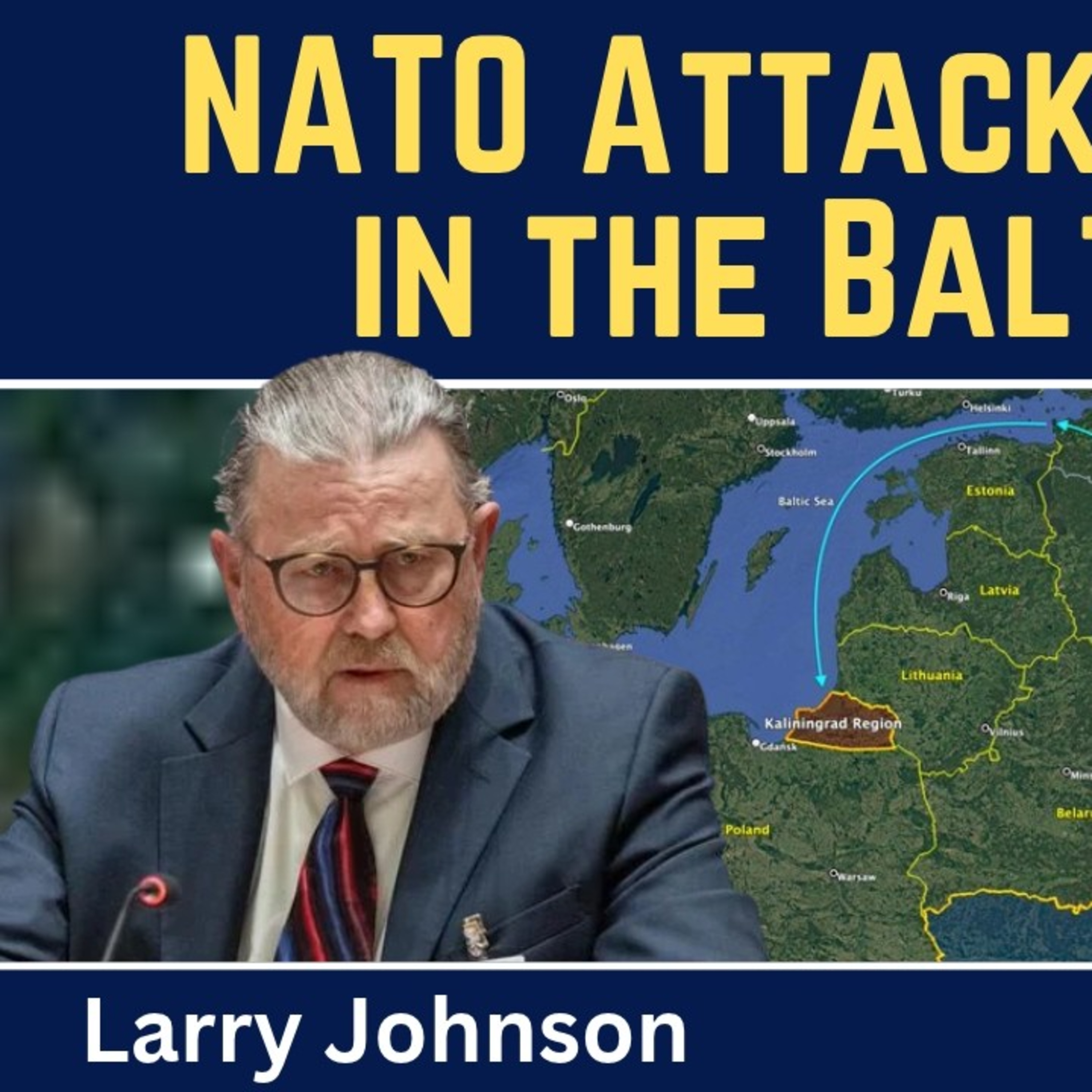
Larry Johnson is a former CIA intelligence analyst who also worked at the U.S. State Department's Office of Counterterrorism. Johnson discusses the attack on a Russian cargo ship in the Baltic Sea, and the air alarms going off in Kaliningrad. Read Larry Johnson's Sonar21: https://sonar21.com/Follow Prof. Glenn Diesen: PayPal: https://www.paypal.com/paypalme/glenndiesenBuy me a Coffee: buymeacoffee.com/gdiesengGo Fund Me: https://gofund.me/09ea012fBuy Diesen merchandise: https://diesen-shop.fourthwall.com/en-nokBooks by Prof. Glenn Diesen: https://www.amazon.com/stores/author/B09FPQ4MDL 00:00 Escalating Tensions in the Baltic Sea02:45 NATO's Role and Russia's Response05:52 The Shift in European Attitudes Towards Russia09:11 Cultural Influences on Perceptions of Russia11:44 The Consequences of Military Escalation15:06 The Irrelevance of Europe in Global Politics25:49 Reassessing Global Power Dynamics32:44 The Role of Europe in a Changing World39:19 The Impact of Economic Interests on Pol
Screen time in schools, kids and AI: why Australian students just posted their worst ever reading and maths results. The federal Education Minister says screens are part of the problem. Sweden led the world putting tablets in classrooms and is now pulling them back out. NSW will cap kindy kids at 15 minutes of screen time a day from next year. So were the "hippie" Steiner schools ahead of their time all along? Karl sits down with Andrew Hill, CEO of Steiner Education Australia, which represents 53 schools that keep screens out of early childhood classrooms. Andrew explains why some Silicon Valley tech executives sent their own kids to a screen-free Steiner school, who has profited from a laptop for every kid ("the terrible thing about handwriting is that it's free"), and why he believes Bluey's creator modelled the show's school on a Steiner school in Queensland. Karl also puts the tough questions: Will kids without screens be left behind? Is it all woo-woo? What about bullying, fees a
November 21, 2026; 12pm: In almost every presidency, there comes a time when the president turns their attention overseas – usually after some sort of political defeat. President Trump’s attention is definitely overseas, but for personal reasons. Ruth Ben-Ghiat points out the red flags of Trump cozying up to notorious Strongmen; Democrats have never held this much power before and it’s not just in Congress, it’s at the state level too. State Rep.-elect Allie Phillips (D-TN) and State Senator-elect Robyn Vining (D-WI) explain how they will set their most important agenda items into action; MS NOW’s Rachel Maddow continues her discussion with Jacob Soboroff about her brand new book “The Department of Fate,” Stephen Miller’s rise, and much more. Hosted by Simplecast, an AdsWizz company.
In this week's Podcast: I’ve just pumped out a 300kg barrel of honey and at the bottom was a thick, granulated layer of sugary goodness. It got me thinking about why honey granulates, the science behind it all, why that’s a good thing and how, we beekeepers, can use it to our advantage. Hi, I’m Stewart Spinks, welcome to Episode 418 of my podcast, Beekeeping Short and Sweet. References: Manikis, I., & Thrasivoulou, A. (2001). The relation of physicochemical characteristics of honey and the crystallization rate. Apiacta, 36(2), 106–112. Escuredo, O., Míguez, M., Fernández-González, M., & Seijo, M. C. (2014). Nutritional value and antioxidant activity of honeys produced in a European Atlantic area. Food Chemistry, 154, 44–51. Venir, E., Spaziani, M., & Maltini, E. (2010). Crystallization in “Tarassaco” (Dandelion) Italian honey studied by DSC. Food Chemistry, 122(2), 410–415. Krishnan, R., Mohammed, T., Kumar, G. S., & Arunima, S. H. (2021). Honey crystallization: Mechanism, evaluation a
Overnight world leaders have walked away from the COP31 summit without a deal. After the longest negotiation in COP history, several countries - including the 27-nation European Union - declared they couldn't accept a draft from the joint Turkish-Australian leadership that didn't mention fossil fuels. Then, Defence Minister Richard Marles has criticised the US Congressional Budget Office over a report that says the AUKUS pact will decrease the number of attack submarines available to the US navy. We hear from the report's author.
Europe's Little Anarchy: The Rise and Fall of Neutral Moresnet (https://bookshop.org/a/12343/9781501788147)(Cornell UP, 2026) uncovers the history of Neutral Moresnet: a once-forgotten space without borders, nationalism, or a recognized government. Between 1815 and 1919, this square mile of land wedged between Belgium, the Netherlands, and Germany was home to thousands of people living off the grid, free of taxation and oversight. But they also had no political status, police, legal currency, proper law courts, or government presence in sectors like public health, infrastructure maintenance, or education. Meanwhile, practical control over Neutral Moresnet lay in the hands of the local industry: a for-profit, multinational mining company that, because it owned rights to the land, also held a near monopoly on the supply of high-quality zinc to the rest of the world. Dr. Steven Press explores how the residents of Neutral Moresnet sought to improve their quality of life, appealing to Germa
This week on Democracy Dialogues, Rachel Beatty Riedl speaks with Filip Milačić to discuss his book, Abandoning Democracy for the Nation. (https://bookshop.org/a/12343/9781009734738)They examine the paradox of why democratically minded citizens choose to support undemocratic leaders and how political actors leverage narratives of national threat to convince voters to prioritize protecting the nation over upholding democratic principles. In this episode, Milačić outlines how political entrepreneurs fabricate threat narratives surrounding national identity, security, and economic well-being to justify subverting democratic practices. He shares findings from his research showing how political parties can effectively push back against radical right platforms—explaining why ignoring or emulating these narratives fails. The conversation concludes with a discussion on the power of courageous counter-narratives, direct grassroots voter engagement, and the need for a forward-looking vision of d
From student demonstrations in France to youth-led movements elsewhere in the world, growing unrest reflects mounting concerns about inequality, public services, and the future of younger generations. In this episode of International Horizons, John Torpey is joined by sociologists Jean Beaman and Ida Susser to examine the connections between France's student protests, the Yellow Vests, and broader movements challenging state violence and social exclusion. They discuss the changing nature of political solidarity and the growing struggle to defend the promises of the welfare state. Hosted by Simplecast, an AdsWizz company.
Interviewers should challenge powerful guests even when doing so risks losing future access.
Share your view, then see how readers voted. No sign-in required. This poll is shared across stories.
Do you agree or disagree?
Common Quandary
A Common Quandary to discuss
Another conversation to explore, separate from this news story.
Your coworker's religious holiday means you work the unpopular shift again. Is that fair?
A workplace accommodates religious observances by asking other employees to cover unpopular shifts. One coworker objects that nonreligious commitments can be equally meaningful but receive less formal protection.
Does equal respect require treating every kind of commitment identically?