The Inside Story of the 50 Who Built Modern AI With Kevin Roose
47 min
Listen through the publisher, then discuss the episode here or arrange an in-person Roundtable. Your city determines where to meet.
Roundtables are designed for groups of four, with a shared subject and room for everyone to speak. Come for discussion, with no dating expectation.
How did the race to build AGI really unfold, and who made the decisions that shaped it? Tech journalist Kevin Roose interviewed 150 people at the center of the AI industry to find out. The result is The AGI Chronicles, a riveting account of how modern AI was built and the choices that will determine what comes next. On this week’s episode of The Every Podcast, Natalia Quintero sits down with Roose to talk about how he got a secretive industry to open up, how he did (and didn’t) use AI in his book writing process, and why he sees his job as explaining the “very confusing and insular” world of Silicon Valley to everyone else. Links to resources mentioned in the episode: Follow Kevin Roose: https://x.com/kevinroose Get Kevin Roose’s book, The AGI Chronicles: https://theagichronicles.com/ Machine Gods: https://www.npr.org/podcasts/g-s1-143588/machine-gods “The Big Blob of Compute Hypothesis” excerpt on Kevin’s Substack: https://kevinroose.substack.com/p/the-essay-that-started-the-ai-race Profiles of the Future by Arthur C. Clarke: https://www.amazon.com/Profiles-Future-Inquiry-Limits-Possible/dp/0575402776 The Making of the Atomic Bomb by Richard Rhodes: https://www.amazon.com/Making-Atomic-Bomb-Richard-Rhodes/dp/1451677618 NotebookLM: https://notebook.google/ Timestamps: 0:00 Introduction 2:23 Are we doomed? Roose on AI risk and the case for mandatory safety testing 7:13 Why Roose raced to write the history of AGI before the records disappeared 10:45 How Roose got 150 sources in a secretive industry to open up 13:49 Dario Amodei’s “Big Blob of Compute” memo 19:12 How Roose’s mother’s book on the survivors of the atomic bomb influenced his work 21:40 The moment Roose first “felt the AGI” 23:24 How a “council of Claudes” fact-checked Roose’s book 31:59 Launching Machine Gods and reinventing video journalism 41:41 Weightlifting versus forklifting: How Roose decides what to hand off to AI
Episode information is provided by the publisher. Listening takes place on the publisher’s service.
The people who built what you want to build will tell you, in private, how close it was to not happening. Uploaded 12-05-26 The public version doesn't include this part. The public version is shaped by the demands of a talk, a press release, a clean retrospective. The mess gets edited out. The near-misses get compressed. The version that arrives in your ears is technically true but materially incomplete. This seminar is about the part that gets left out — the 3 near-misses that show up in almost every honest private account of how a successful life actually got built. CHAPTERS: 0:00 The Private Conversation Behind Every Success 0:35 The Public Version Leaves Out What Mattered Most 6:23 The Texture of What It Actually Felt Like 8:37 Near-Miss #1 — The Financial Near-Miss 9:29 Near-Miss #2 — The Relational Near-Miss 10:22 Near-Miss #3 — The Timing Near-Miss 11:14 Why You Can't Tell Which Moment Matters 13:01 Treat Every Day Like It Could Be The One 17:56 The Hidden Benefit of a Near-Miss
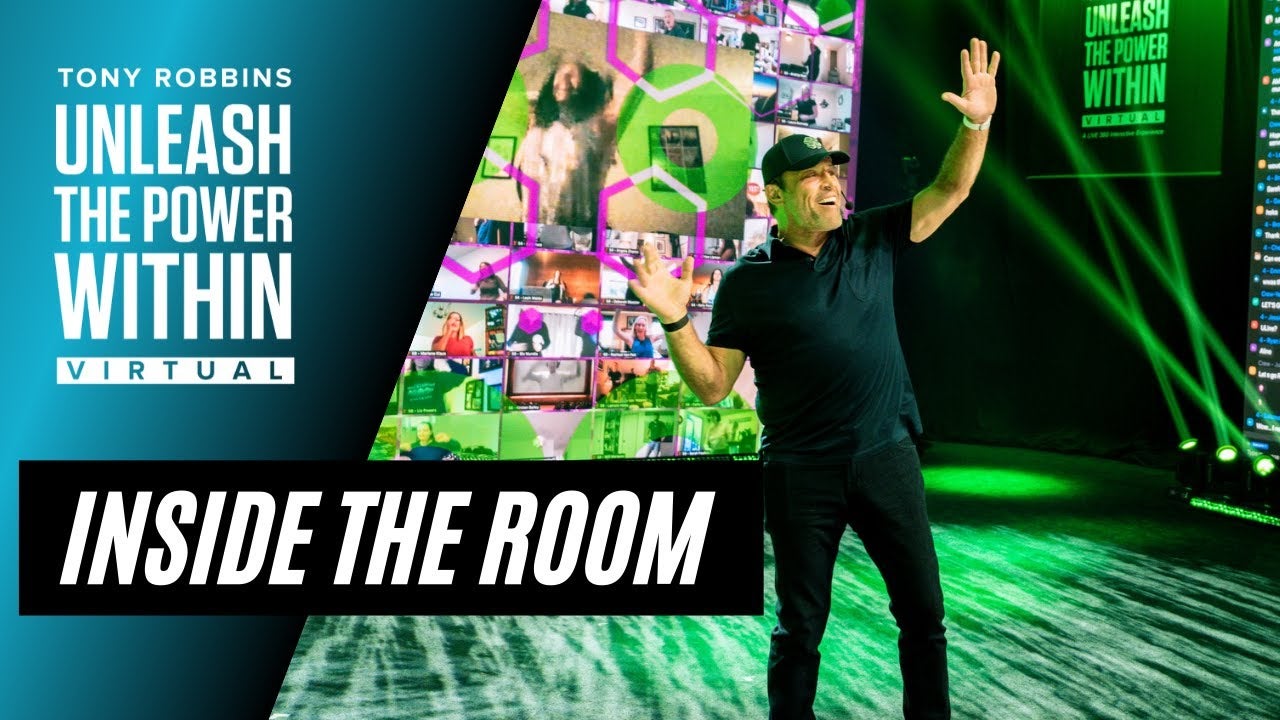
The FIRST Unleash the Power Within of 2022 just wrapped and we had 26,000 households from 151 countries around the world STEP UP and JOIN TOGETHER for one of our largest events in history! Uploaded 23-03-22 Here are some highlights from the week. Enjoy this video for a peek inside our virtual stadium It’s such a privilege to spend time with such DRIVEN, COMMITTED, LOVING SOULS all coming here with a hunger to GROW. For me, getting to hear your goals and witness each of you creating a unique life for yourselves, your loved ones, and your communities is deeply moving. We grow so we have MORE to GIVE, and the truth is, the world is a better, more beautiful and kind place because of people like YOU. If you’ve never experienced an Unleash the Power Within, it can be hard to imagine the HUMAN POTENTIAL and the RAW ENERGY⚡️ that converge over these four days and nights. It's electrifying to feel people from every walk of life, every background, every stage of life UNITE to find a deeper meani
Now Mark wants to help you become financially free as well. Follow the podcast and turn on notifications! This Podcast is fan-made. No copyright infringement intended. --------------------------- ---------- Keywords: side hustles, wealth creation, atm fraud, lottery strategy, career advice, buying vs renting, millionaire mindset, business success
We’re about to time travel into the future Sam Altman is building… I interviewed Sam Altman, the CEO of OpenAI, the company behind ChatGPT. They’re trying to build a “superintelligence” that could far exceed humans in almost every field – and they just released their most powerful tool yet, GPT-5. A few years ago, that would’ve sounded like science fiction! Not anymore. In fact, they’re not alone. We’re in the middle of the most high stakes global race any of us have ever seen. Hundreds of billions of dollars and an unbelievable amount of human work… It’s a profound moment. Most people never see a huge technological shift like this in their lives and it’s happening all around us right now. So in this conversation, I’m going to try to time travel into the future with Sam Altman, to see what he’s trying to build… so you and I can really understand what’s coming. Welcome to HUGE* Conversations. Chapters: 0:00 What future are we headed for? 2:06 What can GPT-5 do that GPT-4 can’t? 6:57 Wha
This episode is brought to you by Sarmaya Partners. Learn more about Sarmaya’s LENS ETF, their full data and comparison, including performance here: https://sarmayaetf.com/ In this episode of Other People's Money, Max Wiethe sits down with Muddy Waters Capital founder Carson Block to discuss his firm's explosive new short thesis on Nvidia. Block breaks down the alarming connections between a former Nvidia executive and a former SMCI executive recently implicated in a major chip smuggling scandal. The conversation dives deep into the national security implications of dual-use technology and how the ongoing geopolitical tug-of-war between the US and China is reshaping the semiconductor sector. Tune in to hear why Block believes this scandal goes far beyond CEO indiscretions and could trigger a massive regulatory reckoning for Silicon Valley's biggest players. Follow Muddy Waters on X: https://x.com/muddywatersre Follow Max on X: https://x.com/maxwiethe Follow Other People’s Money on: App
Bitcoin doesn't excite Ran Neuner anymore, and the Crypto Banter founder explains where he sees the real opportunity in crypto now. Ran tells me why he took profits at $84K, how he's deploying that cash now that sentiment has hit extreme fear, and the two tests he's watching to tell whether the bull market is still on. He explains why he thinks tokenized stocks and AI agents will run on blockchain rails, how he values tokens on "pressure" instead of FDV, why he thinks the old Bitcoin crowd is moving to Zcash, and how worried he really is about quantum. We also get into the midterms, World Liberty Financial, Solana Breakpoint and STRC. Recorded Thursday, November 19. In this episode: 00:00 Intro 01:10 Is the bull market still on? 02:17 What a correction is supposed to do 03:28 Two tests for the bull market 04:12 Why Bitcoin excites Ran less now 05:11 Trading tokenized Anthropic before the IPO 07:24 How AI agents will move your money 09:31 Why agents will settle on blockchain rails 13:25
Lovable is the fastest way to turn ideas into software people love: https://lovable.dev/grow?utm_source=every&utm_medium=podcast&utm_campaign=2026-11-flagship-sponsorship&utm_content=primary (https://lovable.dev/grow) Now that AI enables anyone to build their own software, should you build everything yourself? At Thesis, Notion cofounder and CEO Ivan Zhao joins Every’s Dan Shipper to discuss which tools should and should not be vibe coded—and why you should understand how your systems work, even as agents do the building. Links to resources mentioned in the episode: Ivan Zhao:https://x.com/ivanhzhao Ivan’s post on his 13th year at Notion, “The Next Era of Notion”:https://www.notion.com/blog/the-next-era-of-notion Notion Calendar:https://www.notion.com/product/calendar The IBM System/360, the room-sized computer Ivan references:https://www.ibm.com/history/system-360 Claude Code:https://claude.com/product/claude-code Claude:https://claude.ai (https://claude.ai/) ChatGPT:https://chatgpt.c
Thesis: 2027 is made possible by our founding partners, Lovable and Notion. Lovable is the fastest way to turn ideas into software people love: https://link.lovable.dev/every Notion is the collaborative AI workspace where teams and agents work side by side: https://www.notion.com/?utm_source=youtube&utm_campaign=thesis-2027&utm_content=every-261111-video (https://www.notion.com/) What does great human work look like after automation? It’s a question we try to answer every day at Every, and the one we built our conference, Thesis, around. In his closing keynote, Dan Shipper argues that as AI makes intelligence cheap and widely available, what matters most is human perspective. It’s your “non-consensus” point of view, plus your responsibility for a particular corner of the world, that helps you spot the insight no one else would. On this week’s episode of The Every Podcast, we’re sharing Dan’s full talk at Thesis: 2027. Dan explains why benchmark charts make the future of work look bleak
Long-term public borrowing should account for the burden placed on future generations.
Share your view, then see how readers voted. No sign-in required. This poll is shared across stories.
Do you agree or disagree?
Common Quandary
A Common Quandary to discuss
Another conversation to explore, separate from this news story.
The sign says twelve items and you have fourteen. Is the express lane still yours?
The regular checkout lines are long and the express lane is empty. You count fourteen small items, two over the posted limit. A shopper approaches behind you carrying a single carton of milk as the cashier waves you forward.
Are small rules optional when enforcing them would seem fussier than breaking them?