The legend of the brothers who outmaneuvered the demon queen - Malay Bera
Listen through the publisher, then discuss the episode here or arrange an in-person Roundtable. Your city determines where to meet.
Roundtables are designed for groups of four, with a shared subject and room for everyone to speak. Come for discussion, with no dating expectation.
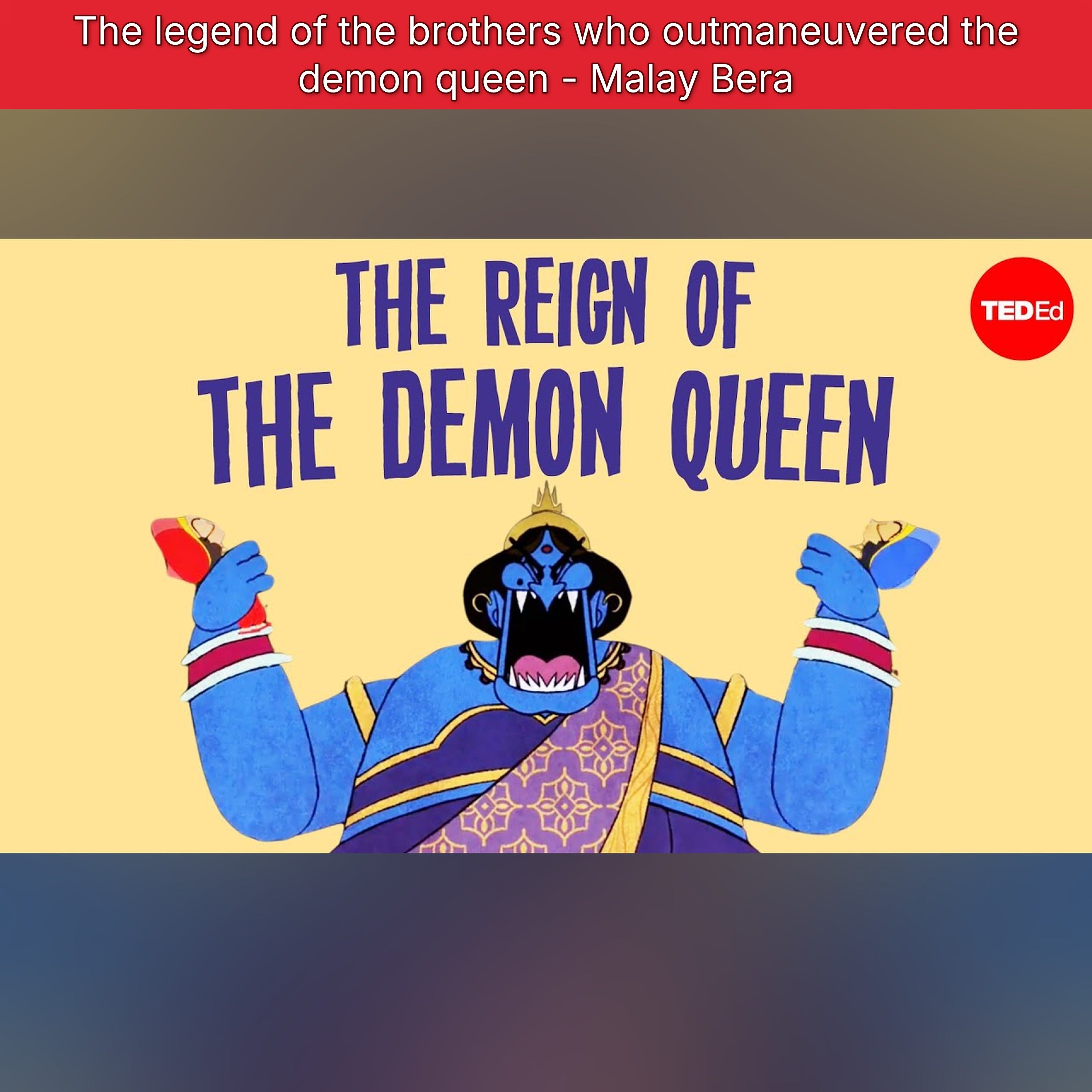
Dig into the Bengali tale of brothers Neelkamal and Lalkamal, two princes seeking to end the reign of demons in their kingdom. -- Achinpur was on the precipice of demonic takeover. A mysterious woman beguiled the king and infiltrated the royal family. But she wasn’t human; under her beautiful façade lurked an insatiable appetite for flesh. One night, the demon queen devoured the king's sons — but the princes managed to evade death. Malay Bera shares the tale of their quest to free the kingdom from the scourge of demons. Lesson by Malay Bera, directed by Ahmad Thabit, Samaka Studio. Although this folktale exists in multiple oral variants across the Bengali-speaking world, this video is based on a variant akin to the better-known literary version, "Neelkamal and Lalkamal", from Thakurmar Jhuli (1907), an anthology of Bengali folktales collected by Dakshinaranjan Mitra Majumdar in the early 20th century. Support Our Non-Profit Mission ---------------------------------------------- Support us on Patreon: http://bit.ly/TEDEdPatreon Check out our merch: http://bit.ly/TEDEDShop ---------------------------------------------- Connect With Us ---------------------------------------------- Sign up for our newsletter: http://bit.ly/TEDEdNewsletter Find us on Twitter: http://bit.ly/TEDEdTwitter Peep us on Instagram: http://bit.ly/TEDEdInstagram ---------------------------------------------- Keep Learning ---------------------------------------------- View full lesson: https://ed.ted.com/lessons/the-tale-of-the-brothers-who-outwitted-the-demon-queen-malay-bera Dig deeper with additional resources: https://ed.ted.com/lessons/the-tale-of-the-brothers-who-outwitted-the-demon-queen-malay-bera/digdeeper Animator's website: https://www.samaka.tv (https://www.samaka.tv/) Music: https://www.campstudio.co (https://www.campstudio.co/) ---------------------------------------------- Thank you so much to our patrons for your support! Without you this video would not be possible! Kack-Kyun Kim, Michael Braun-Boghos, zjweele13, Anna-Pitschna Kunz, Edla Paniguel, Thomas Mungavan, Jaron Blackburn, Venkat Venkatakrishnan, ReuniteKorea, Aaron Henson, Rohan Gupta, Begum Tutuncu, Brian Richards, Jørgen Østerpart, Tyron Jung, Carsten Tobehn, Katie Dean, Ezgi Yersu, Gerald Onyango, alessandra tasso, Doreen Reynolds-Consolati, Manognya Chakrapani, Ayala Ron, Eunsun Kim, Phyllis Dubrow, Ophelia Gibson Best, Paul Schneider, Joichiro Yamada, Henrique Cassús, Karthik Cherala, Clarence E. Harper Jr., Vignan Velivela, Ana Maria, Exal Enrique Cisneros Tuch, Tejas Dc, Khalifa Alhulail, Martin Stephen, Jose Henrique Leopoldo e Silva, Mandeep Singh, Abhijit Kiran Valluri, Morgan Williams, Devin Harris, Pavel Zalevskiy, Karen Goepen-Wee, Filip Dabrowski, Barbara Smalley, Megan Douglas, Tim Leistikow, Ka-Hei Law, and Hiroshi Uchiyama.
Episode information is provided by the publisher. Listening takes place on the publisher’s service.
Listen at the source ↗