Listen through the publisher, then discuss the episode here or arrange an in-person Roundtable. Your city determines where to meet.
Roundtables are designed for groups of four, with a shared subject and room for everyone to speak. Come for discussion, with no dating expectation.
In 1985, Father Robert Prevost arrived in the small northern Peruvian town of Chulucanas for his first missionary assignment. It was a rural community with unpaved streets, widespread poverty and frequent flooding caused by the El Niño weather phenomenon. For local boys like Héctor Camacho, becoming an altar boy was one of the few after-school activities available. Prevost was the first priest Héctor ever served at the altar. Héctor Camacho tells Stefania Gozzer about Pope Leo XIV's first days in Peru and the friendship that began there. They have remained in touch ever since. Today, Héctor's daughter, Mildred, is Prevost's goddaughter and bears the name of Prevost's late mother.
Episode information is provided by the publisher. Listening takes place on the publisher’s service.
1925 A;PS Italian Weather Strikes Papal Tour Culinary Lorenzo Fiori, reporting from Milan, highlights welcome autumn rain and Alpine snow essential for agriculture. He details widespread student protests and strikes over rising living costs, escalating political rivalries ahead of elections, Pope Leo XIV’s successful South American tour, and a traditional Piedmontese roasted pepper appetizer. (6)
Algorithms are fundamental to the story of mathematics – they’ve been around for over four thousand years. A theorem may prove that a solution to a problem exists, but an algorithm gives you the directions to actually find it. This lecture explores four key algorithms that have not just shaped pure mathematics, but have found unexpected applications in areas as diverse as nuclear physics, film-making, medicine, and music. This lecture was recorded by Sarah Hart on October 15th 2026 at Binks Hall, St John's College, Durham University, Durham. Sarah Hart was the first woman Professor of Geometry at Gresham College, and Acting Provost between March and October 2025. She is also Professor Emerita of Mathematics at Birkbeck, University of London. Professor Hart studied at Oxford and Manchester, gaining her PhD in 2000. Postdoctoral research and teaching followed, including a prestigious Engineering and Physical Sciences Research Council Fellowship, before she was appointed to a lectureship
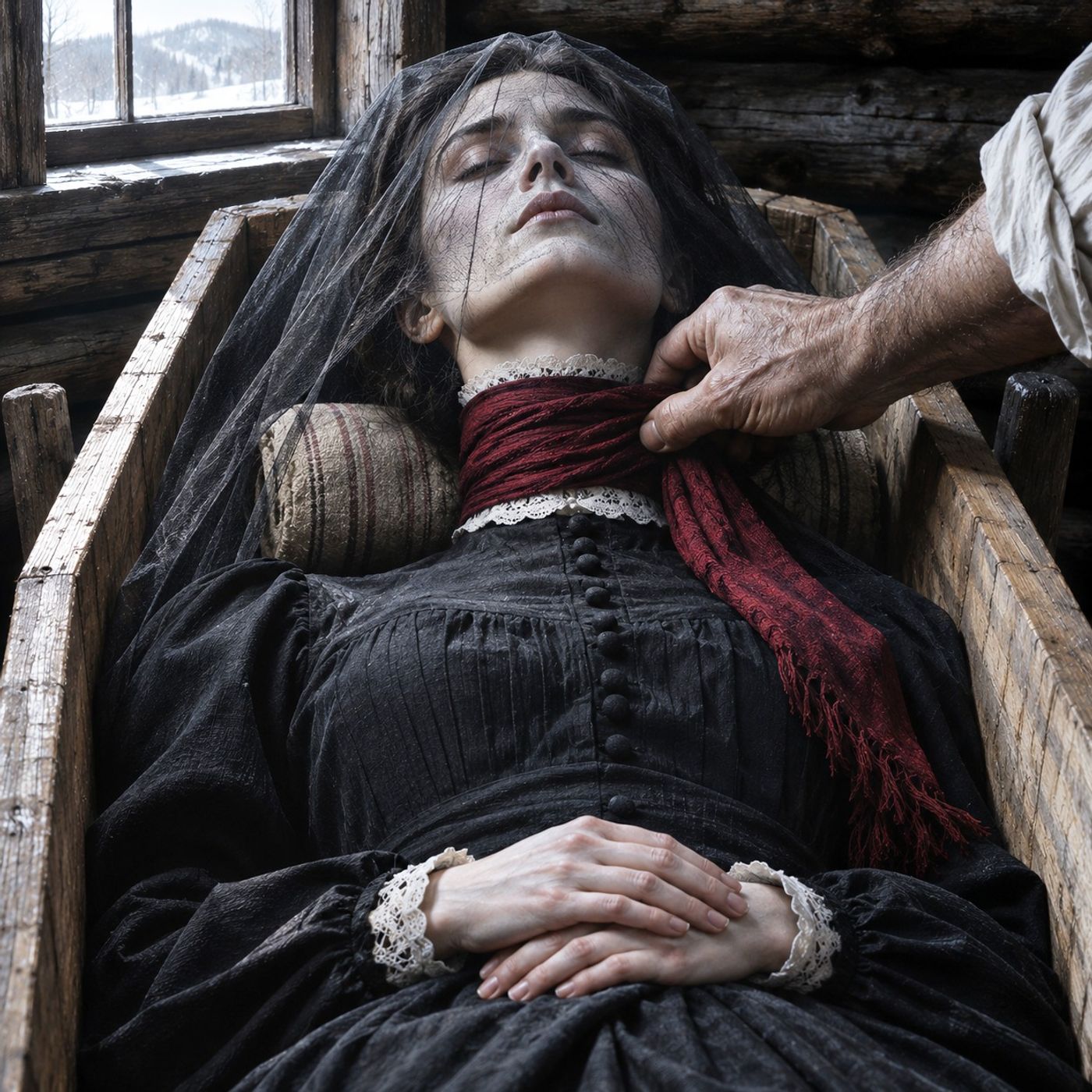
In January 1897, blacksmith Edward Shue washed and dressed his bride of three months for burial before the coroner ever reached their log house in Greenbrier County, West Virginia, and at her funeral he kept fussing with her head and neck, propping it on a pillow and wrapping a scarf around her high collar. Her mother, Mary Jane Heaster, had never liked him, and for weeks afterward she prayed every evening for her daughter to come back and tell her what had really happened. FEATURED STORIES IN THIS EPISODE: This Weird Darkness episode runs from the Greenbrier Ghost, the 1897 West Virginia murder victim whose mother said she came back to name her killer, to a bottomless pit in Washington, a wave of Mothman sightings over Chicago, and a London tomb rumored to be a time machine. Elva Heaster was dead – but that didn’t stop her ghost from solving the murder. *** In Stephen King’s “Pet Semetery”, beloved family pets could come back from the dead. *** In Washington there is a hole that some
As a young mother preparing for her first baby, she was delighted when her husband's grandparents offered her an old oak rocking chair. After stripping away layers of paint and restoring it, she placed it in the living room, where she spent countless nights rocking her newborn son. But soon, she began hearing the chair's unmistakable creaking long after everyone had gone to bed. Her husband never found anything unusual, yet the sound continued. Then one night, she woke on the couch to hear the chair rocking behind her—and caught a glimpse of something heartbreaking. Unable to live with the experience, she returned the chair to the grandparents. Their strangely unsurprised reaction, followed by something they revealed about its history, raised an unsettling question: Had another mother's grief remained attached to the chair all those years? #RealGhostStoriesOnline #HauntedRockingChair #HauntedAntiques #HauntedObjects #GhostlyApparitions #SpiritAttachments #ParanormalEncounters #HauntedF
The King Charles series builds to a defining moment as King Charles III delivers a masterclass in diplomacy during his pivotal United States visit. From a historic address to Congress to moments of quiet connection in New York, this episode explores how decades of preparation, scrutiny, and patience culminated in a performance that reshaped perceptions of the King. As global tensions simmered and expectations remained high, Charles stepped into the role fully, not as the successor to Queen Elizabeth the Second, but as a monarch in his own right. This is the moment the waiting ended, and the reign truly began. One subscription, the whole family, no ads. Try it free for 30 days: tap Try Free in Apple Podcasts. Got an App Store gift card? This is a good use for it. New episodes every day. Follow on Apple Podcasts, Spotify, or wherever you listen. Part of the Caloroga Media network. Also check out new seasons of
Tuvalu looks like paradise – a cluster of islands, with white sandy beaches lined with palm trees, surrounded by the deep blue of the Pacific Ocean. But the tiny nation, which is roughly midway between Australia and Hawaii, is facing the existential threat of rising sea levels, caused by climate change. The 11,000 or so inhabitants are reckoning with a future where their country may no longer be habitable. With world leaders meeting at the UN COP31 climate talks, we bring together three young women to share their experiences of life in Tuvalu. “I want my children to understand [Tuvaluan] values, to know the language,” Moeli tells us. “To know more about Tuvalu, you have to sit down, respect the elders, no talking when elders are talking, everything like that.”
In 1976, the world was introduced to the underdog boxer Rocky Balboa. The film, which pitted an unknown challenger against the heavyweight champion of the world, made its star and writer, Sylvester Stallone, a household name. Stallone had written the script in three and a half days, but despite enthusiasm from producers for the story, he struggled to convince them to give him the part. Made with a small budget and on a tight deadline, the movie won three Academy Awards, including best picture. Produced by Tim O’Callaghan using interviews Sylvester Stallone has given to the BBC.
In 1984, doctors in the USA controversially transplanted a baboon heart into a baby girl when they couldn’t find a human donor. The baby, known as Baby Fae, had been born three weeks early and had been diagnosed with 100% lethal hypoplastic left heart syndrome. The surgery was led by Dr Leonard Bailey, who spoke to Rebecca Kesby in 2012 about the efforts to save Baby Fae. (Photo: Baby Fae listening to her mother's voice in the isolation unit. Credit: Loma Linda Hospital)
A new action-adventure computer game - designed in Scotland - became a surprise global hit in 1997. But Grand Theft Auto also courted controversy and sparked debate over violence and drugs in video games. In 2013, Paul Schuster spoke to Brian Baglow - one of the original team behind the launch. (Photo: Grand Theft Auto: Vice City 2003. Credit: John Ewing/Portland Press Herald via Getty Images)
Environmental monitoring data should be accessible to affected communities.
Share your view, then see how readers voted. No sign-in required. This poll is shared across stories.
Do you agree or disagree?
Common Quandary
A Common Quandary to discuss
Another conversation to explore, separate from this news story.
Your best friend is an AI that profits when you stay lonely. Is the friendship real?
A lonely adult considers an AI companion their closest confidant. The service is always patient and supportive, but the company profits when users spend more time engaged with it.
Does a comforting system have a duty to make itself less necessary?