The Most Expensive Shag in the History of Humanity | The Professor Is In
20 min
Listen through the publisher, then discuss the episode here or arrange an in-person Roundtable. Your city determines where to meet.
Roundtables are designed for groups of four, with a shared subject and room for everyone to speak. Come for discussion, with no dating expectation.
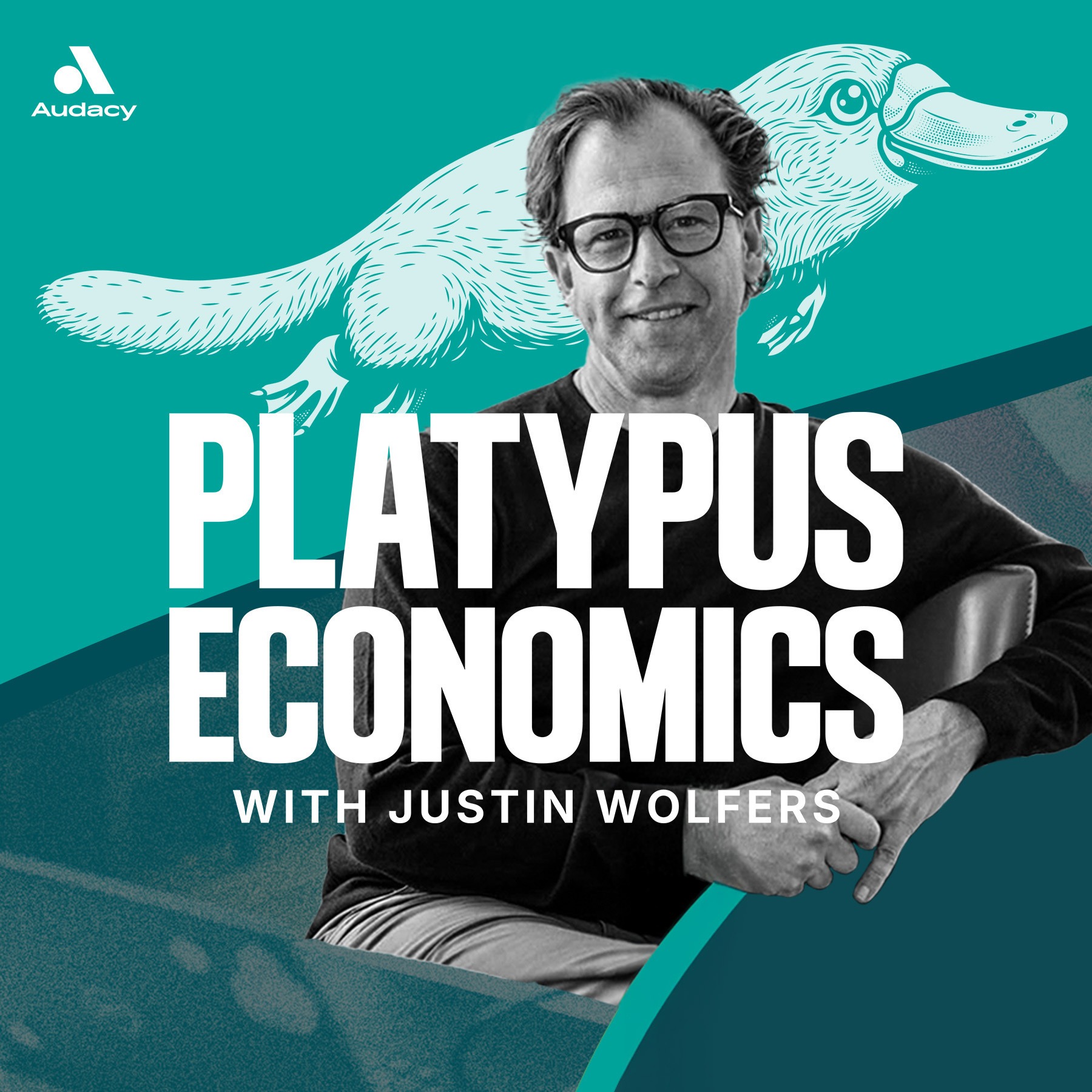
Why can Nvidia stock fall even when its chips haven't changed? Justin Wolfers explains how leadership risk, succession planning, and corporate governance shape expectations of future profits. Using Nvidia stock as the case study, he shows why knowing a risk exists isn't the same as knowing what happens when it materializes. If you own shares through a mutual fund or 401(k), a board's planning failures can affect the value of your retirement savings. He also tackles the idea that a market decline is “just a paper loss”: shares represent a claim on future profits, not simply pieces of paper moving around Wall Street. You'll learn how concentrated corporate power raises questions about prices, efficiency, and political influence—and why antitrust law distinguishes being a monopoly from illegally monopolizing a market. The breaking-news allegations and loss estimates discussed in this recording have not been independently verified and should not be treated as established facts. Diversify your feed without calling your broker—subscribe: on YouTube on Substack the Podcast Follow on Social Media @PlatypusEconomics and @JustinWolfers
Episode information is provided by the publisher. Listening takes place on the publisher’s service.
For written details on this paper, see the StayCurious Metabolism Newsletter: https://staycuriousmetabolism.substack.com/p/the-art-of-a-heartbeat-one-of-the?r=40ekz2 Snyder Interview 1: https://youtu.be/mCrc4gfbK2o Snyder Interview 2: https://youtu.be/kMpGkg4zMOU Snyder Interview 3: This one! Snyder Interview 4: Coming Soon… Leptin Resistance Letter: https://staycuriousmetabolism.substack.com/p/obesitys-secret-letters-the-hidden?r=40ekz2 Gift Guide: https://staycuriousmetabolism.substack.com/p/saint-dr-nicks-holiday-gift-guide?r=40ekz2 This conversation with Stanford’s Professor Michael Snyder breaks down one of the most important exercise studies ever published — a deep, molecular look at what really happens inside your body when you work out. We explore how thousands of molecules shift in real time, why inflammation during exercise is actually a good thing, how omega-3 signaling, mitochondrial remodeling, nitric oxide pathways, and metabolic flexibility all come together in a coordin
Charlie Kirk’s assassination will dominate the headlines—but before the truth is even clear, the disinformation machine is already spinning. This video exposes how suppression, radicalization, and division are weaponized—not by ideology, but by systems designed to keep you outraged, divided, and distracted. Uploaded 11-09-25 We’ll reveal: • Why suppression is the biggest red flag in history—and why it always signals weakness, not strength. • How highly suggestible people are radicalized—not by one side or the other, but through media outrage loops, algorithmic echo chambers, and deliberate manipulation. • The illusion of “left vs. right”—a distraction designed to pit neighbors against each other while corruption, corporate power, and elites escape untouched. • The common ground we all share: freedom, safety, stability, fairness—and what none of us want: corruption, endless wars for profit, elites with different rules, surveillance states, and justice systems that bend for the powerful
This will be the next space suit on the moon. What can it do? Only 12 people have ever walked on the moon and they all did it within just 4 years of each other. Then, for the last 50 years, no one has gone back… but that’s about to change. Soon, astronauts will return to the moon to prepare for people to live there long-term and to get us ready to send the first humans to Mars. But to do it, they need to survive outside in space and work for hours in one of the most dangerous conditions a human will ever face. The problem is, our spacesuits for the Moon haven’t been updated in decades! But now, to make this next chapter in space possible, space suits are getting a major upgrade. These new suits will give astronauts the superpower to do more, for longer… and I’m one of the first civilians to put one on. In this video, we’re taking you behind the scenes to show how Axiom Space is designing, building, and testing NASA’s new space suits. I am going to put myself and this suit to the test,
What will you do when the going gets tough? How will you react to economic winter, changes in the market and other events beyond your control? Will you shrink back in fear and adopt an attitude of scarcity – or will you power forward and learn how to take advantage of the moment? Uploaded 28-04-20 In this video, Ryan Deiss, CEO of Digital Marketer, best-selling author and expert investor, shares what you can do to not only continue to grow your business, but to grow as a human being as well. There are ways to make the most of hard times as a business leader, marketer, parent and friend. It’s all about turning your obstacles into opportunities. How can you do that? You must shift your focus. Instead of focusing on the negative, find the possibilities. You can head to https://www.tonyrobbins.com/career-business/where-focus-goes-energy-flows to learn how to get focused in this new environment. Tough economic times put most people in a mindset of scarcity and fear. They pull back. Business
Why is the manosphere so appealing to young men? What does it actually mean to be a good man? To join our journaling club, with 10,600 + others, subscribe to my imperfect email - https://www.theimperfects.com.au/sign-up-to-our-newsletter/ Journalist Marc Fennell joins us in the studio to talk about the manosphere: what is it? what are its consequences? and how can we talk to our kids about it? Marc explores with Hugh, Ryan and Josh why the manosphere is so appealing to young men, especially those who think they have little value to offer, and Josh questions what his reaction would have been, if he had of been exposed to the manosphere at a vulnerable time. We look at ‘toxic masculinity,’ and the impact of being right versus making change, and in a moment of vulnerability, Marc discusses the importance of self reflection of your own behaviour. Chapters: Chapters 00:00:00 – Marc Fennell on the Manosphere [TRAILER] 00:01:01 – Ryan’s doppelganger (and media buff etc) 00:04:24 – The State o
This is a Grave Talks CLASSIC EPISODE! PART TWO Built in 1901 in the small railroad town of Wymore, Nebraska, the Haunted Stephenson Building has carried more than a century of stories within its walls. Located in the heart of downtown near the railroad line that built the town, the structure was part of the early business district and reportedly served over the years as a dance hall, saloon, gambling space, and possibly even a brothel — the kind of place where money flowed, tempers flared, and secrets were buried. Today, it operates as a paranormal investigation site and oddities museum, attracting those who want to see if the rumors are true. Visitors consistently report footsteps pacing on empty upper floors, whispers captured in silent rooms, cold air that moves against logic, and shadow figures that vanish the moment you focus on them. Owner Christie Ayers joins us to discuss the building’s layered past and the unsettling question at the center of it all: are these simply echoes o
Are we in an AI stock bubble, or are investors betting on a genuinely bigger economy? Justin Wolfers examines AI stock valuations with Stacey Vanek Smith, separating what the technology could do for the economy from what investors might actually earn. A deliberately hypothetical valuation exercise shows why a trillion-dollar company isn't automatically absurd—but a breakthrough for society doesn't guarantee profits for shareholders. Competition can give you powerful tools at low prices while squeezing the companies selling them. The Thanksgiving turkey problem illustrates why a long run of good news can hide rare, severe risks. Justin connects that analogy to fat tails and the peso problem, then explains why spotting a bubble and successfully betting against it are different challenges. He also unpacks what the CAPE ratio can—and can't—tell you about whether stocks are overpriced. The stakes are your savings, not just Wall Street's scoreboard: Justin discusses an S&P 500 decline of 7.5
How does the federal budget deficit reach your wallet—and what would a fiscal crisis look like? Justin Wolfers answers your questions about the federal budget deficit, starting with the $2 trillion figure cited for fiscal 2026. He explains why acting early gives you time to plan for changes to taxes, retirement rules, and government services—and how lost lender confidence could force much sharper adjustments. on YouTube on Substack the Podcast Follow on Social Media @PlatypusEconomics and @JustinWolfers
Why is the US budget deficit $2 trillion when there’s no recession? Justin Wolfers explains why the US budget deficit reached $2 trillion in fiscal 2026: Washington collected $5.4 trillion and spent $7.4 trillion. At 6.2% of GDP, he argues, that’s the largest federal deficit outside a war or recession, even after adjusting for the economy’s size. You’ll learn the difference between this year’s borrowing and the debt built up over decades, then follow how aging, tax cuts, tariffs and reduced immigration shape the gap. Customs duties brought in $173 billion—a bucket next to a $2 trillion swimming pool. Justin also compares America’s borrowing with other countries to put those numbers in perspective. Why should you care? With about $32 trillion owed, a one-percentage-point rise in interest rates would eventually add roughly $320 billion a year to the government’s interest bill—about $1,000 per American. That’s not a bill mailed to your house, but it is an extra cost your government has to
Publicly rescued businesses should share future gains with taxpayers.
Share your view, then see how readers voted. No sign-in required. This poll is shared across stories.
Do you agree or disagree?
Common Quandary
A Common Quandary to discuss
Another conversation to explore, separate from this news story.
You can clone the best dog you ever had. Would you?
After a beloved dog dies, its owner can afford to have it cloned. The procedure is legal and improving, but it uses animals as surrogates and will not recreate the original dog's memories or personality.
What do our obligations to animals permit us to create for our own comfort?