The Roman Empire still rules the world – Deep Dive with Alex von Tunzelmann
30 min
Listen through the publisher, then discuss the episode here or arrange an in-person Roundtable. Your city determines where to meet.
Roundtables are designed for groups of four, with a shared subject and room for everyone to speak. Come for discussion, with no dating expectation.
If men really do think about the Roman Empire once a day, there’s a good reason. From Niccolò Machiavelli to Thomas Jefferson, generations of revolutionary thinkers have looked to ancient Rome for lessons in how to do politics – with mixed results. So how do the Roman Republic and Empire still provide a blueprint for democratic governments today? Are there any leaders today who seem to be trying to become the next Caesar? Jamie Gianoutsos, professor of History at Mount St. Mary's University in Maryland, joins Alex von Tunzelmann to discuss Rome’s enduring political influence. • Buy Jamie’s In Rome's Long Shadow: How the Classical Tradition Shaped the Modern World (https://uk.bookshop.org/a/13277/9780241608333) from our affiliate bookshop and you’ll help fund the podcast by earning us a small commission for every sale. Bookshop.org’s fees help support independent bookshops too. Back The Bunker on Patreon (https://www.patreon.com/bunkercast/membership?vanity=bunkercast%5D) to help keep the podcast going – and get early, ad-free episodes, merch and more. Written and presented by Alex von Tunzelmann. Producer: James Liddell. Audio production: Robin Leeburn. Managing Editor: Jacob Jarvis. Group Editor: Andrew Harrison. Music by Kenny Dickinson. THE BUNKER is a Podmasters Production. www.podmasters.co.uk (http://www.podmasters.co.uk/) Hosted on Acast.
Episode information is provided by the publisher. Listening takes place on the publisher’s service.
1661 The Trajan Diaspora Revolt, the Bar Kokhba Insurgency, and the Rebranding of Roman Judea — Part Two Professor Barry Strauss, author of Jews Versus Rome: Two Centuries of Rebellion Against the World’s Mightiest Empire, examines the later Jewish uprisings, focusing on the multi-front Diaspora Revolt under Emperor Trajan and the intense Bar Kokhba insurgency under Hadrian. He details guerrilla tunnel warfare, Hadrian’s rebuilding of Jerusalem as the pagan Aelia Capitolina, and the punitive renaming of Judea as Syria Palaestina. (2)
Screen time in schools, kids and AI: why Australian students just posted their worst ever reading and maths results. The federal Education Minister says screens are part of the problem. Sweden led the world putting tablets in classrooms and is now pulling them back out. NSW will cap kindy kids at 15 minutes of screen time a day from next year. So were the "hippie" Steiner schools ahead of their time all along? Karl sits down with Andrew Hill, CEO of Steiner Education Australia, which represents 53 schools that keep screens out of early childhood classrooms. Andrew explains why some Silicon Valley tech executives sent their own kids to a screen-free Steiner school, who has profited from a laptop for every kid ("the terrible thing about handwriting is that it's free"), and why he believes Bluey's creator modelled the show's school on a Steiner school in Queensland. Karl also puts the tough questions: Will kids without screens be left behind? Is it all woo-woo? What about bullying, fees a
Alex Murdaugh was a thief and a liar by his own admission. Does that mean a jury can skip the hard work of examining the murder evidence? Psychotherapist Shavaun Scott joins Tony Brueski to untangle the psychological problem behind Murdaugh's upcoming retrial: people can be furious about what someone did and still owe him a fair decision on what prosecutors have actually proved. Murdaugh's convictions for killing his wife Maggie and son Paul were overturned in May 2026 after South Carolina's highest court found improper influence by former clerk Becky Hill. His new trial is scheduled for April 5, 2027. The evidence dispute is not going away, either. Defense lawyers claim the lead investigator misled grand jurors about blood spatter on Murdaugh's shirt; prosecutors reject the claim that the grand jury was materially misled and emphasize the kennel video and other evidence. Tony also walks through the removal of Juror 785, Myra Crosby. She was dismissed just before the closing arguments
Unock the free Masterclass: https://nci.university (https://nci.university/) Uploaded 03-07-25 Before you spoke your first word, the world had already assigned you an identity—names, roles, expectations, and limitations. This video is a decoding of that lie. In this 10-minute deep dive, we explore the hidden machinery behind identity—psychologically, philosophically, and socially. With insight from Carl Jung, Plato, and Social Identity Theory, we confront the truth: most of what you think of as “you” was scripted for you. ⸻ In this video: • Carl Jung’s Shadow and the hidden self • Plato’s Allegory of the Cave and waking up to illusion • The roots of identity through memory, tribe, and opposition • How we’re trained to obey, belong, and perform • The psychological cost of not knowing who you are • The path to reclaiming authorship over your life ⸻ For the Seekers: This is not self-help. This is not motivation. This is for those who suspect the story they’re living isn’t their own. ⸻ If
Megyn Kelly looks back at her past interviews in the archives on AI, including a Nick Bostrom interview from more than 5 years ago, a deep dive with Tristan Harris, and a fascinating conversation with AI whistleblower Jacob Coxon. Follow The Megyn Kelly Show on all social platforms: YouTube: https://www.youtube.com/MegynKelly Twitter: http://Twitter.com/MegynKellyShow (http://twitter.com/MegynKellyShow) Instagram: http://Instagram.com/MegynKellyShow (http://instagram.com/MegynKellyShow) Facebook: http://Facebook.com/MegynKellyShow (http://facebook.com/MegynKellyShow) Find out more information at: Hosted by Simplecast, an AdsWizz company.
This week, producer Tim joins Nancy and Nick Clark for Eurotrash at the Young Vic, with Ben Whishaw and Kathryn Hunter as a son and mother on a deeply peculiar road trip through Switzerland, essentially two brilliant actors being very weird indeed. Then Nancy holds the fort for Eugene O’Neill’s Desire Under the Elms at the Almeida, after illness, flights and scheduling mishaps keep everyone else away. A farmer brings home a much younger wife, she falls for his son, and things go about as well as you’d expect in an O’Neill play. Plus, Nick Curtis talks to playwright extraordinaire Natasha Gordon as her superb debut play Nine Night returns at the Kiln. They discuss the Jamaican mourning tradition behind its story of family, grief and celebration, and Gordon sets the record straight about being called the first Black woman to have a play in the West End. And the ridiculously delightful Francesca Mills answers our five questions as she stars alongside Jill Halfpenny and Paul Chuckle in The
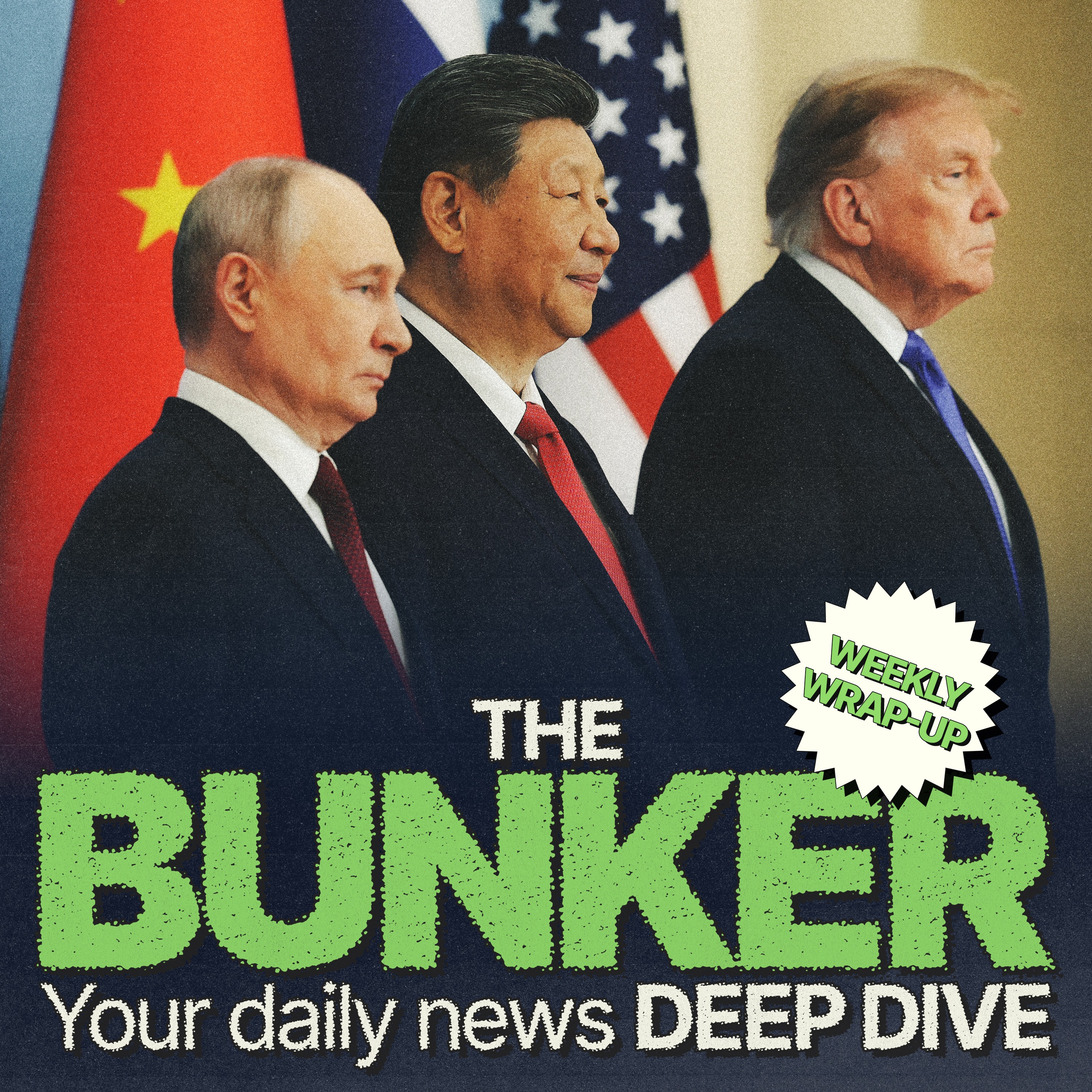
Looking back at the past seven days… A dark moment for the rule of international law as Trump, Putin and Xi rub their power in the world’s face at a trilateral summit blandly dubbed “Yalta 2.0”. Can the three strongmen keep their egos in check? And who gets what in the battle to carve up the world? Plus: Andy Burnham faces hurdles as he visits Brussels to shore up ties with Europe. Alan Milburn’s long-awaited report into the NEET crisis finally lands. The tech world goes into meltdown as service outages ripple across the world. And Grand Theft Auto brings out new levels of cringe from Reform. Jonn Elledge and Andrew Harrison look at the biggest, strangest and most under-reported stories of the week. Back The Bunker on Patreon (https://www.patreon.com/bunkercast/membership?vanity=bunkercast) to help keep the podcast going – and get early, ad-free episodes, merch and more. Written and presented by Group Editor Andrew Harrison. Producer: James Liddell. Audio production: Tom Taylor. Managi
The rich and powerful have long used UK law to keep their secrets under wraps. The newspapers may know the allegations, social media thinks it knows and Auntie Shirley in Swindon is certain she knows. And yet nobody can officially say a word. There are injunctions, super-injunctions, gagging orders and SLAPPs – “Strategic lawsuits against public participation”. But what even are they and how do they work? Is it really about protecting privacy or power? And do you really need one if you’ve done nothing wrong? Mark Stephens CBE, one of Britain’s most experienced media lawyers, joins Emma Kennedy to break down the injunctions crisis. • Read Mark’s contributions to the New York Times’ explainer on the injunctions crisis (https://www.nytimes.com/2026/11/14/world/europe/russell-brand-david-walliams-gag-order.html) Back The Bunker on Patreon (https://www.patreon.com/bunkercast/membership?vanity=bunkercast) to help keep the podcast going – and get early, ad-free episodes, merch and more. Writt
Donald Trump is undoubtedly despicable and dangerous. But does that go far enough? Is he actually evil? Philosopher Susan Neiman thinks so. In fact, Susan, the former director of the Einstein Forum, says that failing to use the word is a moral failure. As the world lurches toward disaster, our language seems more cautious. Why are we so reluctant to call evil by its name? What happens when we soften it with words like “problematic” or “divisive”? And what are the consequences of throwing it around too freely – as Trump, king of hyperbole, so often does? Susan joins Emma Kennedy to discuss what happens when we shy away from calling out evil. • Buy Susan’s book Call it Evil: Understanding the Trump Era (https://uk.bookshop.org/a/13277/9781324131045) from our affiliate bookshop and you’ll help fund the podcast by earning us a small commission for every sale. Bookshop.org’s fees help support independent bookshops too. Back The Bunker on Patreon (https://www.patreon.com/bunkercast/membershi
Interviewers should challenge powerful guests even when doing so risks losing future access.
Share your view, then see how readers voted. No sign-in required. This poll is shared across stories.
Do you agree or disagree?
Common Quandary
A Common Quandary to discuss
Another conversation to explore, separate from this news story.
Your family connection could get your child into their dream school. Do you use it?
A university argues that considering family ties builds loyalty and encourages donations that fund scholarships. Critics say the preference preserves inherited advantage and takes places from stronger applicants.
Can benefits to the whole institution justify an unequal admissions advantage?