Listen through the publisher, then discuss the episode here or arrange an in-person Roundtable. Your city determines where to meet.
Roundtables are designed for groups of four, with a shared subject and room for everyone to speak. Come for discussion, with no dating expectation.
Johannes Vermeer painted about three dozen pictures that we know of. He had eleven children, died in debt in 1675, and was more or less forgotten for two centuries. And yet, the Girl with a Pearl Earring, The Milkmaid, his View of Delft have become some of the most famous paintings in history. Reflecting on seeing Vermeer's interpretation of the Dutch city Proust said "Ever since I saw the View of Delft in the museum in The Hague, I have known that I had seen the most beautiful painting in the world." But it's not just beauty that the painter imbued onto the world, art critic Andrew Graham Bell says that Vermeer "is the painter who holds up the beacon to humanity of where humanity should go, and that has been forgotten." In this episode our art critic Michael Prodger is joined by Andrew Graham-Dixon to discuss his latest book - Vermeer: A Life Lost and Found. Hosted on Acast.
Episode information is provided by the publisher. Listening takes place on the publisher’s service.
Imagine a cozy cavern tucked away from the world, with gentle rain tapping against the roof and a fireplace crackling nearby. It's the perfect place to settle in for a fascinating story about one of history's most influential inventions: the printing press. In this relaxing historical journey, we'll discover how Johannes Gutenberg's printing press transformed Europe, making books more accessible, accelerating the spread of knowledge, and changing how people communicated, learned, and shared ideas. We'll explore the world before mass printing, the remarkable craftsmanship behind movable type, and how printed books helped shape the Renaissance, Protestant Reformation, Scientific Revolution, and the development of modern education. We'll also uncover the earlier printing innovations of East Asia and why Gutenberg's work became such an important turning point in European history. From busy workshops and early printing houses to the first widely circulated books, this episode reveals why th
We spend so much time caught up in the demands of everyday life that we forget to appreciate how extraordinary it is to be alive. Inspired by Robert Greene's new book, The Law of the Sublime (https://www.thepaintedporch.com/products/the-law-of-the-sublime?_pos=13&_sid=e0d7a8c03&_ss=r), Ryan explores what the Stoics understood about finding beauty in the ordinary, seeing life from a different perspective, recognizing our connection to something bigger than ourselves, and remembering just how lucky we are to be alive. Watch this episode (https://www.youtube.com/watch?v=eCjqWcbsK1M) on YouTube: https://www.youtube.com/watch?v=eCjqWcbsK1M Watch the NEW Robert Greene Daily Stoic Podcast Episode HERE (https://www.youtube.com/watch?v=Kp_wYiuPD_o): https://www.youtube.com/watch?v=Kp_wYiuPD_o If you want to get your own dedicated privacy specialist and an emergency threat response team who can protect the privacy of you and your family, go to https://incogni.com/dailystoic Hosted on Acast.
Europe's Little Anarchy: The Rise and Fall of Neutral Moresnet (https://bookshop.org/a/12343/9781501788147)(Cornell UP, 2026) uncovers the history of Neutral Moresnet: a once-forgotten space without borders, nationalism, or a recognized government. Between 1815 and 1919, this square mile of land wedged between Belgium, the Netherlands, and Germany was home to thousands of people living off the grid, free of taxation and oversight. But they also had no political status, police, legal currency, proper law courts, or government presence in sectors like public health, infrastructure maintenance, or education. Meanwhile, practical control over Neutral Moresnet lay in the hands of the local industry: a for-profit, multinational mining company that, because it owned rights to the land, also held a near monopoly on the supply of high-quality zinc to the rest of the world. Dr. Steven Press explores how the residents of Neutral Moresnet sought to improve their quality of life, appealing to Germa
At the trilateral meeting of the leaders of the United States, Russia and China, in Shenzhen this week, Donald Trump was keen to emphasise that they were making history. While wars continue to roil Ukraine and the Middle East, the three leaders sat down to discuss nuclear weapons, boosting petroleum production, reform of the United Nations and their dislike of the International Criminal Court. So was this a Yalta 2.0 as some parts of the media have suggested, or will this meeting soon be forgotten as just another wild moment from final years of Trump's presidency? Guest: Margaret MacMillan, emeritus professor of international history at Oxford University and the University of Toronto
After her father died suddenly, she inherited more than the family farm. She inherited the responsibility of keeping it running without the man who had spent nearly his entire life there. Then the longtime farmhands began quietly sharing strange experiences. One heard her father whistling outside the machine shed. Another heard his familiar footsteps in an empty barn. Someone else saw a man wearing his old brown work jacket standing beside a gate—only to look again and find no one there. She told them grief and memory could make familiar sounds feel more meaningful than they were. Then one evening, while working alone after everyone else had gone home, she heard three notes outside the barn. It was a whistle she had known since childhood. And nobody else on the farm would have understood what it meant. #GhostStories #FamilyGhost #SpiritVisit #HauntedFarm #Afterlife #SignsFromBeyond #Paranormal #FatherAndDaughter #Unexplained #Signs Love real ghost stories? Want even more? Want even mor
Society is collapsing before our eyes—at least, it is if you’re listening to preppers, who have been getting more attention online than ever thanks to recent tech outages. What started with a nationwide ground stop (https://slate.com/business/2026/11/faa-groundstop-airports-ai.html) went on to include a Microsoft outage, an Apple outage, a JP Morgan Chase outage, and more, prompting many of us to wonder if we should be more prepared for a world in which the internet and all the systems we rely on go dark. On today’s episode, host Kate Lindsay is joined by writer, producer, and Defector co-owner Alex Sujong Laughlin, who wrote aboutfalling down the doomsday prepper rabbit hole (https://defector.com/how-do-i-avoid-becoming-a-doomsday-prepper), and what we’re really scared of when we try to prepare for the worst. This podcast is produced by Vic Whitley-Berry, Daisy Rosario, and Kate Lindsay. Hosted on Acast.
Earlier this week the genre defying novelist M. John Harrison was awarded the prestigious Booker Prize. This comes after a career spanning 6 decades, publishing over 20 books ranging from the sub genres 'Mountain Literature' to 'Space Opera'. He is the oldest ever recipient of the prize. His latest work is titled "The End of Everything" and it is as apocalyptic as it sounds, set on the coast of Kent as the indecipherable alien entity named "the iGhetti" swarm above. Our online editor, Emily Lawford, spoke with M. John Harrison shortly after he received the Booker prize. Hosted on Acast.
John Berger taught a generation to look at paintings and then to distrust the people selling them. He won the Booker Prize in 1972 and used his acceptance speech to criticise the sponsor, then gave half the money to the Black Panthers. He made a name for himself as the New Statesman's art critic. This week marks what would have been his one hundredth birthday. He left us in 2017, but his cultural footprint looms large - new generations finding him through mediums even he wouldn't have foreseen. Tom Overton has spent fifteen years reckoning with that legacy - starting even before Berger died. He started as the archivist cataloguing Berger’s papers at the British Library, and ended up on the receiving end of late-night phone calls that began, “This is John. John Berger.” Now he’s written the biography: John Berger: From Life. So what do you do with a hundred years of Berger? Who was he, and why do we still need his company? Hosted on Acast.
Communities should invest in adapting to unavoidable hazards as well as preventing future damage.
Share your view, then see how readers voted. No sign-in required. This poll is shared across stories.
Do you agree or disagree?
Common Quandary
A Common Quandary to discuss
Another conversation to explore, separate from this news story.
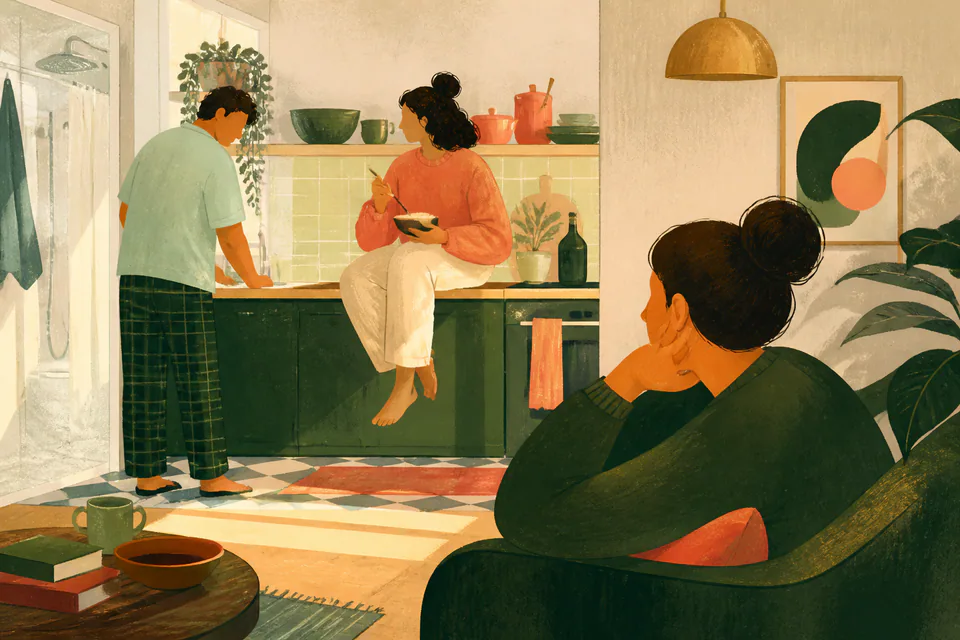
Your roommate's partner sleeps over six nights a week. Are they now a roommate?
Your roommate's partner stays almost every night, showers daily, and keeps food in the kitchen. They are pleasant and spend weekends elsewhere, but pay no rent or utilities. The lease limits overnight guests.
When does welcome presence become an obligation to contribute?