Listen through the publisher, then discuss the episode here or arrange an in-person Roundtable. Your city determines where to meet.
Roundtables are designed for groups of four, with a shared subject and room for everyone to speak. Come for discussion, with no dating expectation.
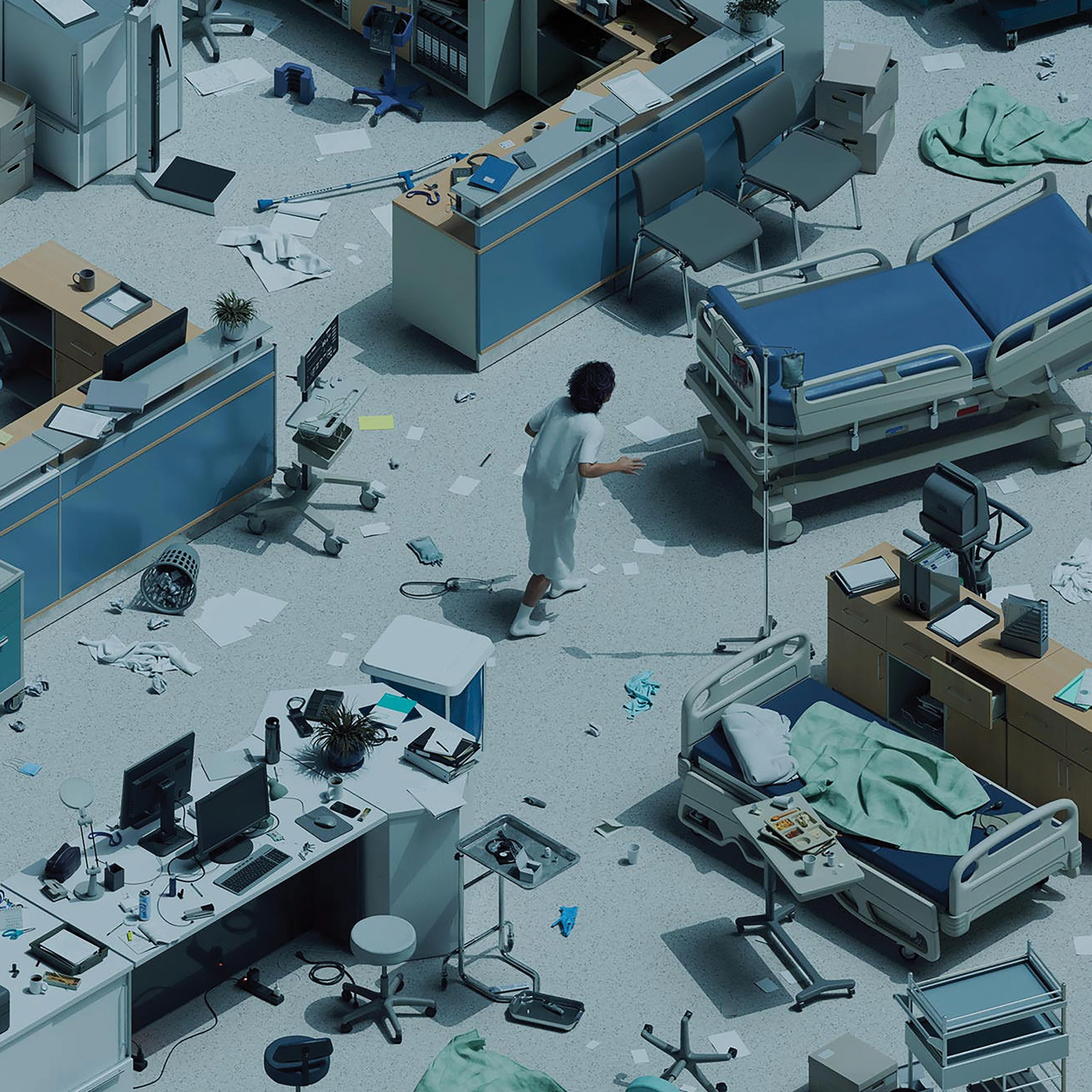
When a new healthcare company took over a struggling hospital in Waukegan, Illinois, residents hoped it would finally revitalize the facility. Vista Medical Center East had already been bought and sold four times—but maybe this time would be different. The new owner was American Healthcare Systems, a for-profit company pitching itself as a turnaround specialist for distressed hospitals. Rick Harris, a local pastor and businessman on the hospital’s board, had never heard of it. And his research turned up a troubling example of its work: A year before, AHS took over a struggling hospital in St. Louis. When financial troubles there got worse instead of better, AHS closed it in less than a year. “I’m just thinking to myself, if I’ve got good intentions, if I can’t pay for this hospital, if I owe all of this money…then where am I getting the money to buy Vista?” he said. Soon, AHS was stiffing vendors, not paying doctors, and leaving millions in taxes unpaid. It asked the state of Illinois for money and got $30 million in loans. AHS promised this money would allow it to pay staff and keep Vista running smoothly. But what happened instead would shine a spotlight on the hospital, AHS, and the for-profit playbook in American healthcare. A 28-year-old woman who came to the ER was found on the roof of the hospital in a gown and socks, frozen to death. This week on Reveal, in an investigation produced in collaboration with the McGraw Center for Business Journalism (https://www.mcgrawcenter.org/) at CUNY's Craig Newmark Graduate School of Journalism (https://www.journalism.cuny.edu/), we find out how her death happened and the financial chaos that laid the groundwork. Support Reveal’s journalism atRevealnews.org/donatenow (https://checkout.fundjournalism.org/memberform?amount=15&campaign=7015d000001wAmaAAE&installmentPeriod=monthly&org_id=cir) Connect with us on Bluesky (https://bsky.app/profile/revealnews.org),Facebook (https://www.facebook.com/ThisIsReveal) andInstagram (https://www.instagram.com/revealnews/)
Episode information is provided by the publisher. Listening takes place on the publisher’s service.
This week on The Necessary Conversation, it's Chad, Haley, and Mary Lou. Bob is still recovering but sent in a video message about Trump calling Putin his friend that we watch together. 🇷🇺 Trump held the first-ever three-way talks with Putin and Xi, called it a "12 out of 10," and produced nothing. Then at a press conference he called Putin his friend — and when asked if Putin is a friend to America, the president of the United States said, "I can't speak to America." That same day, Trump's friend Putin launched massive strikes into Ukraine, hit Poland with two missiles — an act of war against a NATO ally — then struck near a Ukrainian restaurant and drone-bombed the first responders, killing a 7-year-old child and a 20-year-old paramedic. We watch Bob's video and ask Mary Lou: is Russia our friend? 🇨🇳 The House Foreign Affairs Committee revealed Trump's Commerce Department approved nearly 880,000 advanced AI chips for Chinese military-linked companies including Alibaba, Tencent, a
November 21, 2026 On November 22, 1963, President John F. Kennedy and First Lady Jacqueline Kennedy were visiting Texas, They hoped to heal a rift in the Democratic Party, as the white supremacists who made up the base of the party’s southern wing loathed the Kennedy administration for its support for Black rights, That base was furious about the administration’s backing of James Meredith, the first Black American to enroll at the University of Mississippi, By going to Dallas, Kennedy hoped to mend some fences in the state Democratic Party, The President's motorcade began with high spirits, Lady Bird Johnson thought, when she heard three shots, that it “must be firecrackers or some sort of celebration,” The Secret Service, knowing what had happened, rushed the motorcade to a hospital, When Vice President Johnson and Lady Bird were told that the President was dead, officials rushed LBJ away, In the confusion - in addition to the murder, it wasn't clear how extensive the plot was against
Ken Urker died at 34, on his birthday. The Lafourche Parish coroner has now ruled his death an accidental overdose involving multiple substances. Ken was Gypsy Rose Blanchard's former fiancé and the father of her daughter. That's the established medical finding. It is not a finding that Gypsy Rose, anyone online, or a specific argument caused his death. Psychotherapist Shavaun Scott joins Tony Brueski to examine why blame spreads so quickly when a complicated relationship ends in tragedy. Gypsy has been heard on a recorded prison call saying she told Ken she hoped he would overdose. Was that something she actually said to Ken, or was she talking tough during a different relationship? Shavaun considers the difference between an ugly statement, the way it is retold, and evidence of someone's actions. They also discuss Gypsy's account of an incident involving a knife and the headboard of a shared bed, as well as Ken's sister Autumn's claim that he feared Gypsy. These accounts raise hard q
Two members of this family knelt beside wounded strangers this week. Only one was seen doing it. Mark Francis on the week India went perfectly for William and Kate — street cricket with Sachin Tendulkar, sixty rupees on the Metro, five Earthshot winners, and Kate alone at a Mumbai maternity hospital on the final day, holding the hand of a mother who had just lost one of her newborn twins. And on Harry in Lviv, meeting the newest members of Ukraine’s Invictus community, in a visit that landed on the one weekend nobody could look — followed by a Telegraph interview in which he said that if asked to sign up again, “I will 100 per cent be there to serve my country”. Plus Camilla’s private letter, Charles and the Butlin’s holiday he never got, and the royal accounts welcoming Robert Pattinson: “Welcome to His Majesty’s Secret Service, Mr Bond.” One subscription, the whole family, no ads. Try it free for 30 days: tap Try Free in Apple Podcasts. Got an App Store gift card? This is a good use
Europe's Little Anarchy: The Rise and Fall of Neutral Moresnet (https://bookshop.org/a/12343/9781501788147)(Cornell UP, 2026) uncovers the history of Neutral Moresnet: a once-forgotten space without borders, nationalism, or a recognized government. Between 1815 and 1919, this square mile of land wedged between Belgium, the Netherlands, and Germany was home to thousands of people living off the grid, free of taxation and oversight. But they also had no political status, police, legal currency, proper law courts, or government presence in sectors like public health, infrastructure maintenance, or education. Meanwhile, practical control over Neutral Moresnet lay in the hands of the local industry: a for-profit, multinational mining company that, because it owned rights to the land, also held a near monopoly on the supply of high-quality zinc to the rest of the world. Dr. Steven Press explores how the residents of Neutral Moresnet sought to improve their quality of life, appealing to Germa
A wave of major technology outages is raising troubling questions about America's cybersecurity, aging infrastructure, and readiness for a new era of artificial intelligence. Are these isolated technical failures, or warning signs of a much larger national security problem? John Solomon and Amanda Head welcome Ohio Congressman and former Army Ranger Warren Davidson, who discusses recent disruptions involving the FAA, Microsoft, and other critical systems. Davidson calls for greater transparency from government agencies and technology companies, questions whether America's infrastructure is adequately protected against emerging cyber threats, and examines how artificial intelligence could be used both to strengthen defenses and exploit vulnerabilities. The conversation also turns to immigration and national security, with Davidson raising concerns about individuals who entered the country illegally, potential gaps in government screening systems, and the surveillance powers used to moni
More To The Story: This week, Anthropic goes public. Many estimates put the AI company’s valuation at more than $1 trillion, which would make it one of the biggest initial public offerings in history. But Anthropic’s IPO also comes at a time when there are real concerns that the AI boom is a massive bubble—one that could take down the stock market and the economy with it. Science and tech journalist Jacob Ward has been reporting on the AI industry through a critical lens for years, even warning of AI’s red flags months before the launch of ChatGPT. But today, he says one of the things he didn’t fully grasp was the zealotry he now sees from AI’s top leaders. On this week’s More To The Story, Ward talks with host Al Letson about how China is the true wild card in the AI race, what keeps him up at night about the direction of artificial intelligence, and whether Anthropic’s massive spending spree is truly sustainable. Producer: Josh Sanburn | Editor: Kara McGuirk-Allison | Theme music: Fe
Every week, a group of men in their late 60s meets at the Corner Cafe in Elizabethtown, North Carolina. One important reason for these meetups is to discuss what’s going on in their community. Local news has virtually dried up in their rural county, as well as neighboring counties, and some residents say they’re being left in the dark and don’t feel equipped to make informed decisions. “I’m not gonna vote if I can’t get the information,” says Penny Abernathy. Like in much of the country, roughly two-thirds of North Carolina’s counties are considered news deserts. And the lack of local journalism isn’t just making it harder for people to stay informed; it’s exacerbating a crisis of trust in the news media. This week on Reveal, we partner with the podcast Scene on Radio (https://podcasts.apple.com/us/podcast/scene-on-radio/id1036276968) and hosts John Biewen and Chenjerai Kumanyika to understand how American journalism got here and what can be done to repair the cracked foundation of the
More To The Story: On Tuesday, House Republicans blocked a remarkable effort to impeach Defense Secretary Pete Hegseth led by a lone GOP legislator and supported by Democrats. The eight articles alleged that Hegseth violated the Constitution by waging war against Iran without congressional authorization, unlawfully capturing Venezuelan President Nicolás Maduro, and launching strikes on suspected drug boats in the Caribbean, among other charges. But the impeachment efforts failed. In his time as defense secretary, Hegseth has not only helped push the US into a deeply unpopular war with Iran, but he’s also started wars within the military itself. Under his leadership, the US military has ousted female and Black officers, blocked promotions for Black service members, reassigned the first woman to lead the Naval Academy, and targeted transgender service members and just about anyone who doesn’t fit his narrow definition of what constitutes a proper “warrior.” On a special episode of More T
Equipment rules should preserve fair competition even when they limit innovation.
Share your view, then see how readers voted. No sign-in required. This poll is shared across stories.
Do you agree or disagree?
Common Quandary
A Common Quandary to discuss
Another conversation to explore, separate from this news story.
Your family connection could get your child into their dream school. Do you use it?
A university argues that considering family ties builds loyalty and encourages donations that fund scholarships. Critics say the preference preserves inherited advantage and takes places from stronger applicants.
Can benefits to the whole institution justify an unequal admissions advantage?