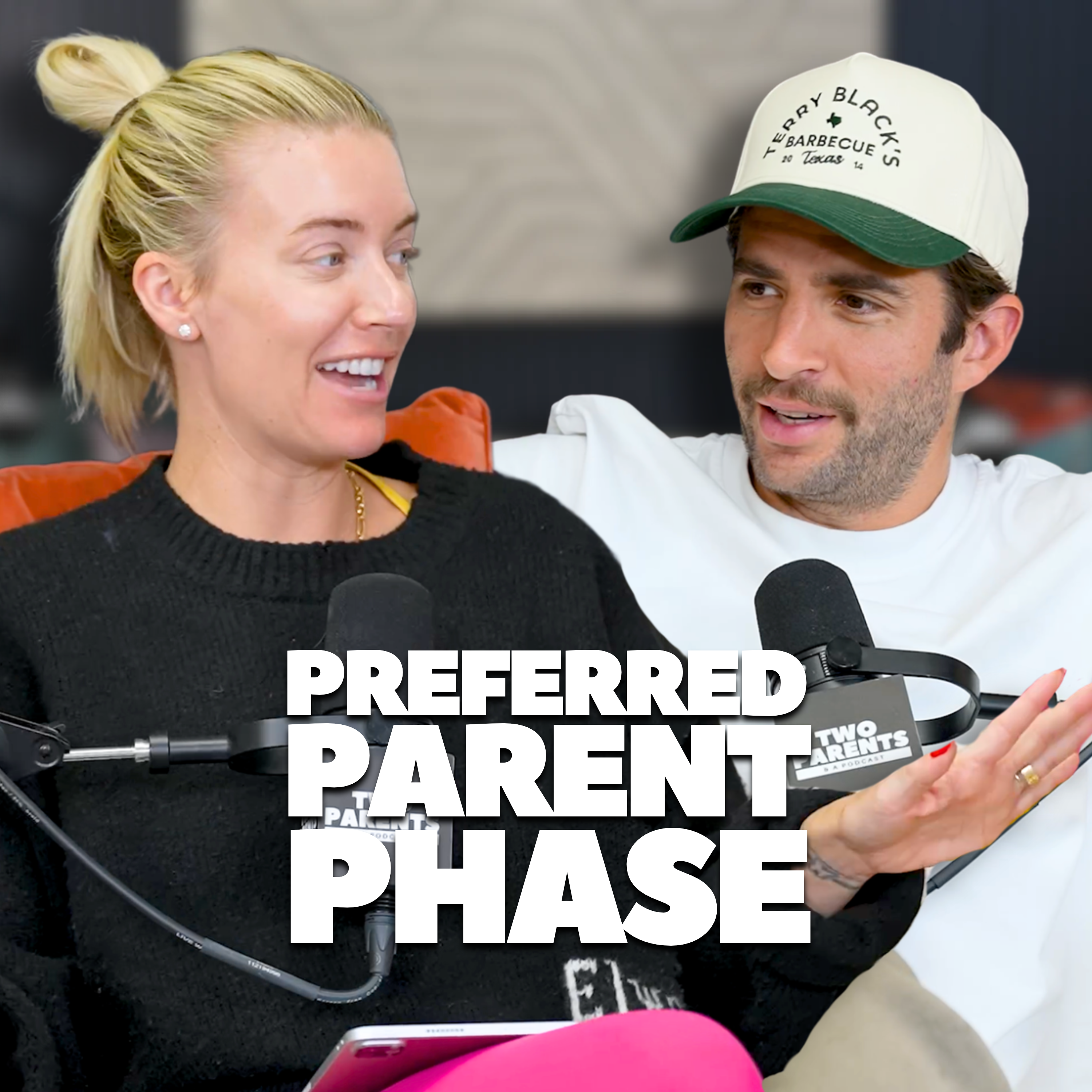
Welcome back to Two Parents & A Podcast! HAPPY NATIONAL LEFTOVERS DAY (is this a thing?? ..it is, we checked)!! Whether you're still in your pajamas, eating pie for breakfast (encouraged), building the perfect leftovers sandwich (cold turkey + mayo on white bread, trust us), deep in a Black Friday cart, or hiding from the dishes: we're glad to keep you company while you relax. Or maybe you're like Harrison and using today to get a head start on your New Year's goals?! (Honestly a great idea.. but also it’s leftovers day, please sit down.) Today's episode is a Q&A, and you guys brought the heat. We're covering: surviving the preferred parent phase (+ the little rituals that beat it), how we got to our "chaos is fun" mentality, whether our house really has room for 4 kids (our case FOR kids sharing rooms), advice for a listener who conceived one month into dating (we were three months in.. no judgment here, just love), how we're doing Santa (PODLINGS WARNING!!!!!), the #1 parenting advic
Are you stuck waiting for the perfect moment, the perfect donation spot, or the perfect system before you can start decluttering? What if the secret to finally making progress isn't perfection at all, but learning to embrace "good enough"? Could letting go of your perfectionist tendencies be the breakthrough you need to transform your home this year? Read / Listen more: https://declutterhub.com/435 In this episode, Ingrid and Lesley tackle one of the biggest roadblocks holding people back from decluttering success: perfectionism. They'll reveal how embracing a "good enough" mindset can help you make steady, meaningful progress without the paralysis that comes from seeking perfection. Plus, they share timely advice on resisting Black Friday buying pressure whilst you're working on decluttering your home. This practical discussion covers everything from choosing donation destinations without overthinking to establishing daily resets that actually work with your energy levels. Lesley and
JD's Instagram: https://www.instagram.com/jddenhamofficial/ Will's Instagram: https://www.instagram.com/williamthaas/ Warrior Coaching: https://www.warrior-makerscoaching.com Peptide Of The Week Website: https://peptideoftheweekpod.com Follow Dani Conway: Instagram: https://www.instagram.com/daniconwayofficial/ Website: https://nutritionthenaturalway.com/ Facebook: https://www.facebook.com/KetoNutritiontheNaturalWay/ Medical Disclaimer: We are not doctors. Use at your own risk. JD Denham and William T. Haas are back with Dani Conway for part two of her episode, and this one is all community questions from School, with a heavy focus on women's health. Dani covers what to do when the routine that worked in your 30s stops working at 40, whether you can be too old or too young for hormone replacement, why she dislikes pellets, and what to do when progesterone makes you exhausted. She also gets into building muscle on keto, hair thinning on HRT, stubborn bloating that hormones don't explain
Thanksgiving is a time to reflect on the things we're grateful for, but when was the last time you stopped to appreciate your sex life? In this episode, we're exploring the surprising connection between gratitude and sexual desire. We'll discuss how feeling appreciated can strengthen intimacy, why gratitude can motivate us to be more attentive to our partners' needs, and simple ways to bring more appreciation into our sex lives without turning it into another obligation. I am joined once again by Dr. Nicole McNichols (https://nicolethesexprofessor.com/about-nicole/), an Associate Teaching Professor in the Department of Psychology at the University of Washington. Nicole's course, "The Diversity of Human Sexuality," is the largest and most popular course in the university's history with four thousand enrolled students each year. Nicole is author of the book You Could Be Having Better Sex. (https://link.amazon/B0iYWx0Q4) Some of the specific topics we cover include: What does it mean to p
"As you both recovered now, do you still experience doubt when anxiety shows up? Or do you just think, oh, it's a wave, and it'll be over soon?" A listener sent in this question, and a lot of people carry it around during recovery. Drew and Josh answer from their own experience: yes, the doubt still shows up sometimes. What changed is what they do next and how much it costs them. We cover why there is no delete button for old anxious pathways, why a trigger can still produce a flash of fear with a "what was that?" attached, and what that moment looks like now: dropping the shopping bags, then picking them back up instead of staring at them for two hours. Josh describes a sauna session where his heart rate stayed high, and Drew a tired evening on the sofa. Both lasted minutes. We also look at the "how will I know I'm recovered?" question and why asking it repeatedly is often more certainty-seeking. Instead, we talk about measuring functional impact: how long it took, how much of your da
A two-year trial made headlines for finding that a high dose of DHA, one of the omega-3s in fish oil, did nothing for thinking scores or brain volume. Listener Bill in Denver asked us to look at it. Tommy walks through what the study did and why he doesn't think it shows omega-3s don't work, and Josh points out what the trial never measured: how much the people in it were challenging their brains. In this episode: 01:25 Bill's question about the new DHA trial 04:05 What the researchers did 07:00 What they found: DHA reached the brain, but made no difference to thinking scores or brain volume 08:10 Why a healthier-than-expected group matters 10:23 Did these people need more omega-3s to begin with? 16:20 Why the trial gave everyone B vitamins 17:20 DHA alone, without EPA, the other main omega-3 20:14 What this one study can and can't tell us 21:39 Tests built to catch decline, not improvement 22:49 Supplements only help when there's a need 23:44 What the trial left out: how much people c
A child can read well and still miss the ball every time. Here’s what’s happening in the brain, and the simple step to take before screen time. Optometrist Dr. Meenal Agarwal, author of Stuck in a Flat World, explains how the parietal lobe handles peripheral vision, balance, body position and threat response, and why hours on a screen leave that system underused. LIKE this video if you found the conversation helpful. COMMENT below with your biggest challenge around screen time and outdoor play. Follow Dr. Meenal Agarwal: Website: https://www.drmeenal.com/ Instagram: https://www.instagram.com/dr.meenalagarwal/ YouTube: https://www.youtube.com/@UncoverYourEyeswithDr.Meenal LinkedIn: https://www.linkedin.com/in/dr-meenal-agarwal-9732a260 Resources : Stuck in a Flat World (book): https://www.drmeenal.com/stuck-in-a-flat-world/ Uncover Your Eyes podcast: https://podcasts.apple.com/us/podcast/uncover-your-eyes-the-truth-about-health-and-wellness/id1742463999 Follow Dr. Murray Clarke: Website
Your child can pass the eye chart and still miss what’s right in front of them. Here’s why. Optometrist Dr. Meenal Agarwal explains why 20/20 eyesight doesn’t tell the whole story. Vision is a brain-driven process, and when the brain stops prioritizing the periphery, kids can look at a scene without perceiving it. She also shares the milestone delays she was seeing in her clinic long before Covid. LIKE this video if you found the conversation helpful. COMMENT below with your biggest question or concern about your child’s screen time and vision. Follow Dr. Meenal Agarwal: Website: https://www.drmeenal.com/ Instagram: https://www.instagram.com/dr.meenalagarwal/ YouTube: https://www.youtube.com/@UncoverYourEyeswithDr.Meenal LinkedIn: https://www.linkedin.com/in/dr-meenal-agarwal-9732a260 Resources : Stuck in a Flat World (book): https://www.drmeenal.com/stuck-in-a-flat-world/ Uncover Your Eyes podcast: https://podcasts.apple.com/us/podcast/uncover-your-eyes-the-truth-about-health-and-well
Your child reads at a grade level above their age but keeps missing the ball. What if it isn’t coordination, attention or shyness, but how their brain is using their eyes? Dr. Murray Clarke and Bryce Wylde sit down with Dr. Meenal Agarwal, a Toronto-area optometrist (Doctor of Optometry, University of Waterloo) who owns three eye clinics and hosts the Uncover Your Eyes podcast. She is also the author of Stuck in a Flat World, which was released November 2, 2026. Dr. Agarwal coined the term “spatial awareness processing disorder” to describe how a screen-heavy childhood may affect depth, movement and peripheral awareness, and she explains why vision is about more than the 20/20 eye chart. Meenal Agarwal: Website: https://www.drmeenal.com/ Instagram: https://www.instagram.com/dr.meenalagarwal/ YouTube: https://www.youtube.com/@UncoverYourEyeswithDr.Meenal LinkedIn: https://www.linkedin.com/in/dr-meenal-agarwal-9732a260 Resources Mentioned in This Episode: Stuck in a Flat World (book): ht
An adaptation should be free to depart substantially from the original work.
Share your view, then see how readers voted. No sign-in required. This poll is shared across stories.
Do you agree or disagree?
Common Quandary
A Common Quandary to discuss
Another conversation to explore, separate from this news story.
Your neighbor keeps playing music at midnight. How many friendly warnings do they get?
A neighbor regularly plays music late enough to disturb your sleep. Friendly requests help briefly, but a formal complaint could threaten their lease in a building with few affordable options.
How far should empathy extend when someone repeatedly ignores your needs?