Listen through the publisher, then discuss the episode here or arrange an in-person Roundtable. Your city determines where to meet.
Roundtables are designed for groups of four, with a shared subject and room for everyone to speak. Come for discussion, with no dating expectation.
Between rising inflation, a weakening labour market, and ongoing war in the Middle East keeping energy costs high, it's a difficult time for the Australian economy. The Reserve Bank's answer to these economic woes has been to hike interest rates fives times in 2026. It's a blunt tool — and an unpopular one among mortgage holders. But are interest rate rises our best bet to fix the economy? Warwick McKibbin sat on the RBA board from 2001 to 2011, and he worked at the bank for decades. He knows what it's like to be in the room making the call on interest rates — and he's also dealt with the fallout of leaked information about those decisions. He sat down with Carrington Clarke on ABC Business Daily to talk inflation, rate rises, and how much the public should know about RBA members' opinions. Got a burning business question? We'd love to hear your questions!
Episode information is provided by the publisher. Listening takes place on the publisher’s service.
In this week's episode of The Wrap with Chris Whalen, Chris says Fed Chair Kevin Warsh has lost credibility with the markets. He compares Warsh to G. William Miller, Carter’s Fed chair, and argues that quarter-point hikes all year would have kept long-term yields in check. He also lays out what real leadership would look like: successive quarter-point hikes and a gap between the fed funds rate and the interest paid on reserves. Chris warns that rates are already at their upper bound. Long-term yields are up four and a half points since 2021, the bottom ten of the 38 mortgage companies he tracks are basically insolvent, and firms like Brookfield are walking away from commercial properties they can’t refinance. He explains why the Fed needs to think in spreads, not just rates, and why the push for centralized Treasury clearing could hurt demand right as Treasury needs to raise $800 billion in January, setting up a possible bond market breakdown. Plus: why central banks can’t fix war-driv
What will you do when the going gets tough? How will you react to economic winter, changes in the market and other events beyond your control? Will you shrink back in fear and adopt an attitude of scarcity – or will you power forward and learn how to take advantage of the moment? Uploaded 28-04-20 In this video, Ryan Deiss, CEO of Digital Marketer, best-selling author and expert investor, shares what you can do to not only continue to grow your business, but to grow as a human being as well. There are ways to make the most of hard times as a business leader, marketer, parent and friend. It’s all about turning your obstacles into opportunities. How can you do that? You must shift your focus. Instead of focusing on the negative, find the possibilities. You can head to https://www.tonyrobbins.com/career-business/where-focus-goes-energy-flows to learn how to get focused in this new environment. Tough economic times put most people in a mindset of scarcity and fear. They pull back. Business
Everyone is saying the same thing: higher rates are depressing the usual AI buy-the-dip mentality. Investors supposedly became less enthusiastic because the Federal Reserve is, in its view, tightening, bond yields are or were rising, and so the discount rate applied to future profits is becoming more painful. Or something. That explanation isn’t just incomplete, it’s dead wrong. Eurodollar University's Money & Macro Analysis ---------------------------------------------------------------------------------- That’s exactly what Monetary Metals does. No selling. No trading. Just more gold every month. Check it out here: https://monetary-metals.com/snider ---------------------------------------------------------------------------------- We need to confront our biggest challenge, but hardly anyone knows what it truly is or how to do it. Eurodollar University Live in February 2027 will change all that. Join us and fight for America's future. Start with the next generation. ------------------
Hey everybody, Tom Bilyeu here. On today’s episode of Impact Theory, we’re taking on a topic that’s got the whole world holding its breath: the escalating crisis between the United States and Iran. As tensions ratchet up, we’re asking the tough questions—how did we get stuck in this “escalation trap,” and what does it mean for America’s global leverage, our economy, and our very sense of security? The conversation focused on why the traditional idea of “strategy” might be failing policymakers, using powerful analogies—like chess versus roulette—to show how doubling down in conflict can spiral out of control. We’ll break down the risks of tactical “wins” that create even bigger crises, the real leverage Iran holds with control of the Strait of Hormuz, and the mounting pressure on President Trump as political support erodes and legacy hangs in the balance. A key theme that emerged is what happens when military might runs into decentralized opposition, and why high-stakes gambles—like the
In this Jim Rohn Motivation video, we unpack the real meaning of resilience—not as something you're born with, but something you build. It’s not about pretending life is easy. It’s about developing the mindset, discipline, and strength to keep going when everything in you says stop. Key Topics From This Motivational Video: Resilience as a skill, not a trait Taking full ownership of your life and mindset Reframing adversity into growth opportunities Emotional regulation and grounded self-talk Endurance, grit, and the decision to grow daily This Jim Rohn Motivational video reminds us that resilience doesn’t come from waiting for life to calm down—it comes from training your mind to rise in the middle of the chaos. It’s a mindset built on consistent ownership, reframed challenges, and the ability to lead yourself under pressure. Strength isn’t given. It’s earned—through the unseen decisions you make when no one is watching. This Jim Rohn Motivational Video Is Perfect For: Anyone feeling o
Get the 200+ Page Optimal Living Daily Workbook (PDF) - Free. Want to turn today's episode into an actionable plan? Episode 3778: Liz Greene explains why introverts get overstimulated in busy spaces and need time alone to recharge. She shares six simple ways to manufacture that alone time when you can't leave the room, from headphones and a good book to small crafts and a few minutes of guided breathing, a useful toolkit heading into a season full of crowded gatherings. Read along with the original article(s) here: https://introvertdear.com/news/alone-introverts-crowded-room/ Quotes to ponder: "Headphones are the introvert's best friend." "The good news is that it is possible to manufacture alone time even when you're fenced in." Airwallex is a financial technology company, not a bank. Services in the US are provided by Airwallex US, LLC, a licensed money transmitter (NMLS ID 1928093) in most states. In some states, services are provided by Evolve Bank and Lead Bank, member FDIC. Terms
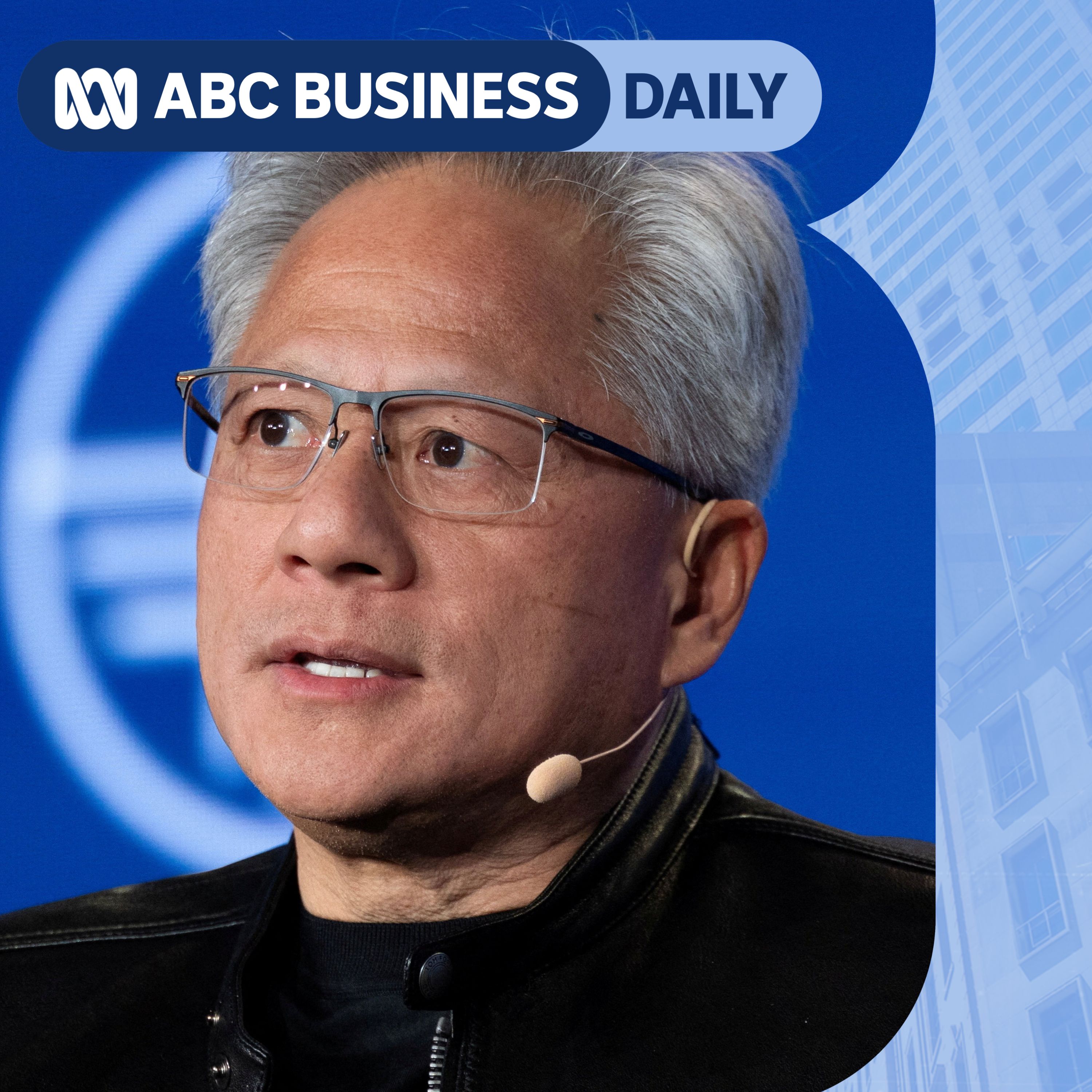
Jensen Huang helped turn Nvidia into one of the world’s most valuable companies. Now, a scandal involving his personal life has forced him out and raised a bigger question - what happens when one person becomes almost as important as the company itself? From Elon Musk to Dario Amodei, does the rise of the celebrity CEO create a business risk of its own? Plus, Anthropic is preparing for the biggest IPO in history - a major test for an AI trade already looking shaky. And back home, Australia’s unemployment rate has jumped to 4.9 per cent, with 43,500 jobs lost in October - potentially changing the calculus for whether the Reserve Bank needs to raise rates again. Lin Lin and CEO of technology research and advisory firm Futurum Group, Daniel Newman, break it all down on ABC Business Daily. Note: Futurum Group is advisor to Nvidia and Daniel Newman personally hold shares in NVIDIA. Got a burning business question? We'd love to hear your questions!
Another day, another Australian company moving jobs offshore. This time it’s Bunnings, which says the AI revolution is part of the reason behind its latest restructure. But while businesses are pouring money into AI, where are the productivity gains? And if we don’t like Australian jobs being moved offshore, what - if anything - should government do about it? And speaking of government intervention, Treasurer Jim Chalmers wants to change the rules governing almost $5 trillion in Australians’ super. Does the idea stack up? Carrington Clarke and Independent Economist Saul Eslake break it all down on ABC Business Daily. Got a burning business question? We'd love to hear your questions!
A pivotal week for AI has arrived - for more reasons than one. The resignation of Nvidia CEO Jensen Huang has added to a broader sell-off in technology stocks, while the US tightens restrictions designed to limit China's access to its most advanced AI chips. And now Australia has joined a US-led agreement aimed at securing the technology and critical minerals needed to power the AI boom - just days before one of the biggest tests yet of investor appetite for Anthropic. Meanwhile, back in Australia, we're learning more about the financial troubles engulfing David Jones. Carrington Clarke and ABC Business Reporter Steph Chalmers break it all down on ABC Business Daily. Read Ian Verrender's latest analysis on AI here (https://www.abc.net.au/news/2026-11-17/wheels-falling-off-ai-investment-boom-nvidia-anthropic/107392122). Got a burning business question? We'd love to hear your questions!
Tax increases should include clear measures for judging whether the promised benefits occur.
Share your view, then see how readers voted. No sign-in required. This poll is shared across stories.
Do you agree or disagree?
Common Quandary
A Common Quandary to discuss
Another conversation to explore, separate from this news story.
A reserved meeting room has been empty for twenty minutes. Can your group take it?
Every library study room is occupied except one marked reserved. Its booking began twenty minutes ago and nobody has appeared. Your group has an urgent presentation to prepare, while library rules say reservations remain valid for half an hour.