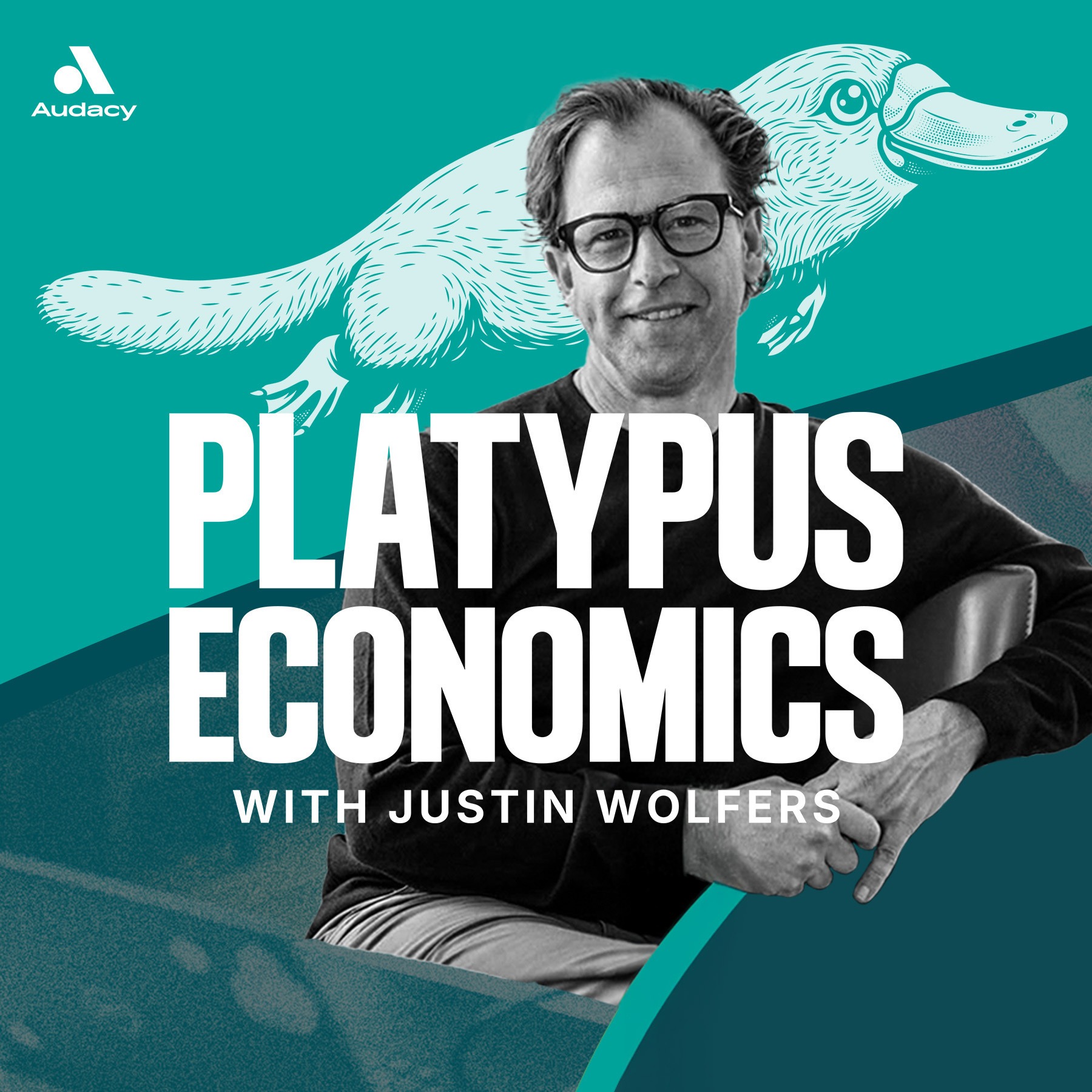
Why Justin Is More Upbeat About the Economy | The Professor Is In
23 min
Listen through the publisher, then discuss the episode here or arrange an in-person Roundtable. Your city determines where to meet.
Roundtables are designed for groups of four, with a shared subject and room for everyone to speak. Come for discussion, with no dating expectation.
What does the October jobs report mean for your paycheck and your next career move? Your next raise may depend on your alternatives, not just your loyalty. Justin shows how outside offers create bargaining power, why employers can reward good work without waiting for a resignation threat, and how scarce AI skills can give you leverage. If your employer isn’t valuing you, his advice is to look elsewhere. No outside offer needed to get more economics—subscribe: on YouTube on Substack the Podcast Follow on Social Media @PlatypusEconomics and @JustinWolfers
Episode information is provided by the publisher. Listening takes place on the publisher’s service.
For written details on this paper, see the StayCurious Metabolism Newsletter: https://staycuriousmetabolism.substack.com/p/the-art-of-a-heartbeat-one-of-the?r=40ekz2 Snyder Interview 1: https://youtu.be/mCrc4gfbK2o Snyder Interview 2: https://youtu.be/kMpGkg4zMOU Snyder Interview 3: This one! Snyder Interview 4: Coming Soon… Leptin Resistance Letter: https://staycuriousmetabolism.substack.com/p/obesitys-secret-letters-the-hidden?r=40ekz2 Gift Guide: https://staycuriousmetabolism.substack.com/p/saint-dr-nicks-holiday-gift-guide?r=40ekz2 This conversation with Stanford’s Professor Michael Snyder breaks down one of the most important exercise studies ever published — a deep, molecular look at what really happens inside your body when you work out. We explore how thousands of molecules shift in real time, why inflammation during exercise is actually a good thing, how omega-3 signaling, mitochondrial remodeling, nitric oxide pathways, and metabolic flexibility all come together in a coordin
Watch where your mind goes in that first raw second, before you've had time to compose yourself. When things fall apart, that instinctive reach tells you almost everything about the direction your life is headed. Uploaded 14-09-26 For most people, the mind goes outward. To the economy. To the boss who didn't recognize them. To the parents, the partner, the timing, the luck that never came. And some of it may be entirely true. But here is the truth: an excuse can be one hundred percent accurate and still be one hundred percent useless. The moment you assign the cause of your problem to something outside yourself, you have also assigned the solution to something outside yourself — and then you wait, helpless, for a world that is in no hurry to change on your behalf. This seminar unpacks the single mechanic behind why some people rise from the exact same wreckage that keeps others stuck: where they point their mind on that first difficult day. CHAPTERS 0:00 Intro — where your mind goes fi
Why is the manosphere so appealing to young men? What does it actually mean to be a good man? To join our journaling club, with 10,600 + others, subscribe to my imperfect email - https://www.theimperfects.com.au/sign-up-to-our-newsletter/ Journalist Marc Fennell joins us in the studio to talk about the manosphere: what is it? what are its consequences? and how can we talk to our kids about it? Marc explores with Hugh, Ryan and Josh why the manosphere is so appealing to young men, especially those who think they have little value to offer, and Josh questions what his reaction would have been, if he had of been exposed to the manosphere at a vulnerable time. We look at ‘toxic masculinity,’ and the impact of being right versus making change, and in a moment of vulnerability, Marc discusses the importance of self reflection of your own behaviour. Chapters: Chapters 00:00:00 – Marc Fennell on the Manosphere [TRAILER] 00:01:01 – Ryan’s doppelganger (and media buff etc) 00:04:24 – The State o
What will you do when the going gets tough? How will you react to economic winter, changes in the market and other events beyond your control? Will you shrink back in fear and adopt an attitude of scarcity – or will you power forward and learn how to take advantage of the moment? Uploaded 28-04-20 In this video, Ryan Deiss, CEO of Digital Marketer, best-selling author and expert investor, shares what you can do to not only continue to grow your business, but to grow as a human being as well. There are ways to make the most of hard times as a business leader, marketer, parent and friend. It’s all about turning your obstacles into opportunities. How can you do that? You must shift your focus. Instead of focusing on the negative, find the possibilities. You can head to https://www.tonyrobbins.com/career-business/where-focus-goes-energy-flows to learn how to get focused in this new environment. Tough economic times put most people in a mindset of scarcity and fear. They pull back. Business
We’re about to time travel into the future Sam Altman is building… I interviewed Sam Altman, the CEO of OpenAI, the company behind ChatGPT. They’re trying to build a “superintelligence” that could far exceed humans in almost every field – and they just released their most powerful tool yet, GPT-5. A few years ago, that would’ve sounded like science fiction! Not anymore. In fact, they’re not alone. We’re in the middle of the most high stakes global race any of us have ever seen. Hundreds of billions of dollars and an unbelievable amount of human work… It’s a profound moment. Most people never see a huge technological shift like this in their lives and it’s happening all around us right now. So in this conversation, I’m going to try to time travel into the future with Sam Altman, to see what he’s trying to build… so you and I can really understand what’s coming. Welcome to HUGE* Conversations. Chapters: 0:00 What future are we headed for? 2:06 What can GPT-5 do that GPT-4 can’t? 6:57 Wha
In this video, Disability Attorney Walter Hnot of the Disability Resolution Law Firm goes over what his holiday present is for 2024. Drum roll please...it is the Coil Audio CA-70 and CA-286 preamps. They sound fantastic, but for the actual audio, you will need to wait for the next video. He is...overly excited :-) Like the content? Review us here: https://g.page/r/CcwyektC7nCPEAg/review . If the link does not work, Google: Disability Resolution, P.A. Welcome to the largest Social Security Disability Tutorial Video Library On Earth. PRIVATE ONE HOUR PHONE CALL THIS IS HOW YOU CAN GIVE BACK TO HELP GROW THE CAUSE: Option 1: Leave 5 |==================5 STAR REVIEWS==================| Google (Search Disability Resolution Orlando, FL)- https://www.google.com/search?authuse... (https://www.google.com/search?authuse...=) AVVO (Search Walter Hnot) - https://www.avvo.com/attorneys/32817-... BBB (Search Disability Resolution Orlando, FL)- https://www.bbb.org/us/fl/orlando/pro... MARTINDALE (Sea
Are we in an AI stock bubble, or are investors betting on a genuinely bigger economy? Justin Wolfers examines AI stock valuations with Stacey Vanek Smith, separating what the technology could do for the economy from what investors might actually earn. A deliberately hypothetical valuation exercise shows why a trillion-dollar company isn't automatically absurd—but a breakthrough for society doesn't guarantee profits for shareholders. Competition can give you powerful tools at low prices while squeezing the companies selling them. The Thanksgiving turkey problem illustrates why a long run of good news can hide rare, severe risks. Justin connects that analogy to fat tails and the peso problem, then explains why spotting a bubble and successfully betting against it are different challenges. He also unpacks what the CAPE ratio can—and can't—tell you about whether stocks are overpriced. The stakes are your savings, not just Wall Street's scoreboard: Justin discusses an S&P 500 decline of 7.5
How does the federal budget deficit reach your wallet—and what would a fiscal crisis look like? Justin Wolfers answers your questions about the federal budget deficit, starting with the $2 trillion figure cited for fiscal 2026. He explains why acting early gives you time to plan for changes to taxes, retirement rules, and government services—and how lost lender confidence could force much sharper adjustments. on YouTube on Substack the Podcast Follow on Social Media @PlatypusEconomics and @JustinWolfers
Why is the US budget deficit $2 trillion when there’s no recession? Justin Wolfers explains why the US budget deficit reached $2 trillion in fiscal 2026: Washington collected $5.4 trillion and spent $7.4 trillion. At 6.2% of GDP, he argues, that’s the largest federal deficit outside a war or recession, even after adjusting for the economy’s size. You’ll learn the difference between this year’s borrowing and the debt built up over decades, then follow how aging, tax cuts, tariffs and reduced immigration shape the gap. Customs duties brought in $173 billion—a bucket next to a $2 trillion swimming pool. Justin also compares America’s borrowing with other countries to put those numbers in perspective. Why should you care? With about $32 trillion owed, a one-percentage-point rise in interest rates would eventually add roughly $320 billion a year to the government’s interest bill—about $1,000 per American. That’s not a bill mailed to your house, but it is an extra cost your government has to
Workers should share in the financial gains from technology that increases their productivity.
Share your view, then see how readers voted. No sign-in required. This poll is shared across stories.
Do you agree or disagree?
Common Quandary
A Common Quandary to discuss
Another conversation to explore, separate from this news story.
One slice of pizza remains and everyone is pretending not to want it. Can you take it?
Six friends have been circling the last slice of pizza for twenty minutes. Nobody claims it when you ask, yet two people keep glancing at the box. You are still hungry and paid the same share as everyone else.
Does politeness require leaving something that nobody will openly claim?