Listen through the publisher, then discuss the episode here or arrange an in-person Roundtable. Your city determines where to meet.
Roundtables are designed for groups of four, with a shared subject and room for everyone to speak. Come for discussion, with no dating expectation.
Xero CEO Sukhinder Singh Cassidy discusses Xero’s H1 FY27 financial performance, small business AI adoption trends, and the launch of XForce. She pushes back on the idea that AI will destroy traditional SaaS, breaks down market volatility around frontier AI spending, and forecasts how enterprise and SMB AI adoption will bifurcate in 2027. MTS chronicles the singularity, live. Monitoring the situation of tech and AI. Follow MTS: Spotify |https://open.spotify.com/show/4HUNNmV1pjV7CW6Lphm1rM Apple |https://podcasts.apple.com/us/podcast/mts/id1891088763 – Brought to you by: Mongo DB - Anyone can prototype an agent. Lovable - Turn ideas into software people love with Lovable. Start today at https://lovable.dev/ Visithttps://factory.com/ Neon (by Databricks) - Scale your startup on Neon. The Postgres backend for apps and agents. Head over to http://getvcx.com (http://getvcx.com/) to learn more Kong - The AI connectivity platform. Larridin - Finally prove what your AI investment is worth. Ship 5x faster. https://blitzy.com (https://blitzy.com/) AdQuick - Make your brand a billboard. Horizon3 - Don't assume you're secure. Prove it. Go hack yourself with AI. https://horizon3.ai/nodezero/ – Timestamps: (00:00) Introduction (00:59) Xero First Half Results And XForce (02:08) How Small Businesses Adopt AI (03:35) Why AI Won’t Kill Traditional SaaS (05:08) Forward Deployed Engineers For Enterprise AI (07:36) Small Business Resilience And Economic Uncertainty (09:05) Market Volatility And Unprofitable AI Spending (10:47) Predictions For Enterprise AI In 2027 –
Episode information is provided by the publisher. Listening takes place on the publisher’s service.
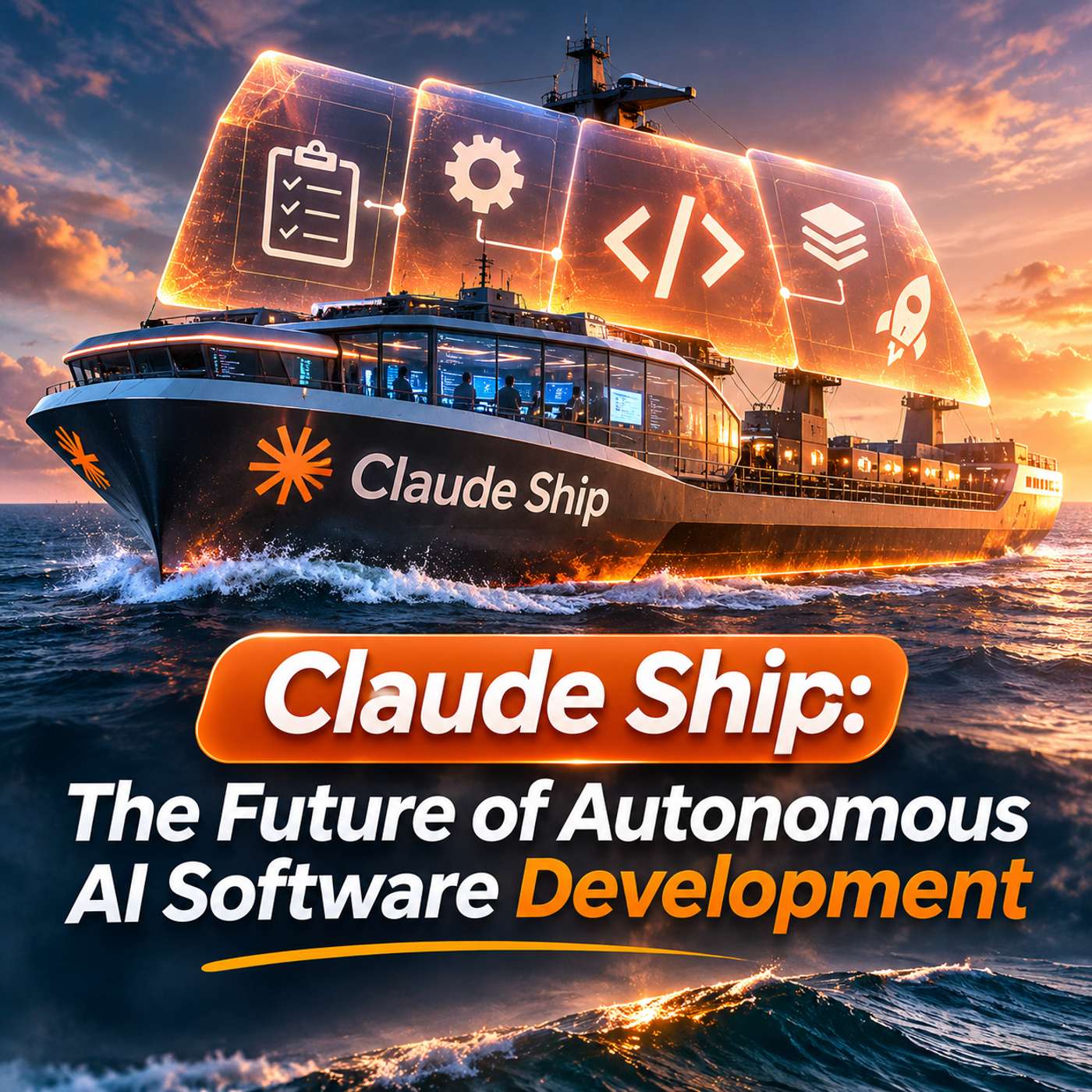
What happens when AI doesn't just write your code but also reviews it, fixes broken builds, resolves merge conflicts, and approves changes without waiting for a human developer? In this episode of TechDaily.ai, host David and AI expert Sophia explore Anthropic's Claude Ship, an AI-powered tool suite designed to automate critical stages of the software development lifecycle. From intelligent code reviews and automated pull request fixes to AI-driven approvals, this conversation examines how autonomous AI agents could transform software engineering, developer productivity, and enterprise code governance. AI coding assistants are already generating thousands of lines of code in minutes. But traditional development pipelines still depend on human reviewers to inspect pull requests, troubleshoot failed CI checks, resolve merge conflicts, and approve deployments. That creates a growing bottleneck between AI-powered code generation and production delivery. Claude Ship aims to address that cha
AI news today: Jensen Huang is back as NVIDIA CEO, new loop transformer models arrive, and a live T3 Code demo runs AI coding agents across machines and models. The conversation opens with Jensen Huang's reinstatement at NVIDIA after government pressure on the board, the open investigations, the stock rebound, and the board's new national security and export control oversight committee. From there it moves to loop transformer architectures in Thinking Machines Lab's Inkling 2 and Z.ai's GLM 5.4, running Inkling 2 Mini locally on a MacBook, NVIDIA's Nemotron Labs Sigma diffusion text model, and Claude Ship, an enterprise tool that reviews and approves routine pull requests. The second half covers using Tailscale to link several machines into one private network, and how T3 Code sits above harnesses like Claude Code, Codex and Antigravity. A live demo picks a model and a machine for each thread. The episode closes on cross-model reviews and a report that Gemini subscriptions may open to
Launch, Scale & Monetize Your Newsletter with Beehiiv! Start today by visiting www.beehiiv.com?via=fellow (https://www.beehiiv.com/?via=fellow) Run Your Agency on Autopilot – White Label CRM, Funnels, and Automations in One Platform for Success. Claim 2-week free trail now www.gohighlevel.com/protrial?fp_ref=fg (https://www.gohighlevel.com/protrial?fp_ref=fg) Mark Tilbury firmly believes that anyone who learns the skill sets of a millionaire can become a millionaire, ANYONE. Mark Tilbury left school at 16 with no qualifications and no money. Now he runs a multi-million dollar business & has grossed over 50 million. He has the house of his dreams and most importantly, the freedom to spend time with his family. Now Mark wants to help you become financially free as well. Follow the podcast and turn on notifications! Follow @MarkTilbury on Tiktok, YouTube, Twitter & IG Disclaimer: All content rights belong to Mark Tilbury. This Podcast is fan-made. No copyright infringement intended. -----
In today's episode of Milk Road Crypto, we sit down with Pranav Kanade, Portfolio Manager of VanEck's Alpha Fund, to discuss how professional investors navigate market volatility, manage portfolio risk, and identify investment opportunities when uncertainty is at its highest. Pranav explains why he believes the current AI sell-off is a market regime change rather than another dot-com crash, why the biggest winners of the past two years may not be the winners of the next two, and how rising financing costs and compute scarcity are reshaping the AI investment landscape. ~~~ Offer ends Tuesday! (https://milkroad.com/portfolioos/) ~~~~~ ~~~~~ Tools & Channels ~~~~~ Follow Milk Road on Social Media: Milk Road Twitter:https://link.milkroad.com/X Apple Podcasts:https://link.milkroad.com/apple-podcast ~~~~~ GUEST INFO Van Eck: https://x.com/vaneck_us It should not be considered as financial, legal.
Claude may have helped prove the Riemann hypothesis just as the Nvidia scandal and Anthropic’s IPO are fueling a backlash over who profits from AI and who gets to call the shots. In the headlines: Grok falls behind and Z.ai previews GLM 5.4. New Episode: How Anthropic Went from AI Safety Outcast to World's Most Important Company Spotify: https://open.spotify.com/episode/1MJpqbn3HWleuU9fUoeCX7Apple: https://podcasts.apple.com/us/podcast/how-anthropic-went-from-ai-safety-outcast-to-the/id6822359990?i=1000803569349 Brought to you by: Gartner - AI strategy, trends and insights - https://www.gartner.com/ai Granola - The AI notepad for people in back-to-back meetings. Try it free granola.ai/brief (http://granola.ai/brief) Newsletter: https://aidailybrief.beehiiv.com/ Interested in sponsoring the show? [email protected]
As organizations accelerate AI adoption, a new security challenge is emerging: AI Agent Collisions. Autonomous and semi-autonomous agents are increasingly operating across business applications, accessing sensitive data, invoking APIs, and taking actions on behalf of users and organizations. Without visibility into which agents exist, what they can access, and how they interact, organizations risk creating unintended access paths, conflicting actions, data exposure, and gaps in security oversight. James Robinson, CISO at Netskope, joins Business Security Weekly to explore the emerging problem of AI Agent Collisions, why traditional security approaches may fall short, and how CISOs can build an effective strategy for discovering, classifying, governing, and securing AI agents. James will discuss how organizations can select the right AI Agent Platforms to establish consistent controls, prevent unintended agent interactions, and protect their most critical applications as the enterprise
Tejas Bhakta, CEO of vertically integrated inference provider Morph, joins Madison Kanna to discuss orchestrating up to 12 concurrent AI agents using custom terminal muscle memory, eye tracking, and voice-to-text. He breaks down why startups get trapped in toxic GPU prepay contracts, how AI kernel writing is suddenly making AMD viable for inference, and why frontier models are forcing software engineers into “ego death” while creating more fake jobs post-AGI. MTS chronicles the singularity, live. Monitoring the situation of tech and AI. Follow MTS: Spotify |https://open.spotify.com/show/4HUNNmV1pjV7CW6Lphm1rM Apple |https://podcasts.apple.com/us/podcast/mts/id1891088763 – Brought to you by: Mongo DB - Anyone can prototype an agent. Lovable - Turn ideas into software people love with Lovable. Start today at https://lovable.dev/ Visithttps://factory.com/ Neon (by Databricks) - Scale your startup on Neon. The Postgres backend for apps and agents. Head over to http://getvcx.com (http://get
Braintrust founder and CEO Ankur Goyal joins MTS to unpack the launch of Patterns, an AI observability agent that digs through logs and traces to catch bugs before users notice. He also breaks down real-world enterprise AI adoption trends, including the surge of Google’s Neon and open-weight models, why OpenAI models perform 15% better in Codex, and why companies will start building their own data centers within a year. MTS chronicles the singularity, live. Monitoring the situation of tech and AI. Follow MTS: Spotify |https://open.spotify.com/show/4HUNNmV1pjV7CW6Lphm1rM Apple |https://podcasts.apple.com/us/podcast/mts/id1891088763 – Brought to you by: Mongo DB - Anyone can prototype an agent. Lovable - Turn ideas into software people love with Lovable. Start today at https://lovable.dev/ Visithttps://factory.com/ Neon (by Databricks) - Scale your startup on Neon. The Postgres backend for apps and agents. Head over to http://getvcx.com (http://getvcx.com/) to learn more Kong - The AI co
Theory Ventures founder Tomasz Tunguz breaks down the macroeconomics of frontier AI following Anthropic’s IPO, highlighting the margin squeeze between rising GPU rental costs and falling token prices. He also warns that US data center bottlenecks will force America to become a net token importer by 2028 to 2030, while arguing that local models are rapidly becoming capable enough to handle 90% of everyday laptop work. -- MTS chronicles the singularity, live. Monitoring the situation of tech and AI. Follow MTS: Spotify |https://open.spotify.com/show/4HUNNmV1pjV7CW6Lphm1rM Apple |https://podcasts.apple.com/us/podcast/mts/id1891088763 – Brought to you by: Mongo DB - Anyone can prototype an agent. Lovable - Turn ideas into software people love with Lovable. Start today at https://lovable.dev/ Visithttps://factory.com/ Neon (by Databricks) - Scale your startup on Neon. The Postgres backend for apps and agents. Head over to http://getvcx.com (http://getvcx.com/) to learn more Kong - The AI co
Communities should invest in adapting to unavoidable hazards as well as preventing future damage.
Share your view, then see how readers voted. No sign-in required. This poll is shared across stories.
Do you agree or disagree?
Common Quandary
A Common Quandary to discuss
Another conversation to explore, separate from this news story.
A parent clearly built the winning science project. Who should lose the prize?
An elementary student submits an elaborate science project far beyond their apparent ability. The parent proudly describes working together all weekend, and the child clearly learned something, but other students completed simpler projects themselves.
What is a fair response when help improves learning but distorts achievement?